Air vs Ocean: Modal Choice Logistics for Electronics 2026
The modal choice for electronics shipments in 2026 directly determines your profit margin, market speed, and supply chain resilience.
IATA confirmed that full-year 2025 air cargo demand grew 3.4% year-on-year, reaching record volumes — a trend that is squeezing available capacity and pushing rates higher into 2026.
Meanwhile, ocean freight capacity is expanding but remains vulnerable to geopolitical disruptions on Asia-Europe lanes.
We break down time-sensitive needs, cost optimization, and a clear decision framework to guide your shipments effectively.
Modal choice logistics starts with understanding electronics shipping needs.
Electronics shipping require careful attention to value density, fragility, shelf-life, and regulatory compliance.
High value-to-weight ratio — often exceeding $100 per kilogram for advanced chips
Short product lifecycle — new model cycles of 12–18 months make delays commercially damaging
Sensitivity to humidity, vibration, and electrostatic discharge (ESD)
Lithium battery classification requirements under IATA DGR and IMDG codes
Strict customs documentation including certificates of origin and HS code accuracy
Export control regulations (EAR, ITAR) affecting certain chip categories
Tradeoffs include balancing urgency against budgets in volatile markets.
Cost optimization requires weighing total landed cost.
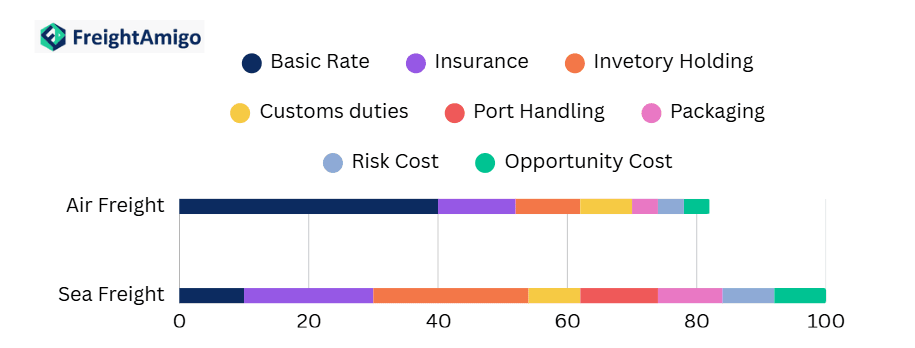
Freight rate is only one component of total landed cost — ignoring the others leads to systematically wrong modal decisions.
Many shippers make the mistake of comparing air and ocean freight purely on rate per kilogram. The true financial picture only emerges when all cost dimensions are considered together.
Risk cost — probability of loss or damage multiplied by cargo value
Opportunity cost — delayed market entry or production disruption
When you run a full landed cost model, air freight often closes the gap significantly for high-value, low-weight electronics. For bulk components moving to stable inventory positions, ocean remains the rational choice.
Air freight excels in time-sensitive freight scenarios.
Speeds of 3-7 days suit urgent electronics.
Door-to-door reliability for small volumes.
Global reach via major hubs.
Less exposure to piracy risks.
Temperature control options available.
Drawbacks include 5-10x higher rates than ocean.
Ocean freight prioritizes cost optimization for volumes.
20-45 day transits work for stable demand.
Ideal for containers of components.
Lower emissions per ton.
Scalable for mass production runs.
Stable rates in contracts.
Challenges involve longer lead times and port delays.
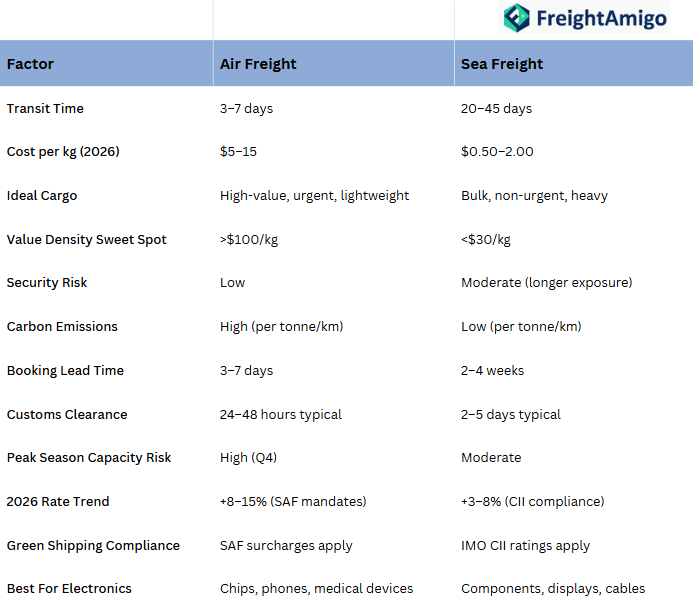
Air vs ocean comparison table for electronics.
Use this at-a-glance comparison to quickly identify which mode aligns with your shipment profile.
This table highlights tradeoffs in modal choice logistics.
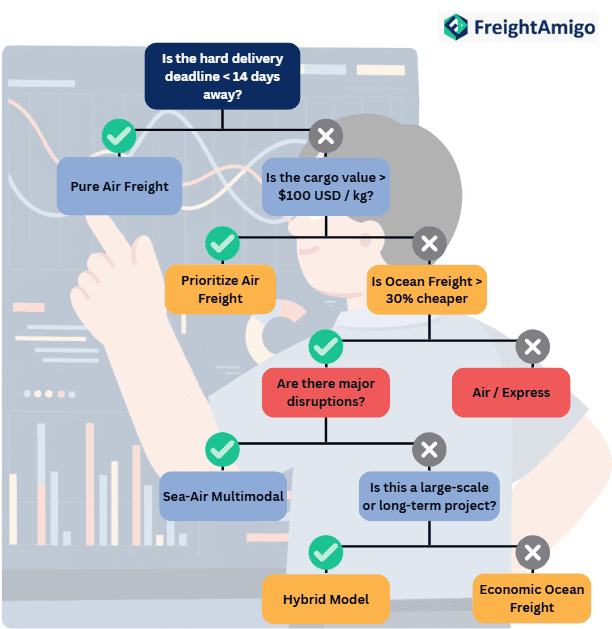
2026 decision framework for time-sensitive freight.
Evaluate based on value density and deadlines.
Assess Urgency
Define your hard delivery deadline. If the required transit time is fewer than 14 days, air is your only viable option. If you have more than 21 days, ocean becomes a candidate.
Calculate Value Density
Divide total cargo value by total weight. If value density exceeds $100/kg, the insurance savings, security benefits, and capital release from air freight typically justify the rate premium.
Model Full Landed Cost
Use FreightAmigo's Digital Logistics Platform to compare air and ocean on total landed cost — including freight, insurance, holding cost, duties, and risk-adjusted delay cost.
Evaluate Supply Chain Risk
Check current disruption alerts for your routing. Is the Red Sea surcharge making ocean significantly more expensive? Is air capacity tight ahead of a peak season? Adjust your modal preference accordingly.
Consider Hybrid Multi-Modal Routing
For large programmes, split shipments strategically: air for the initial urgent tranche to secure market entry, ocean for follow-up volume. Track performance and refine the split ratio each quarter.
Trends shaping cost optimization in 2026.
Fuel surcharges rise with green mandates. Electronics face tariff risks.
Automation at ports cuts ocean times slightly.
Air capacity tightens post-expansion pauses.
Digital logistics platforms enhance decisions.
Tools compare modes instantly for time-sensitive freight.
At FreightAmigo, our Digital Logistics Platform offers real-time quotes and scenario modeling. Freight forwarders use it to adapt quickly.
Clients gain visibility to optimize costs without delays.
2025 case study: Electronics modal shift success.
A client shipped semiconductors amid shortage. Switched to air for 40% faster delivery, saving $200K in downtime.
Ocean fallback for follow-up volumes cut total costs 60%.
Balanced approach via data-driven modal choice logistics.
Conclusion
Mastering air vs ocean for electronics demands balancing time-sensitive freight and cost optimization. We at FreightAmigo help navigate these with our Digital Logistics Solution.








 Global Popular RoutesTop sea & air shipping lanes
 Special OfferLimited-time shipping promotions





 Express
 Document
 Parcel - Air/Sea
 Container
 Relocation