Enhance Supply Chain Visibility for Resilient Electronics Chains Post-2025
In this article, we explore how supply chain visibility, redundancy strategies, and crisis management can build tougher electronics supply chains after 2025 disruptions. We share practical insights to help logistics teams adapt.
The Rising Disruptions Facing Electronics Supply Chains in 2025
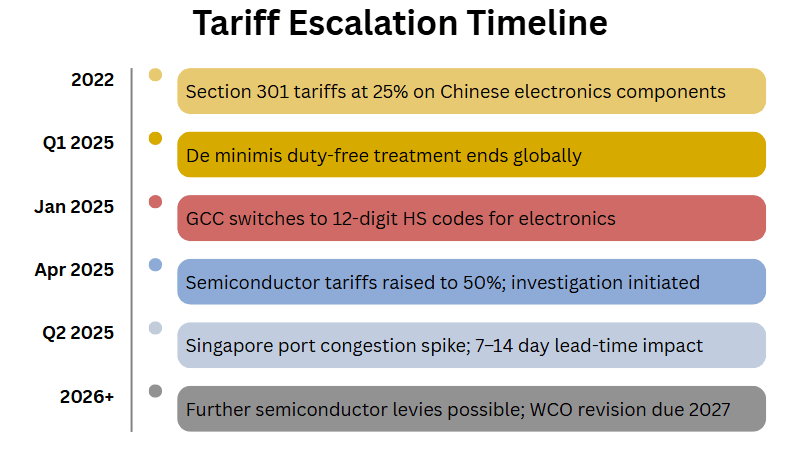
Geopolitical shifts and trade policies will challenge electronics supply chains starting in 2025. New tariffs under Trump and ongoing US-China tensions could raise costs for semiconductors and components. Natural disasters and labor shortages add more risks.
Tariffs on key imports from Asia may increase 60%.
Chip production delays from Taiwan earthquake risks.
U.S. tariffs on Chinese semiconductors reached 50% in 2025, up from 25%.
Taiwan produces ~90% of advanced logic chips (sub-5nm), a single-point risk.
Port delays at LA, Singapore, and Rotterdam added 7–14 days to average lead times.
De minimis duty-free treatment for low-value imports ended globally in 2025.
75% of global electronics supply chains experienced at least one major disruption in 2025.
Air freight costs surged 20% year-on-year, squeezing margins for urgent replenishment.
These factors demand better planning. Without action, delays could cost the industry billions.
Why Supply Chain Visibility Matters More Than Ever Post-2025
Supply chain visibility lets teams track goods in real time, spotting issues early. In electronics, where parts move globally, hidden delays can halt assembly lines.
FreightAmigo's Digital Logistics Platform offers real-time tracking across air, ocean, rail, and trucking modes, with ETA predictions accurate to within two hours and automated alerts for customs holds or carrier delays.
Real-time tracking reduces supply chain blind spots by up to 70%.
Automated delay alerts allow rerouting within hours, not days.
AI-powered analytics predict demand shifts 6–8 weeks in advance.
Blockchain-secured documentation cuts customs processing time by 25%.
FreightAmigo clients recorded 68% fewer unplanned delays in Q1 2026 with live visibility tools.
Tradeoffs include higher tech costs versus fewer disruptions.
Get an instant multi-carrier quote for your next electronics shipment — air, ocean, or multi-modal — and experience the visibility advantage.
Core Redundancy Strategies to Strengthen Electronics Chains
Redundancy strategies involve backup suppliers and routes to avoid single points of failure. For electronics, diversify beyond China for batteries and screens.
The 'China-Plus-One' strategy has accelerated dramatically. Electronics manufacturers are qualifying facilities in Vietnam, India, Malaysia, and Mexico to supplement — or partially replace — China-based production.
Nearshoring to Mexico offers U.S.-bound electronics brands sub-10-day lead times versus 30+ days from Asia, a critical advantage when tariff environments shift rapidly.
Dual-source critical components (semiconductors, rare earths, batteries) from at least two different countries.
Qualify nearshore manufacturing partners in Mexico or Eastern Europe for US and EU markets.
Build 30–45 day safety stock for high-velocity, high-risk components.
Establish multi-modal shipping contracts covering both air and ocean for urgent versus standard shipments.
Create pre-negotiated capacity agreements with freight forwarders to secure space during demand spikes.
Conduct quarterly resilience audits to identify and close new single-point vulnerabilities.
Challenges arise in added costs, but they pay off during crises.
Mastering Crisis Management in Volatile Times
Crisis management plans turn chaos into controlled responses. Test scenarios like factory shutdowns regularly.
Form cross-team response units.
Use AI for quick decision-making.
Partner with reliable forwarders for flexibility.
Review plans yearly with 2025 changes in mind.
Balancing proactive prep with daily ops is key.
Tradeoffs in Building Resilient Supply Chains
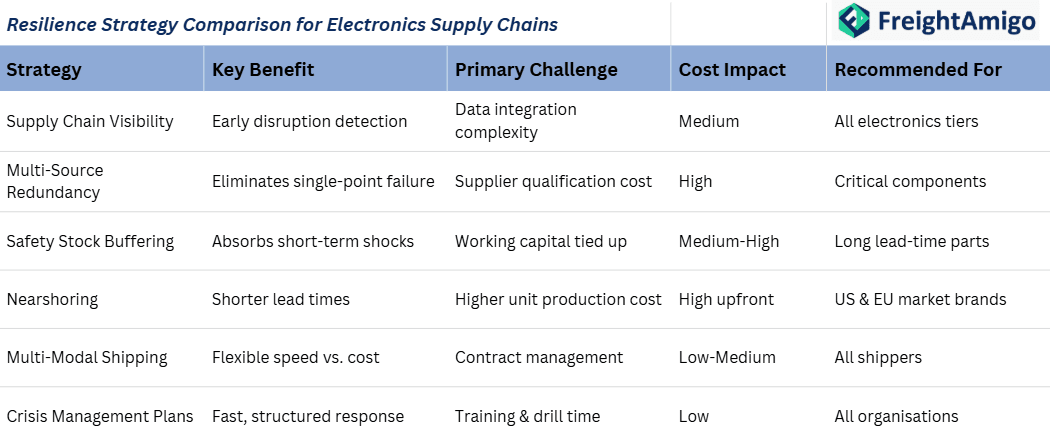
Resilience often trades efficiency for safety. More visibility means more data management, while redundancy raises inventory costs.
This table shows how to weigh options for electronics firms.
Technologies Driving Supply Chain Visibility
Digital tools provide the visibility needed for 2025 resilience. IoT sensors and blockchain track parts from factory to shelf.
AI forecasts demand shifts.
Cloud platforms share data across partners.
Our Digital Logistics Platform at FreightAmigo offers real-time tracking tailored for electronics forwarders.
These help clients spot risks early and adjust routes.
2025 Case Studies: Lessons from Electronics Leaders
Real firms show how strategies work post-2025 changes. A major smartphone maker used visibility to switch suppliers amid tariffs, saving 15% on costs.
Used redundancy to source chips from India.
Crisis drills cut response time by 40%.
Digital platforms integrated data for full visibility.
National policy shifts in 2025, unlike WCO updates until 2027, drove these wins.
Best Practices for Implementation
Start small to build resilient chains effectively. Audit current visibility gaps first.
Train staff on new tools.
Test redundancy quarterly.
Maintain a tiered crisis response team with clear decision-making authority at each level.
Pre-negotiate emergency capacity agreements with at least three alternative carriers per trade lane.
Run quarterly tabletop simulations covering: tariff shock, port closure, supplier bankruptcy, and cyber incident.
Integrate crisis alert feeds (port authority, customs authority, geopolitical risk services) into your logistics platform.
Establish pre-approved rerouting corridors so approvals are not required in the heat of a crisis.
Conduct a post-crisis review within 72 hours to capture lessons and update the playbook.
FreightAmigo helps forwarders adapt with features for crisis alerts and route options.
FAQ
What is supply chain visibility?
Supply chain visibility is real-time tracking of goods and data across the entire logistics network.
Why focus on redundancy strategies in 2025?
Redundancy strategies provide backups against disruptions like tariffs and shortages expected in 2025.
How does crisis management aid electronics chains?
Crisis management offers structured responses to minimize downtime during unexpected events.
What are main 2025 disruptions for electronics?
Main disruptions include trade tariffs under Trump, chip shortages, and port delays.
How to balance visibility costs?
Balance visibility costs risk segments like semiconductors.
Can Digital Logistics Platforms help?
Digital Logistics Platforms enhance tracking and alerts for better resilience.
What role does FreightAmigo play?
FreightAmigo provides tools for visibility and redundancy to support forwarders.
How often to test crisis plans?
Test crisis plans every quarter to stay prepared for 2025 changes.
Are there WCO changes in 2025?
No major WCO revisions until 2027, but national policies shift in 2025.
Conclusion: Steps Forward for Your Supply Chain
Strong supply chain visibility, redundancy strategies, and crisis management build lasting resilience for electronics post-2025. Decisions here impact costs, speed, and reliability.
At FreightAmigo Services Limited, our Digital Platform supports freight forwarders with real-time insights and flexible options to navigate these challenges. Contact us for tailored help.
Book a personalised demo and discover how FreightAmigo's real-time tracking, AI compliance tools, and multi-carrier management can transform your electronics supply chain.








 Global Popular RoutesTop sea & air shipping lanes
 Special OfferLimited-time shipping promotions





 Express
 Document
 Parcel - Air/Sea
 Container
 Relocation