Sustainable Air Freight: Cut Emissions Without Slowdowns
Electronics shippers face growing demands to lower carbon footprints while maintaining speedy deliveries. This article explores sustainable air freight, ocean decarbonization, and electronics ESG strategies for 2026, balancing green goals with efficiency.
The Growing Pressure on Electronics Shippers
Global regulations and consumer expectations push electronics firms toward greener shipping. With electronics ESG reporting now mandatory in many regions, shippers must track emissions across supply chains.
The regulatory landscape has shifted dramatically. The EU Emissions Trading System (EU ETS) now covers 100 % of verified shipping emissions from 2026 onwards, up from 70 % in 2025.
The International Maritime Organization's (IMO) net-zero framework, approved in April 2025, mandates GHG fuel intensity reductions starting in 2027. These are not voluntary targets — non-compliance carries financial penalties.
Scope 3 emissions reporting is now mandatory in the EU under the Corporate Sustainability Reporting Directive (CSRD), and Category 4 (upstream transport) is typically 50–80 % of a company's total footprint.
Major retailers and platform marketplaces increasingly require verified carbon data before onboarding new electronics suppliers.
SAF blending mandates kicked in across the EU at 2 % in January 2025 and are set to rise annually — costs pass directly to air freight customers.
Consumer electronics have short product life cycles, which amplifies pressure to ship fast and green simultaneously.
Institutional investors now benchmark ESG scores — poor shipping sustainability can directly affect cost of capital.
Understanding Sustainable Air Freight Basics
Sustainable air freight reduces emissions through efficient fuels and optimized loads. Airlines like those in IATA's net-zero push use sustainable aviation fuel (SAF).
SAF cuts lifecycle emissions by up to 80% compared to traditional jet fuel.
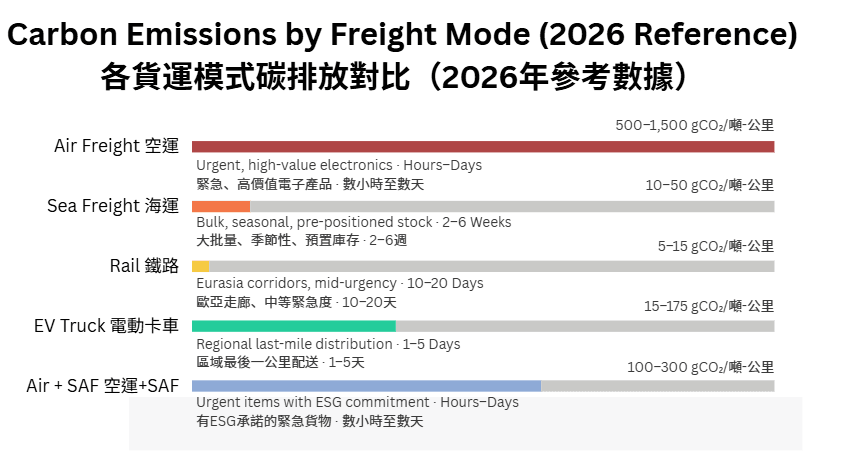
Even a 20–30 % shift from air to ocean or rail on suitable SKUs can cut your logistics carbon footprint by 40–60 % without changing your customers' experience.
Choose certified SAF suppliers.
Consolidate shipments to fill planes better.
Opt for direct routes to minimize fuel burn.
Ocean Decarbonization: A Viable Alternative
Ocean decarbonization leverages slow steaming and green fuels for massive emission cuts. Ships emit far less CO2 per ton than planes, ideal for bulk electronics.
Tradeoffs include longer transit times, but LCL services speed consolidation.
Select carriers operating vessels rated A or B under the CII — these ships use the least fuel per cargo-mile.
Request LNG, methanol, or ammonia-fuelled vessel options — multiple carriers now offer green-fuel itineraries on key Asia–Europe and transpacific routes.
Use slow steaming strategically: dropping vessel speed from 20 to 12 knots reduces fuel consumption by 40–50 %, though it extends transit by 3–5 days.
Opt for LCL (Less-than-Container-Load) consolidation on smaller electronics shipments — it dramatically improves cargo utilisation and emissions per unit.
Wind-assisted propulsion (Flettner rotors, sails) is now commercial on select routes and can cut fuel use by 15–25 % with zero additional cost to shippers.
Electronics ESG Reporting Essentials
Electronics ESG frameworks require verifiable data on shipping emissions. Standards like CDP and TCFD demand transparency in air and ocean logistics.
Total logistics CO₂e (tonnes) by mode — air, ocean, road, rail — per quarter.
Emissions intensity: gCO₂e per tonne-km or per unit shipped, to track improvement year-over-year.
SAF percentage and SAF certificate (SAFc) volume purchased versus total air freight CO₂e offset.
Carrier CII ratings for ocean legs — document which vessels carried your cargo.
Third-party verification status: ISO 14064, PAS 2060, or SBTi-aligned methodology.
Mode shift volume: percentage of cargo migrated from air to ocean/rail versus prior year.
Balancing Speed and Sustainability Tradeoffs
Electronics shippers must weigh emission cuts against delivery timelines. Pure air freight is quick but dirty; full ocean is green but slow.
Hybrid air-ocean for high-value items.
Pre-position inventory near markets.
Invest in carbon offsets as bridges.
Use real-time tracking for efficiency.
Prioritize low-emission carriers.
2026 Innovations Shaping Green Logistics
New tech in 2026 enables emission tracking without speed loss. AI predicts optimal modes, while blockchain verifies green claims.
Electric cargo eVTOLs for short hauls.
Biofuels scaling for transocean routes.
Digital twins simulate low-carbon paths.
National mandates like US IRA credits.
Practical Steps for Electronics Shippers
Start with audits to baseline your emissions. Then layer in sustainable air freight and ocean decarbonization tactics.
Assess current supply chain CO2.
Partner with ESG-certified forwarders.
Test SAF on key routes.
Shift 30% volume to ocean where possible.
Monitor via digital dashboards.
2025 Case Studies in Action
Real electronics firms cut emissions 25% in 2025 trials. One smartphone maker blended sustainable air freight with ocean decarbonization.
Reduced air volume by 40%, emissions down 30%.
No delivery delays via smart routing.
ESG scores improved, attracting investors.
Cost savings from efficient fuels.
Scalable model for global ops.
How FreightAmigo Supports Your Green Journey
We at FreightAmigo provide tools to navigate sustainable air freight and electronics ESG. Our Digital Logistics Platform offers real-time emission calculators and mode optimization.
It uses low-emission fuels like SAF to cut CO2 without changing speeds.
How does ocean decarbonization work?
Ships adopt green fuels and efficient designs to slash emissions per voyage.
Why focus on electronics ESG?
Investors and regs require proof of low-impact supply chains.
Can I cut emissions without delays?
Yes, via hybrids and optimized planning.
What 2026 changes affect shippers?
New fuel mandates and carbon taxes push greener modes.
How to start ocean decarbonization?
Select carriers with green tech commitments.
Is SAF cost-effective?
Premium now, but scales down with volume.
What tools help track ESG?
Digital platforms with API integrations.
Hybrid shipping viable for electronics?
Absolutely, balances speed and sustainability.
Conclusion
Sustainable air freight, ocean decarbonization, and electronics ESG are achievable together. Book a Demo to see our Digital Logistics Solution in action.








 Global Popular RoutesTop sea & air shipping lanes
 Special OfferLimited-time shipping promotions





 Express
 Document
 Parcel - Air/Sea
 Container
 Relocation