Real-Time Visibility in Electronics Supply Chains: 2026 Must-Have
In today's fast-moving electronics industry, real-time visibility is key to staying ahead. By 2026, tools like IoT tracking, predictive ETAs, and digital twin logistics will transform supply chains, helping manage risks and boost efficiency.
The Growing Need for Real-Time Visibility in Electronics
Electronics supply chains deal with short product cycles and global disruptions.
Smartphones, semiconductors, and consumer devices move across 8–14 border crossings before reaching the end customer.
Without real-time visibility, a single port congestion event can ripple into a full production halt downstream.
Global electronics exports surpassed $4.1 trillion in 2025, with Asia-Pacific accounting for 68%.
Average shipment delay cost for electronics: $18,000–$52,000 per day.
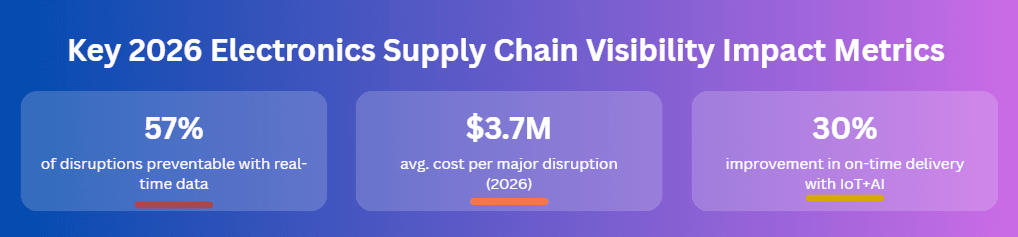
57% of disruptions in 2025 were preventable with real-time data.
The WCO–UPU Electronic Advance Data framework (June 2025 guidelines) now sets the global standard for data sharing.
By Q3 2026, the EU requires live tracking for all Class-A electronics entering the bloc.
IoT Tracking Powers Real-Time Data Flow
IoT tracking uses sensors to monitor goods every step of the way.
These devices send live updates on location, temperature, and humidity.
For electronics, this protects sensitive components from damage.
Tracks shipments in real time
Alerts for temperature changes
Reduces loss from theft
Improves inventory accuracy
Integrates with warehouse systems
Tracking Method
Update Frequency
Condition Data
EAD Compatible
Manual milestone updates
Once per port stop
✗
✗
Carrier EDI feeds
Every 4–12 hours
✗
Partial
IoT Multi-Sensor
Every 60–120 sec
✓ Full
✓ Full
Comparison of Tracking Methods for Electronics Logistics
Predictive ETAs Reduce Uncertainty
Predictive ETAs use AI to forecast arrival times accurately.
They analyze weather, traffic, and port congestion to deliver arrival windows with up to 95% accuracy.
This helps electronics firms plan production better.








 Global Popular RoutesTop sea & air shipping lanes
 Special OfferLimited-time shipping promotions





 Express
 Document
 Parcel - Air/Sea
 Container
 Relocation