HS Code for Adhesive Sheets: Complete Guide to 3919 Classification and Compliance
Imagine this: your shipment of adhesive sheets or tapes is held up at customs, racking up demurrage fees, and facing hefty fines—all because of an incorrect HS code. In the high-stakes world of International Trade, misclassifying these products can lead to delays, unexpected duties, and compliance nightmares that erode profits and disrupt supply chains. But it doesn't have to be that way. We understand the challenges logistics managers and exporters face when it comes to precise tariff classification. This Guide breaks down the HS code for adhesive sheets, dives deep into the HS 3919 tariff, and Empower you to stay informed to ensure seamless global door-to-door clearance.
Adhesive sheets are primarily classified under HS Code 3919: Self-adhesive plates, sheets, film, foil, tape, strip and other flat shapes, of plastics, whether or not in rolls.
This classification helps over 200 countries worldwide assess duties correctly and ensure regulatory compliance. Accurate coding prevents border delays and supports an efficient supply chain.
In-Depth Analysis of HS 3919 Headings and Version Regulations
HS 3919 specifically targets self-adhesive plates, sheets, film, foil, tape, strip, and other flat shapes made of plastics, regardless of whether they are in rolls.
Version Compliance Tip:
According to the official regulations of the World Customs Organization (WCO), HS codes undergo major periodic updates every 5 years (e.g., 2017, 2022, 2027). The current 2022 version remains applicable throughout 2026. This version strictly enforces the distinction between self-adhesive and non-self-adhesive plastics, focusing heavily on material composition and adhesive types.
Key Characteristics:
· Plastic substrates (e.g., PVC, PE, PP, PET)
· Pressure-sensitive adhesive layer
· Flat formats suitable for labeling, packaging, and industrial applications
Key Subheadings and Classification Rules
The selection of the 3919 subheading depends on the width, format, and specific application:
3919.10: In rolls of a width not exceeding 20 cm (e.g., common packaging adhesive tapes)
3919.90: Other shapes (e.g., larger sheets, films, or wide industrial self-adhesive sheets)
Note: The internationally harmonized HS Code consists of only the first 6 digits. Individual countries expand upon these by adding more detailed national tariff extensions.
Crucial Differences: HS vs. HSN vs. National Extensions (e.g., China's 10-Digit Code)
While the core 6-digit WCO code is universally recognized in global trade, individual countries require their legally mandated full-length codes during actual import declaration. Failure to do so will stall door-to-door clearance:
Global Standard: First 6 digits (e.g., 3919.90).
India HSN Code: Extended to an 8-digit code to support domestic GST (Goods and Services Tax) compliance.
China Customs Commodity Code: The official Chinese customs declaration format contains no periods and strictly uses 10 consecutive digits (e.g., a common sub-item for adhesive sheets is 3919909090). The trailing digits differentiate specific material details, import/export tariffs, and statistical regulatory conditions.
US HTS Code: Extended to a 10-digit code (HTSUS), used for precise assessment of Most-Favored-Nation (MFN) tariffs or additional duties.
Common Classification Mistakes and Solutions
Misclassifying self-adhesive sheets as non-adhesive plastics (such as under Heading 3920) triggers customs re-inspections, seizures, and severe penalties.
Common Mistakes:
Ignoring the critical roll width threshold of 20 cm.
Confusing different substrates during mixed-carton shipping (e.g., plastic substrate 3919 vs. paper substrate 4811).
Neglecting the destination country's specific extended codes (e.g., omitting or mistyping the last 4 digits of the 10-digit commodity code when declaring in China).
Correct Solutions:
Verify Adhesive Properties: Ensure the product features pressure-sensitive or self-adhesive capabilities.
Measure Dimensions Accurately: Confirm the width and packaging format prior to dispatch.
Dynamic Data Verification: Always cross-reference destination official customs databases to retrieve the most precise information.
Financial Impacts and Tariff Variables of Accurate Coding
Utilizing the correct 3919 classification can substantially optimize your effective customs duties depending on the destination and applicable Free Trade Agreements (FTAs). Precise coding unlocks Input Tax Credit (ITC) eligibility, averts penalties, and lowers the landed cost of your adhesive sheet shipments.
Customs Duties and Tax Comparison Across Major Global Markets:
Important Note: The tariff rates listed below are approximate reference values. Actual enforced rates vary based on specific subheading extensions (8- or 10-digit breakdowns), FTA reductions, and Certificates of Origin. Importers and exporters are strongly advised to consult the official customs database of the destination country before shipping.
Country/Region
Core Subheading
Typical MFN Base Tariff
GST / VAT / Other Taxes
Potential Savings via Accurate Coding & FTAs
United States
3919.10 / 3919.90
4.2% - 5.8% (Est.)
Varies by State
Declare via 10-digit HTSUS to avoid misclassification fines.
India
391910 / 391990
Base Rate + 18% GST
18% GST
Optimize Input Tax Credit (ITC) via the 8-digit HSN.
European Union
3919.10
Approx. 6.5% (Est.)
Country-specific VAT
Enjoy FTA duty exemptions when paired with a Certificate of Origin.
China
3919
6% - 10% (Est.)
VAT
Must declare using the 10-digit pure numeric code to claim reductions.
Transportation Documents and Compliance Procedures
Global Tariff Discrepancies and Trade Agreement Timelines
Tariffs for adhesive sheets under 3919 vary widely by destination. Leveraging regional trade agreements can dramatically slash costs, but you must keep an eye on implementation schedules and legal validity differences:
RCEP (Regional Comprehensive Economic Partnership): Officially in effect since 2022. As long as a compliant Certificate of Origin is provided, imports and exports of self-adhesive sheets among member nations can gradually enjoy reduced or zero-tariff treatments.
CPTPP (Comprehensive and Progressive Agreement for Trans-Pacific Partnership): Currently, several major trading nations (such as China) are still in the application stage. When planning your 2026 and future supply chains, note that it has not officially taken effect for applicant nations; do not calculate premature tariff reductions into your current costs.
Shipping Documentation and Compliance Steps
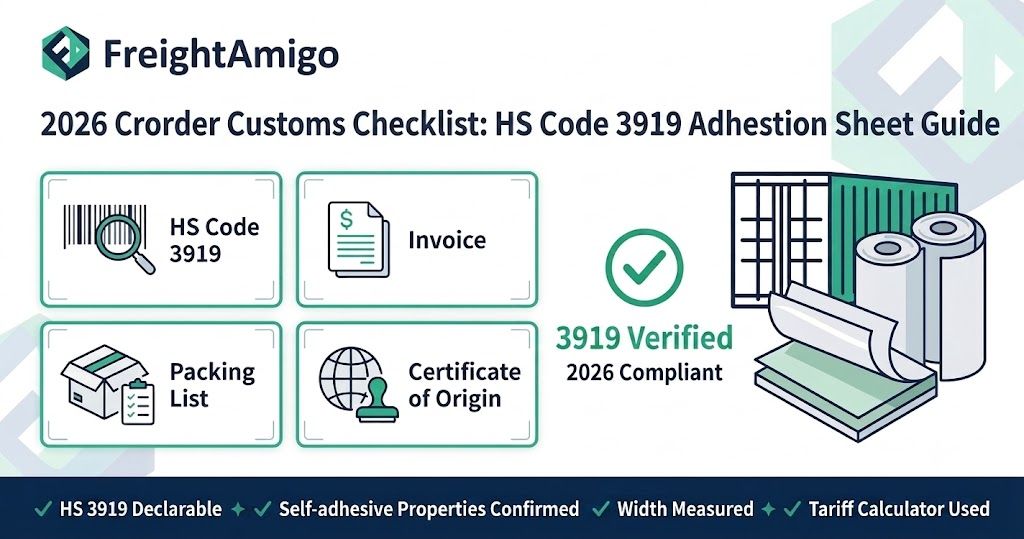
Accurately declaring HS 3919 and its destination country extension code on commercial invoices, packing lists, and bills of lading is a mandatory requirement for transnational logistics.
Customs Compliance Checklist:
Full Tariff Code Declared: Ensure the first 6 digits match the 3919 core, and the trailing digits align with import regulations (e.g., China requires all 10 digits without periods).
Detailed Description: Prepare clear descriptions detailing the product material, substrate type, and self-adhesive characteristics.
Certificate of Origin: Provide a Certificate of Origin as required by active trade agreements like RCEP to secure duty preferences.
Professional Declaration: Hire a licensed customs broker or utilize the FreightAmigo digital logistics platform for end-to-end customs support.
Frequently Asked Questions (FAQ)
Q1: Has the HS code version for self-adhesive sheets changed in 2026?
A: No. The WCO official HS codes are updated every 5 years (the most recent was in 2022, and the next will be in 2027). Therefore, the 2022 version's classification standards remain fully active in 2026.
Q2: Can I directly use "3919.90.90.90" to declare self-adhesive sheets when importing into China?
A: No. The official declaration format for China Customs does not contain any periods; you must input 10 consecutive digits like 3919909090. The first 6 digits represent the international HS code, while the last 4 digits are Chinese customs sub-items and statistical codes. Always verify the format before filing.
Q3: Can I use CPTPP right now to claim duty reductions on self-adhesive sheets?
A: This depends on whether both the exporting and importing countries are ratified member states where the agreement is active. It is vital to note that major trading nations like China are still in the accession application phase. If both trading parties hold active RCEP membership (e.g., China, ASEAN, Japan, South Korea, etc.), it is highly recommended to prioritize RCEP—which took effect in 2022—to apply for tariff concessions.
Conclusion
Mastering the HS code for adhesive sheets under 3919 unlocks efficient, compliant trade. From tape HS code to 3919 HSN code GST rate, this guide arms you against pitfalls.








 Global Popular RoutesTop sea & air shipping lanes
 Special OfferLimited-time shipping promotions





 Express
 Document
 Parcel - Air/Sea
 Container
 Relocation