Conveyor Belt HS Code 4010 Classification: The Complete 2026 Guide for Global Importers & Exporters
Table of Contents (Click to expand)
What Is the Conveyor Belt HS Code?
The conveyor belt HS code is the globally recognized numeric identifier used by customs authorities worldwide to classify vulcanized rubber conveyor belts and transmission belting for import and export declarations.
Under the World Customs Organization's Harmonized System, these products fall under Chapter 40 — Rubber and Articles Thereof, specifically at the 4010 heading.
The first six digits of the HS code are internationally standardized. Every country that participates in global trade recognizes 4010 as the correct heading for vulcanized rubber conveyor belts.
Understanding this code before your shipment leaves the warehouse is not optional — it directly determines the duties you pay, the documentation you file, and how quickly your cargo clears the border.
Breaking Down the 4010 HSN Code Sub-Headings
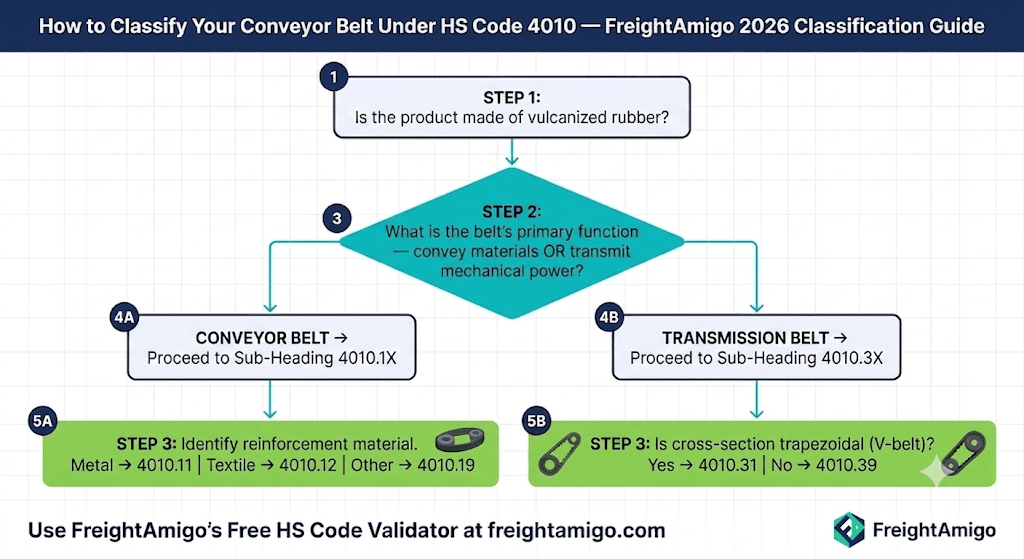
The 4010 HSN code is not a single flat classification — it branches into distinct sub-headings based on the belt's reinforcement material and construction type.
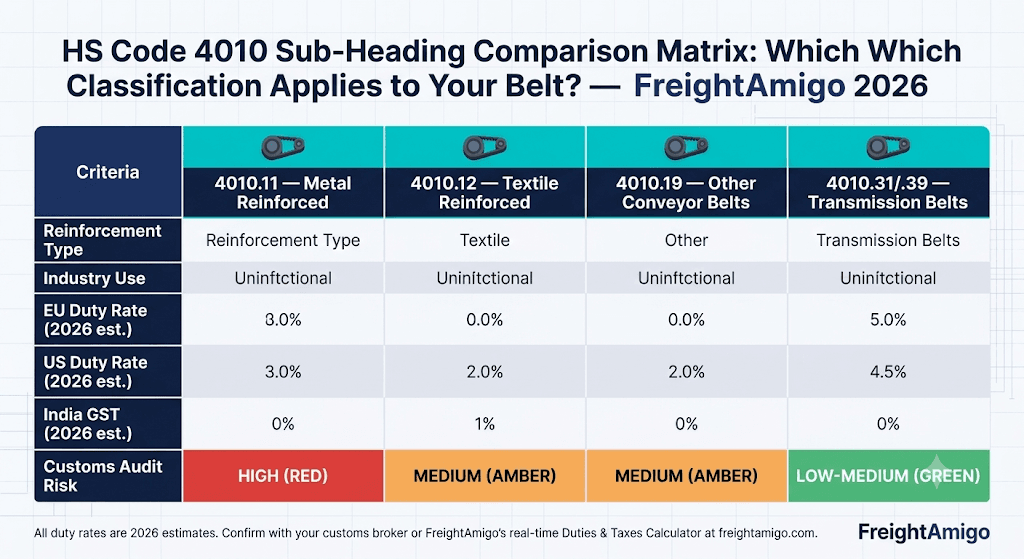
Getting the sub-heading wrong is one of the most common and costly errors in industrial goods logistics. Here is how the heading breaks down:
HS / HSN Code
Description
Reinforcement Type
Typical Duty Risk
4010
Conveyor or transmission belts/belting of vulcanized rubber
All types (parent heading)
N/A — always drill down
4010.11
Conveyor belts, reinforced only with metal
Metal (steel cord)
Higher — often capital goods
4010.12
Conveyor belts, reinforced only with textile materials
FreightAmigo Tip: Always declare at the 6-digit level minimum. Many countries require 8- or 10-digit national extensions beyond 4010 for tariff line accuracy.
Conveyor Belt vs. V-Belt: Are They the Same HS Code?
Many logistics managers incorrectly assume the v-belt HSN code is entirely separate from the conveyor belt classification — the truth is more nuanced and depends on construction specifics.
Both conveyor belts and V-belts (transmission belts with a trapezoidal cross-section) fall under Chapter 40, Heading 4010. However, their sub-headings differ:
Conveyor belts → 4010.11, 4010.12, or 4010.19 (based on reinforcement)
V-belts / transmission belts (endless, trapezoidal) → 4010.31 or 4010.39
Flat transmission belts → Also 4010.39 in most jurisdictions
The key differentiator is function and cross-section geometry, not material alone. A belt used to transmit mechanical power (V-belt) and a belt used to convey materials (conveyor belt) are both vulcanized rubber — but their sub-headings carry different duty rates in markets including India, the EU, and the US.
Always document the belt's intended use in your commercial invoice to support the correct sub-heading declaration.
4010 HSN Code GST Rate by Country in 2026
The GST or import duty rate applied to the 4010 HSN code varies significantly across jurisdictions and is subject to annual tariff schedule reviews.
Below is a 2026 reference overview. Always verify with official customs authorities or FreightAmigo's Duties & Taxes Calculator before filing.
Country / Region
HS Code Used
GST / Import Duty Rate (2026 Est.)
Notes
India
4010 (8-digit ITC-HS)
GST: 18% (standard rate for rubber goods)
Verify ITC-HS extension for exact rate
European Union
4010 (CN 10-digit)
3.7%–6.5% depending on sub-heading
Anti-dumping duties may apply on Chinese origin
United States
4010 (HTS 10-digit)
2.5%–3.7% + potential Section 301 tariffs
China-origin goods face additional 25% tariff
United Kingdom
4010 (UK Global Tariff)
3.5%–5% post-Brexit schedule
Confirm UKGT vs. preferential trade agreement rate
Australia
4010 (AHECC)
0%–5% under FTA schedules
AUSFTA, CPTPP may reduce to 0%
Singapore
4010
0% import duty; 9% GST
GST applies at point of sale/import
UAE
4010
5% GCC standard rate
Free Zone imports may be exempt
2026 Update: With ongoing US-China tariff negotiations and EU Carbon Border Adjustment Mechanism (CBAM) phasing, duty rates on industrial goods are especially volatile. Real-time verification is essential.
Top 5 Classification Mistakes That Trigger Customs Audits
Misclassification of conveyor belt HS codes is one of the leading causes of customs audits for industrial goods importers — and the financial penalties can far exceed any duty savings from an incorrect declaration.
Here are the five most common errors FreightAmigo's customs specialists encounter:
Using the parent heading 4010 without a sub-heading. Many systems accept this at entry, but customs authorities require a fully extended tariff line. This triggers post-clearance audit flags.
Confusing textile-reinforced belts (4010.12) with metal-reinforced belts (4010.11). The reinforcement material must be verified against the technical datasheet, not estimated visually.
Applying a domestic GST rate to cross-border shipments. The 4010 HSN code GST rate in your home market does not automatically transfer to import duty rates in destination countries.
Failing to account for country-of-origin rules. A belt manufactured in China but re-exported from Singapore may still attract China-origin tariff surcharges (e.g., US Section 301) if rules of origin are not met.
Omitting end-use documentation. For V-belts used in automotive manufacturing, some jurisdictions offer preferential duty rates contingent on end-use certificates. Missing this documentation means overpaying.
How to Verify Your Conveyor Belt HSN Code Before Shipment
Proper pre-shipment HS code verification is a four-step compliance checkpoint that protects your cargo from costly delays and customs intervention.
Follow this sequence before every international conveyor belt shipment:
Obtain the product's technical datasheet. Identify material composition, reinforcement type, and belt geometry — the three data points customs authorities use to classify.
Cross-reference with the WCO's Harmonized System Nomenclature. Confirm alignment at the 6-digit level using the official explanatory notes for Chapter 40.
Apply the destination country's national tariff schedule. Add the required 8- or 10-digit national extensions and identify any surcharges, anti-dumping duties, or preferential rates under active trade agreements.
Validate with a digital compliance tool. Use FreightAmigo's AI-powered HS Code Validator to cross-check your classification against live customs databases before submitting your shipping documents.
Retain documentation for post-clearance audit readiness. Store the product spec sheet, HS classification rationale, and duty calculation for a minimum of five years in most jurisdictions.
How FreightAmigo Automates HS Code Compliance in 2026
FreightAmigo's digital freight platform integrates AI-driven HS code validation directly into the shipment booking workflow, eliminating the manual classification burden for logistics teams handling industrial goods.
Here is what FreightAmigo's compliance ecosystem delivers for conveyor belt shippers in 2026:
AI HS Code Validator: Scans product descriptions and technical attributes against the latest WCO and national tariff databases to suggest the most accurate sub-heading.
Real-Time Duties & Taxes Calculator: Inputs your 4010 sub-heading, origin country, destination country, and declared value to return an itemized landed cost estimate in seconds.
Custom API Integration: Syncs your ERP or inventory system with FreightAmigo's classification database, ensuring every SKU in your product catalog carries a verified, up-to-date HS code.
Customs Documentation Autopilot: Auto-populates commercial invoices, packing lists, and customs declarations using validated HS codes, reducing data entry errors.
Post-Clearance Audit Trail: Every classification decision is logged with timestamps, data sources, and rationale — creating a defensible audit record if challenged by customs authorities.
FreightAmigo supports shipments across 160+ countries, with real-time tariff data covering the EU, ASEAN, GCC, North America, and South Asia.
Understanding the 4010 HSN Code in the Context of 2026 Trade Policy
The global trade policy landscape in 2026 has introduced new layers of complexity for businesses relying on the 4010 HSN code, with several major regulatory shifts directly impacting conveyor belt importers.
US Section 301 Tariff Reviews: The ongoing review cycle has maintained elevated surcharges on Chinese-origin rubber industrial goods, including conveyor belts under 4010.11 and 4010.12.
EU CBAM Phase-In: While primarily targeting steel and cement, the Carbon Border Adjustment Mechanism creates indirect compliance pressure for industrial goods supply chains, including documentation standards.
India PLI Scheme: India's Production Linked Incentive scheme for rubber goods manufacturing is reshaping sourcing decisions for 4010-classified products imported into India.
ASEAN Free Trade Agreements: Several ASEAN member states have updated their FTA schedules, offering preferential rates for 4010 goods originating within ASEAN under ATIGA.
UK DCTS (Developing Countries Trading Scheme): Updated preference rates for 4010 products from eligible developing nations entering the UK market post-Brexit.
Staying current with these developments is not a quarterly task — it is a weekly one in 2026.
Frequently Asked Questions
What is the HS code for conveyor belts made of vulcanized rubber?
The correct HS code for vulcanized rubber conveyor belts is 4010, under Chapter 40 of the Harmonized System. The specific sub-heading (4010.11, 4010.12, or 4010.19) depends on the belt's reinforcement material — metal, textile, or other.
What does 4010 HSN code cover exactly?
HSN code 4010 covers conveyor or transmission belts and belting of vulcanized rubber. It includes both material-conveying belts used in industrial settings and power-transmission belts such as V-belts used in automotive and manufacturing machinery.
What is the GST rate for 4010 HSN code in India in 2026?
In India, the GST rate for products under HSN code 4010 is 18% under the standard rubber goods schedule. Always verify the current rate against the GST Council's latest notification, as rates are periodically reviewed.
Is the v-belt HSN code the same as the conveyor belt HS code?
Both V-belts and conveyor belts fall under HS Chapter 40, Heading 4010. However, V-belts (trapezoidal transmission belts) are classified under 4010.31 or 4010.39, while conveyor belts use 4010.11, 4010.12, or 4010.19 — so the sub-headings differ.
What happens if I use the wrong conveyor belt HS code?
Using an incorrect HS code can result in shipment delays, post-clearance audits, financial penalties, and potential cargo seizure. Customs authorities may also issue binding rulings requiring reclassification of all future shipments of the same product.
How do I find the correct sub-heading under 4010 for my specific belt?
Identify three product attributes: (1) reinforcement material (metal, textile, or other), (2) primary function (conveying vs. power transmission), and (3) cross-section geometry (trapezoidal or flat). Match these against the WCO explanatory notes for Chapter 40.
Does HS code 4010 apply to belts made from synthetic rubber?
Yes — synthetic rubber that has been vulcanized falls under Chapter 40. The key qualifier is vulcanization, not the specific type of rubber compound. Non-vulcanized rubber articles may be classified differently under Chapter 40 or other chapters.
Can FreightAmigo validate my HS code before shipment?
Yes. FreightAmigo's AI-powered HS Code Validator cross-references your product description and technical attributes against live WCO and national tariff databases to confirm or suggest the most accurate 4010 sub-heading before you file your customs declaration.
Conclusion: Classify Correctly, Ship Confidently in 2026
In 2026, precision in HS code classification is a competitive advantage — not just a compliance obligation.
The difference between 4010.11 and 4010.12 is not semantic. It can represent thousands of dollars in duty overpayments, weeks of customs delays, or the difference between a clean audit record and a formal customs penalty.
For businesses importing or exporting vulcanized rubber conveyor belts, the path to efficient global trade runs through accurate classification, real-time tariff intelligence, and a digital logistics partner that automates compliance at scale.








 Global Popular RoutesTop sea & air shipping lanes
 Special OfferLimited-time shipping promotions





 Express
 Document
 Parcel - Air/Sea
 Container
 Relocation