Want To Compare The Best Express, Air Freight, Sea Freight, Rail Freight & Trucking Rates So As To Have Better Control On Cost?
If You Wish To Learn More About Ocean Freight Rates, Please Go To The FreightAmigo Page For Inquiries
The procedures for the regulation of restricted items and tariff arrangements are complicated. If you want to safely deliver your favorite items to your new home, it is best to have logistics experts to support you throughout the process! If you are planning to arrange overseas moving, welcome to FreightAmigo’s special page for overseas moving freight quotations.
FreightAmigo offers oversea immigration service to make your move-in easier!
There are different options for cargo transportation. If you want to choose the most convenient and suitable solution, it is best to have the full support of logistics experts! If you are planning to ship goods overseas, please go to the FreightAmigo page for inquiries.
If you are looking for logistics experts, please visit FreightAmigo Page
There Are Different Options For Transporting Goods, And To Choose The Most Convenient And Suitable Solution, It Is Best To Have Full Support From Logistics Experts! If You Are Planning To Ship Goods Overseas, Please Visit The FreightAmigo Page For Inquiries!
FreightAmigo, a supply chain e-marketplace, would ship your documents, small parcels or pallet anywhere in the world with flexible solutions. Get an instant quote on FreightAmigo and make trade easier!
If you’re looking For Cosmetics Shipping, Please Go To The FreightAmigo Page For Inquiries

Understanding HS Codes for Scarves and Fashion Accessories: The Essential Scarf HS Code Guide

Imagine your eagerly awaited shipment of premium scarves and shawls arriving at the port, only to be stalled indefinitely due to an incorrect classification on the customs declaration. Delays mount, storage fees accrue, and potential fines loom large—all because of a misidentified scarf HS code. As logistics professionals who have guided countless importers through such pitfalls, we at FreightAmigo know this scenario all too well. In the fast-paced world of fashion accessories trade, where margins are tight and seasons turn quickly, getting the HS code right isn't just compliance—it's a competitive edge.

This comprehensive guide dives deep into the scarf HS code, shawls HS code, dupatta HS code, and everything under heading 6214. Whether you're importing silk scarves from Asia or exporting wool shawls to Europe, we'll equip you with the knowledge to classify accurately, optimize duties, and streamline your supply chain.

Key Takeaways from This Guide

  • Master the precise HS code for scarf, shawl HS code, and subheadings under 6214 to avoid customs holds and penalties.
  • Understand HSN codes and GST rates for India-specific imports/exports of fashion accessories like dupattas.
  • Learn proven strategies to reduce duty costs and accelerate clearance using AI-driven tools.
HS HeadingDescriptionCommon ExamplesKey Markets
6214.10Of silk or silk wasteSilk scarves, pashmina shawlsEU, US, India
6214.20Of wool or fine animal hairWool mufflers, cashmere veilsUS, UK, Australia
6214.30Of synthetic fibresPolyester scarves, nylon shawlsGlobal eCommerce
6214.40Of artificial fibresViscose mantillasAsia-Pacific
6214.90Of other textile materialsCotton dupattas, knitted scarvesIndia, Middle East

This table provides a quick reference for the core structure of 6214, helping you identify the right scarf HSN code or shawl HSN code at a glance. We'll expand on each in detail below.

What Are HS Codes and Why Do They Matter for Scarves and Fashion Accessories?

The Harmonized System (HS) is a standardized numerical method developed by the World Customs Organization (WCO) to classify traded products globally. HS codes are universally recognized up to the first six digits, with countries adding further digits for national tariff purposes—like the 8-digit or 10-digit codes in the US HTS or India's HSN.

For fashion accessories such as scarves, shawls, mufflers, mantillas, veils, and similar items, the relevant chapter is 62: Articles of apparel and clothing accessories, not knitted or crocheted. Specifically, heading 6214 covers "Shawls, scarves, mufflers, mantillas, veils and the like." This heading is crucial because even subtle differences in material, construction, or intended use can shift classification, dramatically affecting import duties, VAT/GST, and eligibility for trade agreements.

From our experience handling shipments from Hong Kong to over 250 countries, we've seen importers pay thousands in unexpected duties or face shipment rejections simply because a cotton scarf was classified under apparel (Chapter 62) instead of accessories (6214). Accurate classification under the scarf HS code ensures smoother customs clearance, lower costs, and faster market delivery—essential for seasonal fashion trends.

Consider the global trade volume: In 2023, textile accessories like those under 6214 represented billions in trade value, with Asia as the dominant exporter. Misclassification risks not only financial hits but also supply chain disruptions in an era of nearshoring and sustainability scrutiny.

Breaking Down the Scarf HS Code: Detailed Subheadings Under 6214

Heading 6214 is subdivided based primarily on material composition, as textile classification hinges on fiber content. Here's an in-depth look at each subheading, with real-world examples and classification tips we've refined through years of customs brokerage.

6214.10: Of Silk or Silk Waste

This subheading applies to scarves and shawls made predominantly from silk (over 50% by weight). Examples include luxurious Hermes-style silk squares, Indian Banarasi dupattas with silk bases, or lightweight silk veils. Duty rates vary: In the EU, it's around 12%; in the US, 7.5% for most origins. We've helped clients importing from China to the US save 20% on duties by correctly validating silk content certificates against this scarf HS code.

6214.20: Of Wool or Fine Animal Hair

For woolen mufflers, cashmere shawls, or alpaca veils. Fine animal hair includes cashmere, mohair, and angora. Classification requires fiber analysis reports. US duties hover at 16%, but FTAs like USMCA can zero them out with proper origin proofs. Common pitfall: Blends exceeding 50% wool tip into this category.

6214.30: Of Synthetic Fibres

Polyester, acrylic, or nylon-based scarves dominate eCommerce. Affordable and versatile, these face lower duties—12% EU, 14.6% US—but synthetic content must be lab-verified to avoid reclassification as 'other textiles.'

6214.40: Of Artificial Fibres

Viscose rayon (regenerated cellulose) shawls and mantillas fall here. Duties similar to synthetics, but environmental regulations in the EU increasingly scrutinize rayon production.

6214.90: Of Other Textile Materials

Catch-all for cotton, linen, or ramie scarves/dupattas. Most common for Indian exports. US duty: 8.5%; India GST: 12%. We've seen dupattas misclassified as 'handkerchiefs' (6213), leading to audits.

To illustrate duty variations, here's a comparative table based on 2024 tariff schedules (always verify with official sources):

SubheadingUS Duty (%)EU Duty (%)India GST (%)China MFN (%)
6214.107.5121214
6214.201681214
6214.3014.6121214
6214.908.5121213

HS Code vs. HSN Code: Key Differences for Shawl and Scarf Importers

While HS codes are the global standard (6 digits), HSN (Harmonized System of Nomenclature) extends to 8 digits in India for GST compliance. For instance, the shawl HSN code 6214 mirrors HS but adds specifics like 6214.10.00 for silk. India's GST rate for all 6214 items is uniformly 12%, applied post-customs duty.

6214 HSN code GST rate details: Basic customs duty (BCD) + Social Welfare Surcharge + IGST (18% on total). For a $10,000 silk scarf shipment (6214.10), expect ~$1,800 in total taxes if from non-FTA countries. We assist Indian importers daily, ensuring HSN accuracy to claim input tax credits seamlessly.

Pro tip: Always cross-reference WCO Explanatory Notes for borderline cases, like embroidered scarves (may shift to 6214 if accessory-dominant).

Common Classification Challenges and How to Overcome Them

Fashion accessories blur lines: Is a large shawl 'apparel' (6208) or 'accessory' (6214)? Rule: If designed for neck/shoulder adornment, not full-body coverage, it's 6214. Dupattas, often 2-3 meters, stay under 6214.90 unless garment-integrated.

Other pitfalls:

  • Material blends: Predominant fiber rules; test reports essential.
  • Knitted vs. woven: 6214 is non-knitted; knitted goes to 6117.
  • Finished vs. unfinished: Hemmed edges confirm 'made-up' status.

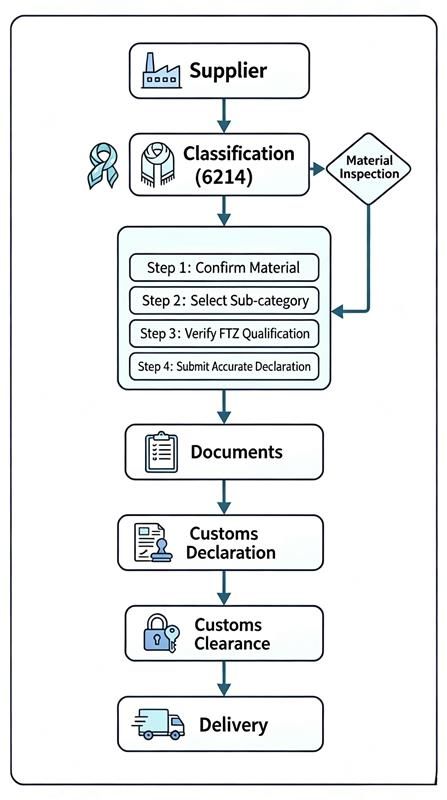
Our Customs Clearance service leverages AI-driven HS code validation, scanning product specs against 100,000+ rulings to suggest the optimal HS code for scarf or shawl HS code. Clients report 30% faster clearances and zero misclassification penalties.

Pair this with our Duties & Taxes Calculator for instant estimates. Input your dupatta HS code, origin, and value—get precise landed costs in seconds, factoring FTAs and anti-dumping duties.

Optimizing Your Supply Chain with Accurate HS Classification

Beyond compliance, precise HS codes unlock strategic advantages. For eCommerce sellers shipping scarves via air or sea, correct coding ensures eligibility for preferential tariffs under CPTPP or RCEP. We've optimized routes for fashion brands, combining Air Freight for urgency with duty savings.

In India, leveraging 6214 HSN code GST rate correctly maximizes refunds. Globally, Track & Trace integration post-clearance keeps visibility high.

Case study: A Hong Kong exporter of synthetic shawls (6214.30) to the US faced 14.6% duties. By validating via our AI tools and certifying origin, they qualified for GSP zero-duty, saving $50,000 annually on $500K volume.

Extend to sustainability: AmiGo Green calculates carbon footprints for 6214 shipments, aiding ESG reporting.

Regional Nuances: HS Codes for Scarves in Major Markets

United States (HTSUS): Mirrors HS but adds 10th digit for stats. 6214.30.50 for synthetic scarves over 20cm wide.

European Union (TARIC): 12% base + VAT; green deal adds eco-label checks.

India (HSN): 6214 uniform GST; AIDC surcharges apply.

China: 14% MFN; lower for ASEAN origins.

Avoid pitfalls like US Section 301 tariffs on Chinese textiles—reroute via Vietnam with proper HS validation.

Best Practices for Documenting and Declaring 6214 Goods

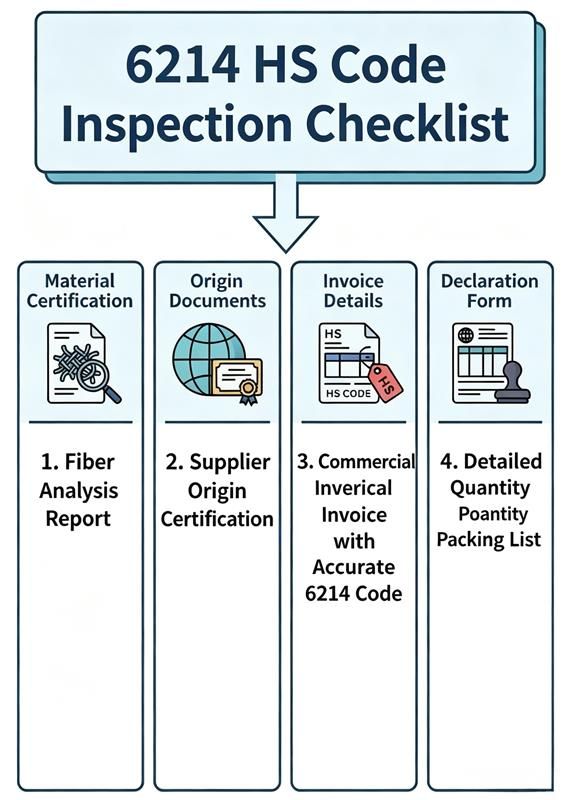
1. Obtain commercial invoices with detailed material breakdowns.

2. Include lab test reports for fiber content.

3. Use binding tariff rulings pre-shipment.

4. Integrate with PO to POD for end-to-end compliance.

Our platform automates this, reducing errors by 95%.

FAQ

What is the scarf HS code?

The primary scarf HS code falls under 6214, with subheadings like 6214.90 for cotton scarves or 6214.10 for silk.

What is the shawl HS code?

Shawls are classified under HS 6214, specifically 6214.20 for wool shawls or 6214.90 for cotton dupatta-style shawls.

What is the difference between HS code and HSN code for scarves?

HS is global (6 digits); HSN is India's 8-digit extension for GST, e.g., 6214.10.00 for silk scarves.

What is the 6214 HSN code GST rate?

In India, all items under 6214 HSN code attract a 12% GST rate, plus customs duties.

Is dupatta HS code the same as shawl HS code?

Yes, dupattas typically use shawl HS code 6214.90 as other textile materials.

How can I validate my scarf HSN code accurately?

Use AI tools like FreightAmigo's Customs Clearance for automated validation against global databases.

Conclusion

Mastering the scarf HS code, shawls HS code, and 6214 nuances empowers your fashion accessory trade with compliance confidence, cost savings, and speed. From AI-powered validation to instant duty estimates, FreightAmigo equips you every step.

Ready to ship scarves seamlessly? Get started with our Customs Clearance and Duties & Taxes Calculator today—or try the Instant Quote for competitive rates.