FOB price refers to the total cost of goods when loaded on board (On Board) the designated vessel at the specified port of origin, in accordance with the currently effective International Commercial Terms (Incoterms) 2020 rules of the International Chamber of Commerce (ICC).
It covers all costs and risks that the seller must bear until the goods are actually loaded on board the designated vessel (since Incoterms 2010, the ICC has officially abolished the old "passing the ship's rail" standard). Subsequent Sea freight, insurance, import customs clearance, and final delivery are the responsibility of the buyer.
This clear division of risk and cost makes FOB one of the most widely used trade terms in maritime trade in 2026.
Accurately calculating the FOB price prevents hidden origin port costs from eroding profit margins.
Key Components of FOB Price
Every FOB price consists of five core cost blocks that must be itemized.
Missing any single item will result in an incomplete quote and lead to subsequent disputes.
Origin Terminal Handling Charges (THC) and loading costs
Together, these elements constitute the commercial invoice value and serve as the basis for customs valuation in most markets.
Component
Description
2026 Typical Example
Product Cost
Factory or procurement price
$5,000
Packaging
Export-grade cartons, pallets, labeling
$200
Inland Freight
Truck or rail to port
$300–$450
Export Clearance
Documents, duties, customs brokerage fees
$100–$200
Loading / THC
Terminal handling and vessel loading fees
$250–$350
FOB Price Calculation Steps and Formula
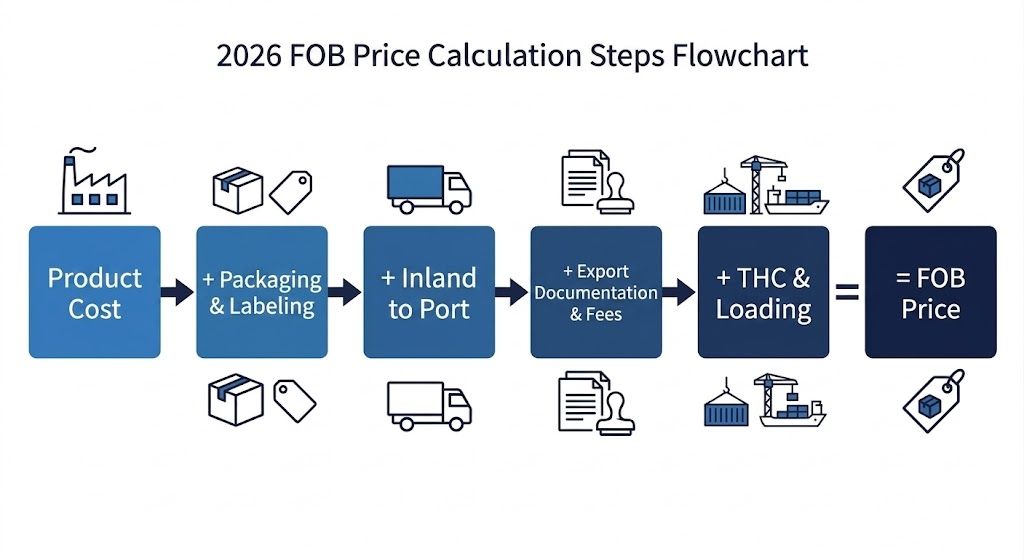
By following these six steps, you can reliably calculate the FOB price every time.
Confirm the per-unit product cost.
Add all export packaging and labeling costs.
Calculate inland transportation costs to the designated port of origin.
Add export customs clearance and related documentation fees.
Add origin terminal handling charges and loading costs.
Sum all the above items to arrive at the total FOB value.
Real-World FOB Pricing Example
Below is a real-world FOB pricing example for exporting 100 electronic components from China to the United States in 2026 (FOB Shanghai).
Product cost: $50 / unit = $5,000.
Packaging: $2 / unit = $200
Inland trucking to Shanghai Port: $350
Export customs clearance: $100
Origin THC and loading: $250
Total FOB price = $5,900, or $59 per unit.
This figure will serve as the commercial invoice value and the customs valuation baseline.
Detailed Breakdown of FOB Shipping Costs
FOB shipping costs end once the goods are loaded on board the vessel and strictly do not include Sea freight or insurance.
In 2026, origin port costs typically account for the following proportions:
Inland trucking: 35–45%
Terminal handling and loading: 25–35%
Export documentation and customs clearance: 15–25%
Packaging and other miscellaneous fees: approximately 10%
Fuel surcharges and port congestion can increase inland rates by 5–12% annually. It is essential to request itemized breakdowns from suppliers.
FOB Rates and Quotes: Key Checkpoints for Buyers
An FOB rate or quote is the seller's all-inclusive price to load goods on board the vessel at the designated port.
You should request a complete cost breakdown rather than a single lump sum.
In 2026, typical quotation validity periods range from 30 to 90 days.
Pay special attention to currency clauses, volume commitments, and any wording stating "final THC subject to actuals," which could shift unexpected costs to you.
FOB Cost Comparison with Other Incoterms
FOB ends the seller's costs and risks once goods are loaded on board; CIF and other terms extend further.
When choosing, consider who controls the main carriage freight and who assumes risk during transit.
While FOB calculations under Incoterms 2020 remain structurally consistent, origin cost drivers have evolved.
Key influencing factors in 2026 include:
Rising terminal handling charges across major ports in China and Southeast Asia
Mandatory green compliance and digital customs declarations
Inland trucking fuel and congestion surcharges
Accelerated electronic export customs clearance across multiple nations
It is recommended to monitor HS Code specific requirements and port congestion indices monthly to maintain quotation timeliness.
Frequently Asked Questions
What is an FOB price?
FOB price refers to the total cost of goods when loaded on board the vessel at the designated port of origin. Under ICC Incoterms 2020 rules, it includes the product, packaging, inland transit, export clearance, and origin loading charges.
How do you calculate FOB price step by step?
Sum the product cost + packaging + inland freight to port + export customs clearance fees + origin terminal handling and loading fees; the total represents the declared FOB value on the commercial invoice.
Does the FOB price include Sea freight?
No. Sea freight, marine insurance, destination port unloading/handling charges, and import duties are all borne by the buyer once the goods are loaded on board.
What costs are included in FOB shipping?
FOB covers product cost, export packaging, inland transport to origin port, export customs clearance, documentation fees, as well as origin THC and loading fees.
What is the difference between FOB and CIF?
Under FOB, the seller's obligations end once goods are loaded on board at the origin port; under CIF, the seller must also arrange and pay for Sea freight to the destination port and provide minimum marine insurance coverage.
How can I obtain an accurate FOB quote from a supplier?
Provide exact quantities, product specifications, packaging requirements, and preferred origin ports, and always insist on an itemized cost breakdown to prevent single lump sums from concealing extra port surcharges.
Can FOB be used for air freight?
No. According to ICC rules, FOB is strictly applicable to sea and inland waterway transport; air freight, road transport, or multimodal Container transport should use FCA instead.
What factors influence FOB rates in 2026?
Inland trucking fuel costs, origin port congestion, rising terminal handling charges, stricter export documentation rules, and green compliance mandates directly impact final FOB origin quotations.
Final Key Takeaways for Accurate FOB Price Calculation
Mastering FOB price calculation gives you clearer cost control and stronger negotiating leverage in global trade.
Always insist on itemized quotations, update rates regularly, and ensure every contract explicitly specifies the designated port and the Incoterms version year.
Accurate FOB figures protect your profit margins and minimize disputes at both origin and destination ports.
For expert guidance, Book a Demo with FreightAmigo.





















 Global Popular RoutesTop sea & air shipping lanes
 Special OfferLimited-time shipping promotions


 Express
 Document
 Parcel - Air/Sea
 Container
 Relocation