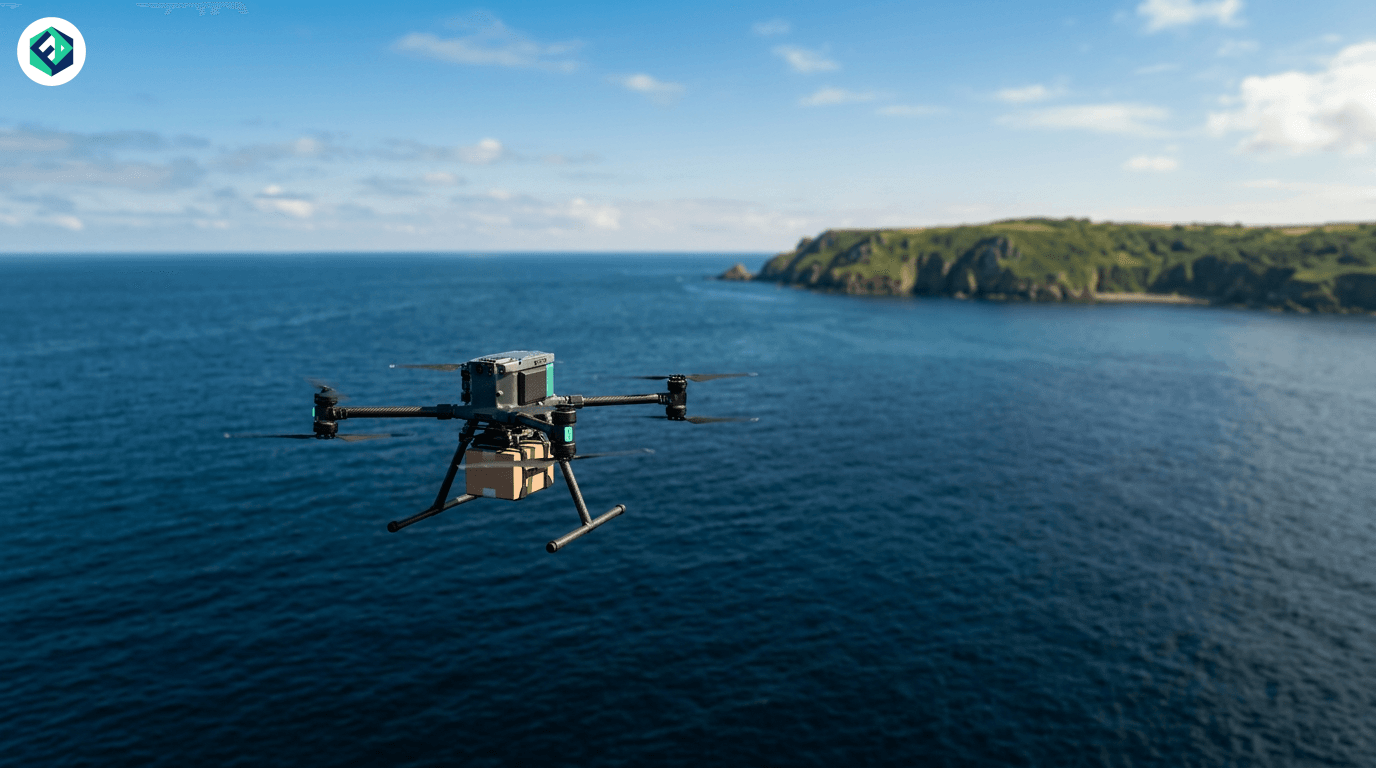
Assessing the Feasibility of Cross-Border Drone Delivery from France to Alderney
Evaluating the Feasibility of Drone Delivery from France to Alderney
Remote islands face unique logistical challenges, driving the need for pioneering transportation methods. A prominent example is the ongoing effort to establish a drone delivery France to Alderney feasibility framework, designed to connect mainland Europe directly to the Channel Islands. Business leaders and local stakeholders are currently examining the viability of launching a cross-border drone flight trial to transport critical goods across the English Channel. This Alderney drone delivery study represents a collaboration between the Alderney Chamber of Commerce and Paris-based DragonFlyPads. According to the BBC, this drone delivery feasibility study shows regional businesses have considerable interest in autonomous aerial routes.
The proposed path would connect Cherbourg, France, directly to Alderney, bridging a maritime gap that historically relied on conventional shipping. The BBC Guernsey Facebook page highlighted how business leaders are exploring this aerial transport feasibility project. The trial seeks to demonstrate how drone transit feasibility can become a reliable, everyday logistics service. This coverage is supported by the BBC Guernsey Twitter/X feed and BBC Guernsey Instagram account, indicating high public interest. While the project remains in its feasibility study stage, the successful execution of a cross-border drone flight trial could redefine the regional supply chain, paving the way for wider adoption across other remote territories.
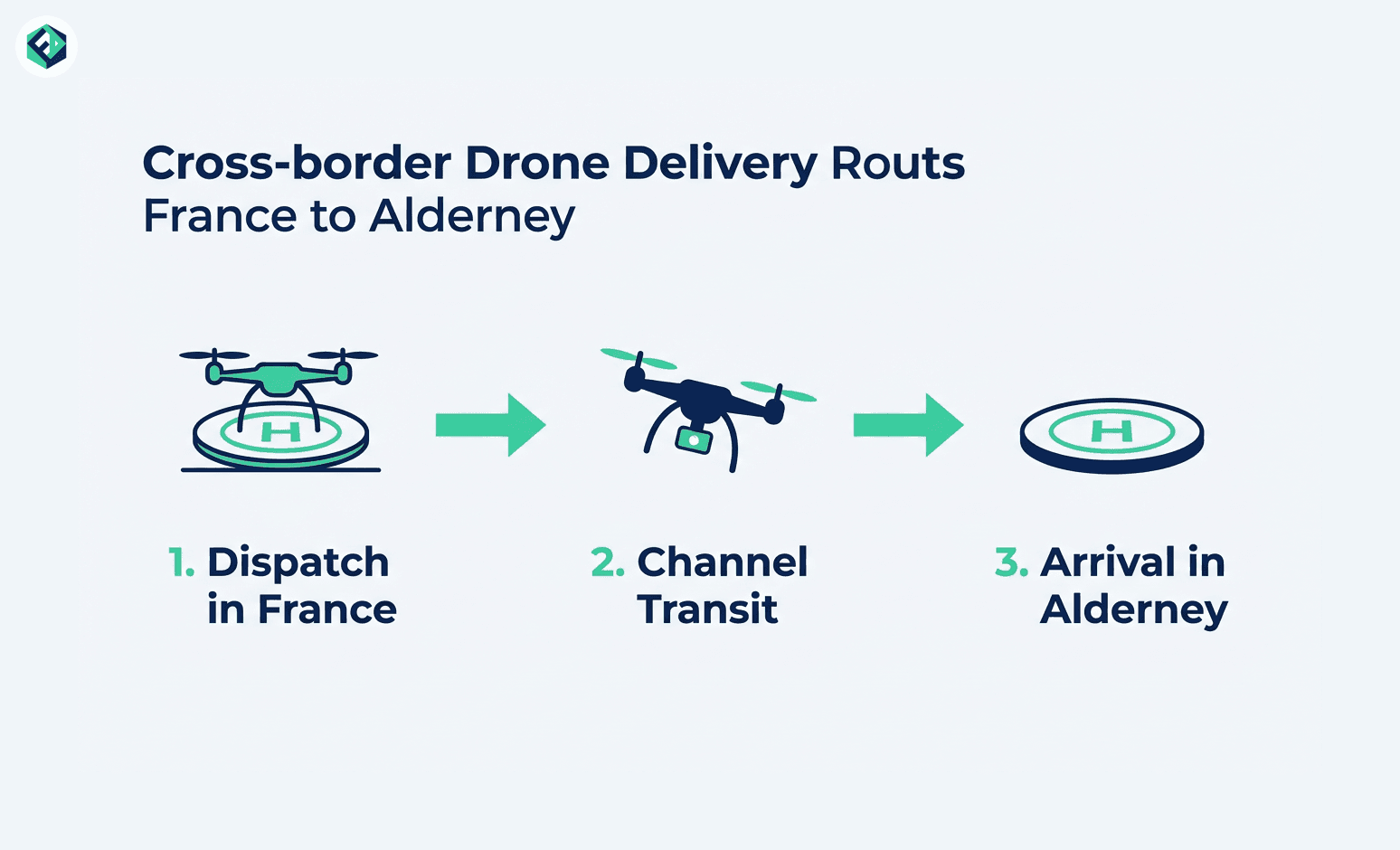
How Cross-Border Drone Delivery Logistics Systems Operate
Operating an international drone route requires a sophisticated integration of technology, international law, and operational coordination. To establish a successful cross border drone delivery network, operators must navigate complex regulatory environments across multiple jurisdictions. Unlike domestic operations, cross border aerial logistics involve compliance with both French civil aviation authorities and the regulatory bodies governing the Bailiwick of Guernsey. Managing these flights requires an autonomous drone traffic management framework capable of coordinating airspace usage in real time. This unmanned traffic management system ensures that unmanned aircraft do not interfere with commercial aviation, private flights, or search and rescue operations.
For international drone shipping to become a standard commercial reality, drone traffic integration must be seamless. The technology relies on continuous communication between the aircraft, ground control stations, and regional air traffic control systems. These systems monitor flight trajectories, manage transponder signals, and enforce virtual boundaries or geofencing. Furthermore, customs and border control processes must be digitized and integrated into the logistics workflow. Because drones carry physical goods across borders, automated declarations and electronic customs clearance must be synchronized with the flight's arrival. While these regulatory and customs systems are still being refined for unmanned flights, they represent the essential backbone of any future commercial cross-border drone operation.
Key Benefits of Implementing Autonomous Drone Logistics Software
At the heart of any modern aerial logistics operation is the autonomous drone delivery software that guides each flight. This software is responsible for calculating optimal flight paths, managing battery consumption, and ensuring the vehicle remains on course despite challenging offshore conditions. An advanced autonomous drone flight system utilizes real-time telemetry to adjust flight parameters dynamically. This is particularly crucial for cross-border maritime flights where weather conditions can shift rapidly. To address the critical question of how autonomous drone logistics software handle weather data integration during flights, these platforms are engineered to ingest live meteorological feeds. By analyzing wind speeds, precipitation levels, and air density, the integrated drone software can automatically adjust the drone's speed, altitude, or even trigger an automated return-to-base protocol if conditions exceed safe operating limits.
Beyond the flight itself, the software must coordinate with physical drone landing infrastructure at both the origin and destination points. This includes smart drone landing systems and automated drone port infrastructure that facilitate safe takeoffs, precision landings, and rapid battery swapping or recharging. Let's represent some of these core software and infrastructure features in a structured list:
- Real-time weather tracking algorithms that continuously monitor atmospheric changes over maritime routes.
- Dynamic rerouting capabilities that calculate alternative flight paths to avoid unexpected obstacles or adverse wind conditions.
- Automated landing synchronization that communicates with precision drone landing systems for safe touchdown in high-wind environments.
- Integrated inventory management systems that update regional logistics databases as soon as a package is loaded or delivered.
These software solutions ensure that the entire supply chain remains visible, predictable, and safe from takeoff to final delivery.
Solving Critical Island Transport Bottlenecks with Aerial Transit
Island communities are uniquely vulnerable to freight transport bottlenecks due to their reliance on sea and traditional air transport. Alderney, as the northernmost of the inhabited Channel Islands, frequently faces island logistics bottlenecks caused by severe weather, vessel maintenance cycles, or limited flight capacities. Overcoming transport bottlenecks is therefore a high priority for local businesses and public services. Traditional ferry and air transit methods can suffer from multi-day delays, leaving residents without immediate access to essential goods. By introducing rapid aerial transit, logistics providers can bypass these physical barriers, offering a consistent transport alternative that operates independently of sea conditions.
One of the most compelling arguments for implementing this technology is the ability to speed up critical and emergency orders. As reported by local news sources, a primary focus of the Alderney drone delivery study is the potential for emergency drone delivery of medical supplies and other urgent goods. When a patient requires specialized medication, waiting for the next scheduled ferry or commercial flight is not always a viable option. Medical drone transport can bridge this gap by delivering lightweight packages within hours of an order being placed.
To illustrate the operational differences, the following table compares traditional island transit options with proposed aerial drone solutions:
| Transport Factor | Traditional Ferry Transit | Traditional Air Freight | Proposed Aerial Drone Transit |
|---|
| Operational Dependency | Highly sensitive to sea conditions and harbor infrastructure | Requires airport availability and scheduled flight slots | Flexible takeoff and landing from localized drone ports |
| Typical Transit Frequency | Scheduled daily or weekly departures | Fixed daily schedules with limited cargo space | On-demand or high-frequency scheduled intervals |
| Primary Cargo Focus | Heavy freight, vehicles, and bulk shipments | General passengers and commercial cargo | Small packages, urgent medical supplies, and documents |
| Vulnerability to Delays | High during winter storms or mechanical issues | Moderate to high during low visibility or airport closures | Low to moderate due to advanced autonomous routing |
This comparison highlights how drones can serve as a valuable complementary service, targeting specific bottlenecks that traditional shipping cannot easily resolve.
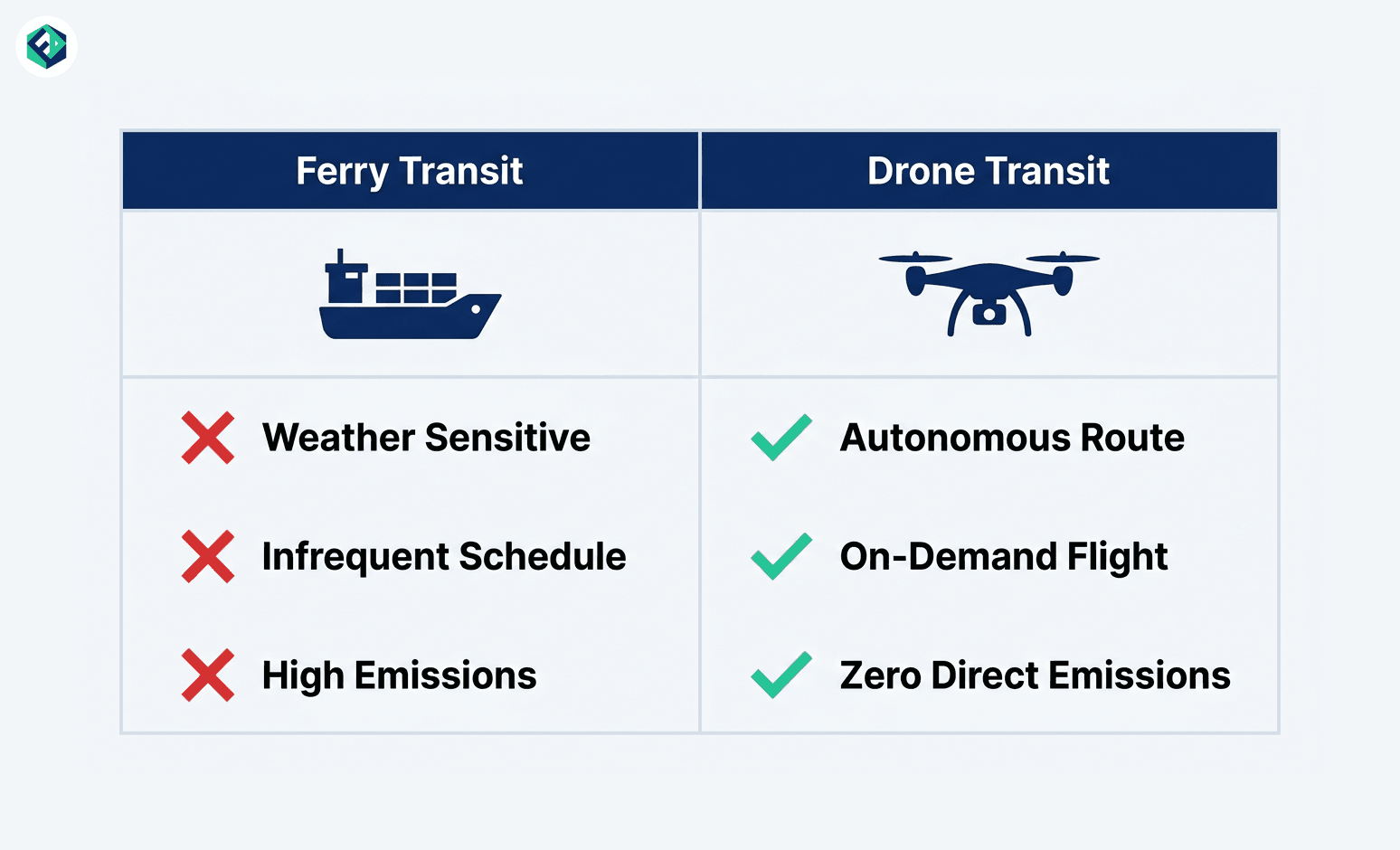
The Environmental Advantages of Low-Carbon Aerial Transit Drone Services
As global industries prioritize sustainability, the environmental impact of logistics has come under intense scrutiny. Traditional cargo shipping and conventional aviation are major contributors to carbon emissions, making the transition to green aerial logistics highly desirable. Implementing low carbon aerial transit drone services offers a viable pathway to reduce the environmental footprint of regional transport. Electric-powered unmanned aircraft produce zero direct emissions during flight, presenting an eco friendly drone transport alternative to carbon-heavy maritime vessels and fossil-fuel-powered aircraft.
The adoption of rapid aerial transit solutions not only supports environmental targets but also enhances operational efficiency. Traditional regional distribution networks often require large, underutilized vehicles to travel long distances for small cargo volumes, resulting in high emissions per package. In contrast, rapid drone logistics allow for the precise, energy-efficient transport of small parcels. This targeted approach minimizes energy waste, ensuring that lightweight deliveries do not require the carbon expenditure of a full-scale transport vehicle. By integrating eco-friendly drone transport into the broader commercial logistics framework, businesses can achieve a balance between rapid delivery speeds and sustainable operations.
Analyzing the Growing Demand for Small Package Drone Delivery
The ultimate success of any new logistics technology depends heavily on market demand and community acceptance. To evaluate the viability of this service, the Alderney drone survey was distributed to local residents and businesses to gauge the islander drone demand. The results of this survey indicate a clear demand for small package drone delivery, particularly for items that are difficult or slow to obtain through traditional channels. Islanders expressed a strong preference for a reliable, lightweight drone courier service that could handle small parcel drone transport, such as documents, spare parts, and specialized consumer goods.
This documented island drone delivery demand underscores the commercial potential for establishing permanent aerial connections between France and the Channel Islands. As businesses prepare for these technological advancements, integrating autonomous logistics into existing supply chains will require careful planning and coordination. FreightAmigo supports this transition by offering expert freight booking and logistics consultation to help you navigate emerging transport methods. Our digital platform coordinates multimodal options, door-to-door support, and precise shipment planning under the correct Incoterms to ensure your supply chain remains resilient. To streamline your cross-border operations and adapt to next-generation logistics, explore how we can build a Tailored Solution for your shipping needs.
FAQ
How does the Alderney drone delivery trial feasibility study impact local businesses and supply chains?
It offers a potential framework to redefine regional supply chains by establishing direct aerial connections. Local business leaders have shown significant interest in the trial to bridge maritime transport gaps and improve the delivery of goods.
What regulations and customs processes govern cross-border drone delivery logistics systems?
These systems must comply with international aviation rules and automated customs procedures. Flights require coordination between French civil aviation authorities and Guernsey regulators, managed through integrated unmanned traffic systems and digitized border declarations.
How does autonomous drone logistics software handle weather data integration during flights?
The software automatically adjusts flight parameters by analyzing real-time meteorological feeds. It evaluates conditions like wind speeds and precipitation to modify flight paths, speed, altitude, or trigger return-to-base protocols if safety limits are exceeded.
Can rapid aerial drone transit successfully solve long-term island transport bottlenecks?
Yes, drone transit bypasses sea-state dependencies to resolve critical transit delays. It serves as a reliable, on-demand alternative to traditional ferries, dramatically speeding up emergency medical deliveries and urgent lightweight orders.
Why are low-carbon aerial transit drone services becoming essential for modern commercial logistics?
They provide an eco-friendly alternative that significantly reduces carbon emissions. Electric unmanned aircraft generate zero direct emissions, allowing businesses to transport small parcels efficiently without relying on carbon-heavy traditional cargo ships.
What do the small package drone delivery demand survey results reveal about Alderney islanders' needs?
The survey shows a strong demand for reliable, lightweight parcel transport. Residents and businesses expressed a clear preference for drone courier services to deliver urgent items like documents, spare parts, and consumer goods that are slow to arrive via traditional channels.



 Global Popular RoutesTop sea & air shipping lanes
 Special OfferLimited-time shipping promotions


 Express
 Document
 Parcel - Air/Sea
 Container
 Relocation