20ft and 40ft Shipping Container Dimensions, Weights, and Capacities: Essential Guide for Global Shippers
Imagine this: your shipment is ready, pallets stacked high, but as the crane lowers your cargo into a 20ft container, it exceeds the weight limit by just a few hundred kilograms. Suddenly, you're facing hefty overweight fines, customs delays, and a reshuffled supply chain that costs thousands. This isn't a rare mishap—it's a common pitfall for importers and exporters who overlook the precise specifications of standard shipping containers. At FreightAmigo Services Limited, we've seen how misunderstanding 20ft and 40ft shipping container weights, dimensions, and capacities can derail even the most meticulously planned operations. In this comprehensive guide, we'll break down every detail you need to select the right container, optimize loading, and ensure compliance across global routes.
Are you grappling with how much does a 20ft shipping container weigh, or calculating the 40ft shipping container weight capacity for your next sea freight shipment? We've got you covered with actionable insights drawn from ISO standards and real-world logistics expertise.
Key Takeaways from This Guide
Master the exact external and internal dimensions of 20ft and 40ft containers to maximize usable space and avoid fit issues.
Understand tare weights, maximum gross weights, and payload capacities to prevent fines and delays from overloading.
Learn what realistically fits in each container size, including pallet counts, volume limits, and truck height compatibility for inland transport.
Specification
20ft Container
40ft Standard
40ft High-Cube
External Length
6.06m (20ft)
12.19m (40ft)
12.19 m (40 ft)
External Width
2.44m (8ft)
2.44m (8ft)
2.44 m (8 ft)
External Height
2.59m (8ft 6in)
2.59m (8ft 6in)
2.89 m (9 ft 6 in)
Internal Length
5.89 m
12.02 m
12.02 m
Internal Width
2.35 m
2.35 m
2.35 m
Internal Height
2.39 m
2.39 m
2.69 m
Door Opening (W × H)
2.34 m × 2.28 m
2.34 m × 2.28 m
2.34 m × 2.58 m
Tare Weight (Empty)
~2,300 kg (5,070 lbs)
~3,750 kg (8,265 lbs)
~3,900 kg
Max Gross Weight
24,000 kg (52,910 lbs)
30,480 kg (67,200 lbs)
30,480 kg
Payload Capacity
~21,700 kg (47,840 lbs)
~26,730 kg (58,935 lbs)
~26,580 kg
Internal Volume
33 m³ (1,172 cu ft)
67 m³ (2,366 cu ft)
76 m³ (2,684 cu ft)
Standard Pallets (Single)
10–11
22–24
22–24
TEU Equivalent
1 TEU
2 TEU
2 TEU
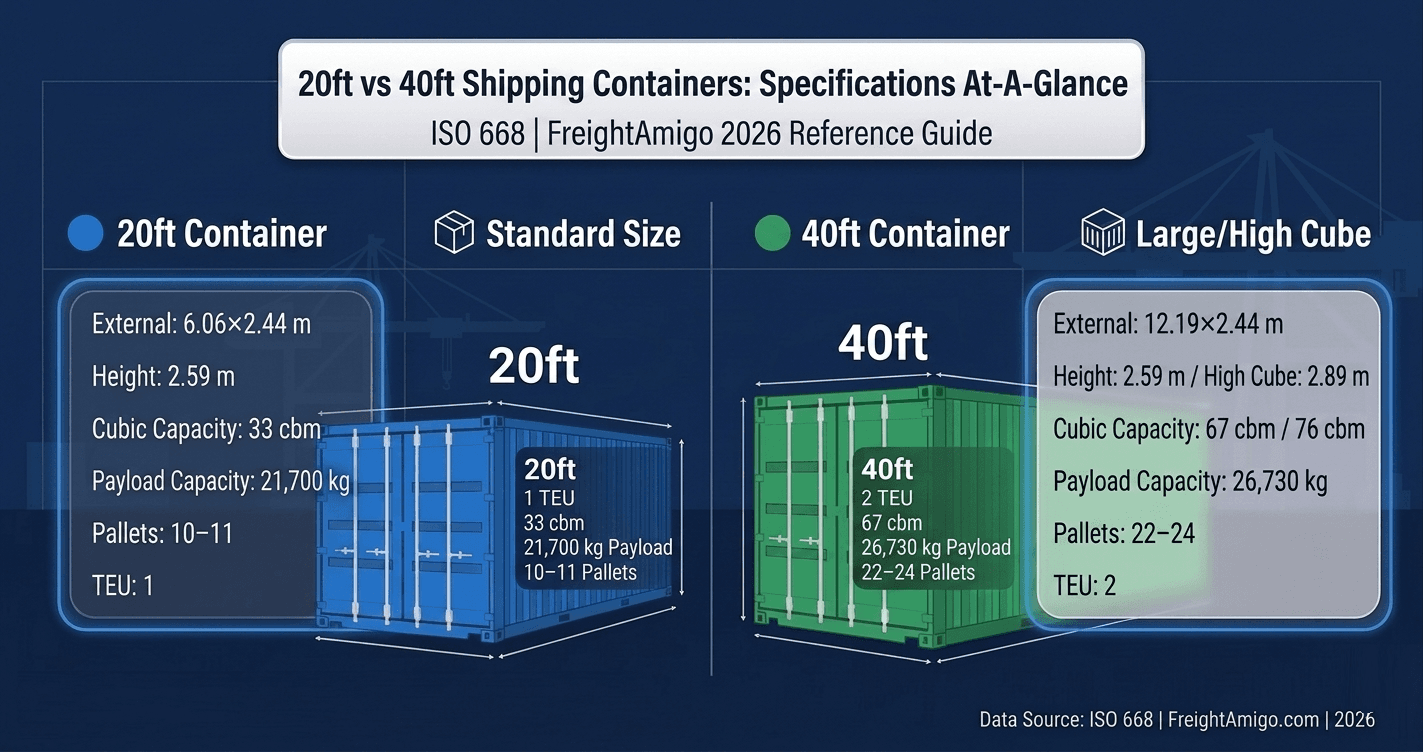
This table provides a quick reference for comparing 20ft sea can weight and 40ft container weight capacity against key metrics. Use it to kickstart your planning process.
Understanding the Fundamentals of 20ft Shipping Containers
The 20ft shipping container, often referred to as a Twenty-foot Equivalent Unit (TEU), forms the backbone of global ocean freight.
Its compact size makes it ideal for smaller shipments, offering flexibility for businesses testing new markets or handling moderate volumes. But to leverage its full potential, you must grasp its precise specifications.
Dimensions of a 20ft Container
The external dimensions of a standard 20ft container measure 6.06 meters in length, 2.44 meters in width, and 2.59 meters in height. Internally, these translate to 5.89 meters long, 2.35 meters wide, and 2.39 meters high, accounting for the steel walls' thickness. The door opening is 2.34 meters wide by 2.28 meters high, which is critical for loading bulky items.
These measurements adhere to ISO 668 standards, ensuring interoperability worldwide. For instance, when planning door-to-door delivery, factor in a 2-3% loss due to corrugations and structural reinforcements, reducing effective stacking height.
20ft Container Weight Breakdown
Tare Weight (Empty Container): ~2,300 kg (5,070 lbs). Older containers with rust reinforcements may exceed 2,500 kg.
Maximum Gross Weight (MGW): 24,000 kg (52,910 lbs) — the total allowable weight including container and all cargo.
Maximum Payload (Net Cargo Weight): ~21,700 kg (47,840 lbs) = MGW minus Tare Weight.
We recommend using our Instant Quote tool alongside weight verifications to simulate full costs, including potential overages.
20ft Container Capacity and Loading Realities
The 20 ft container capacity is roughly 33 cubic meters (1,172 cubic feet), but practical usable volume hovers at 28-30 m³ due to irregular cargo shapes. It accommodates 10-11 standard pallets (1.2m x 1m) in a single tier or 20-22 in double stacking for lighter goods.
For weight of 20 foot shipping container cargo, dense items like machinery max out at payload limits before volume, while lightweight textiles fill space first. Always distribute weight evenly—50/50 front/rear—to prevent tipping during sea swells.
Our CBM calculator above helps you verify if your shipment fits a 20ft unit for popular routes like Hong Kong to the US West Coast.
Diving Deep into 40ft Shipping Containers
For high-volume shippers, the 40ft container doubles efficiency, cutting per-unit costs significantly. Known as a Forty-foot Equivalent Unit (FEU), it's the go-to for bulk commodities, e-commerce overflow, or relocation loads.
Dimensions of a 40ft Container
External specs: 12.19 meters long, 2.44 meters wide, 2.59 meters high. Internal: 12.02 meters long, 2.35 meters wide, 2.39 meters high. Door: same as 20ft. High-cube variants add 30cm height (2.89m external), boosting volume to 76 m³—perfect for voluminous goods like furniture.
These dimensions influence stacking on vessels: a 40ft takes two TEU slots, impacting slot availability during peak seasons.
40ft Shipping Container Weight Details
How much does a 40ft shipping container weigh empty? Around 3,750 kg (8,265 lbs). Max gross: 30,480 kg (67,200 lbs), payload ~26,730 kg (58,935 lbs). In some ports (e.g., EU), reinforced floors support up to 32 tons gross, but verify per route.
Capacity: 67 m³ (2,366 cu ft), fitting 22-24 standard pallets or 44-48 in double stack. Ideal for 3-4 bedroom household goods or 2-3 cars disassembled. Volume-to-weight ratio: aim for 70% fill to balance costs.
Pro tip: Use cross-stacking for stability, leaving 10cm aisles for forklift access.
20ft Container Dimensions and Truck Height Compatibility
The slug highlights truck height—crucial for inland haulage. A standard 20ft container at 2.59m height plus chassis (0.25-0.4m) totals 2.84-2.99m. Most trucks add cab height (2.5m), but low-bed trailers keep under 4.2m (EU limit) or 4.5m (Asia).
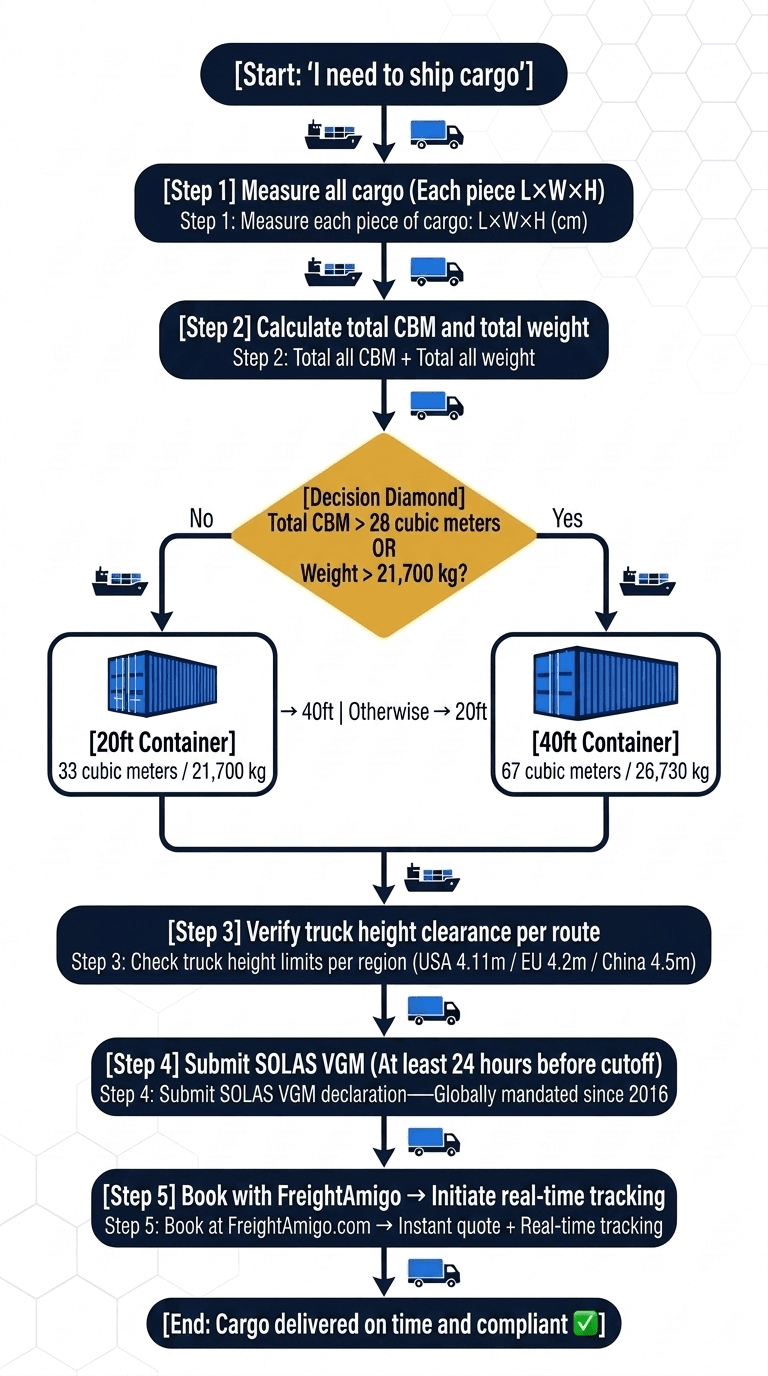
Overheight risks bridge strikes: in the US, interstate max 4.11m; China highways 4.5m. For 40ft, length limits semis to 18.75m total—use extendable trailers. We integrate this into our Sea Freight solutions for seamless port-to-door transitions.
Regional variances: Australia's B-double allows 19m for 40ft; India's 16.5m max favors 20ft. Plan with height simulators.
Region / Country
Max Road Height
Key Consideration
USA (Interstate)
4.11 m (13 ft 6 in)
State-by-state variation; check FHWA database
European Union
4.20 m
Low-chassis trailer required for High-Cube
China (Expressway)
4.50 m
30-tonne gross vehicle weight cap enforced
Hong Kong
4.00 m
Urban tunnel restrictions apply
Australia (B-double)
4.60 m
19 m total length allowed for 40ft
India
4.20 m
16.5 m max length favours 20ft containers
Singapore
4.50 m
30.48-tonne port gross limit strictly enforced Common Overheight Traps & Solutions
Common Overheight Pitfalls and Solutions
1. Ignoring tare variations: +100kg adds height stress. 2. Poor load distribution lifts center of gravity. 3. Non-standard containers: reefers add 0.3m. Solutions: Pre-survey routes, opt for low-profile chassis.
What Fits in a 20ft vs 40ft Container: Real-World Examples
ISO compliance ensures stackability: 9-high on deck, 11-high below.
Sustainability Angle with AmiGo Green
Choosing right size reduces empty returns (20% emissions cut). Our AmiGo Green tools optimize loads for ESG compliance.
How to Calculate and Plan Your Container Load
Step 1: Measure cargo (LxWxH per unit).
Step 2: CBM total.
Step 3: Weight tally.
Step 4: Efficiency check (<90%? Consolidate).
Tools: spreadsheets, 3D software. Common errors: underestimating dunnage (5-10% volume), ignoring ventilation gaps.
Cost Implications
20ft ~60% of 40ft rate but half capacity—full 40ft saves 20-30%. Overweight: $100-300/ton.
Regulatory Compliance and Global Standards
Every container shipped internationally must comply with three overlapping regulatory frameworks — and in 2026, enforcement has become significantly stricter at major transhipment hubs.
Non-compliance is not just a fine risk; it can ground your entire shipment.
The Three Core Compliance Frameworks
ISO 668 & ISO 1496/1: Governs all container physical dimensions and structural strength. Required for stacking up to 9 layers on deck, 11 in hold.
CSC (Container Safety Convention): Mandatory safety certification plate affixed to every container. Check expiry date before loading.
SOLAS VGM (Verified Gross Mass): Mandatory since 2016 — must be submitted at least 24 hours before vessel loading. Two acceptable methods: Method 1 (weigh full packed container); Method 2 (weigh cargo + packing materials + tare).
Case Studies: Success with Proper Sizing
Client A: Switched 2x20ft to 1x40ft, saved 25% on Hong Kong-Dubai route. Client B: 20ft for time-sensitive machinery, used Track & Trace for visibility.
Best Practices for Loading and Securing
Heavy bottom, light top. Lashing points: 20ft has 8-10 bottom. Ventilation: 10% space.
FAQ
How much does a 20 ft shipping container weigh?
The empty weight (tare) of a 20ft container is about 2,300 kg, with max gross 24,000 kg.
What is the 40ft shipping container weight capacity?
Payload around 26,730 kg, from 30,480 kg gross minus 3,750 kg tare.
How many pallets fit in a 20ft container?
10 standard or 11 Euro pallets single tier; double for lighter loads.
What are 20ft container dimensions?
External: 6.06m x 2.44m x 2.59m; internal: 5.89m x 2.35m x 2.39m.
Does truck height affect 40ft containers?
Yes, total height ~4m; check regional limits to avoid overheight fees.
What is the 20 ft container capacity in CBM?
33 m³ nominal, 28-30 m³ usable.
Conclusion
Mastering 20ft and 40ft shipping container dimensions, weights, and capacities empowers you to streamline shipments, cut costs, and mitigate risks. From precise measurements to truck compatibility, this knowledge is your edge in global trade.
Ready to apply it? Get an instant quote with our Instant Quote tool or explore Sea Freight options tailored to your needs. Let's optimize your next shipment together.
For expert guidance, Book a Demo with FreightAmigo.








 Global Popular RoutesTop sea & air shipping lanes
 Special OfferLimited-time shipping promotions





 Express
 Document
 Parcel - Air/Sea
 Container
 Relocation