CBM to KG Conversion: The Complete 2026 Freight Shipping Guide for Smarter Cost Control
Table of Contents (Click to expand)
What Is CBM and Why Does It Matter in 2026?
CBM — cubic meters — is the universal standard for measuring cargo volume in international freight, and in 2026 it remains the foundation of every accurate shipping quote.
CBM tells carriers how much physical space your cargo occupies inside a container, truck, or aircraft hold. Unlike kilograms, which measure mass, CBM measures three-dimensional space consumed.
Getting your CBM right from the start prevents billing disputes, underpacking losses, and last-minute surcharges that erode your margin.
Why CBM is critical for every shipment:
Determines how much container or truck space your cargo occupies
Drives pricing for both FCL (Full Container Load) and LCL (Less than Container Load) shipments
Forms the basis for volumetric weight calculations in air freight
Affects stacking, loading plans, and warehouse storage estimates
Required by carriers for accurate booking confirmations
What Is Chargeable Weight and How Does It Affect Your Bill?
Chargeable weight is the single most misunderstood line item on a freight invoice, and it directly determines how much you pay — regardless of what your cargo actually weighs.
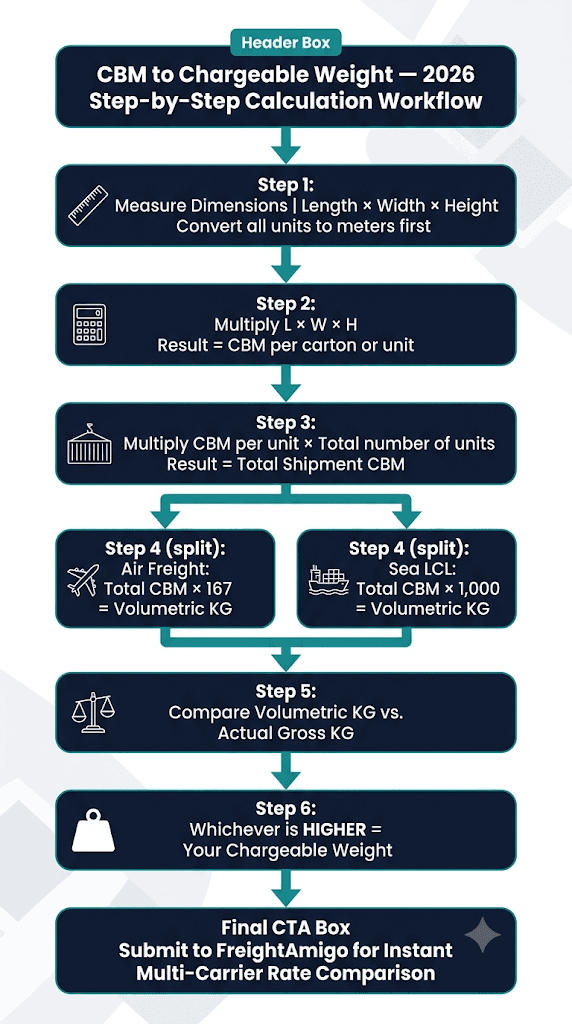
Carriers compare two figures: your cargo's actual gross weight in KG and its volumetric (dimensional) weight derived from CBM. Whichever number is higher becomes the chargeable weight used for billing.
This system protects carriers from losing revenue on bulky but lightweight goods — like foam furniture or empty plastic bottles — that consume space without adding payload mass.
How chargeable weight is determined:
Calculate your cargo's actual gross weight in KG
Calculate volumetric weight using the appropriate CBM conversion factor
Compare both figures side by side
The higher value is your chargeable weight
Apply the carrier's per-KG or per-CBM rate to that figure
Understanding this mechanic before you book is the difference between a competitive quote and an unexpected invoice
Air vs. Sea Freight: CBM to KG Conversion Factors Compared
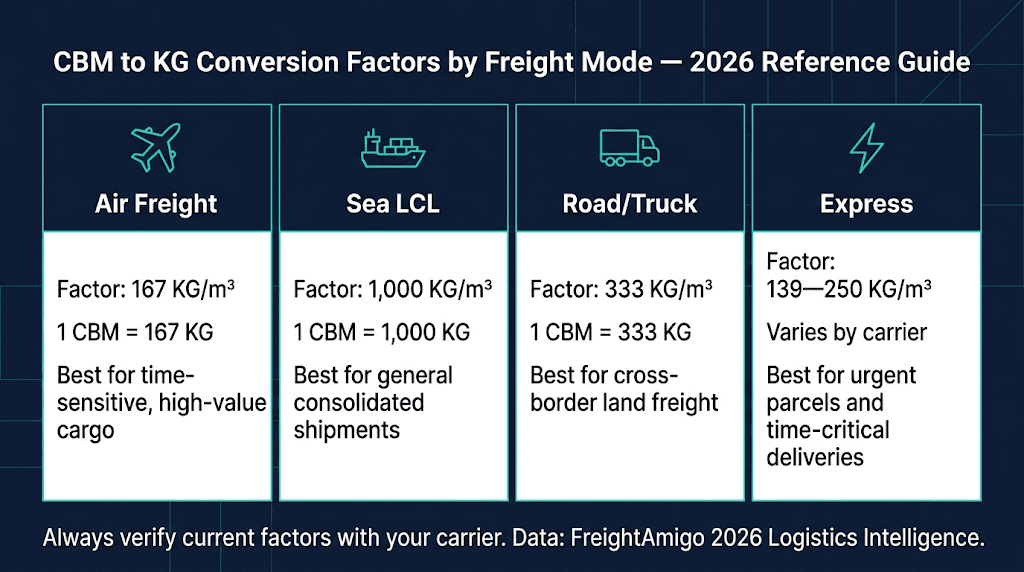
The conversion factor your carrier applies varies dramatically between air and ocean freight, and using the wrong factor can cause you to underprice or overestimate your shipment by hundreds of dollars.
Air freight uses a lower CBM-to-KG factor because aircraft payload capacity is far more restricted than vessel capacity. Sea LCL shipments apply a much higher factor, reflecting the greater volume tolerance of ocean containers.
Always confirm which factor applies before finalising your freight quote.
Freight Mode
CBM-to-KG Conversion Factor
Volumetric KG per 1 CBM
Typical Use Case
Air Freight (Standard)
167 KG/m³
167 KG
Electronics, pharmaceuticals, perishables
Air Freight (Express/Courier)
139–250 KG/m³
Varies by carrier
Urgent, high-value parcels
Sea Freight LCL
1,000 KG/m³
1,000 KG
General cargo, consolidated shipments
Sea Freight FCL
Actual weight dominant
Varies
Heavy industrial cargo, bulk goods
Road / Trucking (EU standard)
333 KG/m³
333 KG
Cross-border land freight
2026 Update: Several major airlines have begun tightening dimensional weight policies for oversized pallets. Always verify the current factor with your carrier or freight forwarder before booking.
Step-by-Step: How to Calculate CBM Accurately
Accurate CBM calculation starts with a single rule: all measurements must be in meters before you multiply — mixing centimetres and meters is the most expensive mistake in freight quoting.
The core formula is straightforward: Length (m) × Width (m) × Height (m) = CBM per item. For multi-piece shipments, multiply that single-piece CBM by the total number of units.
Always measure the outer dimensions of the packaged carton, not the product itself inside. Packaging adds volume that carriers will measure on arrival.
Step-by-step CBM calculation process:
Measure length, width, and height of the packed carton in centimetres
Divide each measurement by 100 to convert to meters
Multiply: L(m) × W(m) × H(m) = CBM per carton
Multiply single-carton CBM by total number of cartons
Round up to the nearest 0.01 CBM or per your carrier's rounding rule
Add pallet base dimensions if shipping on pallets
Verify final figure against your packing list and photos
Quick conversion reminder: If measuring in centimetres, divide the final result by 1,000,000 (cm³ to m³), or simply divide each cm measurement by 100 first.
CBM to KG Conversion: Formulas, Factors, and Cargo Density
CBM to KG conversion is not a fixed universal rate — it is a carrier-specific calculation that depends on your freight mode, your cargo's actual density, and the volumetric factor your carrier applies.
The working formula for air freight volumetric weight is: CBM × 167 = Volumetric KG equivalent. For sea LCL, the factor rises to 1,000, reflecting ocean containers' much larger volume tolerance.
Irregular-shaped cargo — cylinders, machinery, or non-stackable items — requires special handling because standard box formulas underestimate the actual space consumed.
Cargo Type
Typical Density (KG/m³)
Chargeable Basis (Air)
Chargeable Basis (Sea LCL)
Consumer Electronics
200–400 KG/m³
Actual weight likely wins
Volume or weight, check both
Clothing & Textiles
50–150 KG/m³
Volume dominates
Volume dominates
Heavy Machinery
500+ KG/m³
Actual weight wins
Actual weight wins
Furniture / Foam
30–80 KG/m³
Volume dominates heavily
Volume dominates
Automotive Parts
400–700 KG/m³
Often actual weight
Check carrier minimums
Pro Tip for 2026: With IMO and IATA tightening measurement accuracy requirements, freight forwarders are increasingly required to submit verified cargo dimensions at booking — not just estimates. Invest in digital measuring tools early.
KG to CBM: How to Reverse-Calculate for Dense Cargo Planning
When you know your cargo's weight but need to estimate its volume for container planning or back-costing, the KG to CBM reverse formula is an essential planning tool.
The formula is: KG ÷ Density Factor = CBM. For example, 5,000 KG of steel at an average density of 7,800 KG/m³ occupies approximately 0.64 CBM — far less space than a lightweight but bulky shipment of the same weight.
This reverse calculation is especially useful for truckload planning, warehouse slot allocation, and verifying that your LCL booking size is appropriate.
When to use KG to CBM reverse calculation:
Planning heavy metal, mineral, or chemical shipments
Back-calculating available space after confirmed KG weight
Verifying container utilisation for FCL cost optimisation
Estimating storage space requirements at destination warehouses
Checking carrier minimum charge thresholds before booking
Watch out: Overestimating volume when converting from KG can result in paying for empty container space. Underestimating risks cargo rejection or costly last-minute rebooking fees.
The Most Common CBM Calculation Mistakes (And How to Avoid Them)
Even experienced freight professionals make preventable CBM errors that inflate invoices, delay shipments, or cause cargo to be held at origin — and in 2026, stricter carrier audit systems make these mistakes more costly than ever.
The single most common error is measuring in centimetres but entering the value as if it were already in meters. A 50 cm box entered as 50 m produces a CBM figure 1,000,000 times too large — an error that booking systems will flag, but manual quotes will not.
Build a verification checklist into every shipment workflow before submitting dimensions to your carrier or forwarder.
The top CBM calculation mistakes to eliminate in 2026:
Unit confusion: Measuring in cm but calculating in m without dividing by 100
Forgetting pallet height: Not adding pallet base thickness (typically 0.12–0.15 m) to cargo height
Ignoring overhangs: Cargo that protrudes beyond pallet edges must be measured at its widest point
Skipping carrier minimums: Some carriers apply a minimum chargeable CBM regardless of actual size
Not comparing actual vs. volumetric: Failing to run both calculations and selecting the lower — which the carrier will override anyway
Rounding errors: Rounding down instead of up to the carrier's stated decimal rule
Outdated density tables: Using 2023 or 2024 density benchmarks when 2026 IMO standards may differ
Digital Tools and Platforms That Automate CBM to KG Conversion
In 2026, manual CBM calculation is a competitive disadvantage — freight forwarders and shippers using automated digital platforms close quotes faster, reduce billing errors, and win more business.
Modern logistics platforms allow you to upload carton dimensions in bulk, apply the correct volumetric factor per freight mode automatically, and receive instant chargeable weight outputs without touching a spreadsheet.
The best platforms also integrate directly with carrier rate engines, enabling real-time quote comparison the moment your CBM and KG figures are confirmed.
Key features to look for in a CBM calculation tool in 2026:
Bulk dimension upload via CSV or API integration
Automatic air vs. sea volumetric factor selection
Side-by-side actual vs. volumetric weight comparison
Real-time multi-carrier rate lookup based on confirmed CBM
IMO and IATA 2026-compliant density reference databases
Mobile-optimised interface for on-site warehouse use
Exportable calculation reports for customs and compliance documentation
How FreightAmigo Solves Volumetric Freight Challenges in 2026
FreightAmigo's Digital Logistics Platform is built specifically to eliminate the manual errors, conversion confusion, and quoting delays that cost freight forwarders margin on every shipment.
Shippers and forwarders input their cargo dimensions once. The platform instantly applies the correct CBM formula, selects the appropriate volumetric conversion factor for the chosen freight mode, and outputs a verified chargeable weight — ready for carrier submission.
Our platform is trusted across Hong Kong, China, the US, UK, and Australia by freight professionals who need accurate, compliant, and fast CBM-to-KG outputs at scale.
FreightAmigo platform capabilities for CBM and volumetric weight management:
Built-in converters for air (167 factor) and sea LCL (1,000 factor) — no manual switching
Scenario simulation to compare FCL vs. LCL cost outcomes based on CBM input
2026-compliant density databases updated to reflect current IMO and IATA standards
Instant multi-carrier rate comparison triggered by confirmed CBM and chargeable weight
Automated alerts when volumetric weight exceeds actual weight — preventing underquoting
Real-World Case Study: Cutting LCL Costs 15% With Precise Conversions
A Hong Kong-based freight forwarder reduced their LCL electronics export costs by 15% in 2025 by switching from manual CBM estimates to verified digital calculations — a result that scaled across their entire client portfolio.
Before adopting FreightAmigo's platform, the forwarder was consistently overestimating CBM on densely packed electronics cartons. This caused them to book excess LCL space they never filled, paying for volume that went unused.
After implementing automated CBM calculation with real-time actual-vs-volumetric comparison, they identified that actual weight — not volume — was the dominant chargeable basis for their cargo type. Rebooking under the correct chargeable basis cut costs immediately.
Key lessons from this case study:
Proactive CBM-to-KG analysis before booking beats reactive invoice disputes every time
Electronics cargo often crosses the actual-weight threshold — always run both calculations
Digital platforms that flag volume-dominant vs. weight-dominant cargo prevent systematic overbooking
A 15% cost reduction on LCL shipments compounds significantly at scale across a full forwarding book of business
Early carrier dialogue about dimensional weight policies saves costly rebooking fees at origin
Frequently Asked Questions
The questions below reflect the most common search queries and "People Also Ask" results for CBM and freight weight conversion in 2026.
What is 1 CBM in KG for air freight?
For standard air freight, 1 CBM equals 167 KG of volumetric (dimensional) weight. This is the IATA-standard conversion factor applied by most airlines globally. Express couriers may use factors ranging from 139 to 250 KG/m³ depending on their rate card.
How do you calculate CBM for a shipment?
Multiply the length, width, and height of your packed carton in meters: L × W × H = CBM per unit. Then multiply by the total number of cartons. Always measure outer dimensions including packaging, not the bare product.
What is the CBM to KG conversion factor for sea freight?
For Less than Container Load (LCL) sea freight, the standard conversion factor is 1,000 KG per CBM. This means 1 CBM of volumetric space is treated as equivalent to 1,000 KG when determining chargeable weight.
Is KG to CBM simply the reverse of CBM to KG?
Yes. Divide your cargo's gross weight in KG by the applicable density factor to estimate its CBM volume equivalent. For example, 1,000 KG ÷ 1,000 (sea LCL factor) = 1 CBM. This reverse calculation is useful for container space planning.
Why do carriers use chargeable weight instead of actual weight?
Chargeable weight ensures carriers are compensated for both the physical mass and the space consumed by cargo. Bulky but lightweight goods — like foam or clothing — would otherwise generate very low revenue despite occupying large amounts of hold space.
What are the most common CBM calculation mistakes in 2026?
The most frequent errors are mixing centimetres and meters without converting, forgetting to include pallet height, and failing to compare actual versus volumetric weight before booking. IMO 2026 standards now require verified dimensions at submission, making accuracy non-negotiable.
What is the best tool for CBM to KG calculation in 2026?
Digital logistics platforms with built-in automated converters — like FreightAmigo — are the most accurate and efficient option. They apply the correct factor per freight mode, compare actual vs. volumetric weight instantly, and integrate directly with carrier rate engines.
How do 2026 IMO standards affect CBM calculation requirements?
Updated 2026 IMO measurement guidelines require freight forwarders to submit verified, not estimated, cargo dimensions at the time of booking. This increases the accuracy burden on shippers and makes automated digital CBM tools a compliance necessity, not just a convenience.
What happens if my CBM calculation is wrong?
Incorrect CBM data can result in carrier invoice amendments, cargo holds at origin, LCL rebooking fees, and customs declaration discrepancies. In serious cases, carriers may refuse to load unverified cargo under 2026 compliance frameworks.
How does FreightAmigo help with KG to CBM conversion?
FreightAmigo's platform provides instant KG to CBM reverse estimates alongside full CBM-to-chargeable-weight outputs. Users input dimensions once and receive verified figures for both air and sea freight modes, with real-time multi-carrier rate comparison built in.
Conclusion: Master CBM to KG Conversion for Smarter Shipping in 2026
Mastering CBM to KG conversion is not a back-office task — it is a front-line competitive advantage that determines whether your freight quotes are profitable, accurate, and carrier-compliant in 2026.
The gap between shippers who estimate and those who verify CBM is widening. Stricter IMO standards, tighter carrier audit systems, and increasingly automated booking platforms mean that errors surface faster and cost more than they did even two years ago.
FreightAmigo's Digital Logistics Platform gives freight forwarders and shippers the automated calculation engine, real-time rate comparison, and 2026-compliant density databases needed to close every shipment confidently.
For expert guidance, Book a Demo with FreightAmigo.








 Global Popular RoutesTop sea & air shipping lanes
 Special OfferLimited-time shipping promotions





 Express
 Document
 Parcel - Air/Sea
 Container
 Relocation