Ecommerce Shipping Strategies Guide: Optimize Costs and Delivery in 2026
As ecommerce shippers navigating the bustling markets of 2026, we understand the frustration of watching potential sales vanish due to sky-high shipping costs and delivery delays. With global ecommerce logistics hitting $493 billion and last-mile expenses claiming 53% of total costs, the pressure is immense—over 90% of shoppers abandon carts over unexpected fees. But here's the solution: proven ecommerce shipping strategies that slash expenses, boost satisfaction, and scale your operations seamlessly.
In this comprehensive guide, we share our frontline insights from years of supporting ecommerce shippers across 250+ countries, helping you turn these challenges into competitive advantages.
Key Takeaways from This Ecommerce Shipping Strategies Guide
Master the latest trends like AI automation and hyperlocal fulfillment to reduce delivery times by up to 16%.
Implement cost-saving tactics, including right-sizing packaging and zone optimization, to combat the $7.96 average per-order expense.
Unlock seamless ecommerce shipping integration for real-time visibility and scalability amid rising parcel volumes of 236 billion annually.
Metric
Value
Source Context
Global Parcels
236B annually
Ringly.io
Logistics Market
$493B (2026)
Swell
Last-Mile Share
53% of costs
Multiple (Ringly, iDrive)
Avg. Order Cost
$7.96
Swell
Cart Abandonment (Shipping)
70-90%
Capital One, eMarketer
U.S. Returns
$890B (2024)
FreightWaves
AI Adoption
90% retailers
ShipStation
Free Shipping Expectation
45% consumers
eMarketer
Zone Reduction via Distributed
15%
ShipBob
Market Overview: The 2026 Landscape for Ecommerce Shippers
The ecommerce shipping arena in 2026 is a dynamic powerhouse, fueled by relentless growth in online retail. With parcel volumes surpassing 236 billion globally each year, ecommerce shippers face unprecedented scale. Last-mile delivery, the final frontier of the supply chain, devours 53% of shipping budgets, averaging $7.96 per order. This isn't just numbers—it's the reality for businesses where 45% of consumers demand free shipping, and 90% bolt at hidden fees.
Cross-border ecommerce adds complexity, with 55% of shoppers willing to buy internationally. From Hong Kong exporters targeting Europe to U.S. brands expanding into Asia, efficient ecom shipping is non-negotiable. We at FreightAmigo have seen firsthand how overlooking these trends leads to margin erosion below 15-25%, while adopters thrive.
Key Trends Shaping Ecommerce Shipping in 2026
AI and Automation Take Center Stage
AI isn't a buzzword—it's operational bedrock. In 2026, 90% of retailers have ramped up AI for predictive delivery windows, hyper-personalized routing, and automated warehousing. This shift enables same-day fulfillment through hyperlocal hubs, cutting transit times dramatically. For ecommerce shippers, tools that forecast delays or optimize routes mean fewer failed deliveries and happier customers.
Hyperlocal and Distributed Fulfillment
Centralized warehouses are relics; distributed networks dominate. Brands leveraging in-postcode fulfillment report 15-16% gains in shipping zone efficiency and regional speed. We recommend micro-fulfillment centers strategically placed near high-demand areas—think urban clusters in key markets—to shrink distances and costs.
Sustainability as a Must-Have
With 84% of businesses facing last-mile cost hikes, green practices are essential. Low-emission vehicles, consolidated shipments, and right-sized packaging reduce carbon footprints while pleasing eco-conscious buyers. Our AmiGo Green solutions help ecommerce shippers align with ESG goals, turning sustainability into a loyalty driver.
Cross-Border Evolution
De minimis changes and tariffs demand agile responses like overseas warehousing and dedicated lanes. Real-time visibility combats customs hold-ups, vital for 55% of international shoppers.
Customer-Centric Innovations
Parcel lockers and unattended delivery are standard, with 70% abandonment linked to inflexible options. Offering choices builds trust and retention.
Core Challenges Facing Ecommerce Shippers
Cost pressures top the list: Dimensional weight surcharges inflate bills by 25%, while returns—$890 billion in the U.S. alone in 2024—strain reverse logistics. Last-mile bottlenecks from urban congestion and failed attempts project a $201.5 billion market by 2033. Scalability during peaks, visibility gaps in budget carriers, and fragmented integrations compound issues. We've guided countless ecommerce shippers through these, emphasizing proactive strategies over reactive fixes.
The challenges compound fast. Each one, left unaddressed, quietly bleeds your margin and drives customers to competitors. Here's the critical list every ecommerce shipper must confront:
Dimensional Weight Surcharges: Oversized packaging inflates carrier bills by up to 25%. Right-sizing is not optional in 2026.
Last-Mile Bottlenecks: Urban congestion, failed delivery attempts, and address errors project the last-mile market to $201.5B by 2033.
Returns Volume: The U.S. returns burden hit $890 billion in 2024 — reverse logistics is now a strategic function, not an afterthought.
Carrier Visibility Gaps: Budget carriers often lack real-time tracking, creating customer service fires. Integration APIs are the fix.
Peak Season Scalability: Without pre-built buffer capacity, Q4 spikes crush operations. Proactive planning is non-negotiable.
Cross-Border Compliance: De minimis changes, new tariff regimes, and HS code errors cause costly customs holds. Automation is essential.
Fragmented Tech Stacks: Disconnected ERPs, WMS, and carrier platforms create data blind spots. Unified integration is the 2026 imperative.
Tailor choices to your products: Express for lightweight, high-margin items under 2kg; economy postal for non-urgent parcels across 230+ countries. Use data-driven rate comparisons to cluster orders and minimize zones. Our Instant Quote tool lets you compare rates instantly, empowering precise decisions for domestic standard, 3-7 day international express, or cost-effective economy options.
Dedicated lines for scale cut per-unit costs on fixed routes, ideal for growing ecommerce shippers.
2. Optimal Fulfillment Models
In-house offers control but demands heavy investment. Shift to 3PL or overseas warehousing for bestsellers—it trims transit and handles compliance. Distributed networks yield 15%+ zone skips. Prioritize partners with transparent pricing and expertise.
3. Proven Cost Optimization Tactics
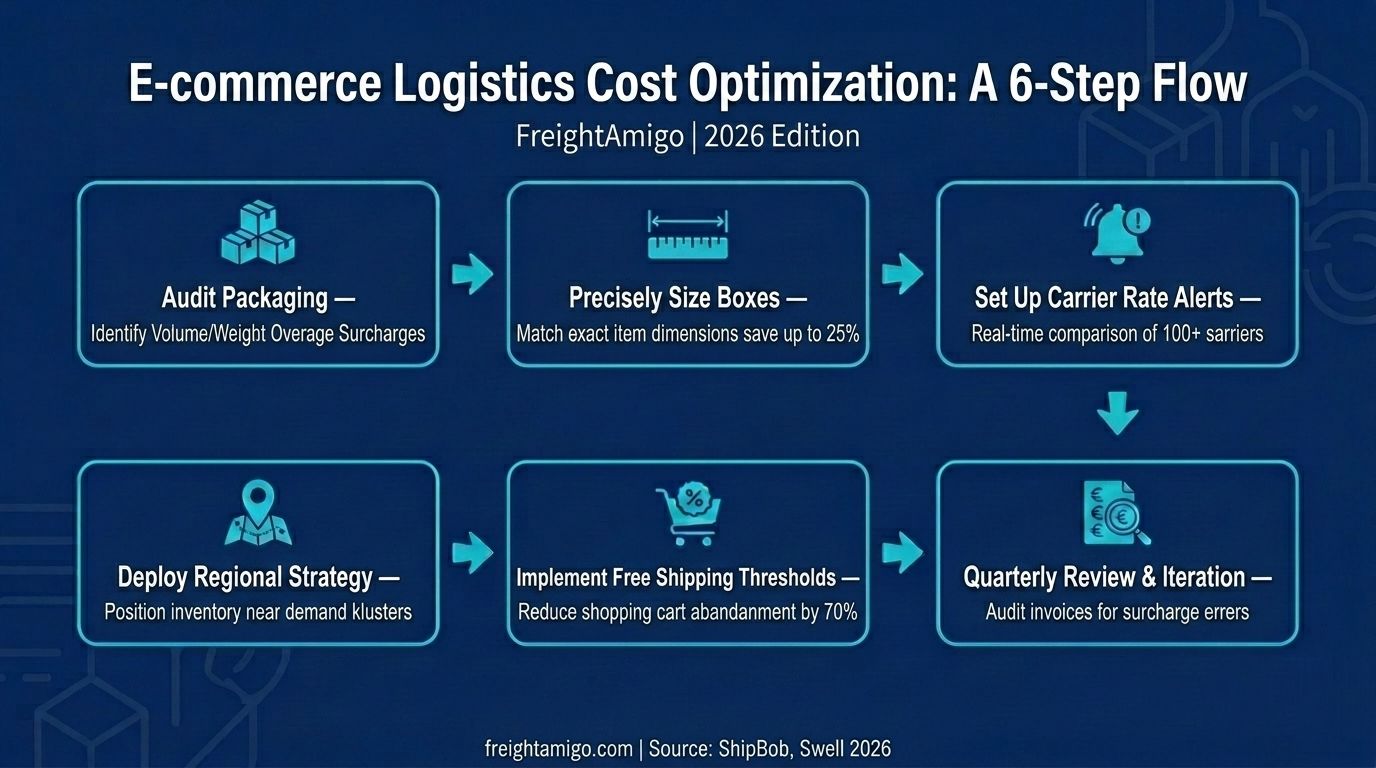
Right-size packaging to dodge 25% surcharges; adopt lightweight materials. Introduce free/flat rates post-threshold to counter 70% abandonment. Zone reduction via inventory placement is key—place stock near customers. Peak planning with buffers and automation ensures holiday resilience.
4. Mastering Returns and Reverse Logistics
Prepaid labels, automated processing, and local hubs streamline returns, slashing costs and enhancing satisfaction. Integrate reverse flows early to manage COD refusals and repeats.
Ecommerce Shipping Integration: The Game-Changer
The shipping software market surges at 13.6% CAGR to 2033, driven by automation. Seamless APIs for rate shopping, label printing, and tracking unify operations. AI/ML predicts delays, syncs inventory. Multi-carrier dashboards handle 100+ options error-free.
For ecommerce shippers, platform compatibility is crucial. Native integrations with stacks like Shopify enable end-to-end flows. In 2026, 86% of scaling brands bet on this for growth. Our Shopify App automates shipping, syncing orders to delivery effortlessly—a direct fix for integration gaps and visibility woes.
Blockchain enhances traceability, AR boosts warehouse efficiency. We've implemented these for clients, witnessing transformative scalability.
Advanced Tips for Ecom Shipping Success
Beyond basics, audit carriers quarterly using real-time data. Leverage predictive analytics for demand forecasting, reducing stockouts. For cross-border, pre-clear customs with HS validation tools. Sustainability audits ensure compliance and appeal.
In Hong Kong, our hub, we've optimized routes to major markets, blending sea, air, and courier for hybrid efficiency. Test A/B shipping offers to refine what resonates. Monitor KPIs like cost per order, delivery success rates (aim >95%), and NPS.
Case in point: A mid-sized ecommerce shipper cut costs 20% via hyperlocal shifts and integrations, boosting repeat buys 30%. These aren't hypotheticals—they're our daily realities supporting clients.
Recommendations to Future-Proof Your Operations
Audit against 2026 trends: Prioritize integrations for visibility, diversify fulfillment for resilience, data-optimize carriers and zones. Balance speed, cost, sustainability. Efficient ecom shipping fuels retention amid booming volumes.
FAQ
What are the biggest costs in ecommerce shipping?
Last-mile delivery accounts for 53% of total costs, averaging $7.96 per order, driven by fuel, labor, and failed attempts.
How can ecommerce shippers reduce cart abandonment?
Offer free or flat-rate shipping with thresholds, transparent tracking, and flexible delivery options to address 70-90% abandonment rates.
What role does AI play in ecom shipping?
AI enables predictive routing, automation, and personalization, with 90% of retailers adopting it for optimization in 2026.
Why choose distributed fulfillment?
It reduces shipping zones by 15-16%, shortens delivery times, and lowers costs through hyperlocal efficiency.
How does ecommerce shipping integration benefit businesses?
It provides real-time data flow, multi-carrier support, and automation, scaling operations as volumes grow to 236 billion parcels yearly.
What strategies combat returns in ecommerce?
Prepaid labels, localized reverse hubs, and automated processing minimize the $890 billion U.S. returns burden and improve satisfaction.
Conclusion: Elevate Your Ecommerce Shipping Today
Mastering ecommerce shipping strategies in 2026 means embracing AI, hyperlocal models, integrations, and cost tactics to conquer challenges like last-mile costs and returns. We've outlined actionable paths drawn from real-world expertise, positioning your business for growth in a $493 billion market.
Ready to optimize? Start with our Instant Quote for competitive rates or explore Shopify App for seamless integration.
For expert guidance, Book a Demo with FreightAmigo.








 Global Popular RoutesTop sea & air shipping lanes
 Special OfferLimited-time shipping promotions





 Express
 Document
 Parcel - Air/Sea
 Container
 Relocation