Malaysia is one of the fastest-growing import markets in Southeast Asia, yet its tax structure presents significant challenges for new importers. Whether you are an SME or a multinational corporation, you must fully understand how Malaysia's import tax system works before entering the market in 2026.
Strategically located at the heart of Asia-Pacific trade, Malaysia attracts hundreds of billions of ringgit in imported goods each year. However, the multi-layered tax system — encompassing import duties, sales tax, and excise duty — frequently causes unnecessary customs delays and cost overruns for businesses.
This guide has been updated in 2026 by the FreightAmigo professional team to provide the most authoritative and practical reference for Malaysia import tax compliance.
When imported goods enter Malaysia, businesses must navigate three distinct but interconnected tax categories. Understanding the boundaries and relationships between these three taxes is the critical first step toward accurately estimating import costs.
The three core tax types are:
Import Duty: Levied on goods entering Malaysia across borders, calculated based on the value or quantity of the goods
Sales Tax (SST): Operates under the Sales and Service Tax framework, covering taxable goods and low-value goods
Excise Duty: A targeted regulatory tax applied exclusively to specific controlled goods categories
Each tax type has its own independent tax base, rate range, and exemption provisions. Confusing these three categories is one of the most common compliance errors made by importers.
Import Duty: Rates & Calculation Methods
Import duty is the most fundamental tax in Malaysia's import tax system and also the one with the greatest rate volatility, ranging from 0% to 60%. The applicable rate is determined precisely by the product's HS Code (Harmonized System Code).
Two methods of import duty assessment:
Ad Valorem: Calculated as a percentage of the goods' CIF value — the most common method
Specific Rate: A fixed amount charged per unit of goods — commonly applied to alcohol, fuel, and similar products
Key factors influencing the applicable import duty rate include:
The product's HS Code classification
Country of origin (whether a Free Trade Agreement preferential rate applies)
Whether the product falls under a protected domestic industry category
Whether the import is for a government-approved specific-use purpose
For alcoholic beverages, poultry products, and pork-related goods, Malaysia imposes significantly higher specific duties, with effective tax rates that can substantially exceed the standard rate ranges.
Sales Tax (SST) & Low Value Goods Tax (LVG)
Malaysia's Sales and Service Tax (SST) system replaced GST in 2018, and its import-related provisions underwent major changes after 2024. Importers must understand the two core sub-categories of SST.
Sub-category 1: Sales Tax on Taxable Goods
Applies to imported and domestically manufactured goods that are sold, used, or disposed of within Malaysia.
Standard rate: 10% (most taxable goods)
Preferential rate: 5% (specific essential goods and raw materials)
Specific rate: Individually stipulated per product's HS Code
Sub-category 2: Low Value Goods Tax (LVG)
Applies to: Online purchases valued below RM 500 shipped from overseas to Malaysia
Applicable rate: Fixed 10%
Effective date: Officially implemented from 1 January 2024
Important note: LVG invoiced before 1 April 2023 is not subject to SST, regardless of actual delivery date
Excise duty is the most targeted element of Malaysia's import tax system, applying exclusively to specific goods categories subject to strict government regulation. Its rates do not follow a uniform standard and are determined entirely by the HS Code and the nature of the goods.
Common goods categories subject to excise duty:
Tobacco products and e-cigarette products
Alcoholic beverages (beer, wine, spirits)
Motor vehicles (including special provisions for new energy vehicles)
Playing cards and certain gambling-related products
Some high-sugar beverages (scope expanded after 2024)
The Malaysian government provides exemption eligibility for certain qualifying persons and goods through the Excise (Exemption) Order 2013. Importers are advised to consult a professional customs clearance advisor before filing to confirm whether exemption conditions are met.
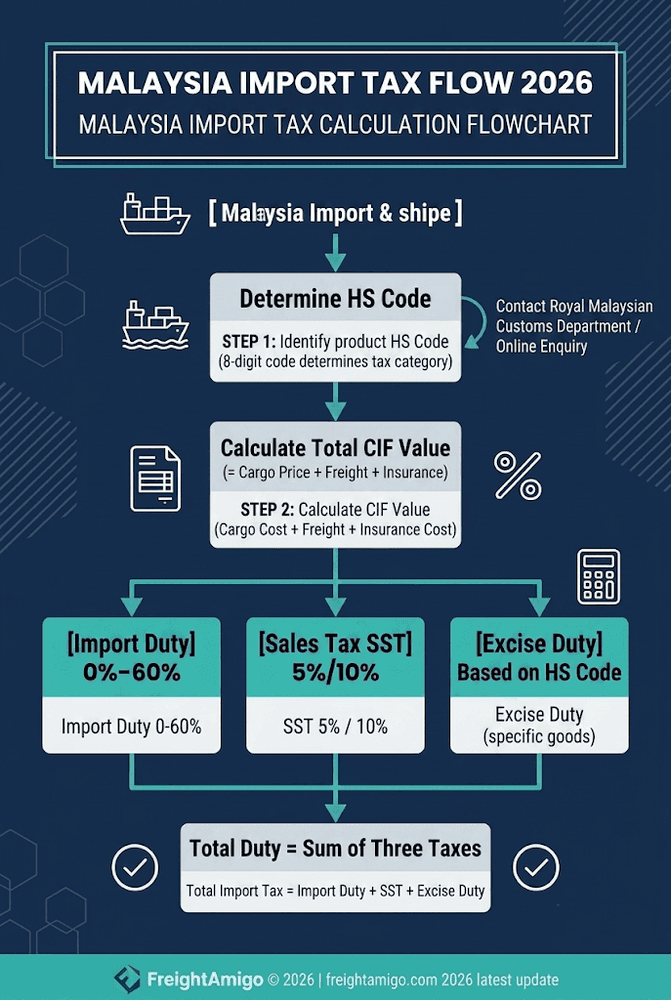
The key to accurately calculating Malaysia import tax lies in strictly following a six-step standard process — any error in any step will result in customs clearance delays or penalties. The following is the latest 2026 standard operating procedure.
Step 1: Determine the Product HS Code
Log in to the Royal Malaysian Customs Department website (customs.gov.my) or use FreightAmigo's built-in platform tool to look up the 8-digit HS Code.
Step 2: Calculate the CIF Value
CIF = Purchase price of goods + International freight charges + Cargo insurance premium
Step 3: Look Up the Import Duty Rate
Using the HS Code, confirm the applicable ad valorem or specific duty rate from the official tariff schedule.
Step 4: Calculate the Import Duty Amount
Import Duty = CIF Value × Import Duty Rate (%)
Step 5: Calculate Sales Tax (SST)
SST = CIF Value × SST Rate (5% or 10%)
Step 6: Sum the Total Tax Payable
Total Import Tax = Import Duty + SST (+ Excise Duty, if applicable)
Special handling for Low Value Goods (LVG):
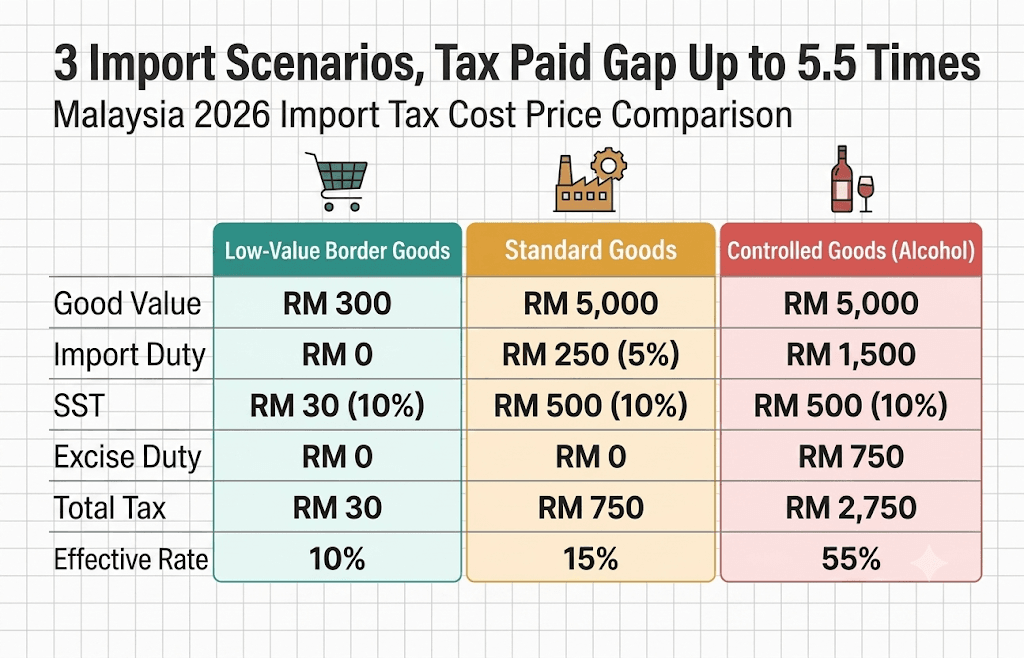
Goods value ≤ RM 500: Only 10% fixed SST applies — import duty is waived
Goods value > RM 500: Full import duty + SST calculation process applies
Invoice date before 1 April 2023: SST is exempt regardless of delivery date
Malaysia Import Tax Rate Comparison Table
The table below clearly presents a comparison of the core parameters of Malaysia's three major import tax categories, helping businesses quickly establish an import budget for 2026.
Tax Type
Tax Base
Rate Range
Scope of Application
Exemption Mechanism
Collecting Authority
Import Duty
CIF Value
0% – 60%
All imported goods
FTA preferential rates / Special exemption approval
Royal Malaysian Customs Dept.
Sales Tax (SST)
CIF Value
5% / 10% / Specific rate
Taxable goods (domestic + imported)
Goods listed in Sales Tax (Exemption) Order 2018
Royal Malaysian Customs Dept.
Low Value Goods Tax (LVG)
Goods Value
Fixed 10%
Online cross-border goods ≤ RM 500
Orders placed before 1 January 2024
Royal Malaysian Customs Dept.
Excise Duty
Per HS Code
Specific rate (variable)
Tobacco, alcohol, vehicles, etc.
Excise (Exemption) Order 2013
Royal Malaysian Customs Dept.
FTA Preferential Rate
CIF Value
0% (within agreement scope)
ASEAN, CPTPP member countries, etc.
Valid Certificate of Origin (COO) required
Royal Malaysian Customs Dept.
Note: Rates in the table above are based on the latest 2026 Malaysian customs regulations. Actual rates are subject to HS Code query results.
Import Cost Optimization Strategies by Industry
Savvy importers do not simply absorb tax liabilities passively — they proactively apply compliant strategies to minimize import tax costs. The following are the five most effective optimization approaches for 2026.
Malaysia has signed multiple FTAs, including the ASEAN Free Trade Area (AFTA), CPTPP, and bilateral agreements with China, Japan, and India. Goods meeting rules of origin requirements may qualify for significantly reduced or even zero-tariff treatment — always obtain a valid Certificate of Origin (COO).
Strategy 2: Plan Your Goods Valuation Declaration Carefully
CIF value is the tax base. Legally optimizing your shipping routes and insurance structure can reduce the taxable base within regulatory compliance. Never under-declare goods value — Malaysian Customs imposes heavy penalties for under-valuation.
Strategy 3: Apply for Bonded Warehouse or Manufacturer Exemption
Manufacturers registered in Malaysia may apply for SST exemption on raw materials and production equipment under the Sales Tax (Persons Exempted from Payment of Tax) Order 2018, substantially reducing production costs.
Strategy 4: Optimize Batch Importing and LVG Threshold Strategy
For cross-border e-commerce operators, strategically utilizing the LVG RM 500 threshold in combination with logistics timing windows can maximize tax efficiency.
Strategy 5: Use a Digital Compliance Platform
All-in-one digital logistics platforms such as FreightAmigo provide real-time HS Code lookup, tax estimation, document management, and customs clearance tracking — reducing manual processing error rates by over 90% while shortening clearance cycles.
Frequently Asked Questions (FAQ)
What is the tax rate range for Malaysia import duty?
Malaysia import duty rates range from 0% to 60%, determined by the product's HS Code. Most industrial goods fall within the 5%–25% range, while regulated goods such as alcohol can attract effective rates exceeding 60%.
What is Malaysia's HS Code and how do I look it up?
An HS Code (Harmonized System Code) is an internationally standardized 8-digit cargo classification code used to determine import tax rates. It can be looked up for free via the Royal Malaysian Customs Department website (customs.gov.my), or quickly retrieved using FreightAmigo's built-in platform tool.
How does Malaysia's Low Value Goods (LVG) tax work?
From 1 January 2024, online cross-border goods valued below RM 500 are subject to a fixed 10% SST (Low Value Goods Tax), but are exempt from import duty. Goods valued above RM 500 are subject to the full import duty + SST calculation process.
Do imported goods in Malaysia need to pay GST?
No. Malaysia abolished the Goods and Services Tax (GST) in 2018. The current system is the Sales and Service Tax (SST). Imported goods are subject to SST (5% or 10%), not GST.
Which goods are exempt from import tax in Malaysia?
Under the Sales Tax (Goods Exempted from Sales Tax) Order 2018 and the Excise (Exemption) Order 2013, certain raw materials, medical equipment, agricultural supplies, and goods for re-export processing may apply for exemption. The specific exemption list should be verified with the Royal Malaysian Customs Department.
How do Malaysia's Free Trade Agreements (FTAs) affect import duties?
Malaysia has signed FTAs with ASEAN member states, China, Japan, India, Australia, and others. Goods meeting rules of origin requirements and supported by a valid COO certificate may qualify for preferential or zero-tariff rates, potentially saving up to 100% of the standard tariff rate.
How is CIF value calculated and why does it matter?
CIF = Goods purchase price + International freight charges + Cargo insurance premium. This is the tax base for Malaysia import taxes — both import duty and SST are calculated using CIF value as the base, so accurately determining your CIF directly determines your total tax liability.
What are the consequences of under-declaring goods value in Malaysia?
The Royal Malaysian Customs Department imposes severe penalties for under-declaring goods value, including goods confiscation, heavy fines (up to 10 times the evaded tax amount), and criminal prosecution. Always declare truthfully and retain complete commercial invoices and transaction records.
Conclusion & Next Steps
Mastering Malaysia's import tax system is a prerequisite for successfully entering this market in 2026, and compliance and cost optimization are not mutually exclusive. By systematically understanding how import duty, SST, and excise duty work, businesses can confidently plan their import budgets and avoid customs clearance risks.
All calculations are based on CIF value, with HS Code determining the applicable rate
The LVG regime was officially implemented in 2024, directly impacting cross-border e-commerce operations
FTA preferential rates can significantly reduce compliant import costs
Digital platforms are the optimal solution for improving customs clearance efficiency
As a leading digital freight platform, FreightAmigo provides real-time quote comparisons (covering courier, air freight, sea freight, rail, and road transport), HS Code tax estimation, automated document management, and end-to-end cargo tracking — empowering businesses to complete the full Malaysia import process at the lowest cost and highest efficiency.
For expert guidance, Book a Demo with FreightAmigo.








 Global Popular RoutesTop sea & air shipping lanes
 Special OfferLimited-time shipping promotions





 Express
 Document
 Parcel - Air/Sea
 Container
 Relocation