How Much Does a Pair of Shoes Weight with Box? 2026 Complete Shipping & Freight Guide
A pair of shoes with box weighs 1-3 lbs (0.5-1.4 kg) typically; this 2026 guide covers weights
Why Shoe Weight with Box Matters for Shipping in 2026
Accurate shoe weight declarations in 2026 are no longer optional — they directly determine your freight costs, customs duties, and carrier compliance standing.
E-commerce volume for footwear is projected to exceed $120 billion globally in 2026. Carriers like DHL, FedEx, and UPS are enforcing stricter dimensional weight audits than ever before.
Even a 0.5 lb discrepancy on a declared shoe shipment can trigger surcharges, delays, or HS code reclassification fines exceeding $500 per consignment.
Understanding how much a pair of shoes weighs with box is the foundational step for any footwear importer, e-commerce seller, or freight forwarder operating in today's precision-driven logistics environment.
Average Shoe Weights with Box: 2026 Data Breakdown
Most pairs of shoes shipped with their original box weigh between 1 and 3 lbs (0.45–1.36 kg) under 2026 standard packaging norms.
Brand packaging has grown slightly heavier year-over-year due to reinforced eco-cardboard mandates in the EU and GCC regions. Budget an additional 5–10% packaging weight versus 2024 baselines.
Here is a quick-reference breakdown by shoe category:
Men's Sneakers: 1.8–2.5 lbs (box included)
Women's Heels: 1.2–2.0 lbs (lighter sole construction)
Boots (Ankle/Knee): 2.5–4.0 lbs (bulk and hardware add weight)
Kids' Shoes: 0.8–1.5 lbs (smallest box footprint)
Sports/Running Shoes: 1.5–2.2 lbs (foam midsoles are light)
Premium/luxury brand boxes: can add 0.6–0.8 lbs (rigid gift-style packaging)
Shoe Types vs Weight with Box: 2026 Comparison Table
This comparison table gives freight planners and e-commerce shippers a fast reference for declaring accurate shoe shipment weights in 2026.
Use these figures as your baseline when calculating volumetric weight, booking air freight, or completing customs declarations.
Shoe Type
Shoes Only (lbs)
Box Weight (lbs)
Total with Box (lbs)
KG Equivalent
Men's Sneakers
1.1-1.6
0.4-0.6
1.5-2.2
0.7-1.0
Women's Heels
0.6-1.0
0.3-0.5
0.9-1.5
0.4-0.7
Running Shoes
0.7-1.0
0.4-0.5
1.1-1.5
0.5-0.7
Boots
1.8-2.5
0.6-1.0
2.4-3.5
1.1-1.6
Sandals
0.4-0.7
0.2-0.4
0.6-1.1
0.3-0.5
2026 shoe weight with box comparison table
How to Weigh Shoes with Box Accurately: 5-Step Process
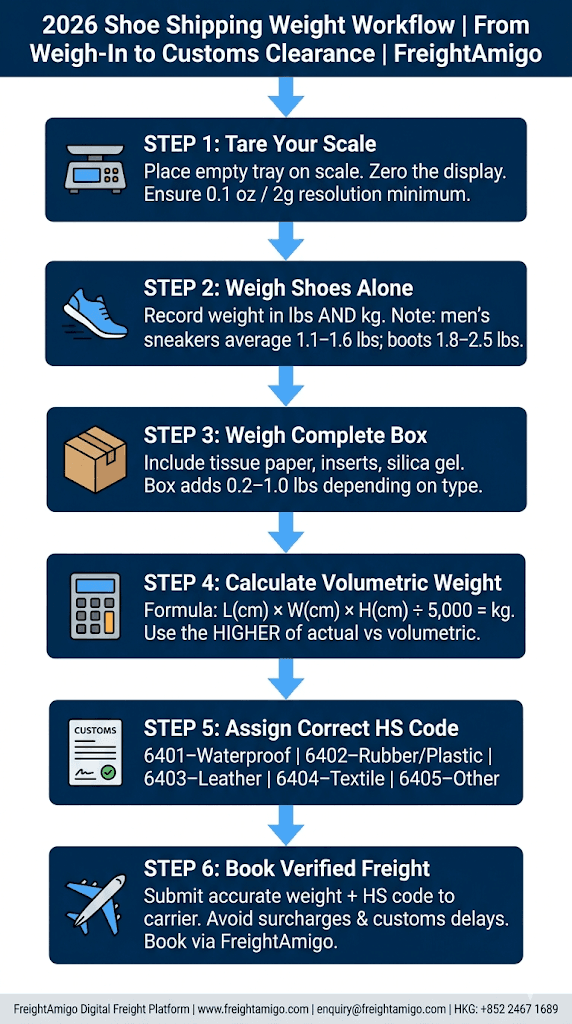
Getting an exact weight for a pair of shoes with the box is a five-minute process that can save you significant freight surcharges and customs compliance penalties in 2026.
Use a digital scale with at least 0.1 oz (2 g) resolution and a 10 lb minimum capacity. Postal or kitchen scales work well for individual pairs; warehouse floor scales suit bulk shipments.
Follow these five steps precisely:
Tare your scale first — Place an empty tray or flat surface on the scale and zero it out to eliminate surface weight from the reading.
Weigh the shoes alone — Record the weight in both lbs and kg for international documentation.
Weigh the complete box — Include all inserts, tissue paper, silica gel packets, and stuffing material; these routinely add 0.1–0.3 lbs.
Combine and verify — Place the boxed pair on the scale as one complete unit; confirm it matches your combined tally within 0.1 lbs.
Calculate volumetric weight — Measure the box (L × W × H in cm), divide by 5,000 for air freight; use the greater of actual vs volumetric weight for your freight booking.
Pro tip: Many carriers now apply AI-driven weight audits at sorting hubs. A mismatch of even 0.3 lbs on a declared shipment can trigger an automated adjustment fee. Always weigh — never estimate.
2026 HS Codes for Shoes: Compliance Essentials
Footwear HS codes under Chapter 64 remain the global standard in 2026, but regional updates in the GCC, EU, and US HTS system mean that correct code assignment is more critical — and more scrutinized — than in prior years.
Misclassification is one of the top five reasons footwear shipments are detained at customs globally. Always cross-reference the HS code with the actual upper material, sole material, and intended end-use.
Key 2026 HS code reference for shoes:
HS 6401: Waterproof footwear with outer sole and upper of rubber or plastics (not assembled by stitching)
HS 6402: Other footwear with outer sole and upper of rubber or plastics (e.g., athletic sandals, clogs)
HS 6403: Footwear with leather uppers — most common for sneakers and dress shoes
HS 6404: Footwear with textile uppers (canvas shoes, fabric trainers)
HS 6405: All other footwear including rubber flip-flops, felt slippers
Critical 2026 regulatory updates to note:
GCC (Gulf Cooperation Council): 12-digit HS refinements effective January 1, 2026 further sub-classify footwear by sole thickness and composition — verify your local customs broker has updated tariff tables.
United States HTS: Post-de minimis threshold reform requires full HTS declarations on all footwear shipments regardless of value; no exemptions apply.
EU CBAM adjacency: Certain synthetic shoe components (plastics, rubber) may attract carbon-content documentation reviews under expanded 2026 environmental compliance checks.
Source: WCO Harmonized System Nomenclature 2026 Edition; consult your freight forwarder for jurisdiction-specific updates.
Shipping Costs for Shoes with Box in 2026
Expect to budget $8–$55 USD per pair of shoes shipped via air freight in 2026, depending on origin, destination, weight, and dimensional factors.
Fuel surcharges, carrier capacity adjustments, and new environmental levies in the EU and UK are pushing air freight rates 8–12% higher than 2024 benchmarks. Sea freight remains the most cost-effective option for bulk footwear orders of 50+ pairs.
Estimated shipping cost ranges by trade lane:
Domestic US (1–2 lbs): $8–$18 per pair via ground parcel
China/Asia to US (air): $22–$45 per pair including fuel surcharge
China/Asia to EU (air): $18–$38 per pair plus import VAT (20–25%)
Intra-EU shipping: $10–$22 per pair with standard parcel services
Australia inbound (air): $25–$50 per pair from Asia origins
GCC (UAE/Saudi) inbound: $15–$35 per pair with updated 2026 HS duties
Key cost factors affecting your final rate in 2026:
Actual vs volumetric weight — Shoe boxes are large relative to weight; volumetric (dimensional) weight often governs the billing weight
Fuel surcharges — Currently ranging 18–28% of base freight rate across major carriers
Remote area surcharges — Add $5–$18 for residential or non-hub deliveries
2026 environmental levies — UK and EU carriers are adding carbon surcharges of $0.50–$2.00 per kg on air shipments
Volumetric Weight Formula (Air Freight): Length (cm) × Width (cm) × Height (cm) ÷ 5,000 = Volumetric Weight in kg. Always compare to actual weight and use the higher figure.
Common Mistakes in Shoe Shipping Weight Declarations
The single most costly mistake footwear shippers make in 2026 is declaring shoe weight without including the box, inserts, and packaging materials — a systematic error that averages 18–22% underdeclaration.
Carriers and customs authorities are cross-referencing declared weights against automated scan data at an unprecedented rate in 2026. The era of "close enough" weight estimation is definitively over.
Avoid these critical errors:
Forgetting box and inserts: Original packaging adds 0.2–1.0 lbs per pair; tissue, silica gel, and cardboard inserts are always included in freight billing weight
Underestimating boots: Knee-high and work boots regularly hit 3.5–4.0 lbs with box; using a generic "2 lb shoe" estimate creates significant discrepancies
Ignoring pair multipliers for bulk orders: Shipping 50 pairs? Multiply your per-box weight by 50 and add pallet/master carton tare weight
Eyeballing instead of weighing: Experienced shippers who "know" their products still consistently underestimate by 10–15% without a scale
Using outdated HS codes: 2026 GCC and US HTS updates reclassify several footwear sub-categories; using a 2023 code on a 2026 shipment risks fines of $500+ per consignment
Ignoring volumetric weight: Shoe boxes are frequently larger than their actual weight suggests; dimensional weight billing is standard for all major carriers
FAQ: Pair of Shoes Weigh with Box Top Questions 2026
Quick answers to People Also Ask on shoe shipping basics.
How much does a pair of shoes weigh with box?
Average 1-3 lbs (0.5-1.4 kg), varying 2.2 lbs.
What is the weight of a shoe box alone?
Standard shoe boxes weigh 0.3-0.6 lbs (0.1-0.3 kg) cardboard.
How to calculate shipping for shoes 2026?
Weigh total (shoes + box), check HS 6403-6405, use volumetric if larger.
What HS code for sneakers in 2026?
HS 6403 for leather/sports shoes with updates in GCC/EU Jan 1.
Does shoe weight affect customs duties?
Yes, accurate weights ensure correct HS classification and tariff rates 2026.
Average men's shoe weight with box?
1.8-2.5 lbs total, including 0.4 lb box.
Women's shoes box weight for freight?
0.9-1.5 lbs total, lighter due to design.
2026 changes for shoe shipping weights?
GCC 12-digit HS and US HTS mandates require precise weights.
Best scale for shoe shipping?
Digital 0.1 oz accuracy up to 10 lbs for pairs with boxes.
Resources for Shoe Shipping Logistics 2026
2025 case study: E-com brand reduced shoe freight costs 35% with accurate weights and HS 6403 compliance.
For expert guidance, Book a Demo with FreightAmigo.








 Global Popular RoutesTop sea & air shipping lanes
 Special OfferLimited-time shipping promotions





 Express
 Document
 Parcel - Air/Sea
 Container
 Relocation