Complete Guide to OEM vs ODM Manufacturing Logistics: Key Differences & Strategies 2026
What Are OEM and ODM Manufacturing Models?
OEM and ODM manufacturing models fundamentally determine how your products move from factory to market, directly shaping your entire logistics strategy.
Both models play distinctly different roles in the global supply chain. Understanding their differences is the essential first step in planning efficient cross-border logistics.
OEM (Original Equipment Manufacturer) Definition:
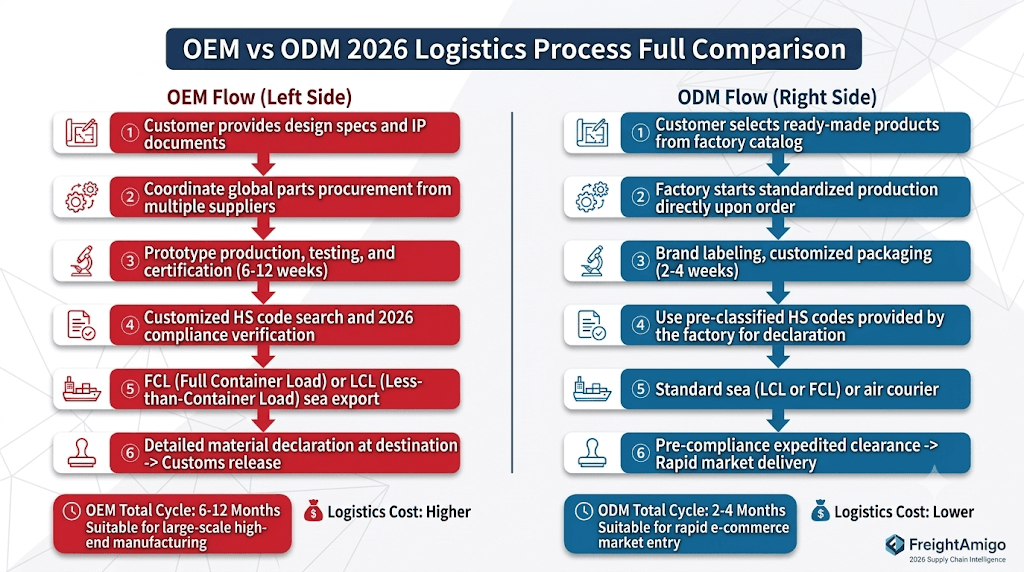
The client provides design specifications and intellectual property
The factory assembles products according to the client's drawings and standards
The brand owner retains full ownership of the product design
The factory independently develops designs and produces ready-made products
The client selects existing products for rebranding
The factory typically holds core technology and design patents
Typical applications: white-label consumer electronics, home goods, bestselling e-commerce products
Both models rely heavily on global logistics networks to transport components, semi-finished goods, and final products. However, their logistics complexity and cost structures differ significantly.
OEM Manufacturing: Full Supply Chain Control in 2026
OEM manufacturing grants businesses complete design ownership while demanding more sophisticated, multi-tiered logistics planning capabilities.
Businesses that choose OEM typically have strong brand differentiation needs and are willing to invest in supply chain complexity in exchange for full product control.
Core Characteristics of OEM Manufacturing:
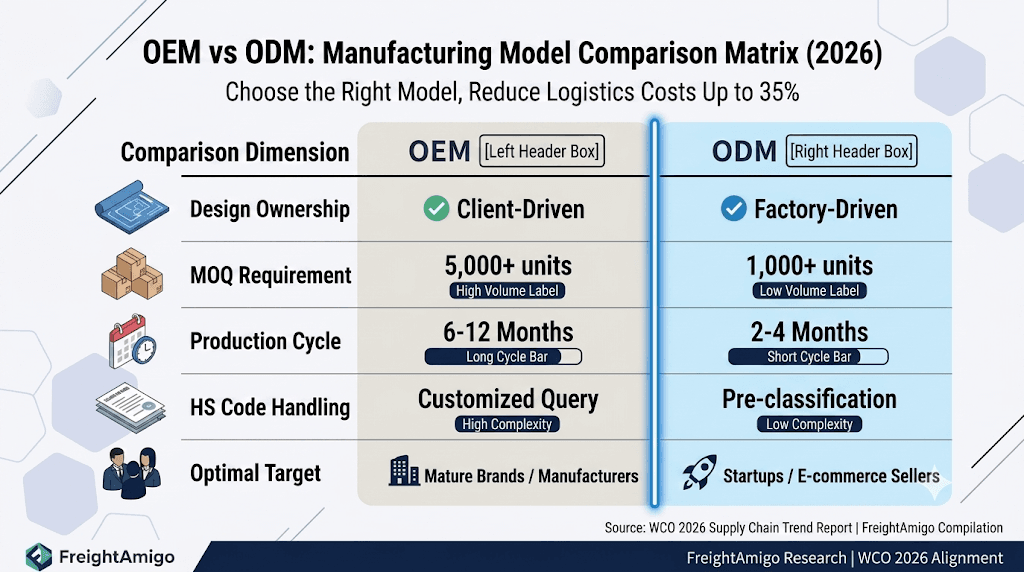
Design Control: The client provides complete technical specifications, engineering drawings, and material standards
High MOQ Requirements: Minimum order quantities typically start at 5,000 units, suited to high-volume production plans
Longer Lead Times: From prototyping and testing to mass production, the cycle typically spans 6–12 months
Intellectual Property Protection: IP belongs to the client and requires robust legal agreements
Strict Quality Standards: The client can define all production and quality control benchmarks
Key OEM Logistics Challenges:
Sourcing specialised components from multiple global suppliers
Managing international express courier and small-batch freight for prototype samples
Complex HS code custom queries and compliance verification
Multi-factory coordination and component tracking management
OEM is best suited to established brand manufacturers, technology companies, or enterprises that require highly customised product production.
ODM Manufacturing: Speed Advantage for Fast Markets
ODM manufacturing significantly accelerates logistics workflows through pre-designed, ready-made products, making it the fastest route to market for e-commerce sellers and startups.
In a highly competitive e-commerce environment, shortening the cycle from procurement to launch often delivers more commercial value than product uniqueness alone.
Core Advantages of ODM Manufacturing:
Low MOQ: Minimum orders as low as 1,000 units or fewer, reducing capital risk
Fast Lead Times: Products are already developed; production cycles of just 2–4 months
Factory-Managed Initial Compliance: Factories typically hold baseline certifications (CE, FCC, etc.)
Cost Flexibility: Lower upfront investment, ideal for small-scale market testing
Potential Risks of ODM:
The factory may sell identical or similar products to multiple clients
Product differentiation is limited by the factory's existing design options
Quality standards are set by the factory, giving brand owners less control
Design intellectual property belongs to the factory, creating competitive exposure
ODM is best suited to e-commerce startups, Amazon sellers, and brand owners looking to rapidly test market response.
OEM vs ODM Cost & Logistics Comparison Table
This comprehensive comparison table helps businesses make the best OEM or ODM manufacturing decision within the 2026 supply chain environment.
The following data is based on WCO 2026-aligned global supply chain trends and FreightAmigo's actual freight data.
Comparison Dimension
OEM
ODM
Logistics Impact Analysis
Design Ownership
Client-led
Factory-led
OEM requires additional IP documents to accompany shipment
Minimum Order Quantity (MOQ)
High (5,000 units+)
Low (1,000 units+)
ODM reduces the need for full container loads
Production Lead Time
6–12 months
2–4 months
ODM more easily achieves air freight time advantages
Unit Production Cost
Higher initially
Lower upfront
OEM optimises consolidated sea freight at high volumes
HS Code Handling
Requires custom queries
Factory pre-classified
Directly affects 2026 import tariffs
Compliance Certification
Client responsible for obtaining
Factory typically holds certifications
ODM accelerates customs clearance
Supply Chain Complexity
High (multiple suppliers)
Low (single factory)
OEM requires stronger 4PL coordination capability
Brand Differentiation
Very high
Low to moderate
Influences long-term market positioning and logistics strategy
Best-Fit Business Size
Medium to large enterprises
SMEs / Startups
Influences 3PL service selection
2026 Tariff Risk
Requires detailed material declaration
Factory assists with classification
OEM tariff compliance costs are higher
Logistics Challenges in OEM & ODM Manufacturing
OEM and ODM manufacturing each face unique and complex logistics obstacles in the 2026 global trade environment, requiring proactive strategies to address them.
With Red Sea shipping lanes continuing to be disrupted, US tariff policy adjustments on Chinese goods, and ongoing HS code system updates, logistics challenges for both manufacturing models have intensified.
Key OEM Logistics Challenges:
Complex Multi-Supplier Coordination: Components sourced from different countries and factories require precise supply chain visibility tools
Prototype Sample Freight Management: Small-batch prototype international shipping incurs high costs and complex customs procedures
Specialised Component Sourcing Risk: Discontinuation or delays of critical components can halt entire production lines
IP Protection Logistics Documentation: Cross-border transmission of technical drawings and specifications requires additional legal and security measures
2026 Tariff Policy Impact: US mandatory HTS updates are particularly significant for customised products
Key ODM Logistics Challenges:
Scaling Batch Consolidation: As orders grow, how to smoothly upgrade from LCL to FCL freight
Quality Consistency Risk: Factories serving multiple clients simultaneously may see quality standard deviations
Inventory Management Pressure: Short production cycles for ready-made products require more flexible warehousing and replenishment strategies
Supplier Concentration Risk: Over-reliance on a single ODM factory creates supply disruption vulnerability
Red Sea disruptions continue to affect Asia-Europe shipping lanes in 2026. Both OEM and ODM buyers are advised to book freight capacity 4–6 weeks in advance and establish contingency plans for alternative routes.
Impact of 2026 HS Code Updates on OEM & ODM Logistics
The 2026 global HS code system update has a profound and direct impact on the import and export customs clearance processes for both OEM and ODM manufacturers.
The World Customs Organization (WCO) revises the HS nomenclature system every five years. The latest version's new and amended classification entries directly affect tariff rates and clearance efficiency.
Region
Key 2026 HS Changes
OEM Impact
ODM Impact
United States
Mandatory HTS update + De Minimis exemption termination
Contact local customs advisors to verify whether existing HS code classifications remain valid
Use WCO official tools or FreightAmigo's HS lookup function to validate new codes
OEM clients must prepare detailed Material Declaration documents
ODM buyers must request updated HS code confirmation documents from factories
Build an internal HS code database and regularly cross-reference with the latest tariff schedules
The termination of the US De Minimis exemption (previously allowing duty-free imports under USD 800) has the most significant impact on ODM e-commerce sellers. Immediate adjustment of pricing and logistics cost models is strongly recommended.
How to Choose Between OEM & ODM for Logistics Efficiency
Choosing the right OEM or ODM manufacturing model is one of the core decisions for optimising 2026 overall supply chain efficiency and reducing costs.
This decision not only affects production costs but directly determines your customs clearance process, tariff burden, warehousing strategy, and overall speed to market.
Five-Step Selection Framework:
Assess Product Uniqueness Requirements
If the product requires fully exclusive design or core technology protection → Choose OEM
If similar products already on the market can meet your needs → Prioritise ODM
Calculate Volume and Capital Capacity
First order < 2,000 units with limited budget → ODM offers greater flexibility
Long-term orders > 5,000 units with full production planning → OEM delivers greater cost advantage
Evaluate IP Protection Priority
Core technology is your competitive moat → OEM protection is mandatory
Brand identity matters more than technical differentiation → ODM can rapidly build market presence
ODM factory pre-classification can reduce compliance costs but requires local verification
Assess Supply Chain Management Capability
If you have multi-supplier management experience and 4PL resources → OEM is viable
If you want to simplify the supply chain and focus on sales → ODM is more efficient
Top 5 OEM/ODM Logistics Tips for 2026
These five practical tips are based on the latest 2026 supply chain intelligence to help businesses maintain a competitive edge in OEM and ODM manufacturing logistics.
In an environment of ongoing global supply chain volatility, advance planning and agile responses are the keys to success.
Tip 1: Book Sea Freight Capacity 4–6 Weeks in Advance Red Sea lane disruptions continue into 2026, with Asia-Europe routes experiencing average delays of 14–21 days. Both OEM and ODM buyers should confirm freight bookings at least 4–6 weeks ahead and establish contingency plans for alternative routes such as the Cape of Good Hope.
Tip 2: Proactively Verify 2026 HS Code Compliance Do not rely on outdated HS codes provided by your factory. Use WCO official tools or FreightAmigo's HS lookup function to actively confirm the latest 2026 classification codes for all products, avoiding customs clearance delays and additional penalties.
Tip 3: Consolidate OEM Prototypes with LCL Shipments OEM prototype samples are typically low in quantity and small in volume, making full container sea freight uneconomical. Choosing LCL consolidation services to share container space with other cargo can reduce prototype shipping costs by 40–60%.
Tip 4: Leverage Free Trade Zones (FTZ) for ODM Imports Importing ODM goods into US, Hong Kong, or Singapore Free Trade Zones can defer tariff payments, enable flexible inventory allocation, and allow duty exemptions under certain conditions, significantly improving cash flow.
Tip 5: Purchase Comprehensive Insurance for High-Value OEM Cargo Customised OEM products typically carry higher replacement costs, with re-production cycles of up to 6–12 months. It is strongly recommended to purchase all-risks cargo insurance (Institute Cargo Clauses A) to protect your supply chain investment.
Frequently Asked Questions (FAQ)
What is the main difference between OEM and ODM manufacturing?
OEM (Original Equipment Manufacturer) produces goods according to design specifications provided by the client, who retains full design ownership. ODM (Original Design Manufacturer) offers self-developed ready-made products for clients to select and rebrand, with the factory retaining design intellectual property rights.
Which is cheaper for logistics: OEM or ODM?
ODM typically has lower logistics costs because smaller MOQ requirements (1,000 units+) reduce full container load needs, and shorter production cycles (2–4 months) lower warehousing costs. However, per-unit sea freight costs for high-volume OEM orders may be more optimised at scale.
How do the 2026 HS code updates affect OEM and ODM?
OEM custom products require bespoke HS code queries since there are no standard ready-made classifications, resulting in higher compliance costs. ODM factories typically provide pre-classified HS codes, but buyers still need to conduct local compliance verification in the destination country.
Should a startup choose OEM or ODM manufacturing?
Startups generally benefit more from ODM: low MOQ reduces inventory risk, 2–4 month fast lead times accelerate market validation, factories already hold preliminary compliance certifications, and overall startup costs and logistics complexity are significantly lower than OEM.
Does choosing OEM or ODM affect customs clearance speed?
Yes. OEM custom products require more complex documentation, including detailed material specifications and custom HS code declarations, making clearance more involved. ODM standard products benefit from factory pre-classification, enabling simpler clearance — an advantage that is even more pronounced after the 2026 HS updates.
What are the main logistics risks in OEM manufacturing?
Key OEM logistics risks include: multi-supplier coordination failures halting production lines, customs clearance delays for cross-border prototype shipments, global procurement disruption risks for specialised components, and reclassification compliance challenges arising from 2026 HS code updates.
What are the specific advantages of ODM for e-commerce logistics?
ODM delivers three core advantages for e-commerce: factory pre-compliance certifications accelerate clearance under the 2026 HS updates; standardised product specifications simplify warehouse management; and low MOQ supports small-batch, high-frequency replenishment strategies that reduce e-commerce overstock risk.
How do I correctly declare HS codes for OEM products?
It is recommended to use the WCO official HS nomenclature table or FreightAmigo's HS lookup tool to match products based on material composition, intended use, and manufacturing process. After the 2026 updates, engaging a licensed customs broker for professional review is advised to avoid misclassification penalties and delays.
How does the 2026 GCC 12-digit HS code affect ODM buyers?
GCC 12-digit granular HS codes require more detailed product specification declarations. ODM factories typically prepare pre-classification documents, but buyers must confirm that the codes provided meet the latest 2026 local requirements of their target GCC country (Saudi Arabia, UAE, Kuwait, etc.).
What impact does the end of the US De Minimis exemption have on OEM and ODM?
The end of the De Minimis exemption means all goods imported into the US (including low-value ODM e-commerce products) must be fully declared and subject to tariffs. ODM small-parcel e-commerce sellers are most affected and must immediately recalculate their profit models. High-volume OEM importers face comparatively limited disruption.
OEM & ODM Logistics Resources
FreightAmigo provides end-to-end digital logistics solutions for OEM and ODM manufacturers, covering everything from HS code lookups to global door-to-door delivery.
Whether you are a large enterprise managing a complex multi-supplier OEM supply chain or an ODM e-commerce seller looking to enter the market quickly, FreightAmigo's intelligent logistics platform can deliver tailored solutions for your needs.








 Global Popular RoutesTop sea & air shipping lanes
 Special OfferLimited-time shipping promotions





 Express
 Document
 Parcel - Air/Sea
 Container
 Relocation