The Panama Canal Crisis: Reshaping Global Shipping Routes and Logistics
A Looming Crisis in Global Shipping
The Panama Canal — a 48-mile artery handling 5% of all global maritime trade — entered a period of unprecedented stress that continues to redefine shipping economics well into 2026.
A combination of severe multi-year drought, climate-driven water scarcity, and geopolitical tensions has forced the Panama Canal Authority (ACP) to implement transit restrictions that have sent shockwaves through every major supply chain on earth.
At FreightAmigo, our Digital Logistics Platform monitors these conditions in real time. This guide gives you everything you need to understand the crisis, adapt your strategy, and protect your cargo from costly disruptions.
The Current Situation: Understanding the Panama Canal Crisis
The 2023–2024 drought imposed the harshest transit restrictions the Canal has seen in its 110-year history, and the structural vulnerabilities those restrictions exposed have not disappeared in 2026.
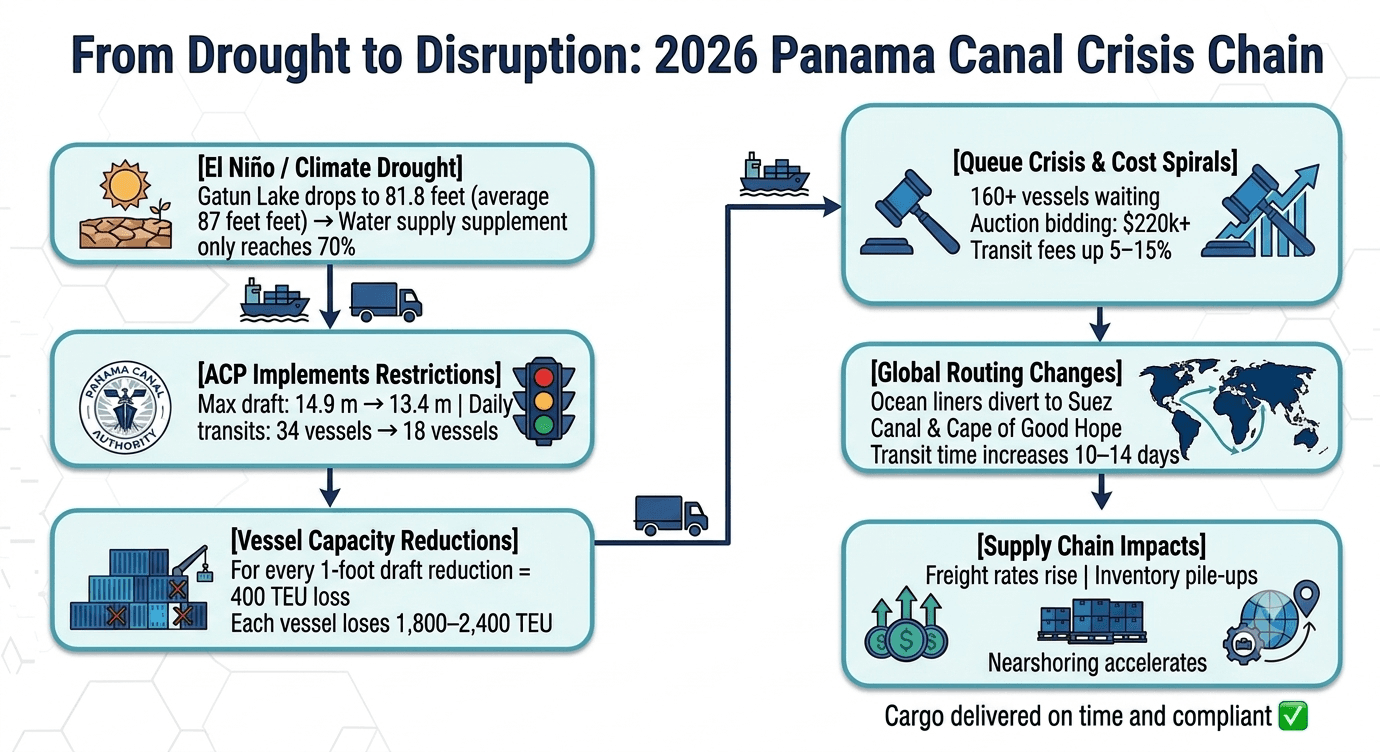
Maximum vessel draft reduced from 14.9 m to 13.4 m, slashing cargo capacity.
Daily transits fell to just 18 passages — roughly half the historical average of 34.
More than 160 vessels were queued in August 2023, waiting to transit.
Neopanamax lock auction bids hit $220,000+ above the $100,000 base reservation fee.
In FY2024, the Canal recorded only 11,290 total transits, vs. the 13,759 average of prior years.
By 2025, rainfall and operational recovery restored transits to approximately 13,404 vessels, offering partial relief. But climate scientists warn that El Niño-driven drought cycles will recur with greater frequency and severity.
The Ripple Effect: How the Crisis is Changing Global Shipping Routes
Major shipping alliances — including THE Alliance (ONE, Hapag-Lloyd, HMM, Yang Ming) and others — have executed large-scale rerouting programmes. The primary alternatives now shaping trade lanes are:
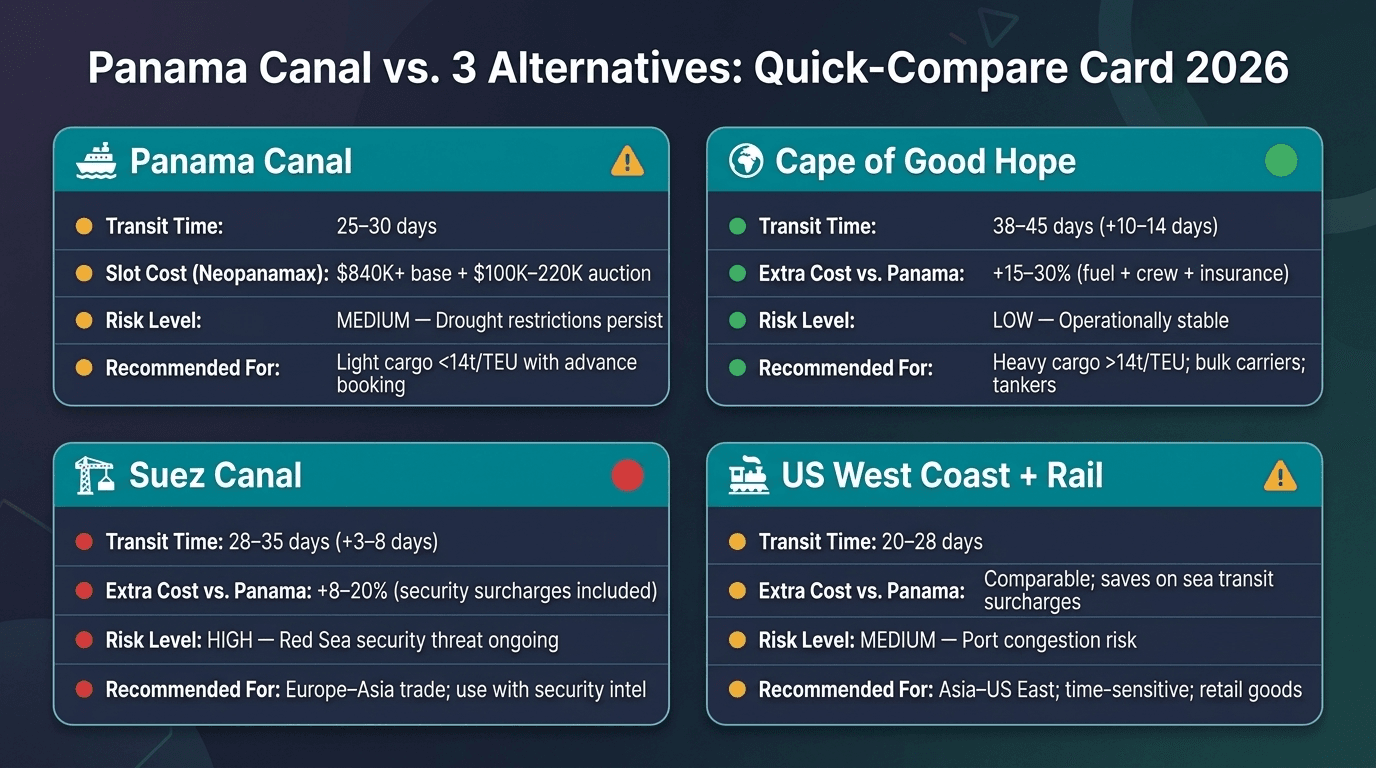
Cape of Good Hope (South Africa): The most commonly adopted alternative. Adds 10–14 extra sailing days and significantly higher fuel and crew costs. Now carrying record cargo volumes.
Suez Canal (Egypt): Historically the first diversion choice from Panama, but its own security crisis (Red Sea Houthi attacks from late 2023) has made it unreliable for many carriers.
U.S. Land Bridge (West Coast + Rail): Asia-to-US-East cargo unloads at West Coast ports (Los Angeles, Long Beach) and travels inland by rail. Viable for time-sensitive, lower-volume shipments.
Arctic Northern Sea Route: Gaining renewed strategic interest as ice retreat widens the seasonal window, though still limited by infrastructure and ice class vessel requirements.
The dual disruption — Panama Canal restrictions AND Red Sea insecurity — is unprecedented and has forced freight forwarders to build genuine route redundancy into their planning for the first time.
Route Comparison: Panama Canal vs. Alternatives (2026)
Port congestion risk; rail capacity constraints; limited volume
Growing demand
Arctic Sea Route
18–22 days (seasonal)
-5 to -8 days
Very High
Ice class vessels only; seasonal window; infrastructure gaps
Limited / Strategic
Understanding the Panama Canal's Water Challenge
To fully grasp the gravity of the situation, it's essential to understand how the Panama Canal operates:
Each ship transit requires approximately 200 million gallons of freshwater.
The canal uses a lock system fed
The lake's water level is currently at 81.8 feet, far below the average 87 feet for this time of year.
The lake is only receiving 70% of the water intake it needs to satisfy the canal's usage.
The ACP's long-term response includes a proposed third reservoir in the Río Indio basin — but construction and financing timelines mean the canal remains vulnerable for the foreseeable future.
The Impact on Vessel Capacity and Shipping Volumes
The restrictions imposed by the Panama Canal
For every one-foot reduction in draft, a container ship must reduce its weight 400 TEU (Twenty-foot Equivalent Units).
The current six-foot reduction in draft translates to a decrease of 1800-2400 TEU in vessel capacity.
This reduction in capacity is leading to increased costs and potential delays for shippers.
As a Digital Logistics Solution provider, FreightAmigo is working to help our clients optimize their shipments within these new constraints, ensuring that goods continue to move as efficiently as possible despite the challenges.
Adapting to the New Reality: Strategies for Shippers
In light of these changes, shippers need to adapt their strategies:
Route Diversification: Stop relying on a single corridor. Build a primary route (e.g., Panama) and a pre-approved contingency (e.g., Cape of Good Hope or U.S. West Coast + rail) into every shipment plan.
Weight Optimisation per TEU: For shipments near or above the 14-ton threshold, consider splitting or consolidating cargo into fewer, heavier loads routed via the Suez Canal or Cape.
Early Slot Reservation: Book transit slots 30–90 days in advance via the ACP portal to avoid auction premium costs, which can reach $220,000+ above base fees.
Inventory Buffer Planning: Add 10–14 days to your safety stock calculations to absorb rerouting delays without triggering stockouts or production halts.
Nearshoring and Friendshoring Review: For high-frequency, time-sensitive supply chains, evaluate whether shifting production closer to end markets (Mexico, Eastern Europe) reduces canal dependency.
Digital Freight Platform Adoption: Use real-time rate comparison and route analytics tools — like FreightAmigo — to dynamically choose the most cost-effective option at time of booking.
At FreightAmigo, we're committed to helping our clients navigate these challenges time information and alternative routing options through our Digital Platform.
The Long-Term Outlook: Potential Impacts on Global Trade
The current crisis at the Panama Canal could have far-reaching consequences for global trade:
Shifts in preferred shipping routes could lead to changes in port infrastructure investment.
Increased transit times may necessitate adjustments to inventory management strategies.
The situation could accelerate the trend towards nearshoring or friendshoring for some industries.
There may be renewed interest in alternative trade routes, such as the Arctic shipping lanes.
As a full-service, one-stop Digital Supply Chain Finance Platform, FreightAmigo is positioned to help our clients adapt to these potential long-term changes in the global trade landscape.
FreightAmigo's Role in Navigating the Crisis
In these challenging times, FreightAmigo's Digital Logistics Platform offers several key advantages:
Real-time tracking and updates on shipment status, crucial for managing extended transit times.
Comparative analysis of different routing options, including door-to-door freight quotes for various transportation modes.
Automated document management to handle the complexities of changing routes and regulations.
Expert support available 24/7 to address any concerns or questions about the evolving situation.
Our combination of artificial intelligence, big data, and industry expertise allows us to provide timely, accurate information and solutions to our clients as they navigate this crisis.
Conclusion: Staying Agile in a Changing Logistics Landscape
The current situation at the Panama Canal serves as a stark reminder of the vulnerabilities in our global supply chains. As the crisis continues to unfold, it's clear that flexibility and adaptability will be key to success in the logistics industry.
At FreightAmigo, we're committed to helping our clients not just weather this storm, but emerge stronger and more resilient.
As we continue to monitor the situation and its impact on global logistics, we invite you to stay connected with FreightAmigo for the latest updates and strategies to keep your supply chain running smoothly. Together, we can turn these challenges into opportunities for innovation and growth in the ever-evolving world of global trade.
For expert guidance, Book a Demo with FreightAmigo.








 Global Popular RoutesTop sea & air shipping lanes
 Special OfferLimited-time shipping promotions





 Express
 Document
 Parcel - Air/Sea
 Container
 Relocation