Understanding the SCFI Freight Index: Key Indicator for Container Shipping Trends and International Sea Freight Rates
What is the SCFI Index in 2026?
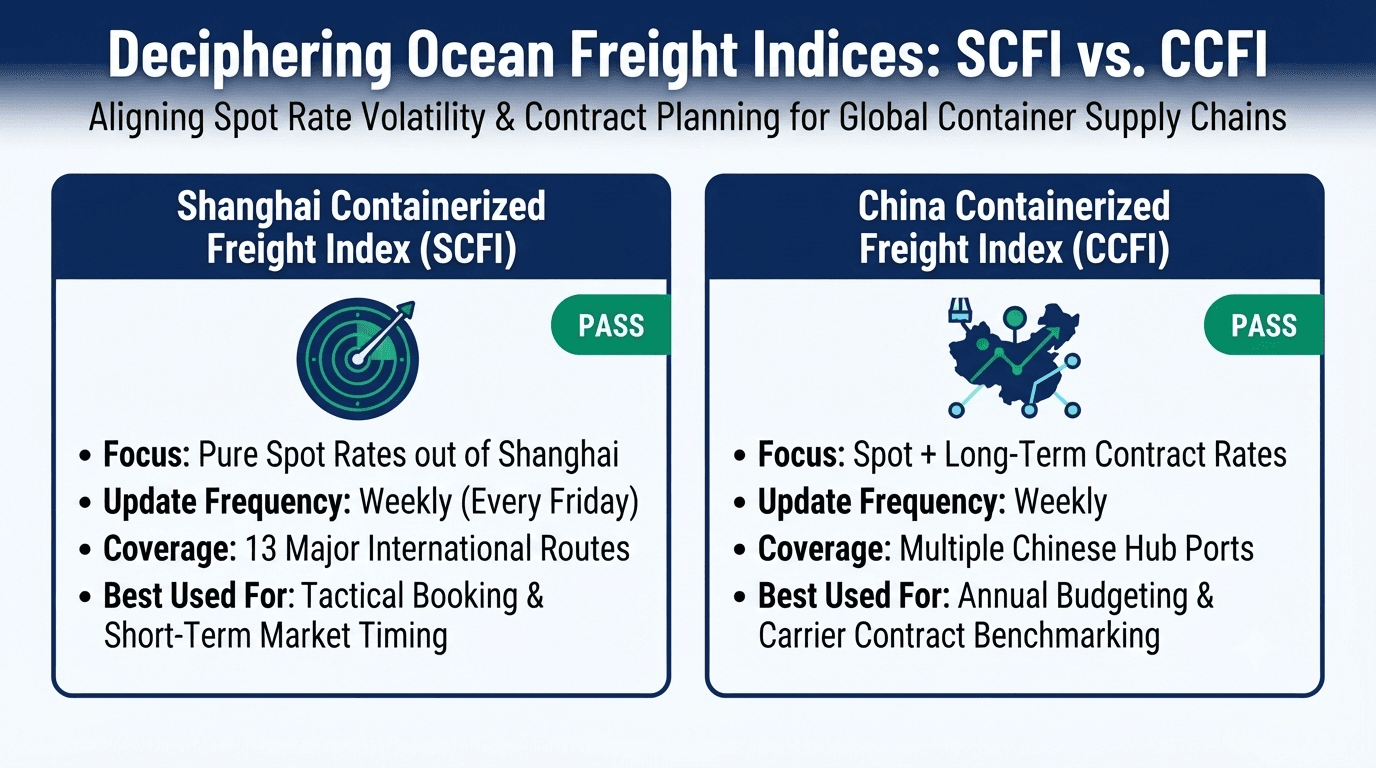
The Shanghai Containerized Freight Index (SCFI) is a benchmark index of Shanghai export containerized spot freight rates published by the Shanghai Shipping Exchange. Updated weekly, it is utilized to observe export ocean freight rate fluctuations.
It tracks actual ocean freight costs inclusive of surcharges, helping shippers navigate market volatility. Launched in 2009, the SCFI covers 13 major export routes.
How the SCFI Index Operates: Calculation Method and Composition
The SCFI aggregates spot freight rates provided by non-vessel operating common carriers and shipping lines to calculate a weighted composite index, which is updated once every week.
Data is derived from surveys of carriers, freight forwarders, and shippers. The composite index reflects different weightings across 13 routes, with European and US routes carrying higher weights.
European routes exert a significant impact due to massive trade volumes.
US West Coast and US East Coast routes utilize Twenty-foot Equivalent Unit (TEU) and Forty-foot Equivalent Unit (FEU) pricing structures.
Includes ancillary expenses such as bunker adjustment factors and peak season surcharges.
Updated every Friday to provide real-time market signals.
Historical peaks demonstrate its high sensitivity to market changes.
Comparison Between SCFI and CCFI: Differences and Selection Guide
The China Containerized Freight Index (CCFI) encompasses multiple Chinese ports and integrates both spot and contract freight rates. Comparing the core differences between SCFI and CCFI helps businesses choose the most suitable observation index for their supply chain in 2026:
Index
Coverage
Calculation Basis
Ideal Target Audience
2026 Applicability
SCFI
Shanghai to 13 routes
Pure spot freight rates
Those needing to quickly grasp Shanghai export market conditions
High volatility signal
CCFI
Multiple Chinese ports
Spot + contract rates
Enterprises requiring long-term planning
Broader market perspective
Other (such as WCI)
Global mixed data
World Container Index (WCI) benchmarks
Shippers needing global comparisons
Multi-route diversification
This comparison table is optimized for quick scanning on mobile devices.
Latest SCFI Trends and Freight Rate Outlook for 2026
The latest SCFI composite index released on July 3, 2026, stands at 3326.87, representing an increase of 87.23 points compared to the previous period's 3239.64.
Driven by route rerouting and capacity tightening, a seasonal peak is anticipated during the fourth quarter.
Key focus should be placed on tracking European and US routes.
Compare with the historical averages of 2025–2026.
Improves budget accuracy.
Pay close attention to geopolitical impacts such as those in the Red Sea.
Primary Factors Affecting SCFI Volatility in 2026
Multiple variables, including fuel prices, port congestion, and geopolitics, continue to influence the trajectory of the SCFI in 2026.
New vessel deliveries, trade policies, and demand shifts add further complexity.
Bunker fuel prices and fuel surcharges directly impact overall costs.
Port congestion and severe weather events.
Adjustments in customs tariffs and trade policies.
Capacity management by shipping lines, such as blank sailings.
Seasonal cycles of e-commerce and manufacturing industries.
How to Utilize SCFI to Optimize Supply Chain Decisions
Integrating SCFI insights into booking timing and route selection can achieve significant cost savings. Platforms like FreightAmigo combine real-time tools to provide optimal solutions.
Advance bookings when the index is at a low point.
Negotiate contracts using the SCFI as a benchmark.
Diversify ports based on sub-indices.
Switch to multimodal transport during high index periods.
Practical Strategies for Hong Kong and Mainland China Exporters
Hong Kong enterprises can combine Pearl River Delta shipments with Shanghai SCFI signals to achieve better logistics coordination.
Pair with local port data and the FreightAmigo platform to enhance end-to-end visibility.
Provides transparency, cost control, and dedicated expert support.
Frequently Asked Questions
What is the SCFI index in 2026? The SCFI is a benchmark index of Shanghai export containerized spot freight rates published by the Shanghai Shipping Exchange, updated weekly to observe export ocean freight price fluctuations. It assists shippers in forecasting costs amidst market volatility.
What is the primary difference between SCFI and CCFI? The SCFI focuses purely on spot freight rates from the single port of Shanghai, whereas the CCFI encompasses multiple ports and synthesizes both spot and contract rates, offering a broader market representation. Choose based on your departure port requirements.
Can the SCFI accurately predict 2026 freight rates? The SCFI reflects current spot market conditions, and combining it with other data points can enhance prediction accuracy, helping enterprises prepare budgets effectively.
How often is the SCFI index updated? It is updated every Friday, providing the latest container shipping freight rate trends. Shippers can check it via official channels.
How can small and medium exporters use the SCFI to reduce costs? By monitoring the index to secure bookings early when rates are low, and utilizing FreightAmigo to compare multi-route options to control logistics expenditure effectively.
How can I obtain real-time SCFI data? The official website of the Shanghai Shipping Exchange provides the latest data, and the FreightAmigo platform also integrates these trends alongside actual shipping quotations.
What are the main factors influencing the SCFI in 2026? Bunker costs, geopolitics, capacity adjustments, and demand fluctuations are key. Continuous monitoring minimizes potential risks.
How does FreightAmigo help interpret the SCFI? The platform references SCFI trends to provide transparent real-time quotes, tracking, and end-to-end solutions, transforming index insights into tangible business advantages.
Conclusion: Transforming 2026 SCFI Insights into Shipping Success
Mastering the SCFI index brings about smarter decision-making, cost control, and supply chain resilience. Partner with FreightAmigo to receive comprehensive support from quotation to final delivery.
Begin optimizing your container shipping strategy today.
For expert guidance, Book a Demo with FreightAmigo.








 Global Popular RoutesTop sea & air shipping lanes
 Special OfferLimited-time shipping promotions





 Express
 Document
 Parcel - Air/Sea
 Container
 Relocation