Waybill vs Tracking Number: Key Differences in Air Freight 2026
Understand the critical waybill vs tracking number differences in air freight for 2026. An AWB handles legal contracts, customs documentation, and HS code compliance — while a tracking number monitors real-time shipment status. Both are essential tools as US HTS mandates, GCC 12-digit expansions, and EU CN updates reshape global air cargo compliance.
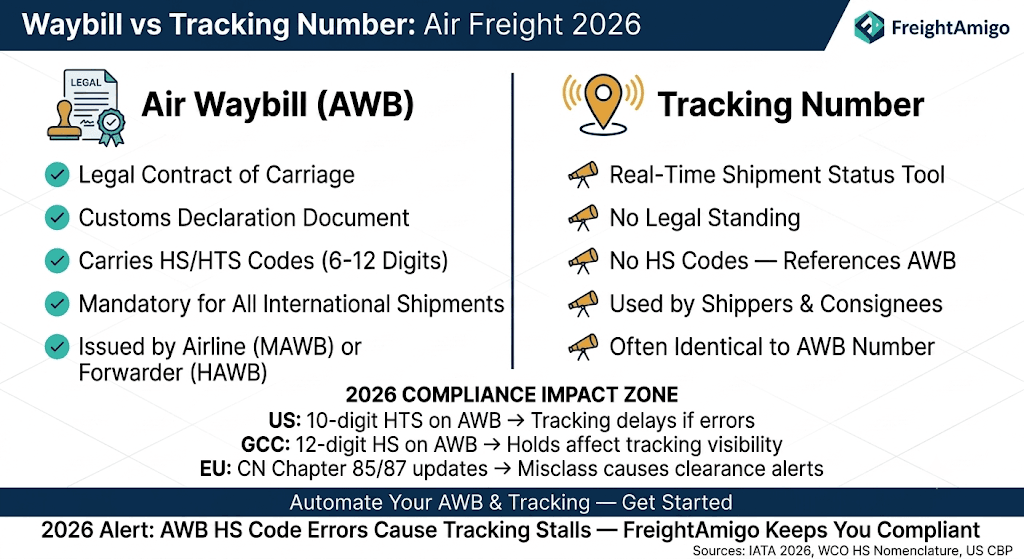
The Air Waybill (AWB) is the foundational legal document that governs every international air freight shipment — functioning simultaneously as a transport receipt, contractual agreement, and customs manifest.
Unlike a bill of lading used in ocean freight, an AWB is non-negotiable, meaning ownership of goods cannot be transferred by endorsing the document. This makes it uniquely suited to the speed requirements of air cargo.
The AWB's standardized 11-digit format — a 3-digit airline prefix, 7-digit serial number, and 1 check digit — is recognized universally by IATA member carriers, customs authorities, and freight forwarders worldwide.
Key AWB characteristics for 2026:
Identifies shipper, consignee, and detailed goods description
Carries HS codes (6–12 digits depending on jurisdiction) for tariff classification
Serves as the binding contract between the shipper and the airline
Is mandatory for every international air cargo movement
Cannot be used to transfer title of goods mid-transit
What Is a Tracking Number in Air Freight Logistics?
A tracking number in air freight is a reference identifier that enables shippers, consignees, and logistics teams to monitor real-time shipment status across the entire air cargo journey.
In most cases, the tracking number is identical to the 11-digit AWB number issued at booking. However, some carriers and forwarders generate proprietary tracking IDs that link back to the underlying AWB.
The core distinction is functional: the AWB is a legal instrument, while the tracking number is an operational tool designed for visibility and communication.
What a tracking number does in 2026:
Delivers live status updates: departed, in transit, arrived, customs cleared
Can be entered directly into airline portals, freight apps, or third-party platforms
Links indirectly to AWB data — including HS code flags raised by customs systems
Supports e-commerce visibility expectations for B2C and B2B buyers
Does not carry legal authority, contract terms, or HS code data independently
Waybill vs Tracking Number: Core Differences 2026
Understanding the precise functional divide between a waybill and a tracking number protects shippers from compliance failures and operational blind spots in 2026's tightened regulatory environment.
The table below maps every critical dimension of comparison, from document purpose and format to HS code responsibilities and regional regulatory impact:
Aspect
Air Waybill (AWB)
Tracking Number
Primary Purpose
Legal contract + customs declaration document
Real-time shipment status monitoring
Format
11-digit standardized (e.g., 999-1234567-8)
Often identical to AWB; some carriers use proprietary IDs
HS Code Requirement
Mandatory (6–12 digits, jurisdiction-dependent in 2026)
Not listed; references AWB data indirectly
Legal Standing
Binding contract of carriage under IATA rules
No legal authority; operational reference only
Customs Role
Required for clearance, inspection, and duty assessment
Not used directly in customs procedures
2026 US Compliance
Must carry 10-digit HTS codes (post de minimis reform)
In 2026, the accurate placement of Harmonized System (HS) codes on the Air Waybill is one of the highest-stakes compliance requirements in global air freight — directly determining duty rates, clearance speed, and tracking continuity.
HS codes appear in the "Description of Goods" section of the AWB. Customs authorities in every major trade corridor now cross-reference these codes against automated tariff classification databases before releasing cargo.
A single misclassified digit can trigger a customs hold — which immediately manifests as a "clearance delay" flag visible in the tracking system, creating downstream disruptions for consignees and e-commerce customers.
2026 HS code requirements by region:
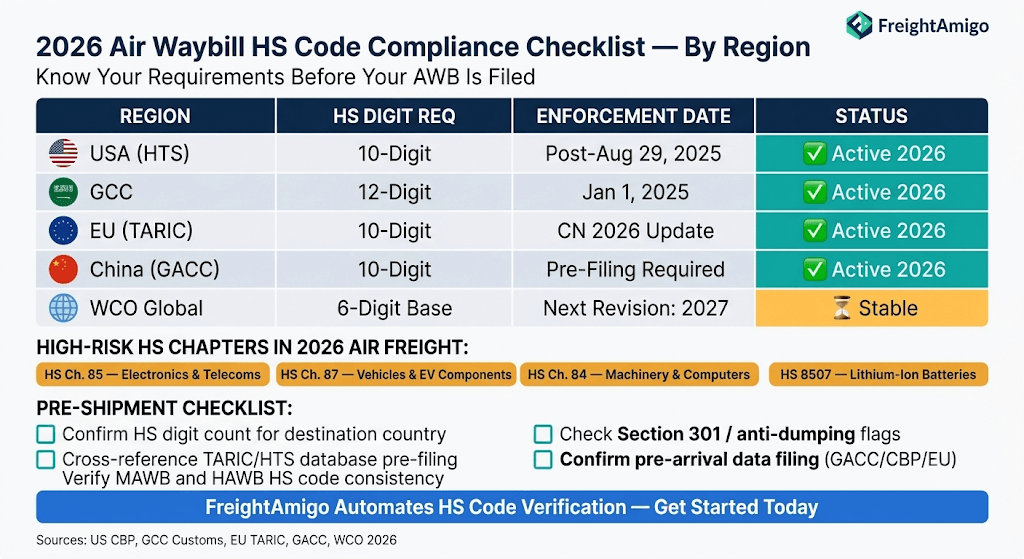
United States: 10-digit HTS codes mandatory on all AWBs following de minimis threshold reforms (effective post-August 29, 2025, enforced through 2026)
GCC (Gulf Cooperation Council): 12-digit HS code expansions mandatory from January 1, 2025, continuing as standard in 2026
European Union: Combined Nomenclature (CN) 2026 updates refine Chapters 85 (electronics) and 87 (vehicles/parts)
Global baseline: WCO's HS 2022 nomenclature remains the international standard; next revision cycle begins 2027
High-scrutiny categories: Electronics (HS 8517), lithium batteries (HS 8507), and EV components (HS 8703) face increased documentation audits
MAWB vs HAWB: Waybill Types and Tracking in Air Freight
The distinction between Master Air Waybills (MAWB) and House Air Waybills (HAWB) determines the level of tracking granularity available to different parties in the supply chain.
When a freight forwarder consolidates multiple shippers' cargo into a single airline booking, the airline issues one MAWB covering the entire consolidated shipment. The forwarder then issues individual HAWBs to each shipper within that consolidation.
This two-tier structure has direct implications for tracking visibility — and for where HS code compliance responsibility sits.
Feature
MAWB (Master Air Waybill)
HAWB (House Air Waybill)
Issued By
Airline or IATA-approved agent
Freight Forwarder (NVOCC)
Covers
Entire consolidated shipment
Individual shipper's cargo
Tracking Level
Master/consolidated level only
Individual shipment visibility
HS Code Responsibility
Consolidated goods description
Per-consignment HS accuracy
2026 Compliance Role
Airline-to-airline handover document
Shipper-to-forwarder legal basis
Customer Access
Limited (forwarder holds MAWB)
Direct access for shipper
Practical implications for shippers in 2026:
Always request your HAWB number for accurate individual shipment tracking
Verify that your forwarder has correctly mapped HAWB HS codes to MAWB manifest data
MAWB tracking gaps are common — direct airline portals may only show consolidated status
Both MAWB and HAWB must carry compliant HS codes under 2026 US, GCC, and EU rules
Discrepancies between MAWB and HAWB HS codes trigger automated customs flags
2026 Regional Regulatory Changes: Impact on Waybill vs Tracking Number
The single most disruptive factor affecting air freight AWB compliance in 2026 is the wave of jurisdiction-specific HS code and tariff documentation mandates that directly determine whether your shipment clears customs — or stalls in a tracking loop.
These regulatory changes do not affect tracking numbers directly. However, because tracking systems pull clearance status data from customs processing systems, any AWB compliance failure immediately surfaces as a tracking delay or hold.
Regional 2026 compliance snapshot:
🇺🇸 United States: 10-digit HTS mandatory on all commercial air cargo AWBs; de minimis exemption removal enforced; Section 301 tariff updates require precise Chapter 84–85 classification
🇸🇦 GCC (Saudi Arabia, UAE, Kuwait, Bahrain, Oman, Qatar): 12-digit HS codes now fully operational; automated customs cross-referencing against Gulf Cooperation Council Tariff
🇪🇺 European Union: CN 2026 revisions impact electronics (Chapter 85) and automotive parts (Chapter 87); TARIC integration updated
🇨🇳 China: GACC AWB data pre-filing requirements continue; enhanced scrutiny on HS 8471 (computers) and 8542 (semiconductors)
Global WCO baseline: No new HS nomenclature cycle until 2027; shippers should not anticipate classification relief before then
How to Use Your Waybill Number for Air Freight Tracking in 2026
Knowing exactly how to convert your AWB into an effective tracking tool — and how to interpret what you see — is a critical operational skill for any air freight shipper or logistics manager in 2026.
The process is straightforward, but 2026's compliance-heavy environment means tracking screens now surface compliance flags, customs holds, and HS code exceptions that were previously invisible to non-customs professionals.
Follow this step-by-step process:
Retrieve your 11-digit AWB number from your booking confirmation, forwarder's shipment advice, or FreightAmigo dashboard
Enter the AWB on the issuing carrier's portal or your freight forwarder's tracking platform (FreightAmigo aggregates multi-carrier tracking in one dashboard)
Review the status milestones: Look for Accepted → Departed → In Transit → Arrived → Customs Processing → Cleared → Delivered
Check for compliance flags: In 2026, tracking systems increasingly display HS code mismatch alerts and customs pre-screening outcomes
Monitor customs hold notifications: US CBP, EU customs, and GCC authorities now push automated holds visible in real-time tracking
Act immediately on delays: Contact your freight forwarder with the AWB number if customs hold exceeds 24 hours — resolution windows are tight under 2026 enforcement timelines
Archive your AWB data: Retain AWBs and tracking records for a minimum of 5 years for trade compliance audit purposes
Common Waybill and Tracking Errors That Cause Delays
The most preventable air freight delays in 2026 are caused by a small, well-documented set of AWB data entry and HS code classification errors — every one of which surfaces immediately in the tracking system as a hold or exception.
Understanding these failure points allows shippers and logistics managers to implement upstream quality controls before cargo is tendered to the airline.
Top AWB and tracking errors to eliminate in 2026:
Incorrect HS code digit count: Submitting a 6-digit code to the US (requiring 10-digit HTS) or GCC (requiring 12-digit) triggers automated rejection
Goods description mismatch: AWB description inconsistent with HS code classification raises red flags in AI-assisted customs screening systems
Consignee data errors: Incorrect tax ID, EORI number (EU), or importer of record details prevent customs from processing the entry
Missing shipper EAD/export declaration reference: Increasingly required in 2026 on AWBs for high-value or controlled commodity shipments
HAWB/MAWB HS code discrepancy: Forwarder HAWBs with different HS codes than the carrier MAWB trigger cross-document compliance flags
Late AWB amendment: Attempting to correct HS codes after the airline has accepted cargo creates delays; most carriers lock AWB data at cut-off time
Duplicate tracking number confusion: Some e-commerce platforms generate platform-specific tracking IDs that diverge from AWB numbers, causing end-customer confusion
What is the main difference between a waybill and a tracking number in air freight?
An Air Waybill (AWB) is a legally binding transport and customs document that carries HS codes, contractual terms, and consignee details. A tracking number — often the same as the AWB number — is an operational reference used solely to monitor real-time shipment status with no legal authority.
Can I use my AWB number as a tracking number for air freight?
Yes, in the vast majority of cases the 11-digit AWB number functions as the primary tracking identifier on airline portals and freight platforms. Some forwarders and e-commerce carriers may issue a separate proprietary tracking ID that maps back to the underlying AWB.
Do tracking numbers include HS codes for 2026 customs compliance?
No. HS codes appear exclusively on the Air Waybill in the "Description of Goods" field. The tracking number references AWB data but does not independently carry HS code, duty, or classification information required by customs authorities.
How do 2026 HS code changes affect air freight tracking status?
If an AWB carries an incorrect or insufficiently detailed HS code — such as a 6-digit code submitted to the US (requiring 10-digit HTS) — customs will issue a hold that immediately appears in the tracking system as a clearance delay or exception flag.
What is the difference between MAWB and HAWB for shipment tracking?
A Master Air Waybill (MAWB) covers an entire airline consolidation and provides only bulk-level tracking visibility. A House Air Waybill (HAWB), issued by the freight forwarder, tracks your individual shipment and is the document most shippers need for consignment-level status updates.
Is an Air Waybill mandatory for all international air freight shipments in 2026?
Yes. Under IATA regulations, an Air Waybill is required for every piece of international commercial air cargo. There are no exemptions for small parcels, e-commerce shipments, or informal trade — particularly following the 2025–2026 de minimis reform enforcement in the US and EU.
How do I find my air freight tracking number if I've lost my shipping documents?
Contact your freight forwarder or the issuing airline with your booking reference, shipment date, and origin/destination details. The AWB number — which is your tracking number — can be retrieved from the carrier's booking system or your FreightAmigo shipment dashboard.
Why is tracking air freight waybills especially important for e-commerce businesses in 2026?
E-commerce sellers face heightened 2026 customs scrutiny, including US de minimis enforcement, EU VAT on low-value imports, and GCC customs digitization. Real-time AWB tracking enables immediate response to customs holds, protecting delivery SLAs and customer satisfaction scores.
What are the US HTS code requirements on air waybills in 2026?
The US requires 10-digit Harmonized Tariff Schedule (HTS) codes on all commercial air cargo AWBs, a mandate that came into full enforcement following the August 29, 2025 de minimis threshold reform. In 2026, CBP's automated targeting system cross-checks every AWB against HTS classification databases.
What HS code format does the GCC require on Air Waybills in 2026?
GCC member states — including Saudi Arabia, the UAE, Kuwait, Bahrain, Oman, and Qatar — require 12-digit HS codes on all commercial AWBs, a standard that took effect January 1, 2025 and remains fully enforced throughout 2026 under the Gulf Cooperation Council Unified Customs Law.
Resources and Next Steps
FreightAmigo provides end-to-end air freight management tools that automate AWB generation, HS code verification, real-time tracking aggregation, and 2026 customs compliance checking across all major trade lanes.
Whether you're managing MAWB/HAWB complexity, navigating US HTS mandates, or scaling e-commerce air freight operations globally, FreightAmigo's platform is engineered to eliminate the compliance gaps between your waybill and your tracking data.
Get started with FreightAmigo today:
For expert guidance, Book a Demo with FreightAmigo.








 Global Popular RoutesTop sea & air shipping lanes
 Special OfferLimited-time shipping promotions





 Express
 Document
 Parcel - Air/Sea
 Container
 Relocation