What Does LCL Mean? A Comprehensive Guide to Less Than Container Load Shipping Basics and Applications
What is LCL
LCL stands for Less than Container Load, which refers to a shipping model where a single shipper's goods are insufficient to fill an entire standard container, requiring them to share the same container space with cargo from other shippers.
This method allows cross-border e-commerce, small and medium enterprises, and multinational importers to operate international ocean freight without bearing the cost of an entire container. Under the global supply chain trend of pursuing agile logistics and flexible inventory, small-volume, high-frequency consolidation demand has become a norm in international trade. It significantly lowers the entry barrier for international trade, enabling businesses to optimize overseas warehousing and inventory turnover rates.
Whether you require Full Container Load or Less than Container Load services, the one-stop digital documentation and digital logistics platform of FreightAmigo can provide the most suitable solution for your needs.
How LCL Shipping Works
The core of Less than Container Load shipping lies in the aggregation and integration of cargo at the container freight station of the port of origin. Shippers deliver their respective loose cargo to the designated container freight station warehouse, where logistics personnel measure, weigh, and safely pack the goods into the same container based on the nature of the cargo and its destination. Once the container is sealed, it proceeds to the terminal for ocean freight. Upon arrival at the destination port, it enters the destination container freight station again for de-consolidation and sorting, before being distributed to different consignees.
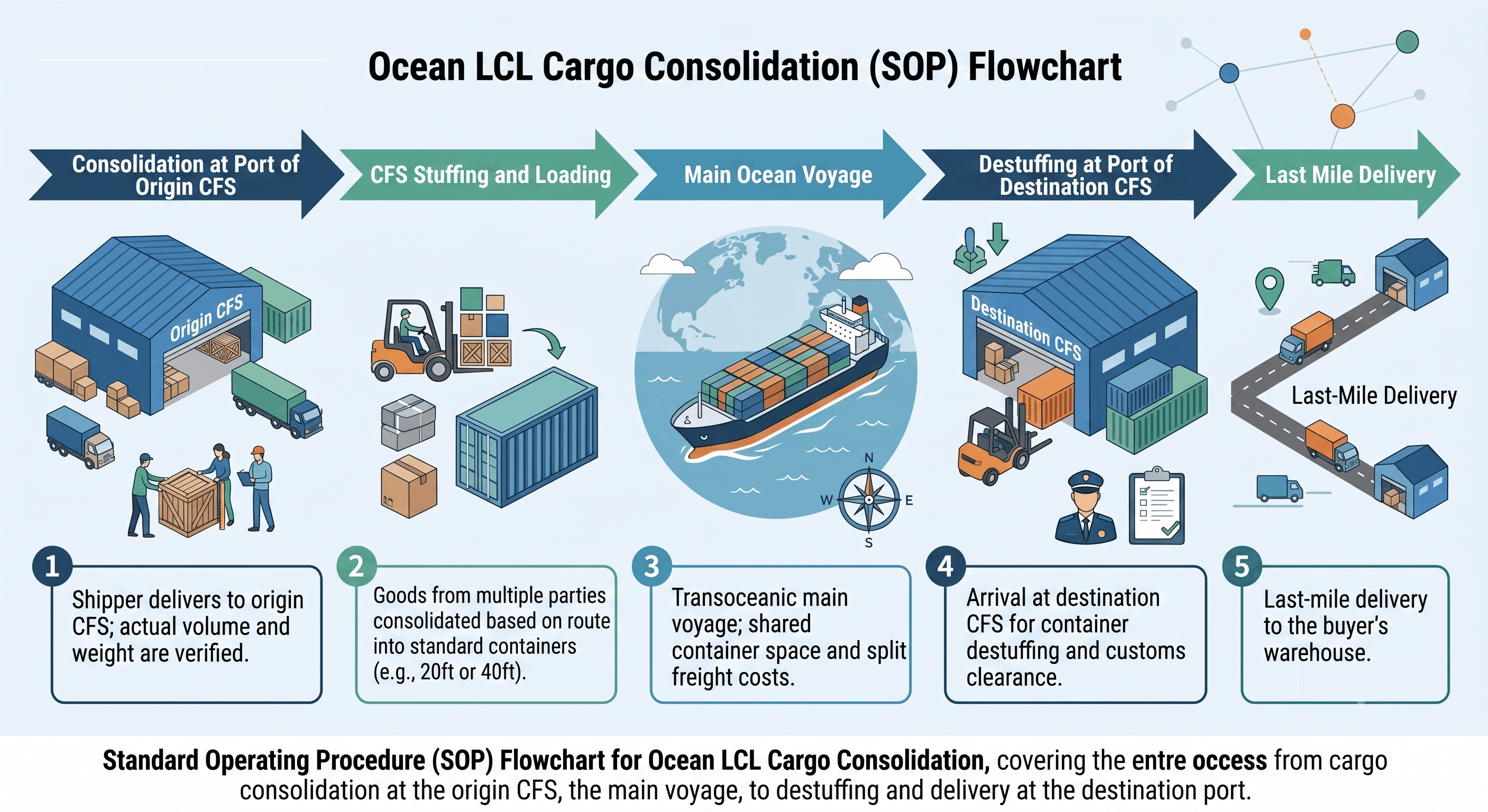
The standard operational workflow for ocean Less than Container Load shipping is as follows:
Origin Freight Station Centralization: Shippers deliver goods to the origin container freight station, where logistics personnel verify the actual volume and weight.
Consolidation and Loading: Cargo from multiple parties is consolidated and loaded into standard containers, such as 20 foot or 40 foot containers, according to the shipping routes.
Main Ocean Voyage: The transoceanic main voyage takes place, where various cargo owners share the container space and distribute the freight costs.
Destination De-consolidation: The container arrives at the destination container freight station for de-consolidation and customs clearance.
Final Delivery: The last mile delivery is executed to transport the goods to the buyer's warehouse.
Choosing between Less than Container Load and Full Container Load is fundamentally a dynamic decision centered around total cargo volume, local charges at both ends, and real-time freight rate fluctuations from carriers. The following table provides a clear comparison based on standard terms and maritime practices of major global carriers:
Comparison Item
LCL Less than Container Load
FCL Full Container Load
Freight Basis
Calculated based on the weight or measurement principle, subject to minimum billing limitations
Fixed freight rate per container
Space Flexibility
Paid according to the actual space occupied in cubic meters
Exclusive use of the entire safe capacity of the container, such as 20 foot or 40 foot
Schedule Stability
Subject to fluctuations due to required time for collection, loading, de-consolidation, and sorting at both ends
High stability as containers are loaded and sealed at the factory, proceeding directly to the terminal for clearance and pickup
Cargo Damage Risk
Higher risk due to multiple stages of manual handling and potential friction, pressure, or contamination from mixed loading
Extremely low risk as the container remains sealed throughout, with no third-party contact unless inspected by customs
Customs Inspection Impact
Vetting of any single cargo owner affects the entire container, causing delays for all parties
Affects only the specific cargo owner, allowing the container to be picked up immediately once cleared
Major Advantages of LCL
For enterprises with smaller shipment volumes, the most direct benefit of Less than Container Load shipping lies in its ability to significantly optimize logistics cash flow and inventory flexibility.
Pay as You Use: Companies only pay for the space they actually occupy, eliminating the waste of paying for empty space when cargo volumes are low.
Reduced Warehousing Costs: It allows businesses to adopt a flexible replenishment model characterized by small batches and multiple shipments, decreasing the risks of overseas warehouse congestion and tied-up capital.
Mitigated Market Testing Risks: Ideal for trial sales of new products, sample delivery, or small-scale distribution by cross-border e-commerce entities, preventing large upfront procurement capital expenditure.
Accelerated Capital Turnover: It lowers the capital tied up in single logistics and procurement operations, granting small and medium enterprises more flexible cash flow.
Potential Drawbacks and Risks of LCL
Despite the high flexibility that Less than Container Load shipping offers, the supply chain uncertainty remains relatively high due to the involvement of mixed cargo from multiple parties and multiple stages of manual loading and unloading.
Consolidation Time Lags: Cargo must wait at the container freight station until other goods for the same route fill the container, and extra time must be reserved for loading and de-consolidation at both ends, making the transit time slower than direct Full Container Load voyages on the same route.
Significant Destination Local Charges: Less than Container Load shipping incurs specific container freight station de-consolidation fees and handling charges. When cargo volumes increase, the accumulated destination local charges might cause the total cost to exceed that of a budget Full Container Load shipment.
Linked Inspection Risks: If goods belonging to other cargo owners in the same container involve incorrect declarations, infringement, or contraband, the entire container will be detained by customs for inspection, causing innocent cargo owners to face identical delays.
Increased Risk of Cargo Damage: Cargo undergoes multiple movements and forklift handlings within the container freight station warehouses, and sharing space with diverse third-party goods increases the likelihood of friction, compression, or cross-contamination.
LCL Cost Structure and Billing Rules
The calculation of Less than Container Load freight strictly follows the international weight or measurement principle, meaning charges are based on whichever value is greater between volume and weight.
Freight Assessment Basis: In ocean consolidation practice, the total cubic meters and total weight in tons are compared. The larger value is utilized as the basis to calculate the main voyage freight and related container freight station local charges. For instance, voluminous but light cargo is billed by cubic meters, while compact but heavy cargo is billed by weight.
Minimum Charge Limitations: The vast majority of consolidation agents and carriers establish a minimum entry threshold, usually 1 cubic meter or 1 ton, depending on carrier terms. Even if the cargo falls below this standard, it will be billed directly at the minimum unit.
A standardized Less than Container Load cost structure typically comprises the following elements:
Ocean Freight: The basic transoceanic freight calculated per billing unit.
Origin Container Freight Station Fee: Charges for cargo collection, sorting, and loading labor at the origin warehouse.
Terminal Handling Charges: Container handling fees at both the origin and destination terminals.
Documentation and Customs Clearance: Service fees for handling export and import customs paperwork at both ends.
Surcharges: Environmental surcharges, bunker adjustment factors, and peak season surcharges.
Destination Container Freight Station De-consolidation and Delivery Fee: Fees for stripping the container, sorting cargo, and executing last mile delivery at the destination.
Our customs declaration and clearance services utilize AI-driven harmonized system code validation and tax optimization to help you estimate import duties accurately, preventing unexpected expenditures at the destination port.
When to Choose LCL: A Dynamic Decision Assessment
In a volatile freight market, enterprises should not rely on rigid volume figures as hard thresholds for switching transport modes; instead, they should establish a dynamic decision assessment framework. In practice, whether to transition from Less than Container Load to Full Container Load depends entirely on a comprehensive comparison between real-time freight rate changes and the cumulative local charges at both container freight stations.
The global ocean freight decision matrix helps you evaluate the optimal switching point:
Small Volume Range: When the total volume of goods is minimal, Less than Container Load shipping is invariably the preferred choice due to its absolute cost advantage. During this stage, shipments are characterized by small volumes, flexible budget distribution, tolerance for consolidation time lags, and flexible inventory replenishment needs.
Dynamic Comparison Zone: As cargo volumes grow, shippers must calculate the main voyage Less than Container Load freight plus the volume-based container freight station de-consolidation and handling fees, comparing the sum against the contemporary flat rate of a 20 foot Full Container Load container. If Full Container Load rates drop sharply or destination local charges are excessive, utilizing Full Container Load directly often yields a lower total landed cost and faster transit times.
Large Volume Range: When the cargo volume approaches the safe capacity limit of a small container, or when the volume reaches a critical point where comparison shows the total cost is more favorable, the flat rate of a Full Container Load shipment begins to offer distinct economies of scale. This mode is better suited for urgent timelines, fragile or high-value goods, or cargo requiring direct sealing at the factory.
Frequently Asked Questions
What does LCL mean in ocean freight?
LCL is the abbreviation for Less than Container Load. It represents a logistics model where goods from multiple shippers share a single container space and distribute the main voyage freight because their individual volumes are insufficient to fill a whole container.
At what volume should I consider switching from LCL to FCL?
There is no fixed cubic meter threshold in practice. As your cargo volume expands, you should obtain quotes for the total Less than Container Load cost, including container freight station local charges at both ends, and compare them against the fixed rate of a 20 foot Full Container Load container to make the most economical choice based on current market dynamics.
How are LCL freight charges calculated?
LCL freight strictly follows the weight or measurement principle, selecting the larger value for billing. Carriers compare the total cubic meters and total weight in tons of the cargo, utilizing the larger figure as the basis to calculate the main voyage and port fees, usually subject to a minimum billing unit.
Why is the transit time for LCL shipping usually slower than FCL?
Less than Container Load shipping requires additional time at the origin container freight station for cargo collection, verification, and loading. Upon arrival at the destination port, the container must be transferred to a freight station for de-consolidation, sorting, and distribution. These pre- and post-carriage operations cause the overall supply chain timeline to be more variable than a direct Full Container Load shipment.
What are the primary risks associated with LCL shipping?
The primary risks involve potential cargo abrasion caused by multiple stages of manual and forklift handling, as well as cross-contamination from mixed loading with third-party goods. Additionally, if other cargo in the same container undergoes customs inspection, your goods will be detained alongside them.
Are the minimum billing standards for LCL identical across all shipping routes?
They are not identical. The minimum charge limitations depend entirely on carrier terms, freight forwarder policies, and specific route regulations. Some routes may require a minimum of 1 cubic meter, while others utilize different billing bases, making it vital to verify with your carrier before booking.
Are there specific packaging requirements for LCL cargo?
Because Less than Container Load cargo undergoes multiple loading cycles, stacking, and mixed storage with other commodities, it is strongly recommended to use moisture-proof, pressure-resistant export-grade wooden crating or reinforced heavy-duty double-wall corrugated boxes, complemented by thorough palletized stabilization and stretch wrap protection.
What does the CFS fee represent in consolidation shipping?
The container freight station fee covers handling costs at the warehouse. This is an exclusive expense in Less than Container Load logistics, utilized to pay for the labor, space, and equipment costs incurred when origin and destination warehouses conduct cargo sorting, measurement, container loading, and de-consolidation distribution.
Conclusion
A thorough understanding of the underlying weight or measurement billing logic and destination local charge structures of Less than Container Load shipping forms the foundation for enterprises to optimize their total landed costs in international trade. In practical operations, leveraging the space flexibility of Less than Container Load shipping while ensuring export-grade packaging protection allows small and medium enterprises to manage global supply chains efficiently without tying up substantial capital. Assessing your current cargo volumes against local charges and establishing a dynamic comparison standard will serve as your most effective strategy for optimizing shipping costs.
Through the integrated logistics platform of FreightAmigo, you can easily compare Less than Container Load and Full Container Load quotes, book transportation solutions, manage freight documentation, and track your cargo movements in real time. To obtain professional guidance from a logistics specialist, please schedule a product demonstration or contact FreightAmigo directly.
For expert guidance, Book a Demo with FreightAmigo.








 Global Popular RoutesTop sea & air shipping lanes
 Special OfferLimited-time shipping promotions





 Express
 Document
 Parcel - Air/Sea
 Container
 Relocation