Logistics 101: Complete Guide to CFS Meaning, Devanning, and FAK Shipping Costs
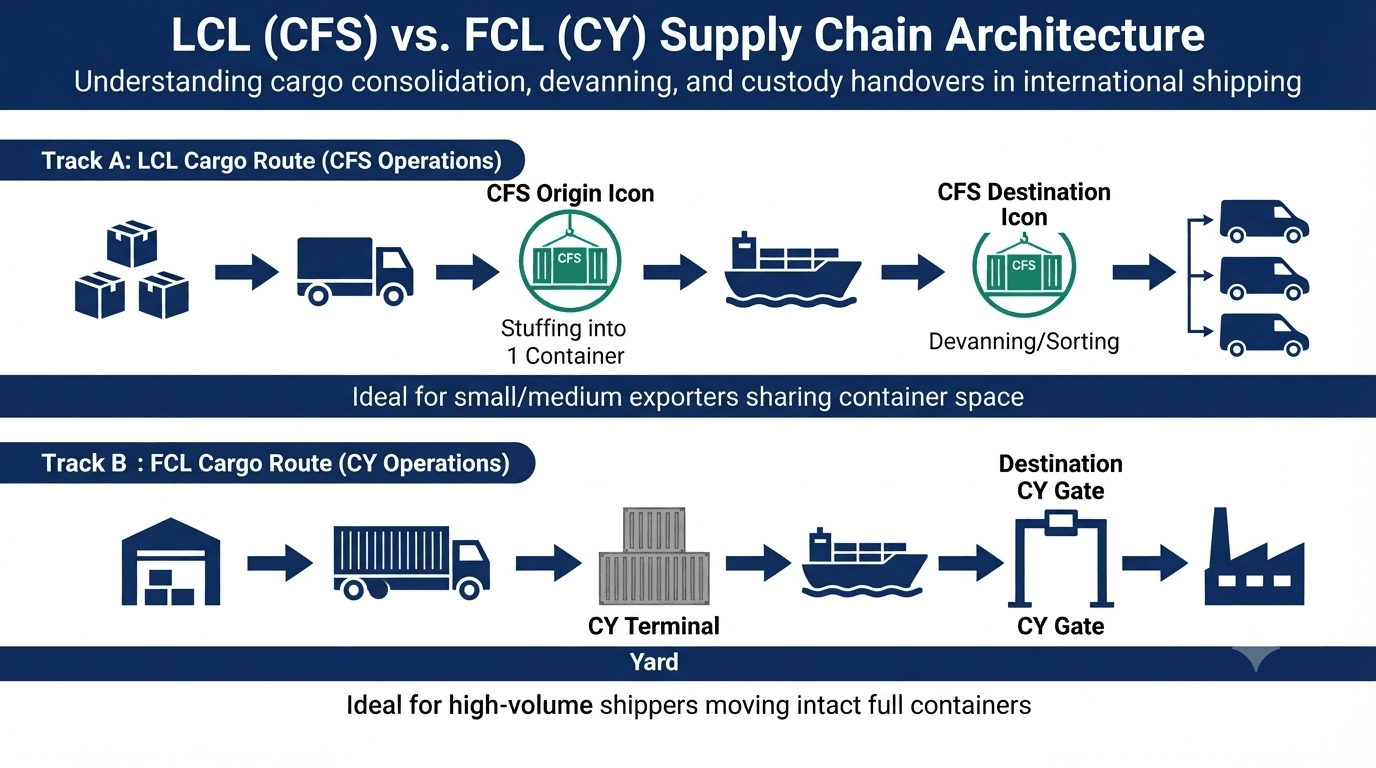
According to the industry standards of the World Shipping Council and major international port authorities, the Container Freight Station (CFS) continues to play a core infrastructure role in the global supply chain. It is primarily responsible for handling the consolidation and de-consolidation operations of Less than Container Load (LCL) cargo.
Benefits for Small and Medium Enterprises
Small and medium enterprises or cross-border e-commerce merchants can enter the international trade market by sharing container space without paying for full container rates. Mastering an authoritative CFS definition, operational workflows, and common cost structures can effectively assist businesses in planning customs clearance timelines and reasonably controlling logistics expenses.
The Definition of CFS in Logistics
CFS is a dedicated logistics and warehousing facility used for receiving, sorting, stuffing, and destination devanning of loose cargo. During export, loose cargo from different shippers is consolidated here and stuffed into the same container; during import, the destination CFS performs unboxing and distribution.
As major global ports gradually promote automation, many modern CFS facilities are progressively adopting digital tracking and document integration systems. In international trade practices, the workflow mainly includes the following common cargo delivery and pick-up modes, though specific descriptions and strictness may vary by region and port:
CFS/CFS: Consolidation at the origin and devanning for distribution at the destination, which is the standard LCL to LCL mode.
CFS/CY and CY/CFS Delivery Modes
CFS/CY: Loose cargo from multiple shippers is consolidated at the origin and then delivered to the destination Container Yard (CY) in the form of a Full Container Load (FCL).
CY/CFS: Loaded as a full container by a single shipper at the origin, and enters the CFS at the destination port for devanning and distribution to multiple consignees.
These交接 modes provide a high degree of transportation flexibility for international trade entities of different scales.
Common Differences Between CFS and CY (2026 Update)
Core Distinctions Between CFS and CY
From the perspective of international shipping practices, the core distinction between CFS and CY lies in whether the operational object is granular loose cargo or a sealed container. CY typically focuses on the storage and vessel loading/unloading of full containers, whereas CFS focuses on the consolidation, sorting, and restructuring of cargo inside the containers. However, it should be noted that actual billing and service details will vary depending on ports, warehouses, freight forwarders, and contracts, rather than being an unalterable universal rule.
Comparison Item
Container Yard
Container Freight Station
Core Function
Responsible for FCL handover, storage, and dispatching
Responsible for LCL consolidation, devanning, and cargo handling
Primary Object
Sealed full container cargo
Loose cargo that is not yet stuffed or needs separation
Billing Basis
Practically calculated by container volume and number of days
Commonly calculated by cargo volume in cubic meters, weight, or whichever is greater
Operational Service
Storage, gate inspection, vessel loading and unloading
Stuffing and devanning, sorting and palletizing, customs inspection support, short-term warehousing (subject to actual services provided by each facility)
Cross-border e-commerce, small and medium enterprises, mixed loose cargo shippers
This framework clearly demonstrates the division of labor under different transit demands. Selecting the correct facility can effectively reduce unit logistics costs.
Definition of Devanning and Its Workflow and Field Operations
Devanning or stripping refers to the operational process of unloading cargo from a container and sorting it item by item at the destination CFS. This is a critical step in loose cargo logistics that requires focus on safety and compliance, and operations should follow local port safety regulations and warehouse systems.
Standard Devanning Operational Steps
Although specific operational flows vary by country, port, and warehouse regulations, standard devanning operations usually include the following core steps:
Seal Verification and Container Opening
Seal Verification: Verify whether the container seal number is intact and record it in the report.
Opening the Container: Authorized professionals open the container doors and conduct a preliminary visual inspection of the cargo inside.
Unloading and Counting: Utilizing forklifts and other warehousing equipment to unload the cargo, then counting and sorting it according to the Bill of Lading (B/L).
Customs and Warehousing Compliance Interface: Within a compliant CFS, cooperate with necessary unboxing spot checks or relevant inspection formalities.
Palletizing and Outbound Delivery: Secure loose cargo on pallets according to requirements to facilitate last-mile delivery.
Interfacing with the backend customs clearance team in advance is the key to ensuring rapid cargo pickup after devanning.
FAK is the abbreviation for Freight All Kinds, meaning a uniform rate applied regardless of the commodity type. It is a homogeneous freight rate charged by common carriers for different types of cargo within the same container. Except for special regulatory goods such as dangerous goods or refrigerated items, carriers generally no longer negotiate individual prices for specific commodity categories.
Advantages of FAK Sea Freight Rates
Against the background of global shipping market fluctuations, FAK rates provide a more predictable cost structure for LCL consolidators and small and medium enterprises:
Simplified Quotation Process: Fast acquisition of basic freight rates without spending time reviewing tedious Harmonized System Code (HS Code) listings.
Optimized Space Utilization: Allows consolidators to mix and match high-density and low-density cargo, helping to reduce the amortized cost per cubic meter.
Reduced Compliance Risk: A uniform rate decreases the probability of freight disputes with shipping lines caused by cognitive differences in commodity declarations.
For cross-border e-commerce cargo with diverse product types, the FAK mode is an indispensable logistics cost control tool.
The Critical Role of Freight Forwarders in CFS Operations
Role of Freight Forwarders in CFS
International freight forwarders act as vital coordinators among shippers, customs, and CFS operators. FreightAmigo, as an industry leader, deeply understands that forwarders are not only responsible for booking space but also need to compile the cargo manifest to ensure all LCL cargo complies with the relevant legal and regulatory requirements of the destination port.
With the gradual popularization of global port digital Application Programming Interface (API) integrations, many modern freight forwarders are now able to provide real-time tracking of internal CFS stuffing and devanning progress, customs release status, and pickup appointment scheduling. This effectively shatters the traditional pain point of the information black box in loose cargo logistics.
CFS Operational Cost Structure and Fee Considerations
CFS fees primarily revolve around the physical handling and short-term storage of cargo. Shippers must clearly distinguish the allocation of expenses between origin and destination, and note that international trade terms (Incoterms) cannot simply summarize all fee divisions; the actual expense allocation still depends on shipping line clauses, destination port fee structures, and freight forwarder arrangements.
Main Elements of CFS Cost Structure
According to common industry operations, the CFS cost structure generally includes the following main elements:
Terminal Handling Charge (THC): Expenses related to container relocation, loading, and unloading operations between the port and the CFS.
CFS Stuffing / Devanning Fee: Substantive labor fees for loading or unloading cargo into or out of containers manually or mechanically.
Documentation and Handling Fees: Administrative processing fees for issuing house bills of lading and filing corresponding manifest declarations.
Short-Term Storage Fee: Cargo retention fees incurred after exceeding the specified free time.
Accurately calculating volume and weight, and completing customs clearance and cargo pickup within the free time, is an effective way to avoid expensive demurrage and storage charges.
How 2026 Technology Assists in CFS Risk Management
Major international ports and large logistics facilities are progressively promoting CFS smart management systems based on the Internet of Things (IoT) and digitalization technologies. The application of electronic seals and real-time sensors allows shippers to more conveniently master temperature and humidity changes as well as vibration data inside the container, helping to reduce the risk of cargo damage during handling.
Furthermore, AI smart scheduling algorithms have been applied by some large operators to optimize container space layout through 3D container loading optimization. This not only maximizes space utilization but also ensures heavy cargo is placed at the bottom and light cargo on top, reducing the probability of cargo damage caused by improper stacking.
Cross-Mode Comparison Between Sea CFS and Air Freight
The sea LCL mode cooperating with a CFS remains a highly cost-effective solution in global bulk loose cargo trade. Although air freight possesses a distinct advantage in speed, sea CFS demonstrates extreme economic adaptability in terms of carrying capacity and cost per kilogram.
For high-value consumer electronic products with strict time requirements, multimodal transportation, such as sea-air transport where sea cargo arrives at the port, passes through a CFS for rapid distribution, and transfers to air freight, is becoming one of the solutions for many multinational corporations to balance logistics budgets and supply chain resilience in 2026.
Frequently Asked Questions
What is the abbreviation and meaning of CFS in logistics? CFS stands for Container Freight Station. It is a logistics and warehousing facility specifically used for the consolidation, stuffing, devanning, and distribution of LCL loose cargo.
What is the devanning operation in logistics? Devanning refers to the operational process of unloading cargo from an sea container that has arrived at its destination. This operation is typically performed at a destination CFS and includes seal verification, mechanical or manual unloading, cargo condition inspection, and classification and counting based on the bill of lading.
How are CFS fees generally calculated in 2026? CFS fees are typically not charged on a full container basis. In many LCL scenarios, they are commonly billed based on the cargo volume in cubic meters, weight, or whichever is greater. However, specific billing rules and items will vary depending on ports, warehouses, freight forwarders, and contracts.
What does FAK sea freight rate mean? FAK stands for Freight All Kinds, representing a uniform rate regardless of commodity type. This means that shipping lines or carriers charge a uniform basic freight rate for cargo within a standard container, rather than differentiating prices based on the specific types of individual goods inside, except for special regulatory cargo.
What are the common differences between CFS and CY in shipping handovers? CFS mainly handles LCL loose cargo that requires consolidation or devanning, whereas CY is primarily responsible for the storage and lifting of sealed full containers, involving no direct contact with the cargo inside. However, the actual service and billing models still depend on individual contracts.
Who should pay the relevant CFS fees in international trade? Although the paying party of CFS fees relates to Incoterms, it cannot be summarized by trade terms alone. The actual allocation of fees relies heavily on shipping line clauses, destination port fee structures, and the specific arrangements of both freight forwarders.
What ways can shippers use to reduce CFS-related costs? Shippers should accurately measure cargo packaging dimensions to avoid inflated billing, select highly efficient CFS facilities to shorten operational time, and strictly control pickup times to ensure cargo is removed within the stipulated free time, thereby minimizing the chance of incurring overdue storage charges.
Is the CFS mode suitable for e-commerce loose cargo in 2026? Highly suitable. For cross-border e-commerce sellers who do not have the volume for full container exports, utilizing LCL consolidation through a CFS is currently one of the most economically viable transportation methods, and the digital tracking functions provided by many modern CFS facilities can also better interface with corporate ERP systems.
Conclusion: Mastering CFS to Create an Efficient 2026 Supply Chain
Against the backdrop of an increasingly complex global trade environment, a deep understanding of actual CFS operational details and cost structures is an important fundamental skill for enterprises to optimize cross-border logistics costs. By choosing a logistics partner that features high quotation transparency and provides online real-time cargo tracking capabilities like FreightAmigo, enterprises can ensure supply chain elasticity and compliance in global loose cargo transportation.
Under the volatile market conditions of 2026, reasonably deploying the operational models of CFS and CY based on your own needs will assist your enterprise in global market layout more intelligently and safely.
For expert guidance, Book a Demo with FreightAmigo.








 Global Popular RoutesTop sea & air shipping lanes
 Special OfferLimited-time shipping promotions





 Express
 Document
 Parcel - Air/Sea
 Container
 Relocation