The procedures for the regulation of restricted items and tariff arrangements are complicated. If you want to safely deliver your favorite items to your new home, it is best to have logistics experts to support you throughout the process! If you are planning to arrange overseas moving, welcome to FreightAmigo’s special page for overseas moving freight quotations.
There are different options for cargo transportation. If you want to choose the most convenient and suitable solution, it is best to have the full support of logistics experts! If you are planning to ship goods overseas, please go to the FreightAmigo page for inquiries.
There Are Different Options For Transporting Goods, And To Choose The Most Convenient And Suitable Solution, It Is Best To Have Full Support From Logistics Experts! If You Are Planning To Ship Goods Overseas, Please Visit The FreightAmigo Page For Inquiries!
FreightAmigo, a supply chain e-marketplace, would ship your documents, small parcels or pallet anywhere in the world with flexible solutions. Get an instant quote on FreightAmigo and make trade easier!
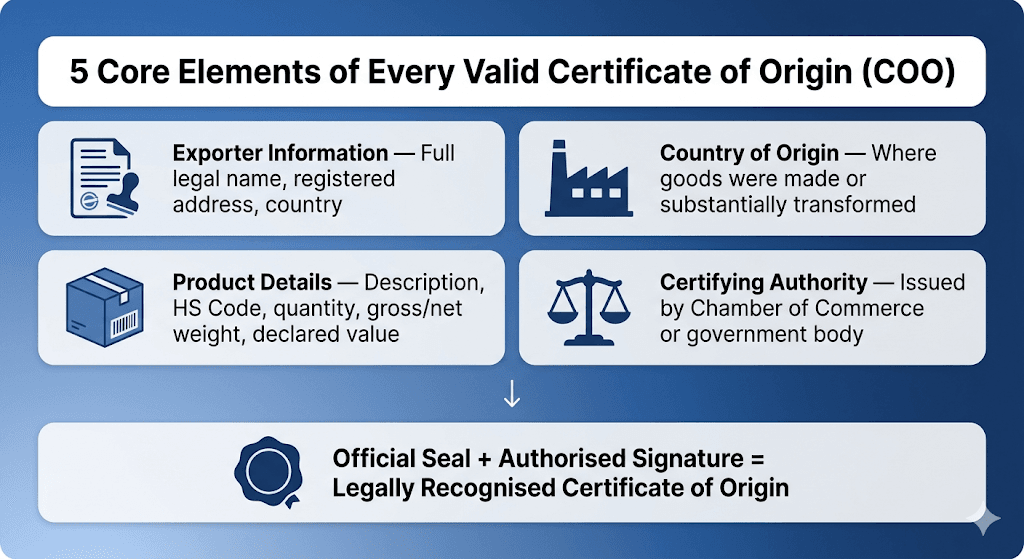
A Certificate of Origin (COO) is an official trade document that formally declares the country in which a product was manufactured, produced, or substantially transformed.
It acts as verifiable proof of origin for customs authorities, trade partners, and regulatory bodies worldwide.
Without a valid COO, shipments can face delays, additional tariffs, or outright rejection at the border.
In 2026, as global trade agreements become increasingly complex, the COO remains one of the most critical documents in any international shipment.
Why Is a COO Important in 2026?
In 2026, evolving trade agreements, tightened customs enforcement, and digital verification systems make the Certificate of Origin more critical than ever before.
Customs authorities use the COO to determine applicable tariff rates, verify regulatory compliance, and prevent fraudulent country-of-origin claims.
For businesses engaged in cross-border trade, a correctly issued COO can mean the difference between paying full duties or benefiting from significant tariff reductions.
Key reasons the COO matters in 2026:
Customs Compliance: Customs officials require the COO to classify goods correctly and apply the right duty rates
Tariff Preference Eligibility: Unlocks reduced or zero-rated tariffs under active Free Trade Agreements (FTAs)
Product Safety Verification: Confirms goods meet origin-specific safety and quality standards required by the importing country
Anti-Dumping Protection: Helps regulators identify and flag goods from countries subject to anti-dumping measures
Supply Chain Transparency: Increasingly demanded by ESG-conscious buyers and procurement teams
Types of Certificates of Origin
There are two primary categories of Certificate of Origin, and choosing the wrong type can invalidate your preferential tariff claim entirely.
Understanding the distinction protects your business from unexpected duty costs at the destination port.
1. Non-Preferential Certificate of Origin
Used for general trade where no special tariff agreement exists
Confirms the country of origin without claiming any tariff benefit
Commonly required for import licensing, trade statistics, and government procurement
2. Preferential Certificate of Origin
Used to claim reduced or zero tariffs under a specific Free Trade Agreement
Must meet strict Rules of Origin criteria defined in the relevant FTA
Examples include: EUR.1 Movement Certificate (EU), Form A (GSP), USMCA Certificate of Origin
Each type has specific issuing authorities, formats, and eligibility rules that must be followed precisely.
When Is a Certificate of Origin Required?
A Certificate of Origin is required whenever customs authorities, trade agreements, or contract terms demand documented proof of where goods were manufactured.
The specific trigger depends on the destination country, the product category, and the trade relationship between the two nations.
Common situations that require a COO:
Free Trade Agreement Exports — Claiming preferential tariff treatment under agreements such as RCEP, CPTPP, USMCA, or bilateral FTAs
Import Restrictions Based on Origin — Certain countries restrict or ban goods originating from specific nations
Government & Public Procurement — Public tenders frequently mandate a COO to ensure domestic or treaty-partner sourcing
International Tenders & Commercial Contracts — Private contracts may specify origin requirements as a contractual obligation
Anti-Dumping & Countervailing Duty Cases — Authorities require COO documentation to apply or exempt applicable duties
Regulated Product Categories — Goods such as food, pharmaceuticals, textiles, and electronics often face origin-specific regulations
How to Obtain a Certificate of Origin: Step-by-Step
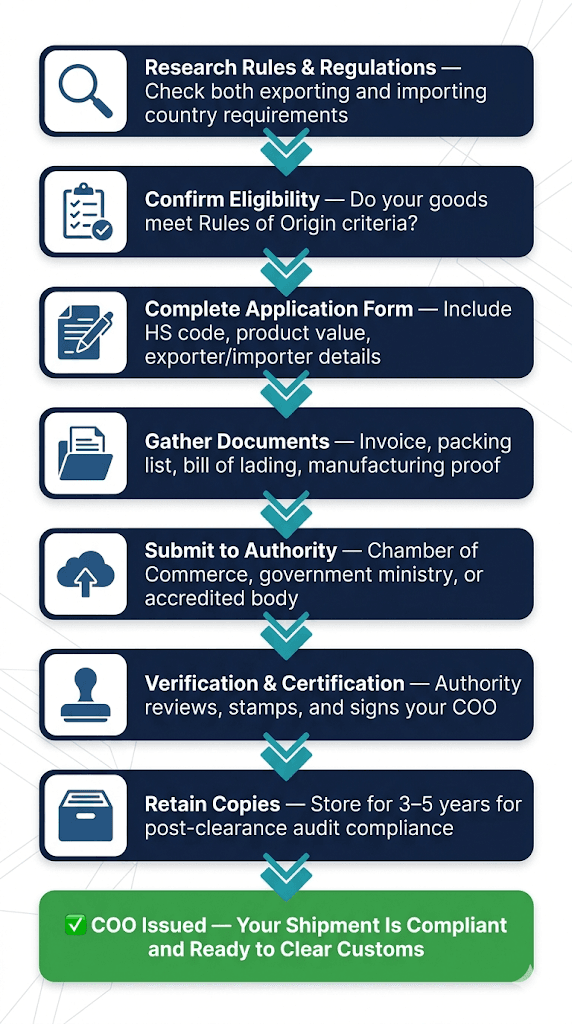
Obtaining a Certificate of Origin follows a structured application process that varies slightly by country, but the core steps remain consistent across most jurisdictions.
Following this process carefully prevents costly errors, rejected shipments, and delayed clearance.
Step-by-Step COO Application Process:
Benefits of Having a Certificate of Origin (COO)
A valid COO offers several benefits to exporters and importers:
Access to Preferential Tariffs:A COO can help businesses qualify for preferential tariffs under free trade agreements or preferential trade programs. This reduces import costs and makes exports more competitive.
Compliance with Trade Regulations:
Market Access and Competitive Advantage:Having a COO can enhance market access by demonstrating compliance with import regulations and eligibility for preferential treatment. It also gives businesses a competitive advantage by offering cost savings to customers.
Building Trust and Credibility:A valid COO adds credibility to a business’s claims about the origin of goods. It helps build trust with customers, trading partners, and regulatory
Conclusion
In conclusion, a Certificate of Origin (COO) is a vital document in international trade and shipping. It confirms the origin of goods and enables customs FreightAmigo is dedicated to assisting businesses in navigating the complexities of international trade, including the process of obtaining a Certificate of Origin (COO).
There Are Different Options For Cargo Transportation. If You Want To Choose The Most Convenient And Suitable Solution, It Is Best To Have The Full Support Of Logistics Experts! If You Are Planning To Ship Goods Overseas, Please Go To The FreightAmigo Page For Inquiries.











 Express
 Document
 Parcel - Air/Sea
 Container
 Relocation