The procedures for the regulation of restricted items and tariff arrangements are complicated. If you want to safely deliver your favorite items to your new home, it is best to have logistics experts to support you throughout the process! If you are planning to arrange overseas moving, welcome to FreightAmigo’s special page for overseas moving freight quotations.
There are different options for cargo transportation. If you want to choose the most convenient and suitable solution, it is best to have the full support of logistics experts! If you are planning to ship goods overseas, please go to the FreightAmigo page for inquiries.
There Are Different Options For Transporting Goods, And To Choose The Most Convenient And Suitable Solution, It Is Best To Have Full Support From Logistics Experts! If You Are Planning To Ship Goods Overseas, Please Visit The FreightAmigo Page For Inquiries!
FreightAmigo, a supply chain e-marketplace, would ship your documents, small parcels or pallet anywhere in the world with flexible solutions. Get an instant quote on FreightAmigo and make trade easier!
Navigating the Direct-to-Consumer Revolution: Insights and Strategies
In the rapidly evolving retail and e-commerce landscape, the rise of direct-to-consumer (DTC) brands marks a significant shift that is changing the way companies interact with their customer base. Not only does this model allow companies to bypass traditional intermediaries, it also enables them to build stronger relationships with their audiences to-consumer approach, brands are not just participating in a trend; they are reshaping the dynamics of retail and e-commerce, reinforcing the importance of direct engagement in today’s digital age. FreightAmigo provides this blog to explore the nature of the direct-to-consumer phenomenon and why it is a critical strategy for modern brands. you will gain insights into how the direct-to-consumer model works and the practical strategies for effectively navigating the direct-to-consumer revolution.
Want to compare the best Express, Air Freight, Sea Freight, Rail Freight & Trucking rates so as to have better control on cost?
What is Direct-to-Consumer?
The Direct-to-Consumer (DTC) model has evolved from a simple sales channel into a full-chain, data-driven brand strategy.
By 2026, successful DTC brands no longer rely on the “black box” data of third-party e-commerce platforms. Instead, they build deep customer connections through their own logistics systems.
Eliminating traditional distribution links saves brands more than 15% in intermediary costs. This flexibility makes businesses more resilient to market fluctuations.
Autonomy: Full control over the unboxing experience and delivery speed.
Profit margins: Skip wholesalers and keep gross profit for R&D.
Data closed loop: Track user behavior from click to delivery.
Core Reasons for DTC Logistics Transformation in 2026
As consumer demand for personalized experiences reaches new heights, DTC logistics has become a key competitive moat for brands. The 2026 e-commerce environment emphasizes immediacy and transparency.
Traditional logistics models can no longer meet modern consumers’ expectations of “order today, ship today.” With DTC, brands can achieve more flexible inventory allocation.
Enhanced customer experience: 85% of buyers say delivery speed directly impacts brand loyalty.
Maximized profit margins: Cutting distribution links can increase gross margins by 15–25%.
Brand consistency: Ensure packaging and delivery align with brand values.
The Digital Brain of DTC: OMS, WMS, and TMS
Integrating Order Management (OMS), Warehouse Management (WMS), and Transportation Management Systems (TMS) is the cornerstone of automated logistics in 2026. Their synergy ensures zero errors from order confirmation to doorstep delivery.
1. Order Management System (OMS)
Collects orders from Shopify, WooCommerce, or proprietary websites. It checks inventory in real time and assigns orders to the most suitable fulfillment center.
2. Warehouse Management System (WMS)
Optimizes picking and packing processes. With the latest AI algorithms in 2026, WMS can plan the shortest routes, boosting staff or robot efficiency by over 30%.
3. Transportation Management System (TMS)
The core tool for reducing shipping costs. It automatically compares rates from hundreds of carriers, selects the fastest and most economical routes, and provides end-to-end parcel tracking.
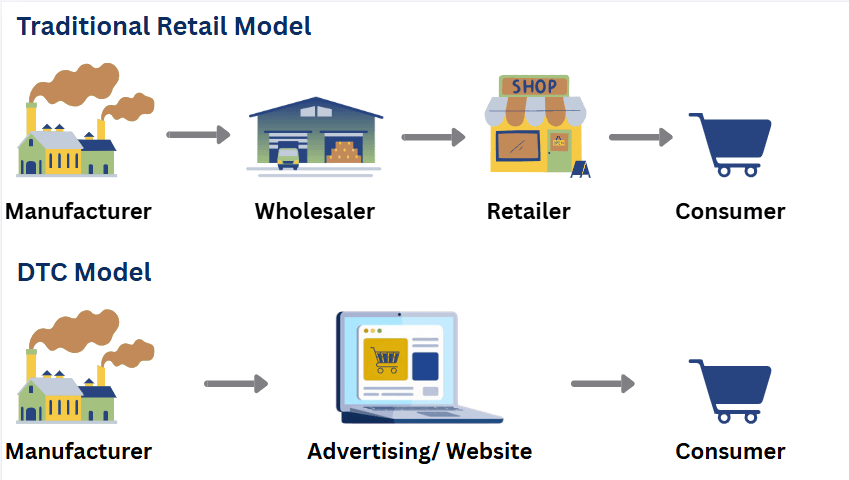
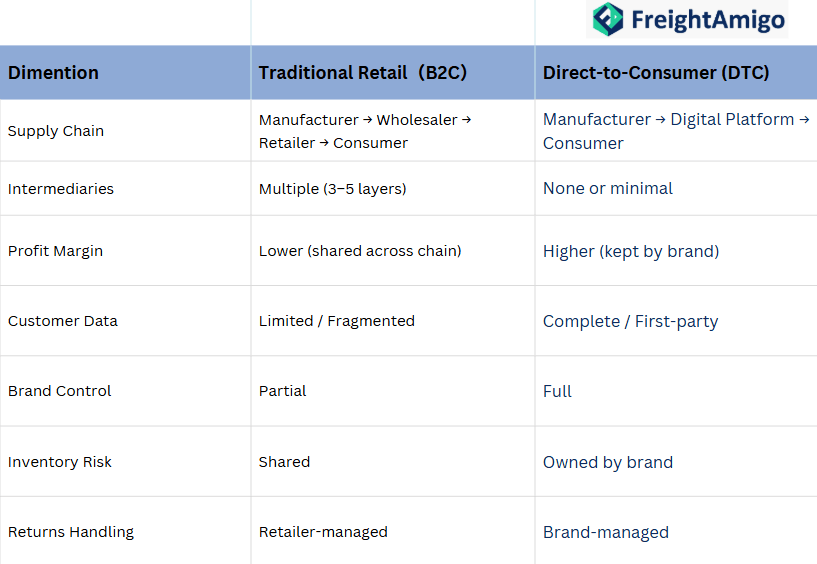
Comparison with Traditional Retail Models
The structural differences between DTC and traditional retail have resulted in fundamentally different logistics needs and cost structures.
Market data from 2026 shows that brands using direct-operated logistics have a customer retention rate 2.5 times higher than the traditional model.
Four Practical Tips for Building an Efficient DTC Supply Chain
Implementing DTC transformation requires not only systems but also sound logistics logic. Based on FreightAmigo’s experience helping thousands of companies, here are four proven tactics:
Hybrid warehousing: Store fast-moving items in regional forward warehouses, long-tail items in central warehouses.
Automated customs interface: Use API-enabled platforms to avoid administrative errors that cause shipment delays.
Dynamic rate comparison: Access real-time best freight rates to hedge against fuel surcharge volatility.
Multimodal transport strategy: Combine sea and rail for non-urgent orders to balance cost and speed.
FreightAmigo’s customized API integration service lets you connect OMS/WMS systems with a single click.
Examples of Successful DTC Brands
Bombas: It is known for its mission-driven approach, provides a pair of quality socks for every pair sold, responding to the high demand for socks in homeless shelters. The brand has expanded its product range and improved its digital shopping experience by integrating flexible payment options and focusing on customer transparency.
Gymshark: It started year-old, grew from a bedroom startup to a billion-dollar brand by focusing on community engagement and leveraging social media. The fitness apparel company initially sold supplements and later pivoted to clothing, using influencer partnerships and social media to build a strong brand community.
Everlane: It has set itself apart in the apparel industry with its radically transparent approach, revealing the true costs and manufacturing processes behind its products. The brand’s commitment to ethical practices and quality, coupled with strategic pricing and marketing, has helped build a loyal customer base and distinguish itself from competitors.
Optimizing the “Last Mile”: The Key to Satisfaction in 2026
The “last mile” is not just the end of a parcel’s journey—it’s the only physical touchpoint between brand and consumer.
Consumers in 2026 expect greater transparency and personalization in logistics.
Orders with real-time delivery updates reduce customer service pressure by 45%.
Flexible delivery: Allow changes to delivery location or time.
Eco-friendly packaging: Use 100% recyclable materials to enhance ESG image.
Unboxing surprises: WMS can precisely add branded gifts to packages.
Breaking Through DTC Logistics Bottlenecks: Costs, Tariffs, and Returns
While DTC is profitable, hidden operational costs can erode margins if unmanaged.
Reverse logistics (returns management), in particular, is often referred to as a "profit black hole".
Cross-border taxation: VAT/GST thresholds vary widely; automated tools are essential.
Returns management: Set up local sorting centers for inspection before deciding whether to ship back to HQ.
Transparent shipping costs: Avoid “surprise fees” at checkout, which cause 60% of cart abandonment.
Data Insights: FreightAmigo’s 2026 Global Shipping Trends
DTC shipments account for over 40% of global e-commerce logistics.
Brands using fully automated TMS save an average of 19.8% annually on logistics.
DTC parcel flows from Asia to North America and Europe grow 12% annually, reaching $1.5 trillion.
Automated API customs declarations are 3.5x faster than manual.
Companies integrating OMS and WMS achieve order error rates below 0.05%.
AI-Powered Future: The Rise of Predictive Logistics
In 2026, logistics shifts from “reactive” to “predictive.”
Predictive routing: TMS uses weather data to avoid potential port congestion.
What is OMS and how does it benefit DTC brands? OMS automates multi-channel orders, ensures inventory consistency, and prevents overselling.
How does WMS reduce logistics costs? By optimizing picking routes and packaging, WMS cuts labor hours and material waste.
Can TMS integrate with existing e-commerce sites? Yes. FreightAmigo’s TMS can embed via API for real-time rate queries.
Most common cause of cross-border DTC delays in 2026? Incorrect customs documents (HS Codes). Automated clearance reduces this risk by 90%.
Do returns always need to go back to Hong Kong? Not necessarily. Local inspection centers can save secondary cross-border costs.
Is FreightAmigo’s data accurate? Yes, based on millions of real shipping transactions annually.
Is DTC suitable for small businesses? Absolutely. Digital tools lower barriers to building global supply chains.
How to handle cross-border tax issues? Automated tax estimation tools and IOSS support streamline compliance.
What is Ship Now Pay Later? A digital finance service for DTC businesses, allowing shipment before payment to optimize cash flow.
The best way to provide an excellent customer experience is with the full support of logistics experts! To find out more about the information of DTC, please visit the FreightAmigo enquiry page.





 Express
 Document
 Parcel - Air/Sea
 Container
 Relocation










 Global Popular RoutesTop sea & air shipping lanes
 Special OfferLimited-time shipping promotions