China Tariff Rate Calculation for Customs Compliance and Logistics Planning
Accurate China tariff rate calculation is foundational for importers managing landed costs, customs compliance, and logistics planning. Duties and fees stack across base rates, China-specific measures, and processing charges. Rates and applicability change with official notices, so every calculation should start from current primary sources and the correct product classification rather than generic assumptions. This guide walks through the practical sequence importers use to estimate duty and fee exposure for U.S. entries, with emphasis on ocean movements and consumer electronics-style goods. Figures below are drawn from official U.S. government materials current as of late 2026; treat product-specific results as estimates pending your own HTS lookup and entry review.
Locating the Specific HTS Code for Your Product
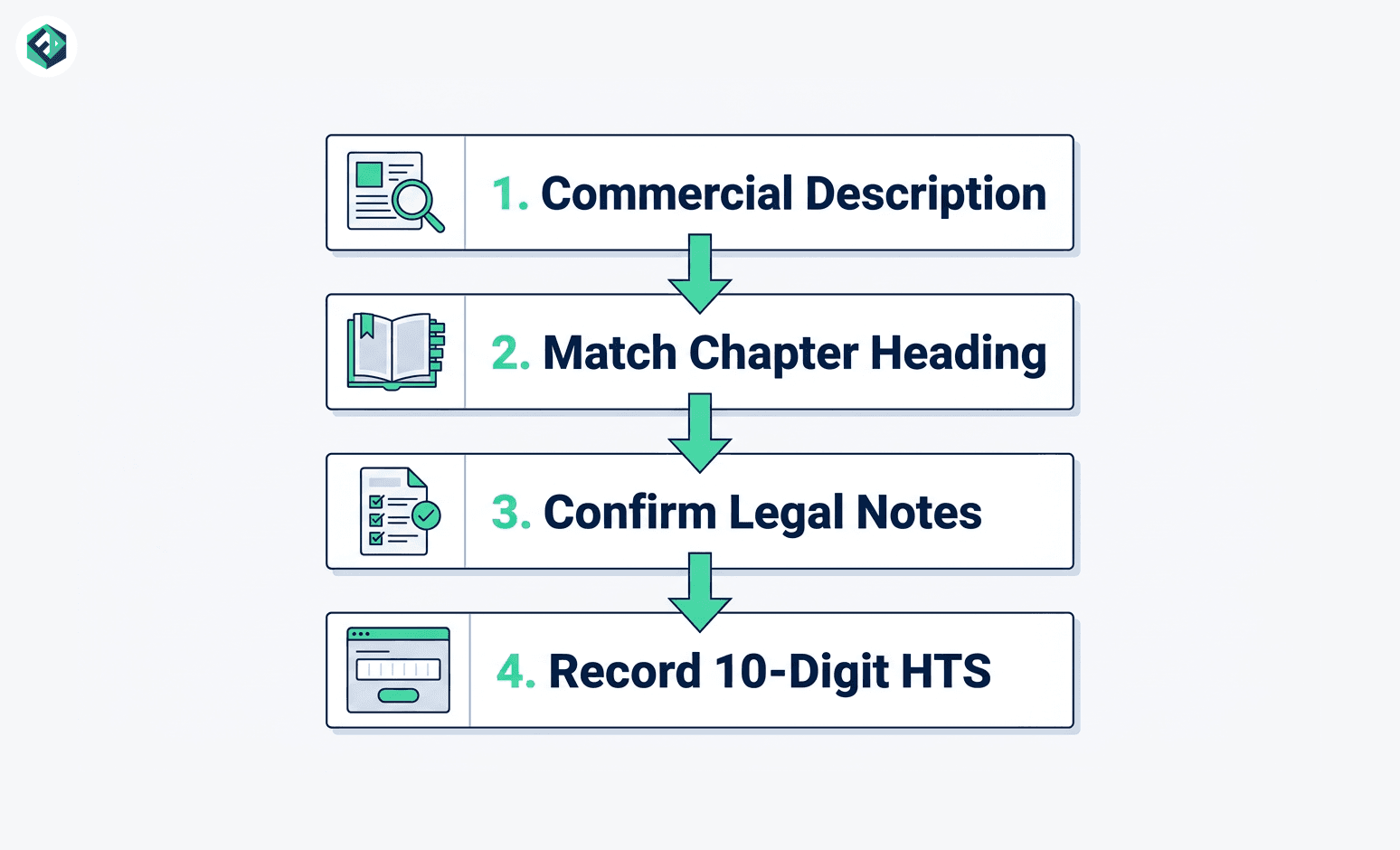
Product classification drives every subsequent rate. The official Harmonized Tariff Schedule of the United States is maintained by the U.S. International Trade Commission. A 2026 interactive HTS search tool provides expanded results (including Chapters 98 and 99), modern filtering, and export options in Excel, JSON, CSV, and PDF. Begin with a precise commercial description, material composition, and principal use, then locate the 10-digit statistical reporting number.
- Identify the correct chapter and heading that matches the article’s essential character.
- Confirm any legal notes, additional U.S. notes, or statistical suffixes that affect rate or reporting.
- Record the full 10-digit HTS code for entry and for cross-checking Section 301 Chapter 99 provisions.
- Establish customs value, normally the transaction value (price actually paid or payable), which becomes the base for ad valorem duties and fees.
Declared value and transaction value must be supportable with commercial invoices and related-party documentation when required. Misclassification is a frequent source of underpayment, delays, and penalties, so verify the code before quoting landed cost. Official starting points include the USITC HTS search tool announcement and the broader set of USITC tariff applications and DataWeb tools.
Determining the Base MFN Duty Rate
Once the HTS number is fixed, read the Column 1 (Most-Favored-Nation) rate that applies to the goods. Column 1 rates form the baseline before any China-specific or emergency overlays. For electrical machinery and equipment under Chapter 85 (relevant to many consumer electronics accessories), MFN rates commonly range from free to roughly 2.5–3.9 percent depending on the exact 10-digit line; chapter overviews often cite an average near 2.5 percent. These are general observations only—exact Column 1 duty must be taken from the current HTS text for your subheading.
Use the same USITC HTS and DataWeb resources to confirm the rate, units of quantity, and any special programs. Preferential programs may reduce or eliminate the base rate and can also affect fee liability, but China-origin goods typically remain subject to the full Column 1 rate plus additional measures discussed below. Document the base MFN duty as the first layer in your stacking worksheet. Further reference material appears on the USITC Harmonized Tariff information page.
Layering Section 301 Tariffs Correctly
Section 301 actions on China remain a major cost driver. Legacy lists continue to apply additional duties (historically including significant ad valorem increases on many technology and intermediate goods) via Chapter 99 headings. In addition, as of 24 July 2026 the USTR imposed a further 12.5 percent duty on imports from China (among other economies) for failure to impose and effectively enforce forced-labor import prohibitions. That 12.5 percent stacks on existing Section 301 measures. Product-specific exemptions and exclusions exist; a substantial set of exclusions was extended through 9 November 2026, with conforming HTSUS Chapter 99 amendments published in 2026.
- Locate any Chapter 99 provision that references your primary HTS subheading.
- Confirm whether the goods appear on active lists or benefit from a current exclusion.
- Add the applicable Section 301 percentage(s) to the Column 1 MFN rate.
- Recheck Federal Register and USTR notices for effective dates and any temporary relief windows.
Because stacking rules and exclusion lists are product- and date-specific, always cross-reference the HTS number against the latest USTR tariff-action materials and Federal Register notices rather than relying on a single percentage. Key official references include the USTR forced-labor Section 301 action, the July 2026 Federal Register notice of actions, the USTR Section 301 tariff actions hub, exclusion-extension materials, and the September 2026 conforming amendments notice.
Factoring in Section 122 Tariffs
Section 122 of the Trade Act of 1974 authorized temporary surcharges for balance-of-payments purposes. A 10 percent surcharge imposed in February 2026 expired on 24 July 2026 and is therefore not part of current China tariff rate calculation for entries after that date. Importers should still monitor new emergency or reciprocal measures, but as of late 2026 the expired Section 122 layer should be recorded as zero unless a successor action is announced. Keep the historical note in your files so that older quotes or open contracts can be reconciled correctly.
Calculating the Merchandise Processing Fee
The Merchandise Processing Fee is a mandatory CBP user fee on formal entries. For fiscal year 2026 the ad valorem rate is 0.3464 percent of the entered value of the merchandise (excluding duty, international freight, and insurance). The fee is subject to a minimum of $33.58 and a maximum of $651.50; a $4.03 surcharge applies if the entry is filed manually. Informal entries use fixed fees of $2.69, $8.06, or $12.09 depending on circumstances. Certain preference-program claims can exempt MPF, so test eligibility after classification.
Compute MPF on the same customs value used for duty, apply the floor and ceiling, then add any manual surcharge. Official FY2026 parameters are published by CBP; see the CBP merchandise processing fee guidance.
Applying the Harbor Maintenance Fee for Ocean Shipments
Harbor Maintenance Fee applies to commercial cargo loaded or unloaded at identified U.S. ports. The rate is 0.125 percent ad valorem of the merchandise value. HMF is collected by CBP as part of the entry process for ocean and certain domestic waterborne movements; it is not assessed on air cargo or mail. For pure ocean freight shipments the fee is therefore a predictable line item once value is known.
Include HMF only when the conveyance and port trigger liability. Confirm port status and value base against current CBP user-fee materials, including the CBP user fee table and the CBP Harbor Maintenance Fee article.
Understanding ISPS Charges in Shipping
The International Ship and Port Facility Security (ISPS) Code, implemented under SOLAS, requires ships and port facilities to maintain approved security plans, certifications, and periodic verifications. U.S. implementing regulations address vessel inspection and related fees (for example under 46 CFR Part 2), which are assessed on the vessel operator by category and are not structured as a standardized ad valorem cargo surcharge comparable to MPF or HMF.
No mandatory government-imposed percentage-based ISPS security surcharge on individual commercial shipments appears in the CBP user-fee tables or USCG fee schedules reviewed for 2026. Carriers and terminals may nevertheless levy commercial security or compliance surcharges under their tariffs. Treat any such line items as contractual carrier charges rather than statutory customs fees, obtain the amount in writing before booking, and keep them separate from duty, MPF, and HMF in the landed-cost model. Reference vessel-fee structure via the eCFR Title 46 vessel inspection fee provisions.
Example Calculation for Electronics Shipment
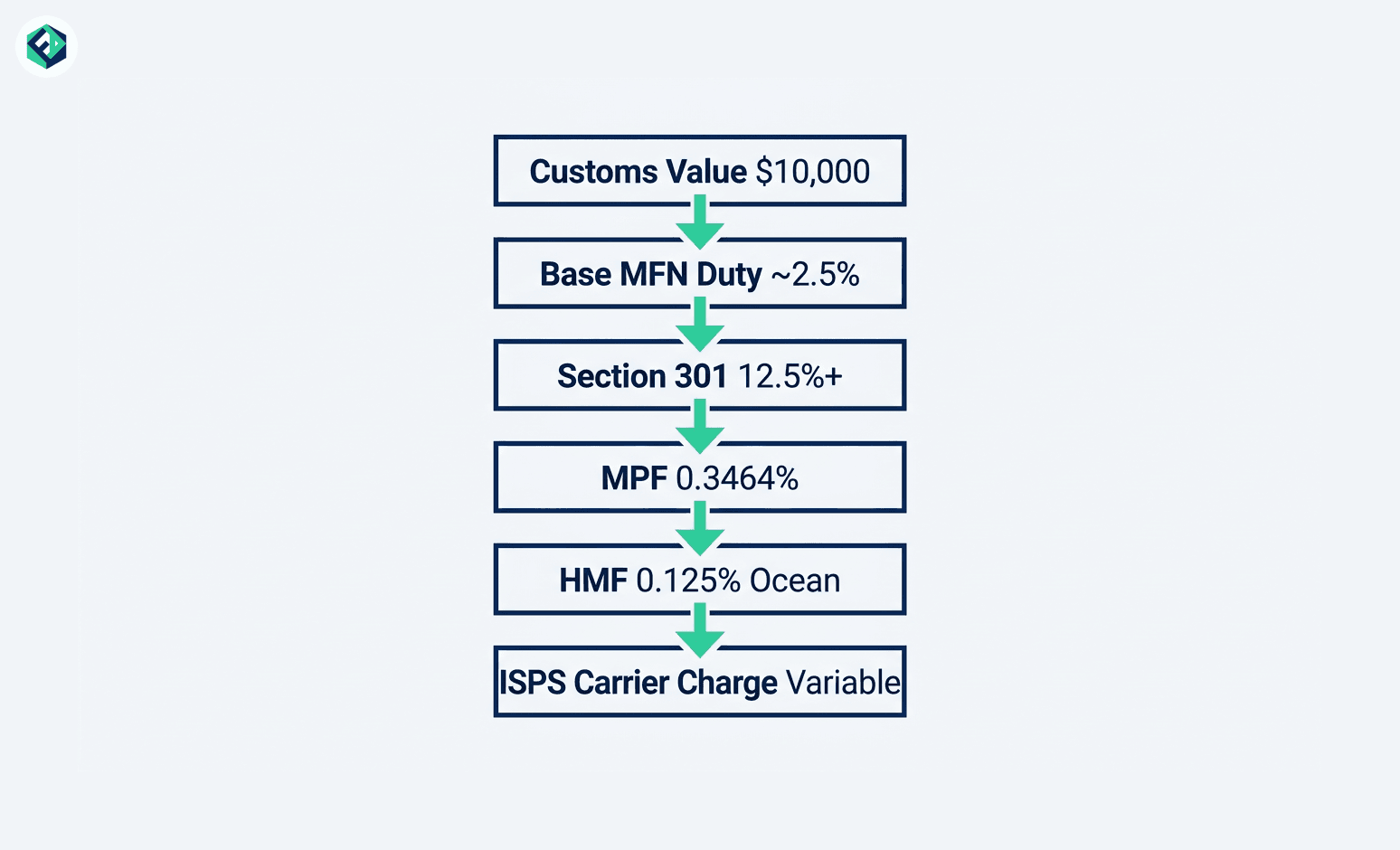
The following worked illustration shows how layers combine for a hypothetical ocean shipment of consumer electronics accessories valued at $10,000 FOB (transaction value). Figures are estimates for methodology only; they are not a substitute for an HTS-specific determination.
| Component | Basis / Rate (illustrative) | Amount (USD) | Notes |
|---|
| Customs value | Transaction value | 10,000 | FOB example; confirm Incoterms and additions |
| Base MFN duty | ~2.5% (Chapter 85 typical range estimate) | 250 | Verify exact Column 1 rate for the 10-digit HTS |
| Additional Section 301 | 12.5% (July 2026 forced-labor action) plus any legacy list rate | 1,250+ | Stacks; add legacy percentage only after HTS/Chapter 99 check; exclusions may apply through 9 Nov 2026 |
| Merchandise Processing Fee | 0.3464% (FY2026), min $33.58 / max $651.50 | 34.64 | Value base excludes duty, freight, insurance |
| Harbor Maintenance Fee | 0.125% (ocean port cargo) | 12.50 | Ocean only; not applicable to air |
| ISPS / security | Commercial carrier charge if any | Variable | No standard statutory ad valorem cargo ISPS fee identified |
In this simplified stack the statutory duty-and-fee subtotal before legacy Section 301 extras and commercial surcharges is roughly $1,547 (2.5% MFN + 12.5% additional + MPF + HMF). Actual cumulative tariff exposure will be higher if an older Section 301 list rate also applies, and lower if a valid exclusion is claimed. Landed-cost components must still add international freight, insurance, domestic drayage, and any carrier security surcharge to reach full door cost.
Actionable next steps for this electronics-style shipment: (1) lock the precise 10-digit HTS code in the current USITC tool and map it to every relevant Chapter 99 heading; (2) confirm whether the 12.5 percent July 2026 measure and any legacy Section 301 rate both apply, and whether an exclusion remains valid before the November 2026 sunset; (3) compute MPF and HMF on the final entered value and mode; (4) obtain written carrier confirmation of any ISPS-related or security surcharge before booking ocean space; (5) rerun the worksheet whenever USTR or CBP publishes a new notice. Even with this stack worked through, product-specific China tariff rate calculation still depends on live HTS and Chapter 99 checks before you lock landed cost. FreightAmigo helps importers validate those duty, MPF, and HMF layers with digital documentation support that reduces manual errors and supports smoother cross-border clearance. When you are ready to apply the same method to your own electronics shipment, estimate exposure with our Import Duty Calculator and align the figures with your routing plan.
FAQ
What specific 10-digit HTS code should I use for consumer electronics accessories?
No single universal 10-digit HTS code applies. Start from a precise commercial description, material composition, and principal use, then locate the matching 10-digit statistical reporting number in the USITC HTS tool and record any related Chapter 99 notes.
What is the standard Column 1 MFN duty rate for most consumer goods?
Column 1 MFN rates are the baseline and commonly range from free to roughly 2.5–3.9 percent for many Chapter 85 electronics accessories. Exact duty must be read from the current HTS text for the specific 10-digit subheading rather than a generic average.
What additional Section 301 tariff percentage applies to my product category?
An additional 12.5 percent Section 301 duty on China-origin goods applies as of 24 July 2026 and stacks on legacy list rates. Confirm the relevant Chapter 99 provision, active lists, and any exclusions extended through 9 November 2026 for the exact HTS.
What is the applicable Section 122 emergency tariff rate?
The prior 10 percent Section 122 surcharge expired on 24 July 2026 and is currently zero. Record that layer as zero for later entries unless a successor emergency or reciprocal measure is announced.
What is the merchandise processing fee percentage with its minimum and cap?
FY2026 MPF is 0.3464 percent of entered value, subject to a $33.58 minimum and $651.50 maximum. A $4.03 surcharge applies to manual filings, and certain preference claims may exempt the fee.
What harbor maintenance fee percentage applies only for ocean freight shipments?
Harbor Maintenance Fee is 0.125 percent ad valorem of merchandise value on qualifying ocean port cargo. It is not assessed on air cargo or mail and is collected by CBP for applicable maritime movements.
What is the mandatory ISPS security surcharge structure for maritime carriers?
No mandatory government-imposed percentage-based ISPS cargo surcharge exists. ISPS covers vessel and port security plans and certifications; any security line items are typically commercial carrier or terminal charges that should be confirmed in writing.
What is the total landed duty and fees for a 10,000 FOB electronics accessories shipment?
A simplified statutory duty-and-fee subtotal is roughly $1,547 before legacy Section 301 extras or commercial surcharges. The illustration uses about 2.5 percent MFN ($250), 12.5 percent additional ($1,250), MPF ($34.64), and HMF ($12.50) on $10,000 value, with actual totals depending on exact HTS and exclusions.








 Global Popular RoutesTop sea & air shipping lanes
 Special OfferLimited-time shipping promotions





 Express
 Document
 Parcel - Air/Sea
 Container
 Relocation