The Complete Guide to International Air Freight Rates in 2026
Understanding International Air Freight Rates and 2026 Market Dynamics
To budget effectively, shippers must monitor international air freight rates and changing market dynamics. In 2026, the air cargo sector is experiencing shifts driven by e-commerce, technology, and macroeconomic factors. According to the International Air Transport Association (IATA), global air cargo volumes are projected to reach 71.6 million to 71.7 million tonnes in 2026, representing a steady year-over-year growth of 0.2% to 2.4% depending on seasonal adjustments.
The financial outlook for the air freight forwarding market remains highly resilient. Industry analysis indicates that global cargo revenues are forecasted to reach approximately $158 billion to $162 billion in 2026. This revenue growth is closely tied to cargo yields, which are expected to stabilize or increase by about 6.5% in 2026, keeping them roughly 30% above pre-pandemic baselines. These elevated air cargo rates are driven by persistent demand for high-value, time-sensitive products, including advanced semiconductors and cross-border e-commerce shipments. Navigating the international air freight price landscape requires a clear understanding of these macro trends, as current air freight rates are highly sensitive to global capacity and carrier operations. Shippers must analyze these air cargo pricing trends to anticipate fluctuations in the average air freight cost per kg across major trade lanes throughout the year.
How to Calculate Chargeable Weight: Volumetric versus Actual Weight
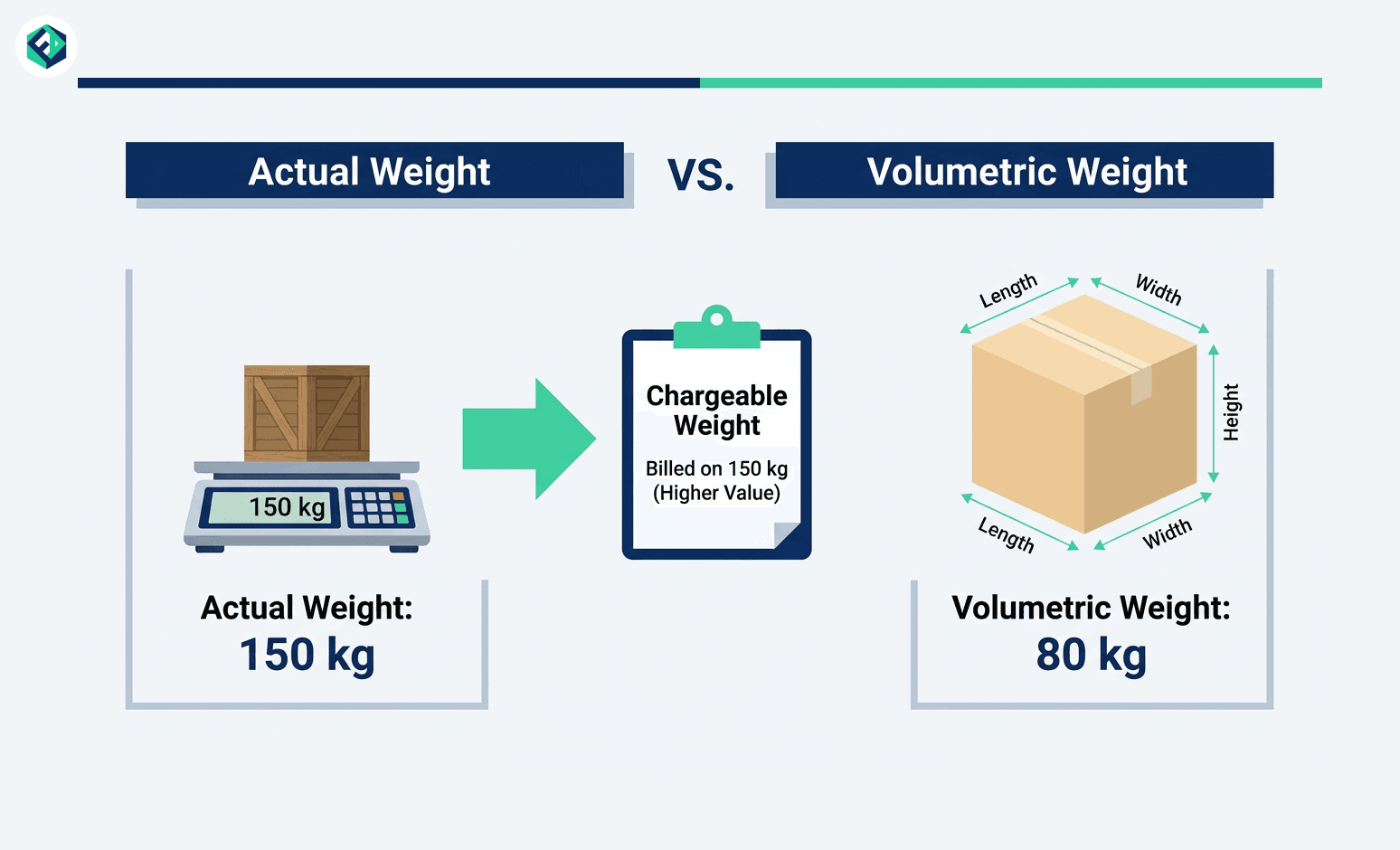
A common point of confusion in logistics is how carriers calculate actual shipping costs. In air transportation, space is as valuable as weight capacity, so air cargo rates are calculated based on chargeable weight. To determine the chargeable weight air freight carriers will apply, shippers must understand the relationship between actual weight vs dimensional weight.
The actual weight is simply the physical weight of the cargo. Volumetric weight, also known as dimensional weight, is a calculation that estimates the volume of the shipment. To calculate dimensional weight, logistics professionals use a standard volumetric weight calculator formula established by IATA. The standard formula involves multiplying the length, width, and height of the package in centimeters and dividing the total by 6,000, which is equivalent to an industry-standard density ratio of 167 kilograms per cubic meter.
To illustrate how the chargeable weight calculation works, consider the following comparison table:
| Shipment Example | Actual Weight (kg) | Dimensions (L x W x H in cm) | Volumetric Weight (Volume / 6000 in kg) | Chargeable Weight (Higher Value in kg) |
|---|
| Shipment A: Heavy Parts | 150.00 | 50 x 50 x 50 | 20.83 | 150.00 |
| Shipment B: Light Containers | 40.00 | 100 x 80 x 60 | 80.00 | 80.00 |
As shown in the table, for Shipment A, the carrier bills based on the actual weight because it exceeds the volumetric weight. For Shipment B, the volumetric weight is twice the physical weight, meaning the carrier bills based on the volumetric weight. Shippers can avoid unexpected fees by performing these calculations in advance.
Comparing Air Freight Versus Ocean Freight for Global Supply Chains
When designing a global supply chain strategy, selecting the transportation mode requires a transit time comparison and analysis of ocean vs air freight cost trade-offs. The choice between air cargo vs sea freight forces businesses to balance urgency, budget, and sustainability.
From a speed perspective, air transport offers shipping transit times of just a few days compared to several weeks or months for maritime transport. However, this speed comes at a premium, with air transport being multiple times more expensive than sea shipping.
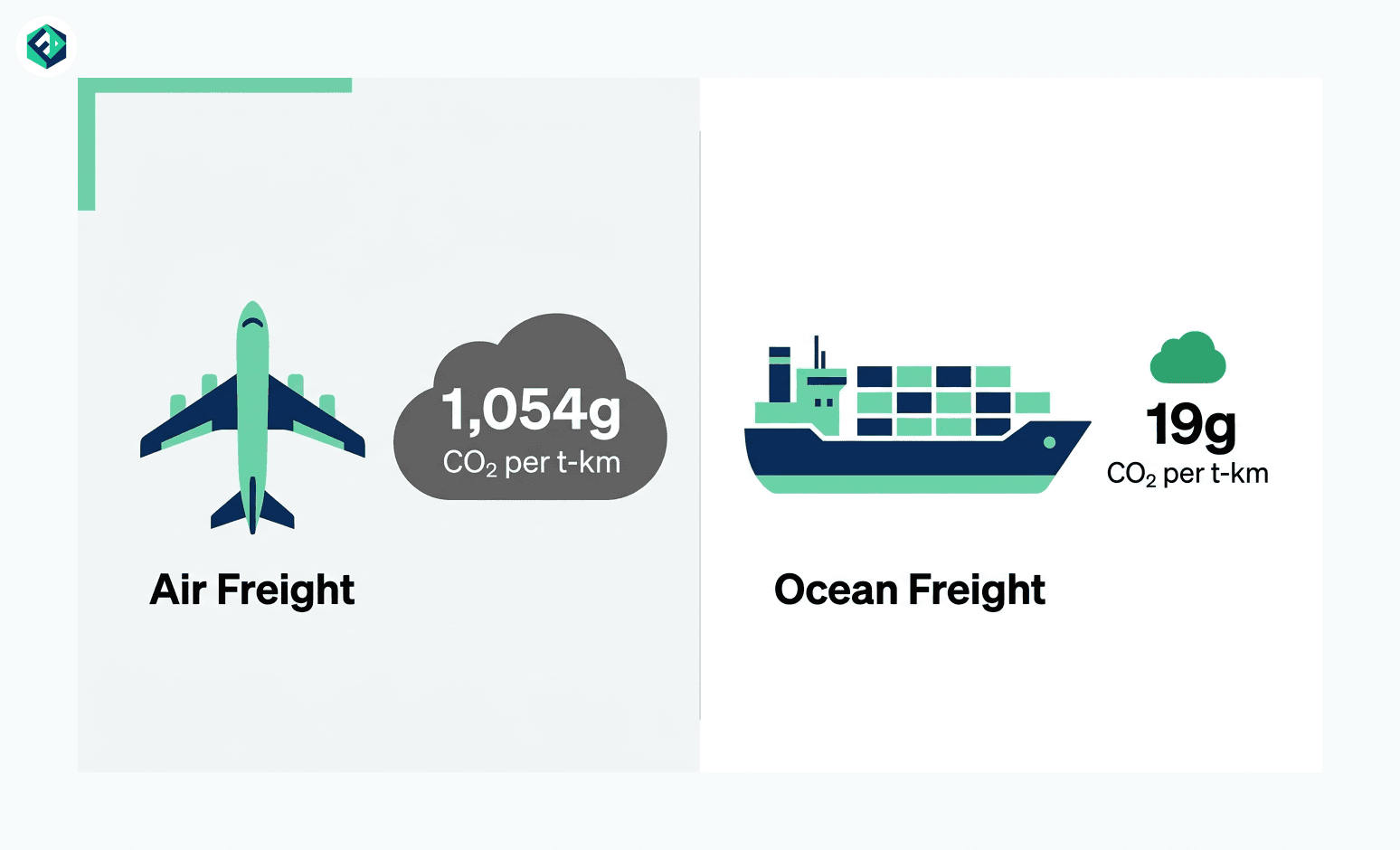
Modern corporations must also evaluate the environmental impact. A study by the UK Department for Environment, Food and Rural Affairs (DEFRA) shows that carrying 2 tonnes of freight for 5,000 kilometers on a small container ship generates 150 kilograms of CO2-equivalent emissions, whereas transporting the same cargo by plane generates 6,605 kilograms of CO2-equivalent emissions (The Guardian, 2014). This indicates that air freight produces about 80 times more carbon emissions than maritime shipping.
Furthermore, research in Environmental Science & Technology highlights that air freight displays an emissions intensity of approximately 1,054 grams of CO2 per tonne-kilometer, compared to maritime shipping's intensity of around 19 grams of CO2 per tonne-kilometer (ACS Publications, 2024). These figures underscore why high-value, perishable, or time-sensitive cargo is reserved for air, while bulk goods suit maritime routes.
Key Factors Affecting Air Cargo Shipping Costs and Surcharges
The final invoice for international air transport is highly influenced by dynamic operational factors and various air freight surcharges. One of the most significant variables is the price of aviation fuel. In August 2026, jet fuel prices rose to $157 per barrel, representing a substantial 79.2% increase compared to the previous year (IATA, 2026). Because fuel represents a major portion of airline operating expenses, carriers adjust fuel surcharges air freight rates upward to offset these costs. Additionally, security surcharges are standard fees applied to cover cargo screening.
Beyond fuel, air cargo capacity constraints play a major role in pricing. The global supply of space is split between dedicated freighter availability and belly hold capacity in passenger aircraft. Geopolitical route disruptions and conflict-related detours have restricted available routes, forcing longer transit paths and reducing efficiency. When capacity on a particular lane is tight, rates naturally rise, making it critical to monitor these factors when planning shipments.
How to Get Accurate Air Freight Quotes Online
Given the high volatility of the modern logistics market, obtaining an accurate, up-to-date air freight quote is a critical step in the procurement process. Spot rates can change rapidly, meaning that most air freight quotes are issued with short validity windows, sometimes lasting only a few days.
To secure a reliable estimate, shippers should avoid relying on vague, non-binding estimates. A comprehensive quote must be fully itemized, detailing not only the base airport-to-airport transport rate but also destination charges, local handling fees, and customs clearance fees. To simplify this complex process, modern digital logistics platforms allow businesses to request air cargo quote options and compare rates in real-time.
When dealing with volatile spot rates, gaining instant cost visibility is essential to keeping your supply chain budgets predictable. FreightAmigo streamlines this process by offering a multimodal platform where you can compare real-time air, sea, and courier rates side-by-side. By entering your shipment details, you can instantly analyze multiple routing options and secure competitive pricing without manual delays. To manage your logistics costs efficiently, feel free to obtain an Instant Quote for your next shipment.
Choosing the Right Air Freight Forwarders for Your Logistics Needs
Selecting an experienced air freight forwarder is a key decision that can determine the success of an international supply chain. Rather than acting simply as a transport provider, a qualified air freight company serves as a strategic partner, managing complex regulatory requirements, customs compliance, and physical cargo handling.
The air freight forwarding industry has a long history of solving critical customs and timing challenges. For instance, the global logistics pioneer DHL was co-founded in December 1969 by Larry Hillblom, Adrian Dalsey, and Robert Lynn. In its early days, the company operated by sending shipping documents from the US West Coast to Hawaii via airline passenger baggage, ensuring the paperwork arrived before the cargo vessels so that customs clearance could be expedited (Wikipedia, 2026).
When partnering with freight forwarders today, shippers should evaluate several key criteria:
- The breadth of the provider's global network and carrier relationships.
- The availability of specialized freight forwarding services, such as temperature-controlled shipping or dangerous goods handling.
- The speed and transparency of their customs clearance processes.
- The technological tools they offer for real-time tracking and exception management.
A reliable partner ensures that cargo moves efficiently across borders without costly delays.
Navigating Air Freight from China to USA: Rates and Transit Strategies
The trade corridor connecting Asia and North America is one of the most vital transpacific air cargo lanes. Managing air freight from china to usa requires a strategic approach, particularly as e-commerce volumes and high-tech product releases put pressure on available capacity.
According to IATA market data from August 2026, the Asia-North America route experienced a major 13.2% year-over-year surge in cargo demand, accounting for 23.5% of all global cargo tonne-kilometers (IATA, 2026). This surge, driven heavily by e-commerce platforms and high-tech manufacturing, has led to capacity constraints, particularly during peak seasons. Consequently, china to usa air freight rates have remained elevated, forcing shippers to plan ahead to secure space on this critical china to us air route.
Navigating these transpacific capacity constraints requires a reliable strategy that balances speed, cost, and route efficiency. FreightAmigo helps businesses optimize their supply chains on major international corridors by providing comprehensive air forwarding and multimodal transit options. Through our digital platform, you gain access to real-time rate comparisons, global carrier networks, and reliable door-to-door solutions that protect your shipments from seasonal disruptions. If you are looking to secure space and streamline your transpacific shipping, we invite you to explore our Air Freight services.
FAQ
What are the average global air cargo shipping rates per kilogram for international shipments in 2026?
Global air cargo rates in 2026 are shaped by robust demand and elevated cargo yields. While exact per-kilogram rates vary across lanes, cargo yields are expected to stabilize or increase by approximately 6.5%, remaining roughly 30% above pre-pandemic baselines due to e-commerce and semiconductor demand.
What is the exact chargeable volumetric weight calculation formula for air cargo shipments?
Volumetric weight is calculated by multiplying package dimensions and dividing by 6,000. Under standard IATA rules, you multiply length, width, and height in centimeters and divide by 6,000, with carriers billing based on whichever is higher between this volumetric weight and the physical weight.
How do I evaluate the cost difference between air cargo and sea freight shipping for my cargo?
Evaluating the difference requires balancing rapid transit times against significantly higher transportation costs and carbon emissions. Air transport delivers cargo in days but produces roughly 80 times more carbon emissions than maritime shipping, which is much slower but far more cost-effective for bulk goods.
How do fuel and security surcharges affecting international air freight impact my final shipping invoice?
Surcharges directly increase your final invoice to offset fluctuating operational and security expenses. When jet fuel prices rise, carriers adjust fuel surcharges upward to cover operating costs, while standard security surcharges are added to cover mandatory cargo screening.
What is the best process for requesting instant international air cargo shipping quotes online?
The best process is using a digital logistics platform to compare itemized, real-time rates. Shippers can enter shipment details on platforms like FreightAmigo to instantly compare air, sea, and courier rates side-by-side, ensuring local handling, destination, and customs fees are fully included.
What criteria should I use when selecting experienced international air freight forwarding companies?
Evaluate forwarders based on network reach, specialized logistics services, customs expertise, and digital tracking tools. A reliable strategic partner should offer strong carrier relationships, fast customs clearance, and advanced technological tools for real-time tracking and exception management.
What are the current China to USA air freight cargo shipping rates in 2026?
China to USA rates remain elevated due to capacity constraints and a surge in transpacific shipping demand. Driven by e-commerce and high-tech manufacturing, the Asia-North America route experienced a 13.2% year-over-year demand surge in August 2026, making advanced booking essential to secure cargo space.








 Global Popular RoutesTop sea & air shipping lanes
 Special OfferLimited-time shipping promotions





 Express
 Document
 Parcel - Air/Sea
 Container
 Relocation