2026 HS Code Lookup Finder for Accurate International Classification
Accurate product classification sits at the center of compliant cross-border trade. A reliable 2026 HS code lookup approach helps importers, exporters, and logistics teams identify the right Harmonized System and national tariff codes before goods move. This guide explains what HS and HTS codes are, how their structure works, how U.S. systems relate to Schedule B, practical search methods, duty and compliance uses, export-import documentation needs, and step-by-step ways to confirm the correct code using official sources. Facts below are grounded in World Customs Organization and U.S. government materials; duty rates and final rulings remain national and case-specific.
What Is an HS or HTS Code in Global Trade
The Harmonized Commodity Description and Coding System, commonly called the Harmonized System or HS, is an internationally standardized system of names and numbers used to classify traded products. It was developed and is maintained by the World Customs Organization and came into effect in 1988. According to the Harmonized System overview, it is used by more than 200 countries and economies as a basis for customs tariffs and for collecting international trade statistics.
HTS generally refers to a country-specific extension of that international base. In the United States, the Harmonized Tariff Schedule provides the detailed import classification framework built on the same six-digit HS core. In plain terms, HS coding gives customs administrations, statistical agencies, and traders a shared language for describing the same goods at the border. The WCO notes that the nomenclature supports uniform classification of goods moving worldwide and forms the basis for customs tariffs, statistical nomenclatures, and trade data, as summarized in its HS fact sheet.
For day-to-day shipping, treating HS as the international standard and HTS as the national tariff schedule extension reduces confusion when documents, quotes, and entry filings must align.
HS Codes Structure Explained Fully with Chapter and Digit Breakdown
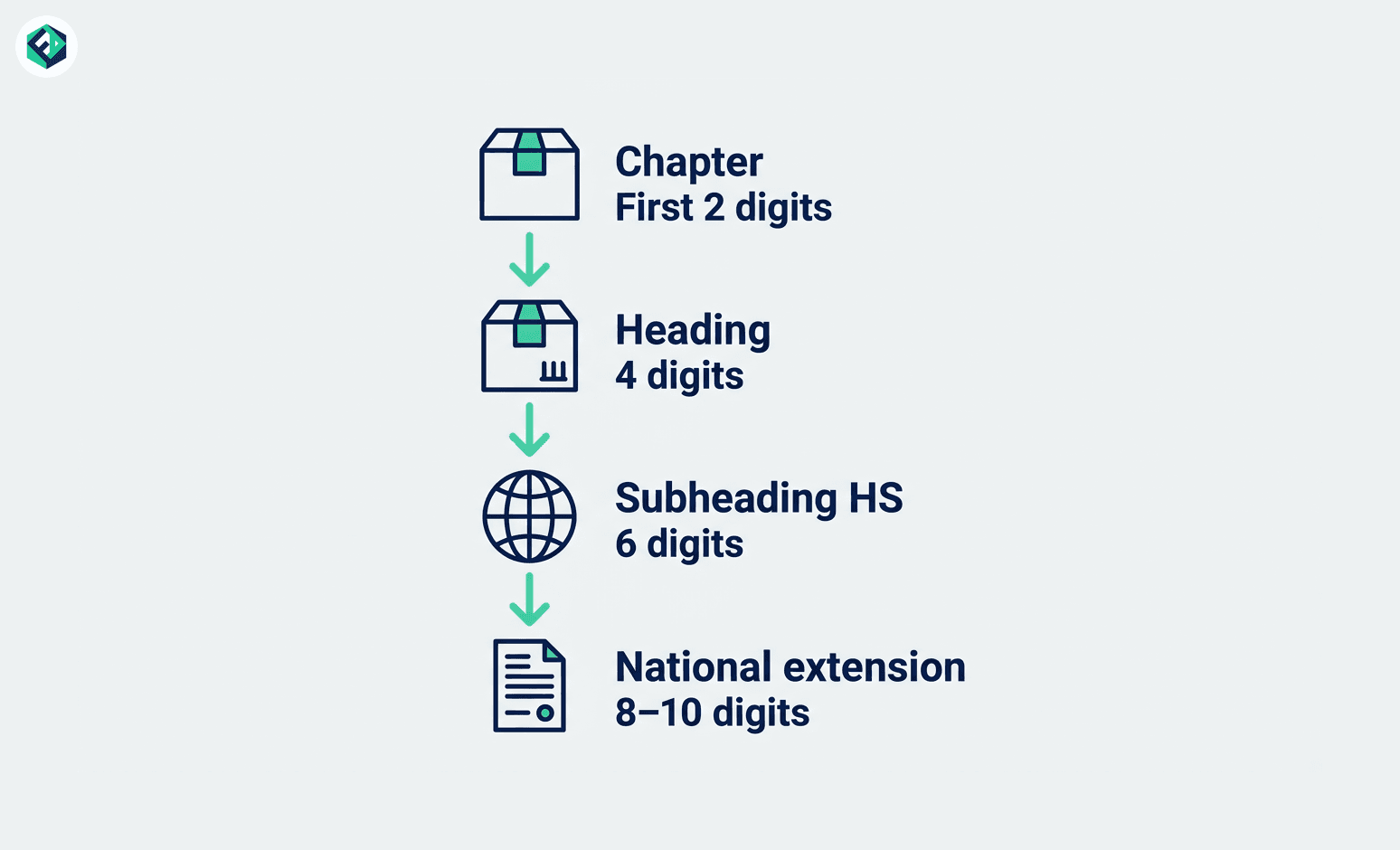
HS codes follow a hierarchical structure. Legal classification is driven by heading terms, Section and Chapter notes, and the General Rules for Interpretation, not by section or chapter titles alone. The WCO nomenclature introduction explains that headings are four digits and that six-digit codes are the core international HS level. National administrations may add further digits for tariffs and statistics.
| Level | Typical digits | What it represents | Practical note |
| Chapter | First 2 | Broad commodity group | Titles are for reference only |
| Heading | 4 | More specific product family | Legal text starts here with notes and GIRs |
| Subheading (international HS) | 6 | International standard code | Common baseline across contracting parties |
| National extension | 8–10+ | Tariff line or statistical breakout | Varies by country; U.S. import HTS is commonly 10 digits |
The 2022 edition structure referenced by the WCO comprises 21 Sections, 96 Chapters, 1,228 headings, and 5,612 subheadings. That architecture remains the working baseline into 2026, while countries update national extensions on their own calendars. When you parse a six-digit HS code, read material, function, and processing state against the legal notes rather than forcing a match from a short product nickname.
USA HS and HTS Codes and Their Relation to Schedule B
In the United States, import and export coding systems share the international six-digit HS root and then diverge. The USITC FAQ on Schedule B and HTS states that U.S. import classifications use the Harmonized Tariff Schedule administered by the U.S. International Trade Commission, typically at 10 digits, while export classifications use Schedule B numbers administered by the U.S. Census Bureau, also at 10 digits. The first six digits are identical; they can differ at the eight- to ten-digit level.
HTS detail supports duty application and import admissibility decisions used by U.S. Customs and Border Protection. Schedule B supports statistical reporting on exports and Automated Export System filings. Multiple HTS numbers may map to fewer Schedule B numbers, so a correct import tariff line is not automatically the correct export statistical code. Official lookup paths are summarized by USITC: HTS search via the Commission’s HTS tools and Schedule B search via Census resources, as noted in the USITC Schedule B definition FAQ.
For 2026 planning, treat HTS as the import tariff schedule of record and Schedule B as the export statistical counterpart, and verify both when the same SKU moves inbound and outbound.
HS Code Search and Lookup Methods for Accurate Results
Effective HS code search starts with a precise commercial description, then moves through official schedules and interpretation rules. A practical customs code lookup sequence looks like this:
- Capture composition, primary function, form (finished, parts, kits), and any processing that changes character.
- Search official tariff or statistical tools rather than informal lists alone.
- Apply the General Rules for Interpretation in order and read Section, Chapter, and subheading notes that bind the heading.
- Compare candidate lines against commodity groups in the HS hierarchy instead of keyword-only matches.
- Review published ruling databases where available, then escalate uncertain cases to a broker or a formal ruling request.
U.S.-focused guidance on official databases and user approaches is outlined by Trade.gov customs information resources. Harmonized System sections and chapters help narrow the field, but WCO classification logic still controls the final international six-digit result. An internal product classification chart or HS code list is useful for speed only when it is mapped back to current official text. Ultimate classification authority rests with the customs administration of the importing country, so a tariff code finder result should be treated as a working hypothesis until confirmed for that destination.
HS and HTS Codes Purpose in Duty Calculation and Compliance
HS and HTS codes are not filing formalities alone. The WCO overview of the Harmonized System explains that codes enable governments to apply border treatments uniformly, including taxation, restrictions, and prohibitions. They support customs tariffs, merchandise trade statistics covering the large majority of world trade, trade negotiations, internal taxes, rules of origin, quota controls, and monitoring of controlled goods.
For commercial teams, customs classification use translates into three immediate outcomes:
- Duty calculation and landed-cost modeling tied to the correct tariff line and any preference program claims.
- Regulatory screening for licenses, prohibitions, or special certificates that attach to specific codes.
- Consistent documentation so commercial invoices, packing lists, entries, and export filings describe the same goods.
Misclassification can understate or overstate duty, delay release, or create penalty exposure. Specific duty rates are national—for example, U.S. General rates in the HTS—so an international six-digit match does not finish the duty analysis. Label rate quotes as estimates until the entry line and valuation method are confirmed.
HS Codes for Export Import Requirements in International Shipping
Export and import HS codes appear throughout international shipping paperwork because the HS provides a universal economic language for goods in trade. WCO materials on the Harmonized System Convention emphasize that contracting parties use HS headings and subheadings without modification as the foundation for tariffs and statistics, while national extensions may go further. Resources such as the WCO Trade Tools convention context underscore obligations that support documentation, compliance, and data interchange across more than 200 economies.
In practice, global trade classification supports:
- Commercial invoices and transport documents that identify goods consistently for carriers and intermediaries.
- Import entries and export statistical filings that must align with national extensions of the same six-digit root.
- Origin, preference, and control checks that often key off tariff lines.
International shipping codes therefore need dual attention: the shared HS baseline for interoperability, and the destination or export-reporting extension for legal effect. When multi-country lanes are involved, map each SKU once at six digits, then maintain country-level suffix tables rather than inventing separate product identities per market.
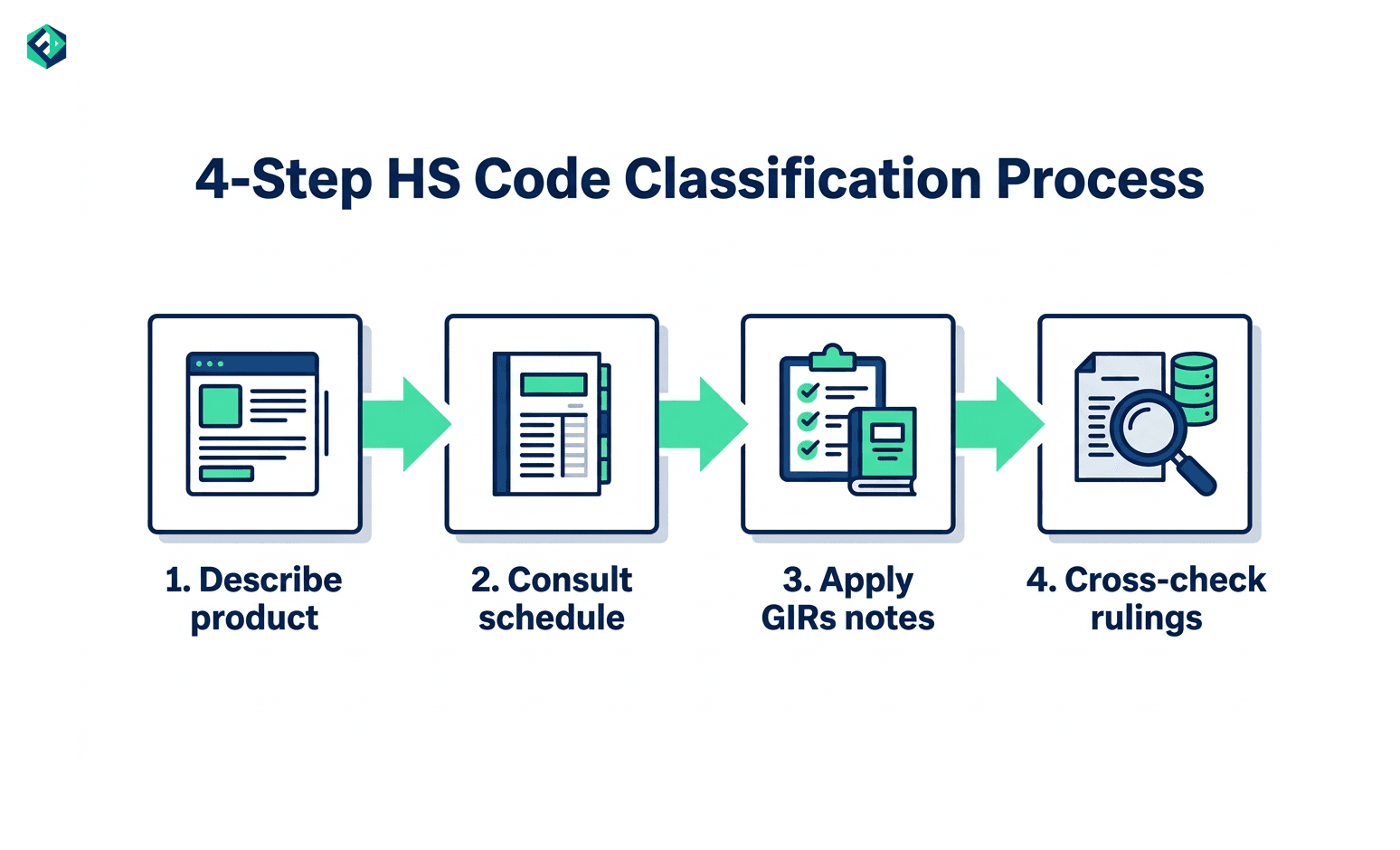
How to Get Your HS Code Using Reliable Classification Steps
To find the correct HS code for customs clearance, follow a controlled process instead of a single keyword search.
- Describe the product precisely: materials, essential character, use, and physical state.
- Consult the official schedule that applies—international HS text, destination HTS or tariff, and Schedule B for U.S. exports when relevant.
- Apply GIRs hierarchically and read every applicable note before selecting a line.
- Cross-check published rulings or prior treatments for similar goods where databases exist.
- If uncertainty remains, seek customs broker help or request guidance from the competent authority; final authority is the importing customs administration.
U.S. importers typically work from the HTS; U.S. exporters confirm Schedule B for AES. Keep evidence of the classification rationale with the SKU master data so operations, finance, and compliance teams reuse the same decision. Revisit codes when products change design, composition, or kit content, and when national tariff revisions publish.
2026 International HS Code Lookup Tool and Duty Resources
There is no single global private “2026 finder” that replaces official nomenclature. What matters for 2026 is using current national publications on top of the stable international HS framework. USITC announcement materials show that the U.S. HTS is updated through frequent revisions, including a basic edition and multiple 2026 revisions with technical corrections and tariff adjustments. The USITC harmonized tariff announcement archive is the reference point for U.S. revision timing. International base codes continue under WCO maintenance cycles, while duty outcomes still depend on national tariff lines, valuation, origin, and any temporary measures.
For a workable 2026 international HS code lookup workflow, combine official HTS search for U.S. import duty lines; Census Schedule B search for U.S. export statistics; WCO nomenclature and notes for the six-digit backbone; and internal landed-cost checks that treat any duties calculator output as an estimate until entry data is final. Once codes are confirmed, duty and tariff planning still need HS-linked cost visibility and cleaner digital documentation so teams avoid re-keying errors between classification and entry prep.
FreightAmigo helps connect those steps by pairing schedule checks with practical duty and tariff insights on one platform. You can estimate landed-cost impact with our Import Duty Calculator, then list top SKUs, store each rationale, and re-validate against the latest 2026 HTS revision before the next import entry or export filing.
FAQ
What is the HS code meaning for global trade classification?
HS is the internationally standardized system for classifying traded products. Maintained by the World Customs Organization and used by more than 200 countries, it supplies a shared language for customs tariffs and trade statistics, while HTS refers to national extensions such as the U.S. Harmonized Tariff Schedule.
What is the HS code chapter heading and subheading breakdown?
HS codes follow a hierarchy from chapters to six-digit international subheadings. The first two digits mark the broad chapter, four digits form the legal heading, and six digits are the international standard, with countries adding further digits for tariffs and statistics.
What is the difference between US HTS and Schedule B codes?
HTS is for U.S. imports and duties while Schedule B is for export statistics. Both typically use 10 digits and share the first six international HS digits, but they can differ at the eight- to ten-digit level and are administered by different agencies.
What is the best way to find an accurate HS code for shipment?
Start with a precise product description and search official schedules using interpretation rules. Capture composition and function, apply the General Rules for Interpretation with binding notes, compare hierarchy candidates, and confirm via rulings or a broker because destination customs has final authority.
How do HS codes determine import duties and tariffs?
Correct HS and HTS classification selects the tariff line used for duty calculation and compliance. Codes support uniform border treatments, landed-cost modeling, regulatory screening, and consistent documentation, though specific duty rates remain national.
What are the HS code requirements for international shipping paperwork?
HS codes must identify goods consistently across export and import documents. They appear on commercial invoices and transport papers, align national entries and statistical filings to the shared six-digit root, and support origin, preference, and control checks.
What are the steps to choose the correct HS code for customs clearance?
Describe the product, consult official schedules, apply rules, and verify the result. Capture materials and essential character, use applicable HS or HTS text with GIRs and notes, review similar rulings, escalate uncertain cases to a broker or authority, and keep the rationale on file.
Where can I access an updated 2026 HS code finder tool for US duties?
Use current official HTS, Schedule B, and WCO resources rather than one private global finder. Combine USITC HTS search for import duty lines, Census Schedule B tools for exports, and WCO nomenclature for the six-digit base, treating calculator outputs as estimates until entry data is final.








 Global Popular RoutesTop sea & air shipping lanes
 Special OfferLimited-time shipping promotions





 Express
 Document
 Parcel - Air/Sea
 Container
 Relocation