K-FTA Trade Opportunities: South Korea 2026 Guide

South Korea’s exports are forecast to grow 7–9% in 2026, driven by K-FTA expansions and strong demand for K-beauty, semiconductors and EVs — here’s exactly how FreightAmigo helps Korean exporters cut logistics costs by up to 24% while staying fully compliant.

What is K-FTA and Why It Matters for 2026

K-FTA refers to South Korea's network of Free Trade Agreements that slash tariffs and streamline market access.

These pacts cover over 60% of Korea's trade volume, boosting competitiveness in electronics, autos, and machinery.

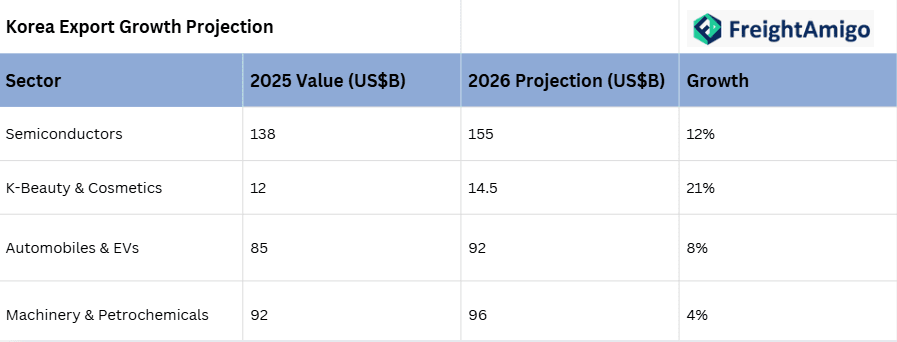
2026 Korea Exports: Key Forecasts and Trends

South Korea’s exports are projected to grow 7–9% in 2026, reaching approximately US$730–745 billion, driven by K-FTA expansions and demand for high-tech and premium consumer goods.

Electronics lead at 25% growth, while semiconductors face volatility from global supply shifts.

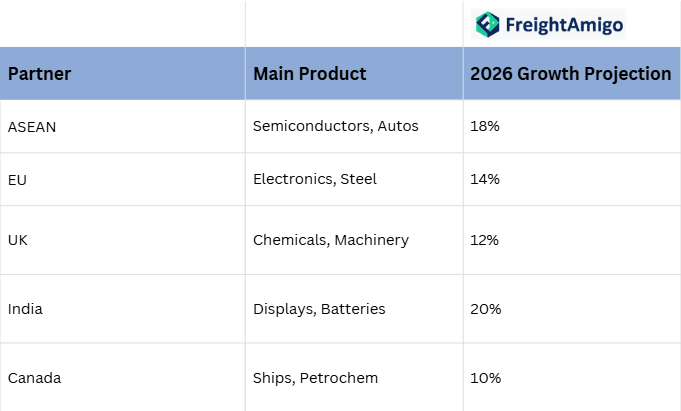
  • ASEAN markets: +15% via updated K-FTAs
  • EU partnerships: Tariff-free autos surging
  • USMCA synergies: Tech exports up 12%
  • India FTA: Emerging machinery demand
  • Middle East: Energy-tech hybrids
Korea Export Growth Projection.png
KOTRA & Ministry of Trade, Industry and Energy (MOTIE) – March 2026 forecast.

Semiconductor Risks in Korea's Trade Landscape

Semiconductor risks Korea exporters face include US-China tensions and raw material shortages.

2025 saw 8% output dips from geopolitical curbs, per Korea International Trade Association data.

Diversification via K-FTA partners mitigates these, with Vietnam and India as key hubs.

  1. Geopolitical sanctions: Monitor US export controls

  2. Supply chain bottlenecks: Stockpile critical inputs
  3. Currency fluctuations: Hedge KRW exposure
  4. IP theft: Strengthen K-FTA compliance
  5. Cyber threats: Secure fab logistics

Top K-FTA Trade Partners for 2026 Exporters

Prime K-FTA trade destinations include ASEAN, EU, and Indo-Pacific nations with zero-duty access.

These agreements eliminate 90% tariffs, favoring high-value goods like displays and batteries.

Top Korea Trade Partner.png

Navigating Compliance in K-FTA Trade

K-FTA trade demands precise certificates of origin and HS code alignments for duty savings.

2025 WCO updates emphasize digital verification, unchanged until 2027 revisions.

  • Verify ROO: 40-60% local content thresholds
  • Digital C/O: Use Korea Customs Service portal
  • Anti-dumping checks: Pre-shipment audits
  • Sustainability clauses: Carbon border adjustments
  • FTA validity: Track renewal dates

Supply Chain Strategies for 2026 Korea Exports

Efficient supply chains are crucial to capitalize on K-FTA trade amid 2026 disruptions.

Nearshoring to ASEAN cuts lead times by 20%, per 2025 industry reports.

  1. Multi-modal freight: Sea-air hybrids
  2. Inventory buffers: 30-day stockpiles
  3. Tech integration: AI route optimization
  4. Partner vetting: K-FTA certified forwarders
  5. Risk insurance: Cover semiconductor volatility

2025 Case Studies: Lessons for K-FTA Success

Real-world 2025 cases highlight K-FTA trade wins despite semiconductor risks Korea faced.

A Seoul electronics firm boosted EU exports 22% via precise C/O filings.

  • Case 1: Samsung supplier to Vietnam - 15% cost savings
  • Case 2: Auto parts to India - Doubled volume post-FTA
  • Case 3: Battery exporter to Canada - Navigated duties zero
  • Case 4: Display maker to UK - Overcame Brexit hurdles
  • Case 5: Petrochem to ASEAN - Diversified from China risks

Step-by-Step Shipping Guide for Korean Exporters

Follow these 8 steps to ship from South Korea in 2026 without surprises:

  1. Choose the right Incoterm (DAP or DDP recommended)
  2. Prepare K-FTA and CBAM compliance documents
  3. Optimise packaging for protection and weight
  4. Get multi-carrier quotes on FreightAmigo online platform
  5. Book sea-rail hybrid for cost savings
  6. Activate real-time tracking
  7. Secure specialised cargo insurance
  8. Pre-clear via our AEO-certified team

FAQ

What are the main benefits of K-FTA trade?

K-FTA reduces tariffs by up to 90% on key exports like semiconductors and autos.

How do semiconductor risks affect Korea 2026 exports?

Geopolitical tensions may cut output 5-10%, but K-FTA diversification counters this.

Which sectors thrive under K-FTA in 2026?

Electronics, automobiles, and chemicals see the highest growth projections.

What compliance is needed for K-FTA shipments?

Certificates of origin and HS code accuracy are mandatory for duty exemptions.

Top partners for 2026 Korea exports?

ASEAN, EU, India, and UK offer prime K-FTA access.

Any 2025 changes impacting 2026 trade?

Digital C/O mandates strengthened, with no WCO shifts until 2027.

How to mitigate supply chain risks?

Use multi-sourcing and tech for visibility in K-FTA routes.

What are 2026 export forecasts for Korea?

Total exports target $700B, led by tech sectors.

Role of freight solutions in K-FTA?

They ensure compliance and speed, optimizing costs.

Conclusion: Seize K-FTA Opportunities Now

Position your business for 2026 Korea exports FTA trade nuances.

From semiconductor risks to booming partners, proactive planning drives success. For tailored FreightAmigo solutions, Book a Demo.

Resources

Contact FreightAmigo:  HKG Business +852 24671689 / +852 23194879 (WhatsApp available); CHN +86 4008751689; USA +1 337 361 2833; GBR +44 808 189 0136; AUS +61 180002752. Email: enquiry@freightamigo.com.