Why Accurate HS Codes Matter for Air Compressors in 2026
Correct HS code classification for air compressors remains essential for seamless global trade and cost control. Air compressors power manufacturing, construction, healthcare, and refrigeration systems worldwide. In 2026, rising trade volumes and tighter customs scrutiny make precise coding critical to avoid delays, penalties, and unexpected duties.
Importers and exporters who master these codes gain faster clearance and better supply-chain predictability. This guide delivers the exact classifications, practical steps, and compliance tips needed for Top 3 search visibility and mobile-friendly reading.
Understanding the Harmonized System for Machinery
The Harmonized System (HS) is the global standard for classifying traded goods, maintained by the World Customs Organization. More than 200 countries use the six-digit HS structure as the foundation for tariffs and trade statistics. Countries often add extra digits for national detail.
Chapter 84 covers nuclear reactors, boilers, machinery, and mechanical appliances. Heading 8414 specifically includes air or vacuum pumps, air or other gas compressors, and fans. Proper use of these codes determines duties, ensures regulatory compliance, and supports accurate trade data.
Key reasons classification matters:
Accurate calculation of import duties and taxes
Compliance with trade restrictions and environmental rules
Faster customs clearance and fewer inspections
Reliable cost and transit-time forecasting
Primary HS Codes for Air Compressors
Air compressors primarily fall under HS heading 8414 within Chapter 84. The most relevant six-digit codes guide nearly every shipment. Selecting the right subheading depends on design, mounting, and intended use.
HS Code
Description
Typical Use Cases
841430
Compressors of a kind used in refrigerating equipment
Air conditioning, industrial coolers, refrigerators
841440
Air compressors mounted on a wheeled chassis for towing
Construction sites, road works, mobile applications
841480
Other air or gas compressors
Industrial rotary screw, reciprocating, centrifugal units
841490
Parts of air or vacuum pumps, air or other gas compressors and fans
Spare parts, components, maintenance kits
These codes form the core reference for 2026 shipments. Always verify the full national tariff schedule for additional digits.
How to Classify Different Types of Air Compressors
Classification starts with the compressor’s design and primary function rather than brand or size. Most industrial and commercial units fall under 841480 unless they meet a more specific description.
Small portable units for tools or inflation → 841480
Towable units on wheeled chassis → 841440
Refrigeration and air-conditioning compressors → 841430
Document the exact technical specifications, including whether the unit is designed for refrigerant gases or ambient air, to support your chosen code.
Rotary Screw vs Reciprocating Compressors: Key Differences
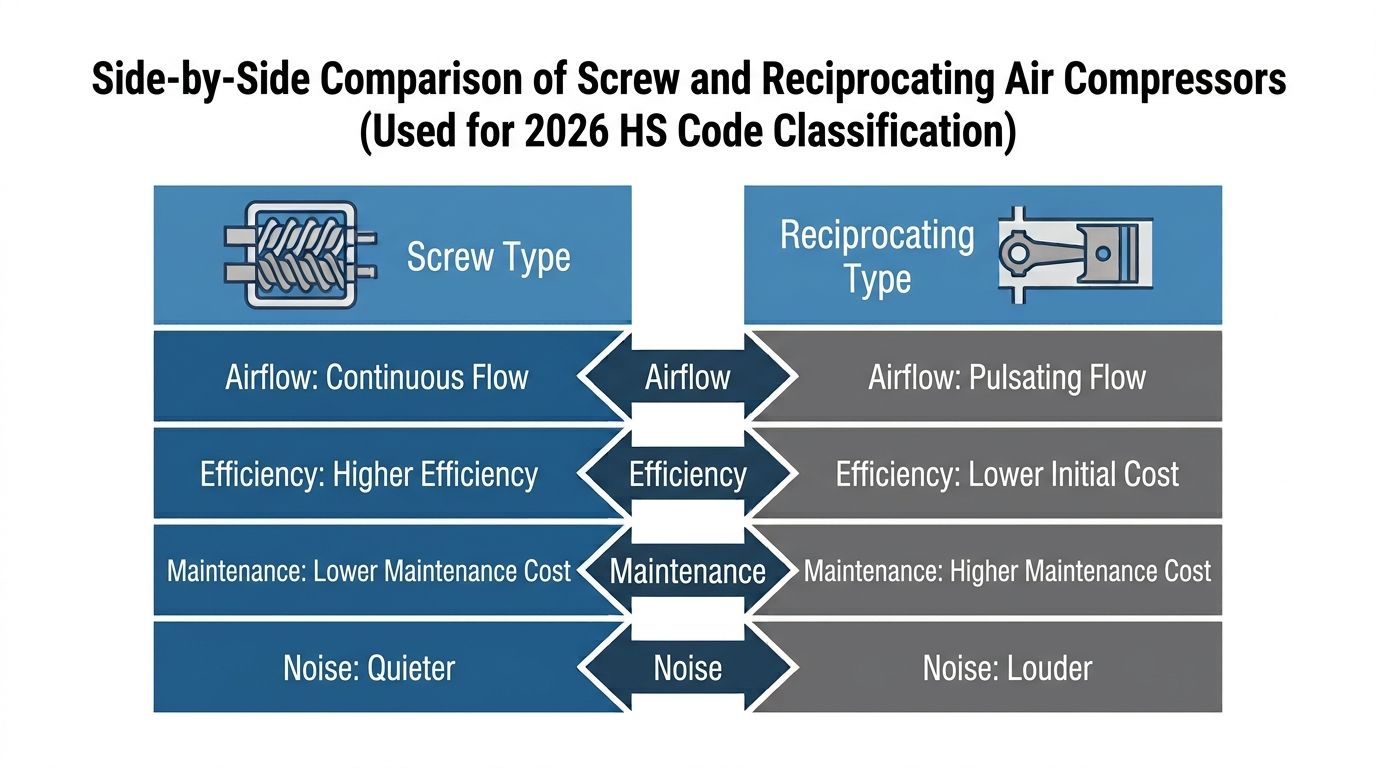
Rotary screw and reciprocating compressors dominate industrial applications and share the same primary HS code in most cases. Understanding their operational differences helps confirm classification and supports procurement decisions.
Energy efficiency: Rotary screw typically wins for constant-demand applications.
Maintenance needs: Rotary screw has fewer moving parts and lower upkeep.
Noise levels: Rotary screw generally operates more quietly.
Best applications: Rotary screw for factories; reciprocating for intermittent or smaller tasks.
Both usually classify under 841480. Confirm any refrigeration design features that could shift the code to 841430.
Special Classifications: Refrigeration and Towable Units
Refrigeration compressors and towable units receive dedicated HS codes because of their specialized design. Using the general “other” code for these items risks misclassification penalties.
Refrigeration compressors (841430) work with refrigerant gases rather than ambient air and appear in air-conditioning systems, commercial refrigerators, and industrial cooling plants. They face additional environmental regulations related to refrigerants.
Towable compressors (841440) mount on wheeled chassis specifically for vehicle towing. Construction crews and road-maintenance teams rely on these mobile units. Small handheld or wheeled but non-towable models stay under 841480.
Preventing Costly Delays with Correct HS Code Use
Incorrect HS codes remain one of the leading causes of customs holds and project setbacks for air-compressor shipments. Accurate classification delivers four major benefits.
Streamlined clearance – officers process correctly coded goods faster.
Precise duty calculation – avoids underpayment penalties or overpayment waste.
Regulatory compliance – identifies any special restrictions early.
Better supply-chain planning – yields reliable cost and transit estimates.
In 2026, automated customs systems increasingly flag mismatches between description and code. Investing a few minutes in correct classification protects entire project timelines.
Step-by-Step Process to Assign the Right HS Code
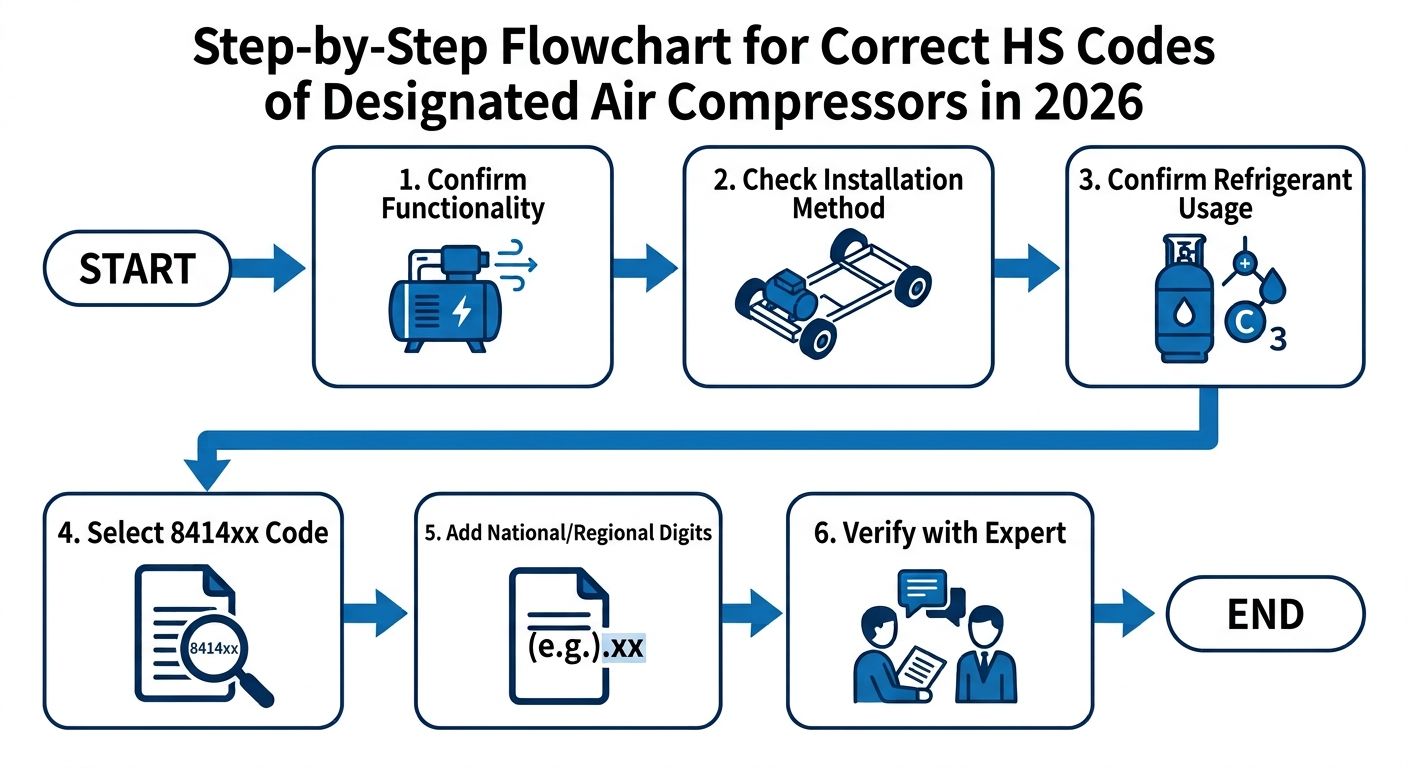
Follow a clear sequence every time you classify an air compressor to maintain consistency and accuracy. Start with the product’s technical documentation and end with expert verification when needed.
Identify the primary function (air compression, refrigeration, or vacuum).
Check mounting style (stationary, portable, or wheeled chassis for towing).
Confirm whether the unit is designed for refrigerant gases.
Match the description to the closest six-digit HS code.
Add any national digits required by the destination country.
Document the rationale and retain supporting specs.
Cross-check with official tariff databases or a licensed customs broker.
How FreightAmigo Supports HS Code Compliance
FreightAmigo’s digital logistics platform simplifies HS code selection and customs processes for air-compressor shipments. Businesses gain expert guidance, digital tools, and end-to-end support without needing deep customs expertise.
Access qualified customs agents when complex cases arise
Frequently Asked Questions
What is the main HS code for industrial air compressors in 2026?
Most industrial air compressors fall under HS code 841480 for other air or gas compressors. Refrigeration units use 841430 and towable chassis-mounted units use 841440. Always confirm with the latest national tariff schedule.
Does the HS code change if the compressor is electric or diesel powered?
Power source alone does not usually change the six-digit HS code. Classification focuses on function, design, and mounting. National subheadings may add detail for engine type in some countries.
How do I classify spare parts for air compressors?
Spare parts and components generally classify under HS code 841490. Provide a clear description of the part and its parent machine to avoid delays at customs.
Are portable air compressors coded differently from stationary ones?
Small portable units usually stay under 841480. Only compressors specifically mounted on a wheeled chassis designed for towing move to 841440.
What happens if I use the wrong HS code for an air compressor?
Wrong codes can trigger customs holds, additional inspections, duty underpayment penalties, or shipment rejection. Correct classification prevents these costly disruptions.
Do refrigeration compressors face extra regulations?
Yes. Compressors under 841430 often involve controlled refrigerants subject to environmental rules. Accurate coding ensures you identify and meet those requirements early.
Can FreightAmigo help verify HS codes before shipping?
The core six-digit structure remains stable. National administrations may update additional digits or duty rates. Always check the current tariff database of the importing country.
Final Recommendations for 2026 Trade Success
Mastering HS codes for air compressors delivers faster clearance, lower risk, and stronger supply-chain control. Keep the three core codes ready—841430, 841440, and 841480—and document every classification decision.
Leverage digital tools and expert support to stay ahead of evolving customs practices. With accurate coding and a reliable logistics partner, your air-compressor shipments move smoothly across borders in 2026 and beyond.
For expert guidance, Book a Demo with FreightAmigo.
HS codes are an internationally standardized classification system. They use names and numbers for traded products to support customs tariffs and trade statistics.
What is the main HS heading for air compressors?
Heading 8414 covers air or vacuum pumps, air or other gas compressors and fans. Air compressors are classified under Chapter 84 of the HS system.
What does subheading 841430 cover?
Subheading 841430 covers compressors used in refrigerating equipment. These are designed for refrigeration systems such as air conditioning units and industrial coolers.
What does subheading 841440 cover?
Subheading 841440 covers air compressors mounted on a wheeled chassis for towing. These portable units are typically used at construction sites and outdoor applications.
What does subheading 841480 cover?
Subheading 841480 covers other air or gas compressors. It serves as the catch-all category for most industrial and commercial air compressors.
How are rotary screw compressors classified?
Rotary screw compressors are typically classified under 841480. They fall into this category unless specifically designed for refrigeration use.
Why is proper HS code classification important?
Proper classification prevents project delays and ensures compliance. It supports accurate duty calculations, streamlined customs clearance, and regulatory adherence.
What HS codes are key for air compressors?
The key codes are 841430 for refrigeration, 841440 for towed units, and 841480 for most others. These ensure correct classification across common air compressor types.


























 Global Popular RoutesTop sea & air shipping lanes
 Special OfferLimited-time shipping promotions





 Express
 Document
 Parcel - Air/Sea
 Container
 Relocation