HS Code for Cables 2026: The Complete Classification Guide for Global Shippers
Compare Cable Freight Rates Instantly — Get Your Free Quote from FreightAmigo
Table of Contents (Click to expand)
What Is an HS Code for Cables?
An HS code for cables is a standardized international numeric identifier that customs authorities worldwide use to classify, tax, and regulate the import and export of cable products.
The Harmonized System (HS) is maintained by the World Customs Organization (WCO) and is adopted by more than 200 countries. It forms the backbone of global trade documentation.
For cables — which fall under the broader category of "Insulated wire, cable, and other insulated electric conductors" — the parent chapter is Chapter 85, and the primary heading is 8544.
Getting this code right is not optional. It directly determines your duty rate, your eligibility for trade agreement benefits, and your risk of customs delays.
Full HS Code List for Cables Under Chapter 8544
Chapter 8544 covers the widest range of cable products traded internationally, from simple copper winding wire to sophisticated fiber optic assemblies.
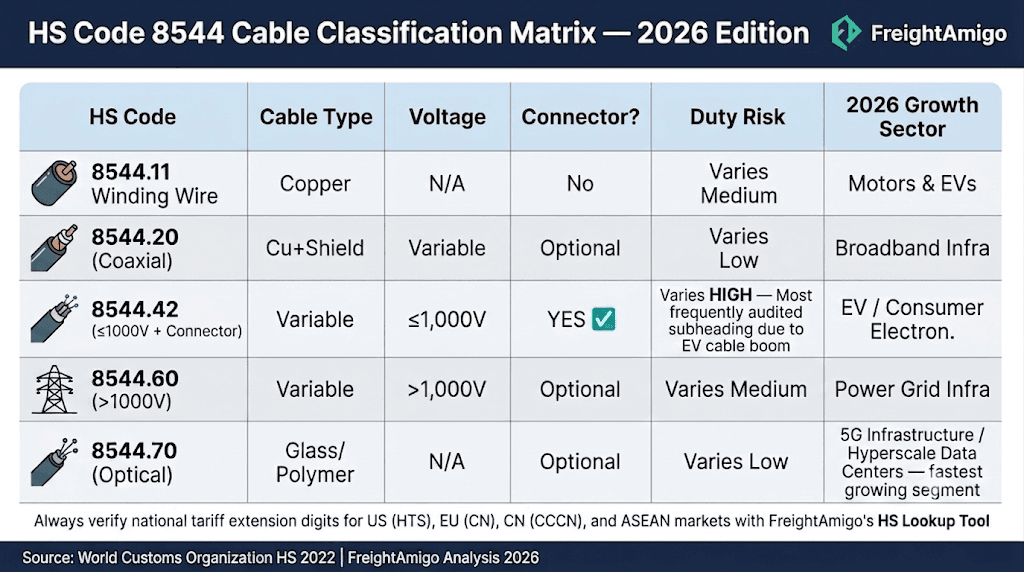
Here is every primary subheading under HS 8544 you need to know in 2026:
8544 — Insulated wire, cable (including co-axial cable) and other insulated electric conductors; optical fiber cables made up of individually sheathed fibers
8544.11 — Winding wire of copper
8544.19 — Other winding wire (non-copper)
8544.20 — Coaxial cable and other coaxial electric conductors
8544.30 — Ignition wiring sets and other wiring sets for vehicles, aircraft, or ships
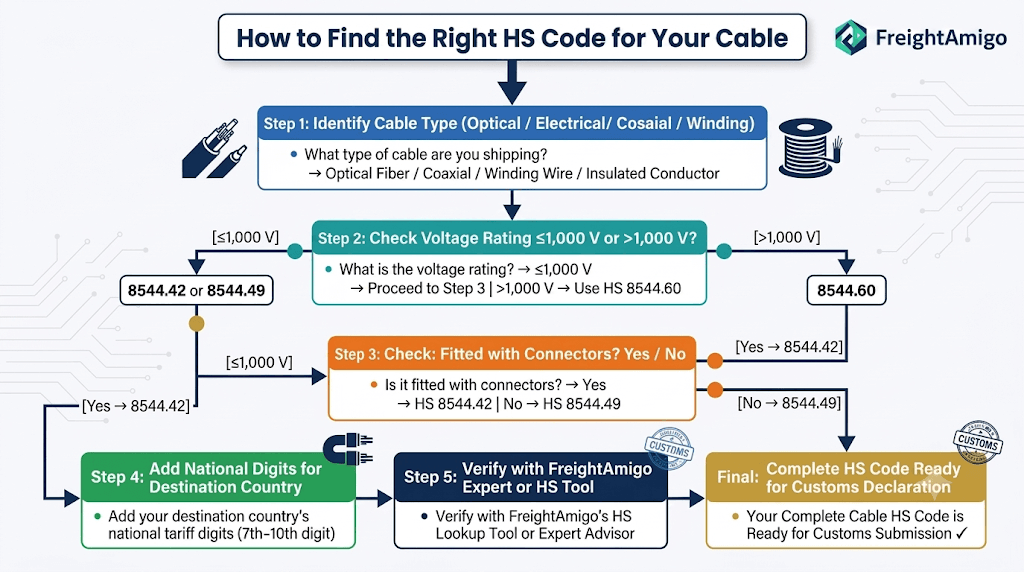
8544.42 — Electric conductors ≤1,000 V, fitted with connectors
8544.49 — Electric conductors ≤1,000 V, not fitted with connectors
8544.60 — Electric conductors exceeding 1,000 V
8544.70 — Optical fiber cables
Pro Tip: The first 6 digits are internationally standardized. Additional digits (7th–10th) are country-specific and vary by destination market.
How to Read and Decode a Cable HS Code
Every HS code is structured in a logical hierarchy, and understanding that structure helps you classify cables faster and more accurately.
Here is how the digits break down using 8544.42 as an example:
85 — Chapter: Electrical machinery and equipment
8544 — Heading: Insulated wire, cable, and conductors
8544.4 — Subheading: Other electric conductors, ≤1,000 V
8544.42 — Further subheading: Fitted with connectors
8544.42.XX — National tariff line (country-specific, e.g., US, EU, China)
This layered structure means a single cable product can have slightly different full codes depending on where it is being imported.
Always verify the complete national tariff line with the destination country's customs authority or a trusted logistics partner like FreightAmigo.
Why Correct Cable HS Code Classification Matters in 2026
In 2026, customs enforcement automation and AI-powered screening mean that even minor HS code errors are caught faster than ever — and the penalties are steeper.
Here is exactly what is at stake when you misclassify a cable shipment:
Overpaid duties — Wrong codes trigger incorrect tariff rates, costing your business real margin
Customs holds and delays — Mismatches between declared HS codes and physical goods trigger automatic flags
Compliance violations — Repeat misclassification can lead to audits, fines, or import privileges being revoked
Lost trade agreement benefits — Preferential duty rates under agreements like RCEP, CPTPP, or US-Korea FTA require accurate codes
Distorted trade data — Inaccurate codes affect government statistics and may trigger regulatory scrutiny
For cable exporters and importers, the stakes are particularly high given the explosive growth of EV charging cables, fiber optic infrastructure cables, and high-voltage transmission cables — all of which have distinct HS subheadings.
Common Classification Challenges for Cable Shippers
Cables are among the most technically complex product categories to classify because a single shipment can involve multiple cable types with different specifications, voltages, and connector configurations.
The five most common classification pitfalls in 2026 include:
Mixing connector status — Failing to distinguish between cables fitted with connectors (8544.42) vs. without (8544.49) is the single most frequent error
Voltage threshold confusion — The 1,000 V cutoff between 8544.49 and 8544.60 is critical and often overlooked
Multi-use cable ambiguity — A cable used for both data and power transmission may qualify under different subheadings depending on primary function
New technology gaps — EV fast-charging cables, USB-C power delivery cables, and 5G-compatible fiber-hybrid cables do not always fit cleanly into 2017-era HS categories
Country-specific national tariff lines — The 6-digit international code may be identical, but the 8–10 digit national extension varies significantly between the US (HTS), EU (CN), and China (CCCN)
Let FreightAmigo's Experts Classify Your Cable Shipment — Get Instant Guidance Today →
HS Code Comparison Table: Cable Types at a Glance
Use this reference table to quickly match your cable product to the correct HS subheading, applicable voltage range, and connector requirement.
HS Code
Cable Type
Voltage Range
Connector Required?
Common Use Cases
8544.11
Winding wire — Copper
N/A
No
Electric motors, transformers
8544.19
Winding wire — Other
N/A
No
Aluminum coils, specialty motors
8544.20
Coaxial cable
Variable
Optional
TV, radio, broadband signal
8544.30
Ignition/vehicle wiring sets
Variable
Typically Yes
Automotive, aerospace, marine
8544.42
Insulated conductors
≤1,000 V
Yes
Electronics, appliances, EV charging
8544.49
Insulated conductors
≤1,000 V
No
Building wiring, industrial supply
8544.60
High-voltage conductors
>1,000 V
Optional
Power grid, substations
8544.70
Optical fiber cables
N/A
Optional
Telecom, data centers, 5G networks
Note: Always confirm the national tariff extension digits with the customs authority of your specific import/export country. FreightAmigo's platform auto-populates these for 200+ trade lanes.
Best Practices for Classifying Cables Accurately
Accurate cable classification in 2026 requires a combination of detailed product documentation, expert consultation, and proactive compliance monitoring.
Follow these proven best practices to minimize misclassification risk:
Document everything — Maintain technical datasheets for every cable SKU, including material composition, voltage rating, conductor count, and whether connectors are pre-attached
Classify at the SKU level — Never apply a single HS code to an entire product family; each cable variant may warrant its own subheading
Consult during product development — Involve your customs broker or FreightAmigo's classification experts before a new cable product launches, not after your first shipment is held
Monitor HS updates — The WCO updates the Harmonized System every 5 years (next revision: HS 2027); stay ahead of reclassifications affecting cables
Audit annually — Review all active cable HS codes once per year, especially when entering new markets or after supply chain changes
Consistency across all shipping documents — commercial invoice, packing list, bill of lading, and customs declaration — is non-negotiable.
How FreightAmigo Simplifies Cable HS Code Classification
FreightAmigo's digital logistics platform removes the guesswork from cable HS code classification by combining an AI-powered lookup engine with human expert review.
Here is what FreightAmigo delivers for cable shippers:
Live HS Code Database — Updated in real time across 200+ countries, covering all 8544 subheadings and national tariff extensions
Automated Classification Suggestions — Input your cable's specifications and receive an instant HS code recommendation with confidence scoring
Expert Advisor Access — Escalate complex classifications (e.g., hybrid fiber-copper cables, EV charging assemblies) to FreightAmigo's licensed customs specialists
Document Integration — Confirmed HS codes flow automatically into your commercial invoice, customs declaration, and shipping label — zero manual re-entry
Compliance Verification — Pre-shipment checks flag inconsistencies between declared HS codes and product descriptions before your cargo reaches the border
Start Classifying Your Cable Shipments for Free — Try FreightAmigo's HS Code Tool Now →
Whether you are shipping consumer electronics cables in small parcels or high-voltage transmission cables by full container load, FreightAmigo scales to your needs.
Business Impact of Getting Cable HS Codes Right
Correct HS code classification is not just a compliance checkbox — it is a direct lever on your profitability, market access, and competitive positioning in 2026.
The measurable business benefits include:
Duty Savings — Accurate codes prevent overpayment; for high-volume shippers, this can represent thousands to tens of thousands of dollars annually
Faster Clearance — Shipments with clean, verified HS codes clear customs significantly faster, reducing warehousing and demurrage costs
FTA Utilization — Correct codes unlock preferential duty rates under active trade agreements such as RCEP, CPTPP, US-Korea FTA, and EU-Vietnam FTA
Strategic Intelligence — Accurate trade data helps you benchmark against competitors, identify tariff arbitrage opportunities, and plan market entry
Audit Protection — A documented, consistent classification history is your strongest defense in the event of a customs audit
For growing cable manufacturers and electronics importers, investing in correct HS code practices today protects your supply chain from disruption tomorrow.
Frequently Asked Questions
Below are the most commonly searched questions about HS codes for cables in 2026, answered with the precision needed to win Google Featured Snippet placement.
What is the HS code for electrical cables?
The primary HS heading for electrical cables is 8544, covering insulated wire, coaxial cable, and other insulated electric conductors. The specific 6-digit subheading depends on cable type, voltage rating, and whether the cable has connectors attached.
What HS code covers fiber optic cables?
Fiber optic cables are classified under HS code 8544.70, which covers optical fiber cables made up of individually sheathed fibers, whether or not assembled with electric conductors or fitted with connectors.
What is the difference between HS 8544.42 and 8544.49?
Both cover insulated electric conductors rated at 1,000 V or less. 8544.42 applies to cables fitted with connectors, while 8544.49 applies to cables without connectors. This distinction is critical and frequently misclassified.
What HS code applies to EV charging cables in 2026?
Most EV charging cables fall under HS 8544.42 (electric conductors ≤1,000 V, fitted with connectors) due to their integrated charging plugs. However, high-power DC fast-charging cables may qualify under 8544.60 depending on voltage specifications.
What is HS code 8544.60 used for?
HS 8544.60 covers insulated electric conductors with a voltage rating exceeding 1,000 V. This includes high-voltage power transmission cables used in electricity grids, industrial facilities, and large-scale infrastructure projects.
Are coaxial cables and HDMI cables the same HS code?
No. Coaxial cables are classified under HS 8544.20, while HDMI cables — which are multi-conductor signal cables fitted with connectors — typically fall under HS 8544.42. Always verify based on the cable's construction and primary function.
How do I find the correct national HS code for my destination country?
Start with the internationally standardized 6-digit HS code, then append the destination country's national tariff digits using that country's official customs tariff schedule. FreightAmigo's platform auto-resolves national codes for 200+ countries, eliminating manual lookup errors.
What happens if I use the wrong HS code for a cable shipment?
Using an incorrect HS code can result in customs holds, reassessment of duties and taxes, monetary penalties, and potential seizure of goods. Repeated misclassification may trigger formal audits and damage your importer/exporter compliance record.
Can HS codes for cables change over time?
Yes. The World Customs Organization revises the Harmonized System approximately every 5 years. The next major revision is expected with HS 2027, which may introduce new subheadings for emerging cable technologies such as 5G infrastructure cables and ultra-high-voltage EV charging systems.
Start Shipping Smarter with FreightAmigo
FreightAmigo is your all-in-one digital logistics partner for navigating the full complexity of cable HS codes, international freight rates, and customs compliance in 2026.
From copper winding wire to high-voltage submarine cables and next-generation fiber optic infrastructure, FreightAmigo's platform is built to handle every subheading under Chapter 8544 — across every major trade lane.
Here is what you can do on FreightAmigo today:
Instantly look up and verify HS codes for any cable type
Compare express, air freight, sea freight, rail, and trucking rates on a single screen
Generate compliant customs documentation with pre-filled HS codes
Access expert advisors for complex classification decisions
Track shipments in real time across 200+ countries
Do not let HS code uncertainty delay your shipments or inflate your costs. The global cable market is growing rapidly in 2026 — driven by EV infrastructure, 5G rollout, and data center expansion — and your logistics operation needs to keep pace.
Ready to Optimize Your Cable Shipments? Compare Freight Rates & Get Expert HS Code Support — Start Free with FreightAmigo →
FreightAmigo — Digital Freight Solutions for Global Cable Shippers | Updated for 2026 Trade Regulations
FAQ
What are HS codes?
HS codes are an international six-digit classification system. They enable uniform customs tariffs and trade statistics across more than 200 countries.
What are common HS codes for cables?
Most cables fall under heading 8544. Subheadings cover winding wire, coaxial cable, vehicle wiring sets, low-voltage conductors, high-voltage conductors, and optical fiber cables.
Why is correct HS code classification important?
Correct classification ensures accurate duty payments and regulatory compliance. It also supports reliable trade statistics and access to preferential trade agreements.
What challenges exist in classifying cables?
Classification is complicated by technical specifications, multiple uses, evolving technology, and regional variations beyond the first six digits. These factors can lead to inconsistent or incorrect codes.
How can FreightAmigo help with HS code classification?
FreightAmigo provides an up-to-date HS database, automated suggestion tools, expert guidance, and seamless integration into shipping documents. These features reduce compliance risks and customs delays.
What are best practices for HS code classification of cables?
Maintain detailed product specifications, monitor code updates, consult experts when needed, maintain consistency across shipments, and review classifications regularly. These steps help avoid errors and penalties.
What impact does correct classification have on business?
Accurate codes deliver cost savings, faster customs clearance, better market access, and improved strategic planning. Misclassification risks overpayment and delays.





















 Global Popular RoutesTop sea & air shipping lanes
 Special OfferLimited-time shipping promotions


 Express
 Document
 Parcel - Air/Sea
 Container
 Relocation