Mastering HS Code Classification: The Essential Guide to Importing and Exporting Jackets
Mastering the 2026 outerwear Harmonized System Code (HS Code) classification is a vital foundation for success in import and export trade, effectively reducing risks and optimizing costs.
Importance of 2026 Outerwear Harmonized System Code Classification
Precise outerwear Harmonized System Code classification assists importers and exporters in avoiding customs clearance delays and additional expenses. The Harmonized Commodity Description and Coding System (HS) is the global standard for trade classification. With tariff schedules regularly adjusted in 2026 and customs enforcement strengthened, the correct coding for apparel such as outerwear directly impacts tariffs, taxes, and overall compliance. Incorrect classification can lead to severe customs delays, unexpected tax increases, or even hefty fines, thereby eroding your profit margins.
We deeply understand the pressure you face. FreightAmigo empowers businesses every day to streamline their operational processes, from shipping initial samples to managing large-scale seasonal product launches. Understanding the details of Harmonized System Code categories is the cornerstone of a successful global trade strategy. In this guide, we will break down the complexities of textile and leather classification to help you ship your goods with greater confidence.
Key Advantages of Accurate Classification
Ensures accurate digital documentation, preventing expensive customs delays and administrative fines.
Identifies the correct tariff codes, leveraging preferential tax rates to optimize your landed costs.
Main Factors Influencing Outerwear Harmonized System Code Classification
Details such as material, construction, and intended use collectively determine the Harmonized System Code classification of outerwear. Importers need to pay close attention to fabric composition, gender design, functional styles, and rules of origin. These factors carry significant weight under various national regulations.
Specific use of the outerwear (casual, outdoor, formal)
Trade agreements and rules of origin qualification
Common Outerwear Materials and Corresponding Harmonized System Codes
Different materials of outerwear correspond to specific chapters; correct identification can drastically reduce errors. Chapter 61 covers knitted apparel, Chapter 62 covers non-knitted apparel, and leather outerwear is classified under Chapter 42. Precise subheadings must be confirmed based on the actual material, construction, gender, and style.
Material Type
Typical Harmonized System Code Range
Estimated 2026 Tariff Rates (e.g., US/EU)
Key Considerations
Synthetic Fiber (Polyester)
6201.93 / 6103.33
15–28%
Common in windbreakers and functional outerwear
Cotton
6203.32 / 6209
2–16%
Popular choice for casual outerwear
Wool / Fine Animal Hair
6203.31
16–20%
Formal suit jackets and blazers
Leather
4203.10
Varies by country of origin
Subject to stricter scrutiny
Note: Actual tariff rates vary by country, origin, free trade agreements, and specific subheadings. This table is for reference only; please refer to the latest tariff regulations from your local customs.
Classification Differences Between Knitted and Woven Outerwear
Distinguishing between knitted and woven construction is a critical step in outerwear classification. Knitted outerwear mostly utilizes the 6101–6103 series codes, while woven outerwear falls into the 6201–6203 series. Men's jackets frequently encounter issues due to misjudgments in this distinction.
Check fabric elasticity and structure.
Confirm the manufacturing method.
Refer to official Harmonized System Code explanatory notes.
Query the latest official databases.
Classification of Leather and Specialty Outerwear
Leather outerwear must be classified independently under Chapter 42. HS 4203.10 covers leather apparel. Mixed-material outerwear is determined based on the primary component.
Pure leather outerwear: 4203.10
Leather with textile lining: Still primarily classified under 4203
Faux leather / Synthetic materials: Usually reverts to textile classifications
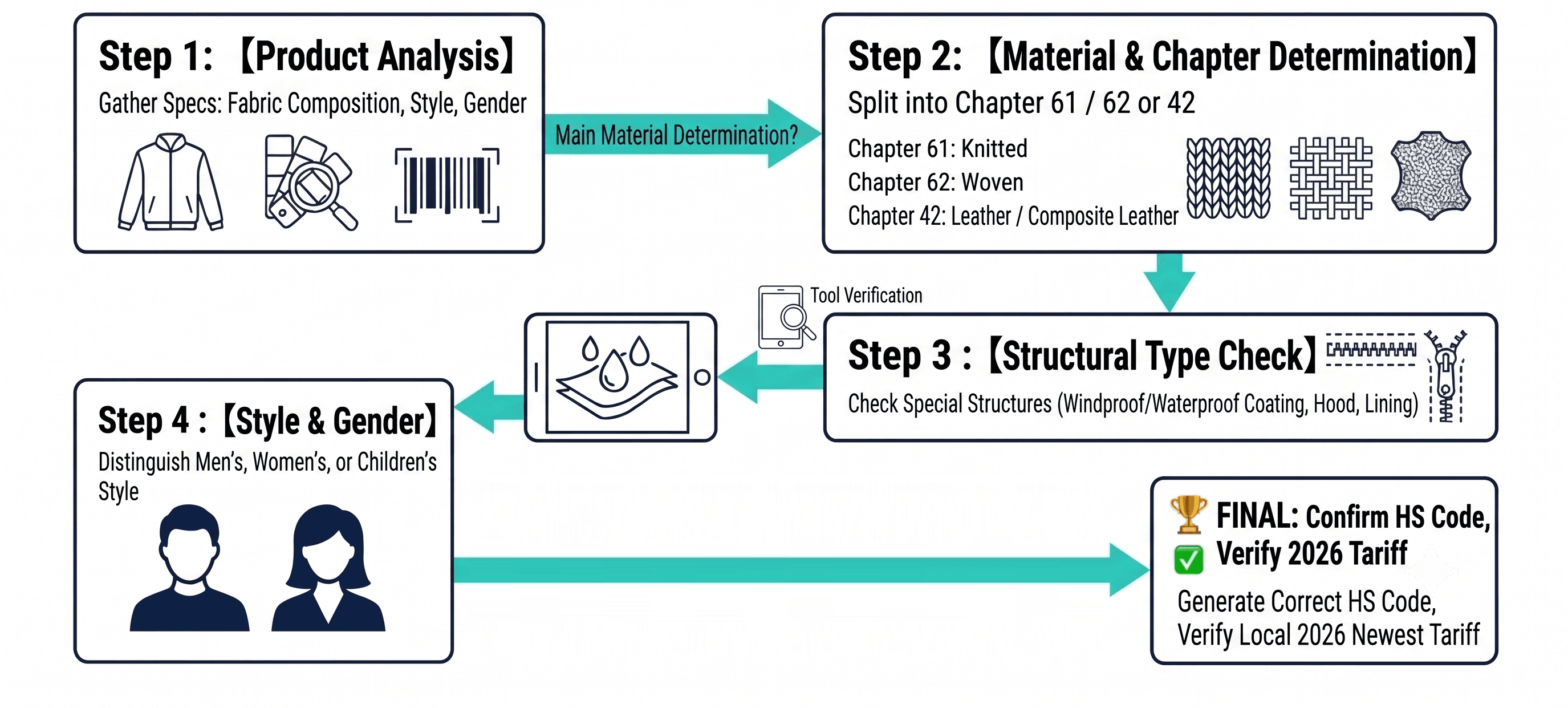
Step-by-Step Outerwear Harmonized System Code Classification Process
Following a standardized process ensures the accurate determination of an outerwear's Harmonized System Code. Detailed product specifications serve as the starting point for successful classification.
2026 Outerwear Import/Export Tariffs and Compliance
The correct Harmonized System Code can significantly lower the tariff burden on outerwear imports and exports while ensuring compliance.
In 2026, certain countries have strengthened country-of-origin verifications and sustainability compliance requirements (such as carbon tariffs and supply chain due diligence), but the core principles of Harmonized System Code classification remain unchanged. Incorrect classification can result in delays, fines, or cargo seizures.
Leverage free trade agreements to enjoy preferential tax rates.
Declare accurately to accelerate the digital customs clearance process.
Lower the risk of customs audits.
Hong Kong utilizes an 8-digit Hong Kong Harmonized System code (2026 edition), which can be verified using the Census and Statistics Department's online search tool.
Best Practices for Outerwear Import/Export Harmonized System Codes
Adopting professional strategies ensures zero errors in outerwear Harmonized System Code classification. Proactive verification is the best way to prevent cost increases.
Use official tariff databases and online tools.
Maintain complete records of materials and component percentages.
Regularly track local regulatory adjustments.
Frequently Asked Questions (FAQ)
What are the common Harmonized System Codes for men's outerwear in 2026?
Polyester woven men's outerwear is commonly found around 6201.93, while cotton men's outerwear is mostly around 6203.32. The exact subheading must be confirmed based on fabric ratios, styles, and gender, which can be searched through the Hong Kong Harmonized System (2026 edition).
How do you distinguish between the Harmonized System Codes for knitted and woven outerwear?
Knitted outerwear is primarily in Chapter 61, while woven outerwear is mostly in Chapter 62. This is the most common point of distinction in classification.
Is the Harmonized System Code for leather outerwear different from general fabric outerwear?
Yes, leather outerwear is classified under 4203.10, and its rules differ significantly from those for textiles.
Are there major updates to the outerwear Harmonized System Codes in 2026?
Tariff schedules undergo periodic adjustments, but the core principles of HS classification remain unchanged. It is recommended to consult the latest version from local official sources.
What is the impact of using an incorrect Harmonized System Code on outerwear imports and exports?
It can lead to customs delays, additional tariffs, fines, or even the seizure of goods. Professional assistance can effectively prevent these issues.
Do gender differences affect outerwear Harmonized System Codes?
Yes, men's, women's, and children's outerwear have different subheading classifications across various chapters.
How many digits of the Harmonized System Code are required for importing/exporting outerwear in Hong Kong?
Hong Kong utilizes an 8-digit Hong Kong Harmonized System code (2026 edition), which differs from the international 6-digit code. Please verify via the Census and Statistics Department online query.
Conclusion
Mastering the 2026 outerwear Harmonized System Code classification can significantly boost your import/export efficiency and competitiveness.
For expert guidance, Book a Demo with FreightAmigo.








 Global Popular RoutesTop sea & air shipping lanes
 Special OfferLimited-time shipping promotions





 Express
 Document
 Parcel - Air/Sea
 Container
 Relocation