What Is an HS Code? Why Does It Matter More in 2026?
The Harmonized System (HS) code is a globally standardized numerical classification system used by customs authorities in over 200 countries to identify traded goods.
Developed by the World Customs Organization (WCO), HS codes determine tariff rates, trade compliance requirements, and eligibility for preferential trade agreements.
In 2026, with tightening customs regulations and the widespread adoption of AI-driven border enforcement, using the correct HS code is more critical than ever for electronics and hand tools.
The Correct HS Code for Soldering Irons: 8515.11 Explained
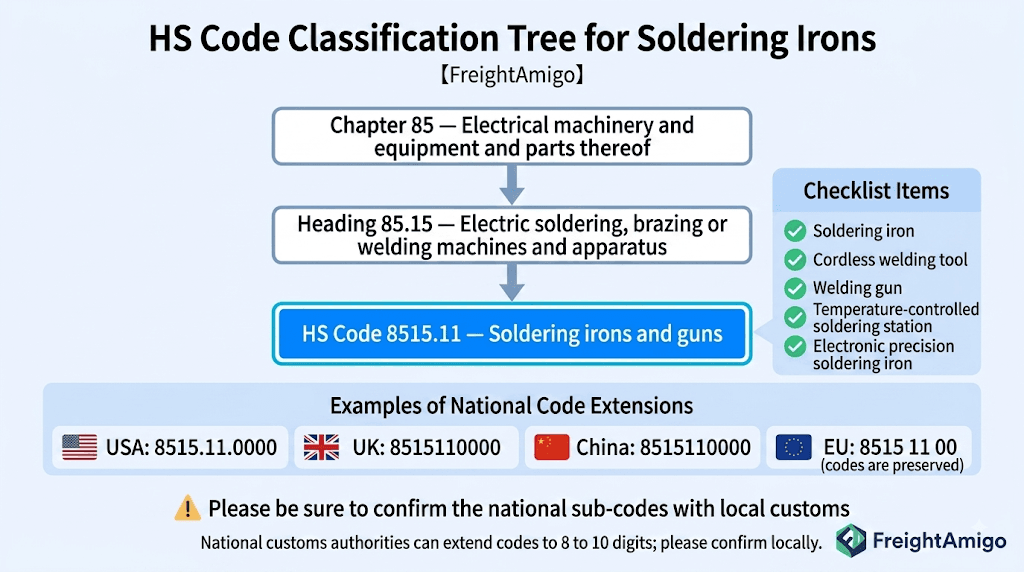
The primary HS code for soldering irons — covering electric, electronic, and cordless variants — is 8515.11.
This 6-digit international code is universally recognized across all WCO member countries as the benchmark classification for soldering irons and soldering guns.
Individual countries may append additional digits (e.g., 8-digit or 10-digit national codes) for more granular classification purposes.
Quick Reference:
HS Code: 8515.11
Product Category: Soldering irons and guns (electrically powered)
Parent Heading: 85.15 – Electric soldering, brazing and welding apparatus
Full Classification Breakdown: Heading 85.15
HS Heading 85.15 covers a wide range of electrically powered joining and cutting apparatus, making it one of the most technically detailed headings in Chapter 85.
The full heading description reads as follows:
"Electric (including electrically heated gas), laser or other light or photon beam, ultrasonic, electron beam, magnetic pulse or plasma arc soldering, brazing or welding machines and apparatus, whether or not capable of cutting; electric machines and apparatus for hot spraying of metals or cermets."
This broad definition means that even advanced precision soldering equipment — such as laser soldering stations — may fall under related 8515 subheadings.
Types of Soldering Tools Covered Under HS 8515.11
HS code 8515.11 covers a broad spectrum of soldering tools commonly found in electronics manufacturing, PCB assembly, plumbing, and repair industries.
The following tool types are generally classified under this code:
Note: Pure hot-air rework stations may be classified differently depending on their primary function. Always confirm with a licensed customs broker.
Why Correct HS Code Classification Is Critical
In 2026's stricter trade environment, misclassifying a soldering iron by even one digit can trigger duty overpayments, customs holds, or formal penalty notices.
Here are the key reasons why correct classification matters:
Duty Rate Accuracy —— Each HS code carries a specific tariff rate. Wrong codes mean wrong duties.
Customs Compliance —— Misclassification is a customs violation in most jurisdictions.
Trade Agreement Access —— Preferential rates under FTAs (e.g., RCEP, CPTPP) are tied to correct HS codes.
Import/Export Licensing —— Some markets require specific permits for electrical tools based on HS classification.
Trade Statistics Integrity —— Accurate codes support correct national trade data reporting.
Audit Protection —— Documented correct classification protects your business during customs audits.
Common Classification Challenges for Soldering Irons
As soldering technology evolves rapidly in 2026, classifying modern tools has become increasingly complex for importers and exporters worldwide.
Key challenges include:
Multifunctional Devices: A tool that solders, desolds, and hot-air reworks may span multiple HS subheadings.
Emerging Technologies: Laser soldering and plasma arc tools may not map cleanly to existing codes.
Kit vs. Individual Tool: Soldering station kits (iron + stand + tips + solder) may be classified as a set or broken into individual components.
Battery Regulations Overlap: Cordless irons with lithium batteries trigger additional UN38.3 / IATA DGR requirements on top of standard HS classification.
Country-Specific Sub-codes: The USA, EU, China, and Australia each extend the 6-digit HS code differently at the 8–10 digit national level.
How to Ship Soldering Irons Internationally in 2026
Shipping soldering irons across borders in 2026 requires careful attention to packaging standards, documentation requirements, and destination-country import regulations.
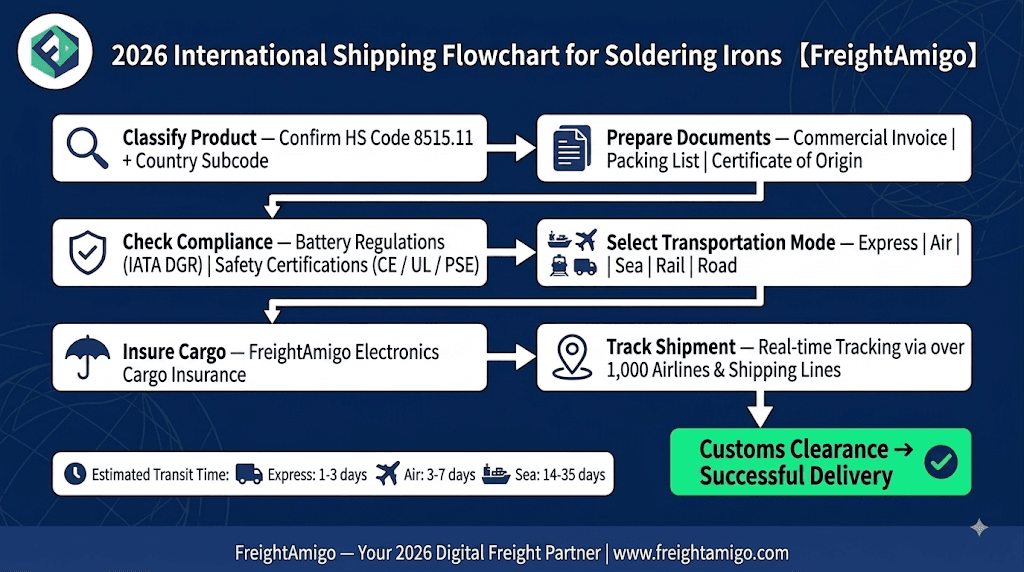
Follow this checklist before dispatching your shipment:
Confirm HS Code —— Verify that 8515.11 applies; check national sub-code extensions for both origin and destination countries.
Prepare Commercial Invoice —— Include full product description, unit value, and HS code.
Assess Battery Regulations —— If cordless, ensure compliance with IATA DGR / IMDG lithium battery provisions.
Check Import Restrictions —— Some markets restrict electrical tools without safety certifications (CE, UL, PSE).
Choose the Right Freight Mode —— Compare air freight, sea freight, and express courier based on volume and urgency.
Arrange Customs Clearance —— Pre-file entry documents with a licensed broker to ensure smooth release.
How FreightAmigo Simplifies Soldering Iron Shipments
FreightAmigo's AI-powered digital logistics platform is purpose-built to eliminate the complexity of shipping precision electronics like soldering irons across borders.
Here is what the platform delivers end-to-end:
FreightAmigo Feature
Benefit for Soldering Iron Shippers
HS Code Verification Tool
Instantly confirms whether 8515.11 classification is correct
Multi-Mode Rate Comparison
Compare express, air, sea, rail and trucking in one search
Connected to 1,000+ airlines and shipping lines globally
Customs Clearance Arrangement
Pre-filing support to avoid customs holds
Cargo Insurance
Coverage for high-value precision soldering equipment
Automated Document Generation
Auto-creates commercial invoices, packing lists, and certificates of origin
24/7 Expert Support
Live logistics specialists available across time zones
FreightAmigo integrates artificial intelligence, big data analytics, and trade compliance databases to ensure every soldering iron shipment is correctly classified, accurately documented, and successfully delivered.
Compare door-to-door freight rates for soldering irons right now — air, sea, express and more →
Freight Rate Comparison: Shipping Soldering Irons by Mode
Choosing the right freight mode for soldering iron shipments depends on cargo weight, urgency, budget, and the customs requirements of the destination country.
Freight Mode
Typical Transit Time
Best For
Relative Cost
International Express Courier
1–3 business days
Samples, small orders (<30kg)
$$$$
Air Freight
3–7 business days
Mid-volume orders (30–500kg)
$$$
Sea Freight (FCL)
14–35 days
Full container loads (500kg+)
$
Sea Freight (LCL)
18–40 days
Partial loads, budget shipping
$$
Rail Freight
12–20 days
China–Europe corridor shipments
$$
Road / Trucking
2–10 days
Regional cross-border shipments
$$
Pro Tip: For high-value precision soldering equipment, air freight with cargo insurance is recommended regardless of shipment volume.
Frequently Asked Questions
The following FAQs address the most common search queries about HS codes and international shipping for soldering irons in 2026.
What is the HS code for a soldering iron?
The standard international HS code for soldering irons and soldering guns is 8515.11. This falls under Chapter 85, Heading 85.15, covering electric soldering, brazing, and welding apparatus. Always confirm the country-specific national extension digits with your customs broker.
Is HS code 8515.11 valid for all countries in 2026?
The 6-digit code 8515.11 is recognized by all 200+ WCO member countries. However, individual nations extend this to 8 or 10 digits for national tariff purposes. Always verify the destination country's full national code before filing customs declarations.
What is the import duty rate for soldering irons under HS 8515.11?
Duty rates vary by country. The EU applies approximately 1.7–2.7%, the USA typically 0%, and China up to 6–8%. Rates may be reduced under active FTAs such as RCEP or CPTPP. Confirm current rates via the destination country's official customs tariff portal.
Can I ship a cordless soldering iron by air freight?
Yes, but cordless soldering irons with lithium-ion batteries are subject to IATA Dangerous Goods Regulations (DGR). Batteries must meet UN38.3 testing requirements and be correctly declared. FreightAmigo's compliance team can assist with proper dangerous goods documentation.
What documents are required to ship soldering irons internationally?
Key shipping documents include: (1) Commercial Invoice with HS code 8515.11, (2) Packing List, (3) Certificate of Origin, (4) Bill of Lading or Air Waybill, and (5) any applicable safety certifications (CE, UL, PSE) required by the destination country.
Are soldering stations classified under the same HS code as soldering irons?
Temperature-controlled soldering stations are generally classified under HS 8515.11 alongside standard irons. However, advanced rework systems with hot-air components may be classified under 8515.19 (other) or alternative subheadings. Consult a licensed customs classifier for complex multi-function units.
What happens if I use the wrong HS code for my soldering iron shipment?
Misclassification can result in customs holds and shipment delays, retroactive duty demands, financial penalties, and potential import bans in repeat-offense cases. In 2026, AI-assisted customs scanning has significantly increased detection rates. Use FreightAmigo's HS verification tool to avoid these risks.
How do I find the country-specific HS code extension for soldering irons?
Start with the universal 6-digit code 8515.11, then access national tariff databases: USA (USITC HTS), EU (TARIC), China (GACC), Australia (Australian Border Force tariff finder). FreightAmigo's platform integrates live tariff data to surface the correct national code for your origin-destination pair.
Ship Smarter with FreightAmigo
FreightAmigo is your all-in-one digital freight partner for classifying, documenting, and shipping soldering irons and precision electronics tools worldwide.
Whether you are a manufacturer exporting electric soldering irons, an electronics distributor importing precision tools, or an e-commerce seller shipping soldering guns globally — FreightAmigo's platform handles every step.
From instant HS code verification to real-time multi-carrier rate comparison, automated document generation, and 24/7 expert support, FreightAmigo removes the friction from international logistics.
Key takeaways from this guide:
The correct HS code for soldering irons is 8515.11
Always verify national sub-code extensions at both origin and destination
Last updated in accordance with 2026 trade compliance standards. FreightAmigo is a licensed digital freight forwarder serving importers, exporters, and manufacturers across Asia-Pacific, Europe, and the Americas.

























 Global Popular RoutesTop sea & air shipping lanes
 Special OfferLimited-time shipping promotions





 Express
 Document
 Parcel - Air/Sea
 Container
 Relocation