Understanding HS Codes for Notebooks and Stationery Items
Want To Compare The Best Express, Air Freight, Sea Freight, Rail Freight & Trucking Rates So As To Have Better Control On Cost?
The Harmonized System (HS) typically serves as the foundation for the global trade classification of notebooks and stationery products in 2026.
HS is an international standardized commodity classification system developed by the World Customs Organization (WCO). In 2026, as various national customs administrations update their respective national tariffs, precise coding helps ensure smooth customs clearance under changing trade regulations.
Short paragraphs assist mobile users in quick browsing. Correct HS codes generally affect customs duties, taxes, and compliance requirements.
Enterprises engaged in international stationery trade are advised to master the latest 2026 rules to cope with potential customs clearance procedures.
Common HS Codes for Notebooks
Most standard notebooks are typically based on the universal six-digit HS code 4820.10.
This category covers registers, account books, notebooks, order books, receipt books, letter pads, memorandum pads, diaries, and similar articles. Exercise books are usually classified separately under 4820.20.
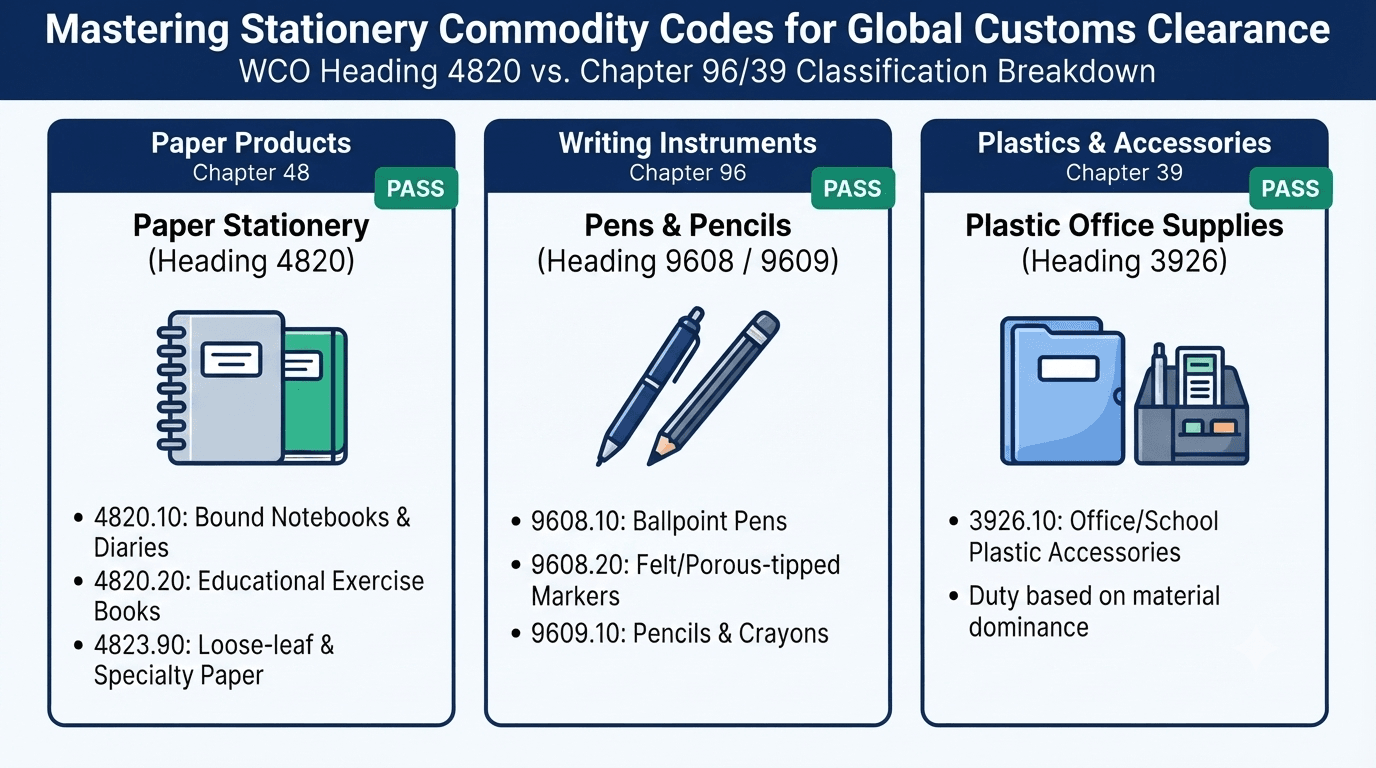
4820.10: Common universal code for bound notebooks and similar writing books.
4820.20: Educational exercise books with printed lines or squares.
Sub-classifications, such as local tariff extension codes of various countries, still need to be confirmed according to the current tariff schedule of the destination country, usually depending on binding type, dimensions, and independent national interpretation rules.
Understanding these distinctions helps reduce classification risks during transportation in 2026.
HS Codes for Other Stationery Products
Stationery products cover a wide range, including pens, pencils, and paper articles.
Common codes include:
4823.90: Other paper and paperboard products, such as loose-leaf paper.
9608.10: Ballpoint pens.
9608.20: Felt-tipped and other porous-tipped pens and markers.
9609.10: Pencils and crayons.
3926.10: Office or school supplies made of plastics.
Material, function, and packaging usually significantly affect the final determination of the HS code.
Consideration must be given to composition (paper versus plastic covers), specific use, manufacturing processes, and whether they are sold in sets. Customs administrations in different countries may interpret the classification of mixed materials and legal texts, such as chapter notes, heading notes, and rules of interpretation, differently.
In 2026, detailed product descriptions and compliance with destination customs specifications will assist in successfully completing declarations.
Importance of Correctly Using HS Codes
Correct HS codes often directly affect customs duties, compliance, and transportation efficiency.
Key benefits include:
Assists in accurately calculating customs duties and taxes.
Helps accelerate customs clearance workflows.
Reduces the risk of fines and cargo seizures.
Provides reliable trade statistical data.
Improves supply chain predictability.
Misclassification can cause expensive delays in the highly competitive stationery market.
How to Determine the Correct HS Code
Following a systematic process helps correctly classify notebooks and stationery in 2026.
Consult the WCO or the official customs tariff databases of various importing countries.
Thoroughly analyze product specifications including binding, material, and dimensions.
When uncertain, it is recommended to apply for a binding pre-ruling from the destination customs.
Verification against the current tariff schedule of the destination country combined with the latest tariff text is still required.
Professional verification helps maintain long-term compliance.
Common Errors and How to Avoid Them
Incorrectly classifying stationery sets is a common problem.
Other pitfalls include ignoring material differences, using expired codes, or failing to notice specific national extension codes and special tariff measures of various importing countries. Dynamically cross-checking the latest official tariffs is recommended.
Proactive verification and reference to official customs pre-rulings can reduce trade risks.
How FreightAmigo Assists in HS Code Compliance
Modern digital systems can assist enterprises in interfacing more efficiently with the official customs databases of various countries.
Through tools that interface with the tariff schedules of the WCO and major importing countries, enterprises can quickly retrieve the first six universal digits and various national extension sub-codes, streamlining the preparation time for customs declaration documents. Simultaneously, professional personnel are available to assist with customs clearance and declarations, providing expert support for complex classification issues.
Utilize digital tools to optimize your 2026 logistics and landed cost budgets.
Frequently Asked Questions
What is the HS code for notebooks in 2026?
The primary universal six-digit code for most notebooks is typically based on 4820.10. This code covers bound writing books. Upon actual declaration, it is still necessary to confirm the complete national extension code according to the current tariff schedule of the destination country to comply with 2026 compliance specifications.
How does the classification of exercise books differ from general notebooks?
Exercise books typically use the universal code 4820.20. Unlike general notebooks under 4820.10, they feature educational printed formats. This distinction often affects tariff applicability and documentation requirements according to the specific implementation rules of various customs administrations.
Does the material affect the HS code of a notebook?
Yes, paper type, cover material, or jacket structure will affect the specific national extension code. Although basic paper books fall under Chapter 48, special materials may involve heading notes and exclusionary chapter notes of various customs. Detailed specifications are usually the key to determination.
Are there any updates to HS codes for stationery in 2026?
The core six-digit HS codes of the WCO are usually stable, with changes primarily occurring in national extension codes and implementation rules. For instance, local tariff schedules in regions like the European Union and the United States undergo refined adjustments annually, so regular consultation with official sources is recommended.
What are the consequences of using an incorrect HS code?
Improper coding can lead to customs clearance delays, fines, or shipment rejections. Correct coding and item-by-item verification help support regulatory compliance and precise cost control in international stationery trade.
How do I find the HS code for stationery sets?
Mixed sets usually need to be evaluated step-by-step according to the General Rules for the Interpretation (GIR) of the Harmonized System. Generally, the universal code is determined based on the component that gives the set its essential character, or components are broken down for independent declaration as required by destination customs.
How can the accuracy of cross-border stationery HS codes and tax rates be ensured?
It is recommended to retrieve information using official databases or pre-rulings as the final authority. Cross-border declaration relies heavily on official regulatory texts, chapter notes, precedents, or official advance classification rulings, and should not rely on generalized secondary internet information.
Are import duties on notebooks typically low?
Many markets apply lower tax rates to items under 4820.10, but this cannot be taken as a fixed conclusion. Actual applicable tariffs usually fluctuate dynamically with the country of origin of the goods, bilateral trade agreements, temporary trade remedy measures, and the current tariff schedule of the importing country.
Conclusion and Next Actions
Mastering the 2026 WCO universal framework and the independent extension tariffs of various importing countries helps give your business a compliance advantage in global trade.
Maintaining updates on official information, studying the local implementation rules and national extension codes of destination customs, and conducting official verification for specific tariff numbers before shipment will mitigate cross-border regulatory risks.
For expert guidance, Book a Demo with FreightAmigo.








 Global Popular RoutesTop sea & air shipping lanes
 Special OfferLimited-time shipping promotions





 Express
 Document
 Parcel - Air/Sea
 Container
 Relocation