FOB Incoterm: Understanding Who Pays Freight and Key Responsibilities
Imagine you are about to complete a large sea freight shipment from Hong Kong to Europe, only to suddenly discover unexpected freight charges due to a misunderstanding of FOB Incoterms, severely eroding your profit margins. This is a common pitfall for many importers and exporters, who often face hidden fees such as port handling, insurance, or customs clearance, mistakenly believing they were already included.
At FreightAmigo, we see this situation every day—we are here to explain FOB Incoterms in detail, along with related terms like FCA and EXW, ensuring your supply chain operates smoothly without any surprises.
Whether you are negotiating with Asian suppliers or managing imports into the EU, mastering who pays the freight under FOB Incoterms can save you thousands of dollars in unnecessary expenses and disputes.
Key Takeaways of This Guide
Familiarize yourself with FOB Incoterms to clearly define the point in time when freight responsibility transfers from the seller to the buyer.
Compare FOB with related terms like FCA, EXW, and CFS to select the best option for your shipping mode.
Avoid common mistakes in Incoterms selection through practical examples and cost-saving strategies.
What is Incoterms® 2020 and Its Importance in 2026
Incoterms® 2020 are standardized international trade terms established by the International Chamber of Commerce (ICC) to clearly define the costs, risks, and logistics responsibilities of buyers and sellers.
These rules help prevent disputes in global transportation. In 2026, amid ongoing supply chain fluctuations, mastering Incoterms® 2020 is crucial for cost control. FreightAmigo simplifies the application of Incoterms® 2020 through its online instant quotation tool.
FOB Incoterms® 2020 Explained: Core Rules
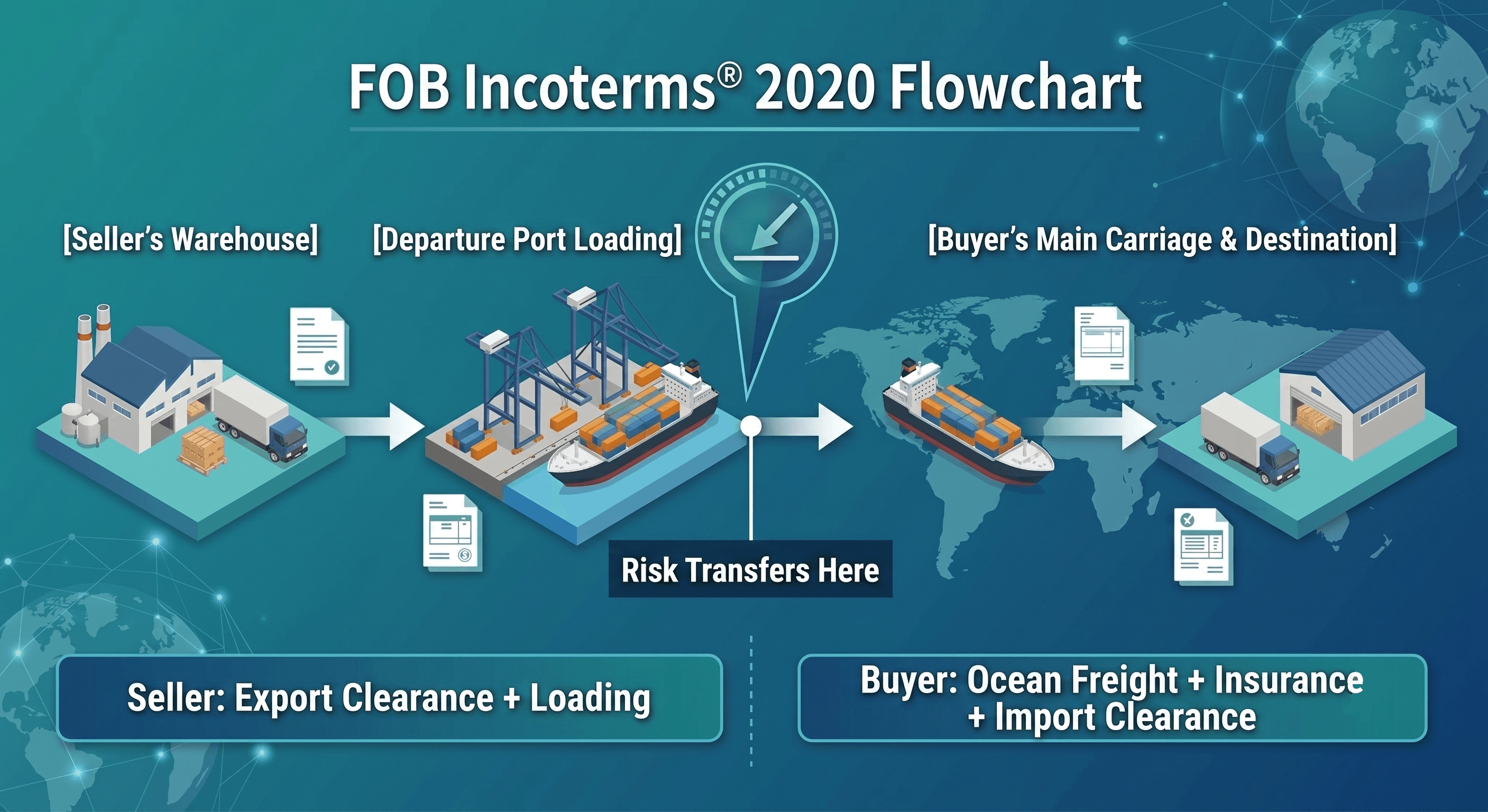
FOB (Free On Board) is an Incoterms® 2020 term applicable to sea freight and inland waterway transport, where the seller is required to load the goods onto the vessel at the designated port of shipment.
Once the goods are loaded onto the vessel, the risk transfers to the buyer. This allows the buyer to take control of major transportation choices. FOB is particularly suitable for experienced importers handling Full Container Load shipments.
Seller and Buyer Responsibilities Under FOB
Under FOB Incoterms® 2020, the seller is responsible for all costs and risks until the goods are loaded onto the designated vessel at the port of origin. The buyer then takes over subsequent freight, insurance, and destination charges. This division is vital for accurate budgeting.
Seller's Responsibilities:
Packaging and inland transportation to the port
Export customs clearance
Loading charges and port-of-origin fees (such as THC)
Providing the Clean Shipped on Board Bill of Lading
Buyer's Responsibilities:
Designating the vessel and paying the sea freight charges
FOB performs exceptionally well in sea freight scenarios, especially for transportation from Asia to Europe or North America. The port should be clearly specified in the contract, such as "FOB Hong Kong," and the Incoterms® 2020 version must be noted to avoid misunderstandings.
Best Practices Workflow for Loading:
Confirm vessel designation with the buyer as early as possible.
Ensure that Shipped on Board Bill of Lading documentation is complete.
Calculate the Terminal Handling Charges (THC) at the port of origin.
Confirm that export customs clearance has been completed.
Common Mistakes and How to Avoid Them
Many traders misunderstand the exact moment of FOB risk transfer, leading to unexpected expenses. Contracts must always specify the version (Incoterms® 2020) and the designated port.
Avoid using FOB for air freight or Less than Container Load (unless adjusted through specific clauses).
Rising freight rates and sustainability requirements in 2026 make the control provided by FOB even more valuable. Buyers can negotiate more favorable carrier rates after loading. Online digitalization tools further enhance supply chain visibility.
Best Practices for Successfully Using FOB
Successfully utilizing FOB requires clear communication and reliable partners. Collaborate with experts like FreightAmigo to secure optimized routing and compliance support:
FOB (Free On Board) means that after the seller loads the goods onto the vessel at the port of origin, the buyer assumes all subsequent costs and risks. This definition remains unchanged under the Incoterms® 2020 rules.
Who pays the freight under FOB Incoterms® 2020?
The buyer pays the main sea freight charges and all subsequent costs after loading. The seller is only responsible up to the point of loading onto the vessel.
Is FOB still valid in 2026?
Yes, the Incoterms® 2020 rules (including FOB) remain the global standard in 2026, as no new Incoterms 2026 version has been released. It is essential to explicitly state the "Incoterms® 2020" version in your contracts.
Which is better for sea freight, FOB or FCA?
FOB is suitable for Full Container Load sea freight with explicit loading requirements (risk transfers upon loading onto the vessel), whereas FCA is better suited for multimodal transport or Less than Container Load delivery at the carrier's premises (risk transfers upon delivery to the carrier). Choose based on your control needs.
What costs does the seller bear under FOB?
The seller bears the costs of packaging, inland transport to the port, export customs clearance, and loading. The buyer is responsible for everything thereafter.
Can FOB be used for air freight?
No, FOB is strictly applicable to sea freight and inland waterway transport. For air freight or multimodal transport in 2026, please use FCA.
How does FOB affect insurance liability?
The buyer must arrange marine insurance once the goods are loaded onto the vessel. Unless otherwise agreed, the seller has no such obligation.
What are common pitfalls for beginners using FOB?
Beginners often overlook destination charges or fail to designate a vessel in time, causing delays and extra expenses. Working with professionals is highly recommended to mitigate these risks.
Conclusion
Mastering FOB Incoterms® 2020 allows you to effectively control freight costs and risks in international trade throughout 2026.
For expert guidance, Book a Demo with FreightAmigo.








 Global Popular RoutesTop sea & air shipping lanes
 Special OfferLimited-time shipping promotions





 Express
 Document
 Parcel - Air/Sea
 Container
 Relocation