Break-of-Bulk Point: A Critical Concept in Modern Logistics
Want To Compare The Best Express, Air Freight, Sea Freight, Rail Freight & Trucking Rates So As To Have Better Control On Cost?
Shipping Trends in 2026
Global trade highly relies on efficient logistics networks. The shipping industry continues to carry approximately 90% of the world's trade volume, with daily cargo transportation reaching millions of tons in major markets.
Bulk cargo, break-bulk cargo, and project cargo continue to grow due to infrastructure construction, renewable energy, and industrial projects.
Companies must clearly distinguish between different cargo types and master the concept of transfer points to maintain a competitive advantage in 2026.
Conceptual Distinction Between Bulk, Break-Bulk, and Project Cargo
Correctly distinguishing between bulk cargo, break-bulk cargo, and project cargo is the foundation of logistics planning. Confusing these concepts can lead to wrong choices in transportation modes and increased costs.
In 2026, global supply chains place greater emphasis on precise multimodal transport matching.
Comparison of the Three Cargo Types
- Bulk Cargo: Loose, homogeneous commodities poured directly into the ship's hold.
- Break-Bulk Cargo: Irregular cargo packed into pieces and handled on a piece-by-piece basis.
- Project Cargo: High-value, oversized, and complex industrial cargo, usually tied to specific projects.
Understanding the differences helps in choosing the most suitable vessel and transfer strategy.
Characteristics of Traditional Bulk Cargo Transportation
Traditional bulk cargo mainly refers to loose commodities such as coal, grain, and ore. These cargoes are loaded and unloaded in large quantities using bulk carriers via conveyor belts or pumps.
In 2026, this type of transportation still dominates the commodities trade.
Typical Examples of Traditional Bulk Cargo
- Coal and coke
- Grain and foodstuffs
- Iron ore and other minerals
- Fertilizer and cement (in bulk form)
- Sugar and bulk liquids
These cargoes emphasize transportation efficiency with high volume and low cost.
Transportation Advantages of Break-Bulk and Project Cargo
Break-bulk and project cargo are suitable for oversized or irregular items that cannot fit into standard containers. Wind turbine components, steel coils, and heavy machinery fall into this category and must be handled piece by piece.
This method allows the complete transportation of large components, reducing assembly costs at the destination.
Main Advantages
- Supports the complete transportation of oversized equipment.
- Enables the use of small and medium-sized ports that lack container facilities.
- Provides the flexible planning required for project logistics.
- Adapts to the needs of the infrastructure and energy industries.
- Enhances the reliability of time-sensitive industrial cargo.
- Global accessibility is an important advantage for expanding into emerging markets.
Major Challenges in Break-Bulk and Project Cargo Operations
Compared to container transportation, break-bulk and project cargo incur higher costs and require specialized handling. Oversized dimensions lead to low space utilization and increased handling complexity.
In 2026, labor, equipment, and risk management remain critical issues.
Common Operational Obstacles
- Higher freight rates due to space requirements.
- Specialized lifting equipment and technicians are required.
- Risks of damage or delay during loading and unloading.
- Complex route surveys and permit applications.
- Higher dependence on weather and port capabilities.
Detailed advance planning can effectively mitigate these risks.
What is a Bulk Cargo Transfer Point in 2026?
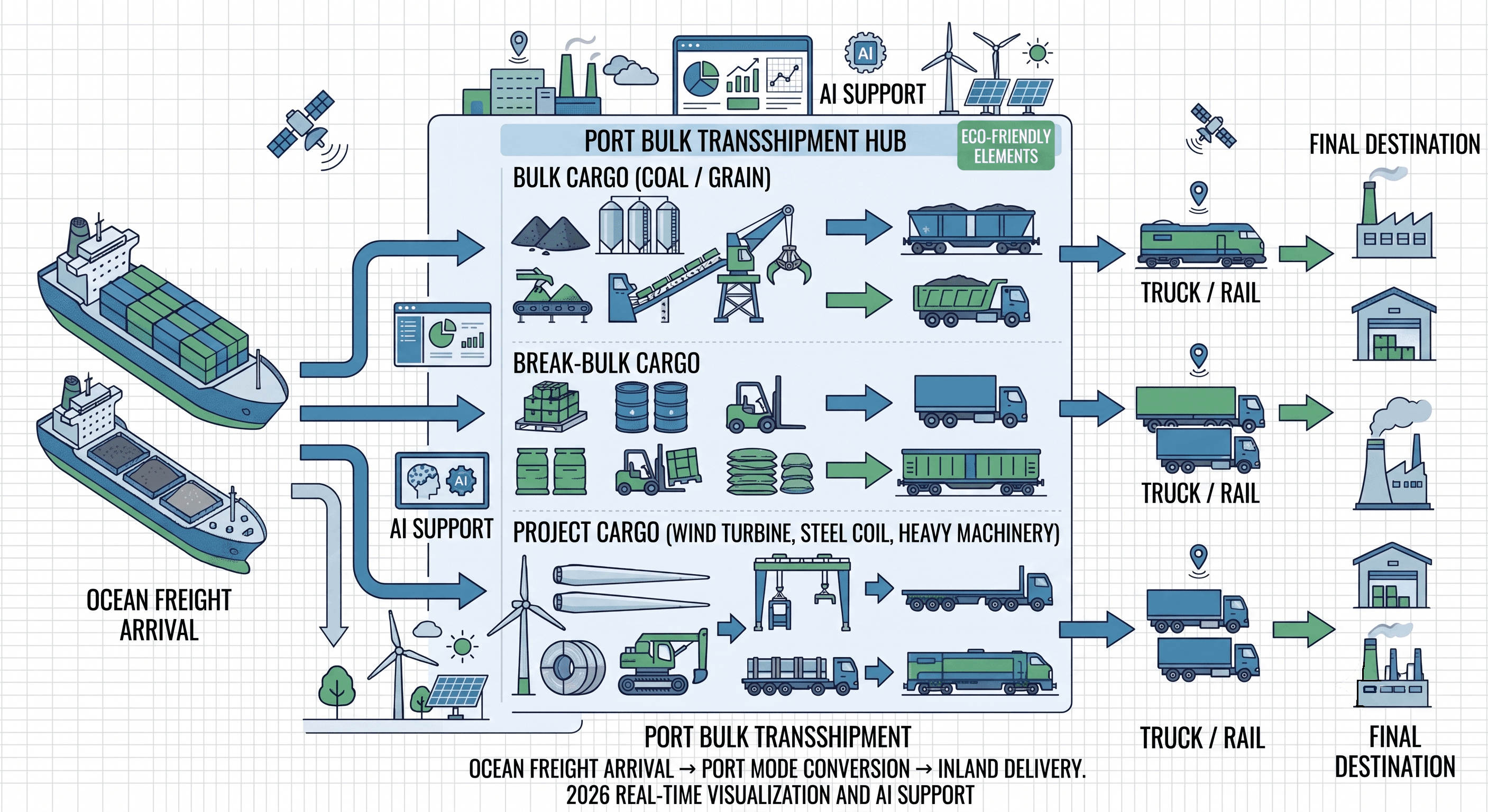
A bulk cargo transfer point refers to a node where cargo is converted from one mode of transportation to another. It is commonly found in ports, railway hubs, or inland transfer stations.
In 2026, they are the core of the multimodal supply chain.
Role in Modern Supply Chains
After sea freight break-bulk or project cargo arrives, it is transferred to trucking or rail to complete inland delivery. This process optimizes long-haul efficiency and addresses last-mile delivery needs. Accurately understanding transfer points helps precisely forecast transit times and costs.
Importance of Bulk Cargo Transfer Points to Enterprises
Bulk cargo transfer points directly affect supply chain visibility, cost control, and risk management. It involves additional handling, warehousing, and compliance procedures.
If companies plan effectively, they can significantly enhance overall logistics performance.
Key Benefits for Enterprises
- Improved end-to-end track & trace capabilities for cargo.
- More accurate predictions of total landed costs.
- Enhanced cross-border regulatory compliance.
- Proactive reduction of transit delays.
- Increased customer satisfaction through accurate ETA.
Technology and Sustainability Trends in Bulk Cargo Transfer Points
In 2026, AI scheduling and track & trace are significantly boosting the efficiency of transfer points. Ports continue to invest in automated equipment to accelerate cargo movement. Carbon footprint management tools are becoming increasingly popular, but full standardization still depends on regulations.
Emerging Trends Comparison
- Track & Trace: Traditional Method: Manual updates | 2026 Digitalization Mode: Real-time GPS and IoT sensors
- Handling Equipment: Traditional Method: Traditional cranes | 2026 Digitalization Mode: Automated and electric systems
- Scheduling: Traditional Method: Manual planning | 2026 Digitalization Mode: AI optimization and real-time dispatching
- Compliance Docs: Traditional Method: Paper-based | 2026 Digitalization Mode: Electronic documents and automated checks
- Cost Efficiency: Traditional Method: Higher variable costs | 2026 Digitalization Mode: Multimodal route optimization
These technologies reduce environmental impact while increasing speed.
How FreightAmigo Optimizes Break-Bulk and Project Logistics in 2026
FreightAmigo provides comprehensive solutions specifically designed for break-bulk and project cargo. The digital logistics platform supports multimodal quotation comparison and real-time visualization, making it ideal for oversized items that cannot fit into standard containers, such as wind turbine components, steel coils, and heavy machinery. We empower enterprises to streamline complex transfer processes.
FreightAmigo Supported Features
- Real-time price comparison.
- Expert transfer assistance.
- Automated shipment documentation and digital customs support.
- Sustainable options for carbon footprint tracking.
- Full-process integration of project logistics planning.
Frequently Asked Questions (FAQ)
What is the difference between bulk cargo and break-bulk cargo?
Bulk cargo refers to loose commodities like coal and grain poured directly for loading, while break-bulk cargo refers to irregular packed cargo handled piece by piece. Correct distinction affects vessel selection and costs.
What is the relationship between project cargo and break-bulk cargo?
Project cargo is usually a complex form of break-bulk cargo, containing oversized industrial components such as wind turbines. It requires more detailed engineering planning.
What is the main function of bulk cargo transfer points in 2026?
It is a key node for converting cargo transportation modes, such as from sea freight to land freight. It supports efficient multimodal transport and impacts overall timeliness.
What are common examples of traditional bulk cargo?
These include commodities such as coal, grain, and iron ore. These cargoes emphasize high-volume, low-cost transportation.
Which category of cargo do wind turbine components, steel coils, and heavy machinery belong to?
These are all oversized items that cannot fit into standard containers and are usually transported as break-bulk or project cargo. They require professional heavy lifting equipment for handling.
How does technology improve transfer points in 2026?
AI scheduling and track & trace significantly reduce delays and errors. Automated equipment improves handling efficiency.
What are the main challenges faced by break-bulk cargo transportation?
Higher costs, the need for specialized equipment, and risks of transit delays. Advance route planning and insurance are crucial.
Conclusion
Mastering logistics in 2026 requires a clear distinction between bulk, break-bulk, and project cargo, and leveraging bulk cargo transfer points is the key to success. Combining modern technology enables cost optimization and reliable delivery.
Ready to transform your logistics experience? Explore FreightAmigo's digital logistics platform today to learn how we can help you navigate the complexities of global shipping, including bulk cargo and break-bulk cargo transfer point management. Let's redefine logistics together!
For expert guidance, Book a Demo with FreightAmigo.
HKG Business +852 24671689 / +852 23194879, Personal +852 28121686 / +852 23194878 ︳CHN +86 4008751689 ︳USA +1 337 361 2833 ︳GBR +44 808 189 0136 ︳AUS +61 180002752 ︳Email: enquiry@freightamigo.com
If You Wish To Learn More About Ocean Freight Rates, Please Go To The FreightAmigo Page For Inquiries








 Global Popular RoutesTop sea & air shipping lanes
 Special OfferLimited-time shipping promotions





 Express
 Document
 Parcel - Air/Sea
 Container
 Relocation


