


























 Express
 Document
 Parcel - Air/Sea
 Container
 Relocation


What Does “Awaiting Fulfillment” Mean in Shipping? Complete 2026 Guide
Table of Contents (Click to expand)
- What Does “Awaiting Fulfillment” Mean?
- Complete Order Fulfillment Process in 2026
- “Awaiting Fulfillment” vs. Other Order Statuses
- How Long Does Awaiting Fulfillment Take?
- Why Efficient Fulfillment Is Critical for eCommerce Success
- How FreightAmigo Optimizes Your Fulfillment Operations
- Best Practices for Managing the Awaiting Fulfillment Stage
- Fulfillment Status Comparison: All Stages at a Glance
- Frequently Asked Questions
- Conclusion: Master Fulfillment with FreightAmigo
What Does “Awaiting Fulfillment” Mean?
“Awaiting fulfillment” means your order has been received and confirmed by the seller or fulfillment center, but physical preparation—picking, packing, and labeling—has not yet started.
You can think of it as your order waiting in a digital queue for warehouse staff or an automated system to begin processing it.
This status does not mean there is a problem with your order. It is a completely normal and expected checkpoint in the eCommerce and logistics workflow.
During the awaiting fulfillment stage, several behind-the-scenes activities may take place:
- Inventory checks to confirm that all ordered items are in stock
- Assignment of the order to a specific fulfillment team or warehouse zone
- Prioritization based on shipping speed or customer status
- Preparation of shipping and customs clearance documents
- System synchronization between the retailer’s platform and the carrier
Understanding this stage helps businesses and customers set realistic expectations while reducing unnecessary customer service inquiries.
Complete Order Fulfillment Process in 2026
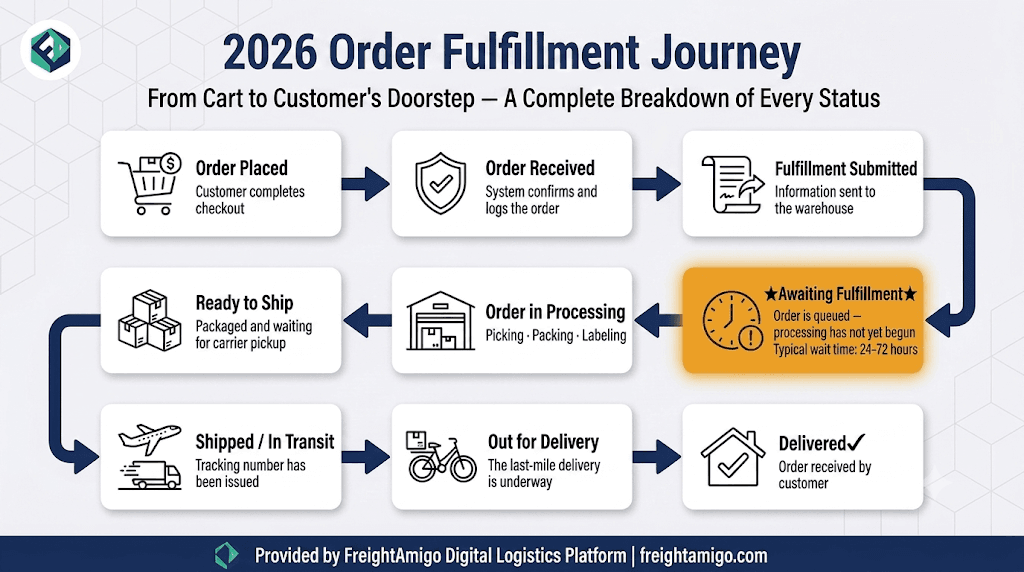
The modern eCommerce fulfillment journey in 2026 follows an organized sequence of statuses, with each status representing a distinct operational milestone.
Understanding each stage helps you identify exactly where a delay has occurred and find an appropriate solution quickly.
The standard end-to-end order fulfillment process includes:
- Order Placed — The customer selects products and completes payment
- Order Received — The seller or platform confirms and records the order
- Submitted for Fulfillment — Order data is transmitted to the warehouse
- Awaiting Fulfillment — The order is queued for physical processing
- Order Processing — Products are picked, packed, and labeled
- Awaiting Shipment — The package is ready for carrier pickup
- Shipped / In Transit — The carrier has collected the package
- Out for Delivery — The package is undergoing last-mile delivery
- Delivered — The customer has successfully received the order
Each stage builds directly on the previous one. A bottleneck during the “awaiting fulfillment” stage can cause cascading delays across every stage that follows.
“Awaiting Fulfillment” vs. Other Order Statuses
Confusing “awaiting fulfillment” with similar order statuses is one of the most common sources of frustration for online shoppers.
Here is a clear explanation of the differences between each related status:
Submitted for Fulfillment
This status appears before “awaiting fulfillment.” It confirms that the customer’s payment has been captured and the order data has been transmitted to the warehouse system. The warehouse has not yet accepted or queued the order.
Awaiting Fulfillment
The warehouse has received and queued the order, but physical work has not yet started. This status is often misunderstood because nothing appears to be happening, even though inventory checks and order prioritization may already be underway.
Sent for Fulfillment
This status is functionally similar to “submitted for fulfillment.” Some platforms use it to indicate that the order has been transferred from the storefront system to a third-party logistics (3PL) provider.
Awaiting Shipment
The order has been picked, packed, and labeled. The package is positioned at the warehouse loading dock and is waiting for carrier pickup. This status usually appears immediately after fulfillment is completed.
Shipped
The carrier has scanned and collected the package. The tracking number is now active and visible to the customer.
How Long Does Awaiting Fulfillment Take?
Under normal operating conditions, the awaiting fulfillment stage usually lasts between 24 and 72 hours, although several variables can significantly shorten or extend this period.
Key factors that affect the duration include:
- Order volume surges — Peak periods such as Singles’ Day, Black Friday, and the fourth quarter can create longer queues
- Fulfillment center efficiency — Automated warehouses generally process orders faster than manual facilities
- Order complexity — Multi-item, fragile, or dangerous goods orders require additional handling time
- Inventory availability — Out-of-stock products must be replenished before processing can begin
- Carrier pickup schedules — Cutoff times affect how quickly an order moves to the “shipped” status
- Geographic routing — Cross-border and multi-warehouse orders require additional coordination
In the best-case scenario, an automated 3PL provider may clear an order from the “awaiting fulfillment” stage within two hours. During holiday peak periods, however, waiting five to seven business days is not uncommon.
Why Efficient Fulfillment Is Critical for eCommerce Success
In the highly competitive eCommerce environment of 2026, fulfillment speed and accuracy have become major purchasing factors alongside price and product quality.
Research consistently indicates that customers may avoid making another purchase after a single poor delivery experience.
Optimizing the awaiting fulfillment stage can deliver measurable business benefits in the following areas:
Customer Satisfaction and Retention
Faster progression from “awaiting fulfillment” to “shipped” is directly associated with higher Net Promoter Scores (NPS) and repeat purchase rates.
Inventory Accuracy
Efficient processing identifies inventory discrepancies in real time, helping prevent overselling and stockouts from blocking the fulfillment queue.
Cost Reduction
Streamlined picking and packing workflows can reduce labor costs per order and improve warehouse space utilization, directly supporting stronger profit margins.
Competitive Differentiation
Businesses that consistently fulfill orders on the same day or the next day often outperform competitors in customer lifetime value (CLV).
How FreightAmigo Optimizes Your Fulfillment Operations
FreightAmigo’s Digital Logistics Platform is designed to eliminate bottlenecks across every fulfillment stage, including the critical “awaiting fulfillment” queue.
Here is how our platform can deliver measurable improvements:
Real-Time Order Tracking
Our dashboard provides real-time status updates throughout the shipment journey—from “awaiting fulfillment” to final delivery—so businesses and customers can always access the latest information.
Intelligent Order Routing
Advanced algorithms automatically route each order to the most suitable fulfillment center based on distance, inventory availability, and carrier cutoff times.
Automated Documentation
Our system automatically generates required shipping labels, commercial invoices, and customs clearance documents, helping reduce manual errors and shorten transition times between stages.
Multi-Carrier Integration
FreightAmigo connects with more than 1,000 reputable airlines and shipping lines worldwide, helping each order leaving the fulfillment queue match with a suitable carrier.
24/7 Professional Logistics Support
Our logistics experts are available around the clock to manage exceptions, escalations, and carrier issues that could otherwise disrupt the fulfillment queue.
Best Practices for Managing the Awaiting Fulfillment Stage
Proactively managing the awaiting fulfillment stage is one of the most effective ways for businesses to improve overall delivery performance and customer satisfaction.
Implement these proven best practices in 2026:
- Set Clear Expectations at Checkout — Display estimated processing times directly on product pages and in order confirmation emails, such as “Ships within 1–2 business days.”
- Establish Order Prioritization Rules — Automatically prioritize orders based on shipping level, customer loyalty status, or destination distance to reduce average fulfillment queue times.
- Maintain Real-Time Inventory Synchronization — Connect your storefront directly to a warehouse management system (WMS) to prevent orders for out-of-stock items from entering the queue.
- Optimize Warehouse Slotting — Position your highest-selling SKUs close to packing stations to reduce the distance warehouse staff travel for each order.
- Automate Exception Alerts — Configure triggers to flag orders that remain in “awaiting fulfillment” beyond the SLA threshold, such as 48 hours, for immediate manual review.
- Use a Digital Logistics Platform — Solutions such as FreightAmigo can automate documentation, carrier selection, and status notifications to reduce fulfillment cycle times.
- Conduct Regular Fulfillment Audits — Review queue times, error rates, and carrier performance each month to identify systemic inefficiencies before they result in customer complaints.
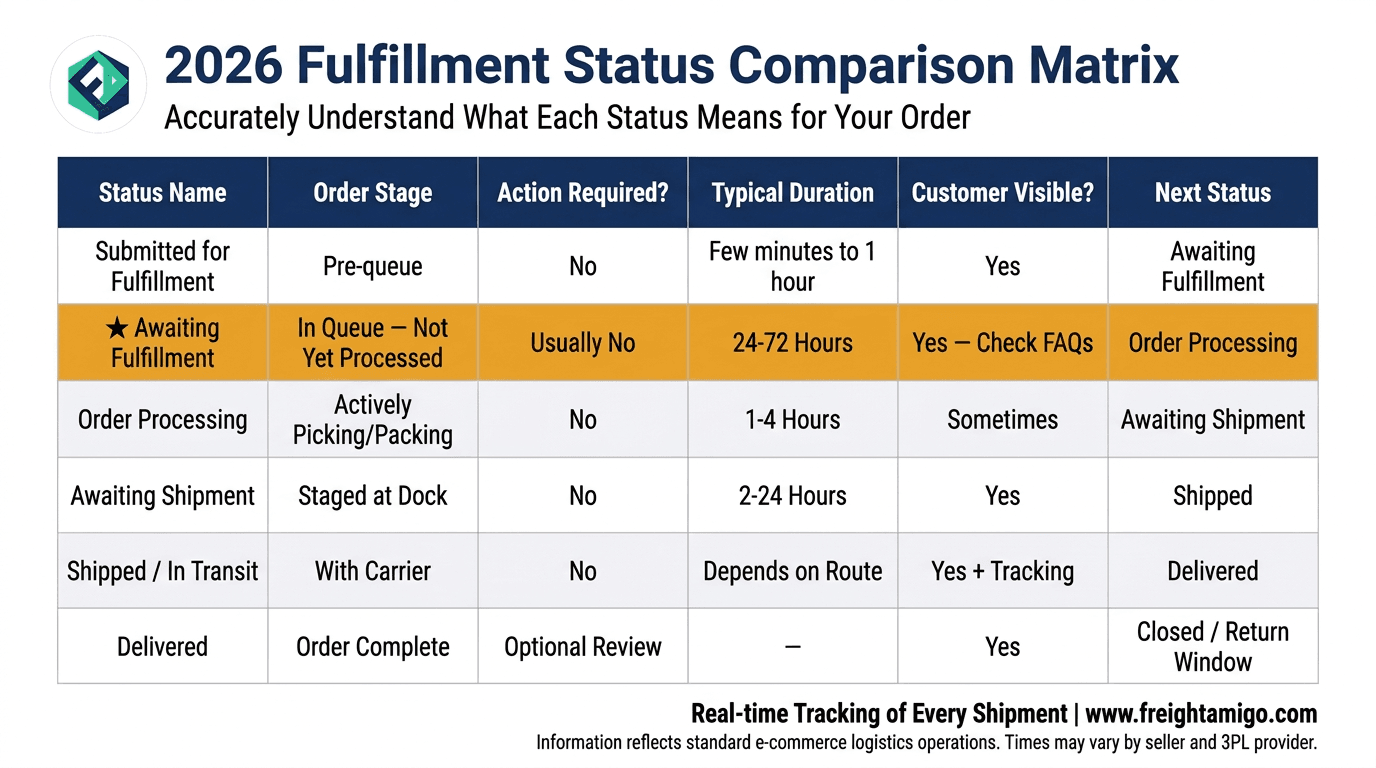
Fulfillment Status Comparison: All Stages at a Glance
This reference table gives merchants and customers a quick, scannable comparison of every order status, including any action required at each stage.
| Status | Meaning | Typical Duration | Customer Action Required? | Problem Indicator? |
|---|---|---|---|---|
| Order Placed | Payment captured; order recorded | Immediate | None | No |
| Submitted for Fulfillment | Order data sent to the warehouse | A few minutes to 1 hour | None | No |
| Awaiting Fulfillment | Queued; physical processing has not started | 24–72 hours | None, usually | No |
| Order Processing | Items are being picked, packed, and labeled | 1–4 hours | None | No |
| Awaiting Shipment | Packed and waiting for carrier pickup | 2–24 hours | None | No |
| Shipped | With the carrier; tracking is active | Depends on the route | Track the package | No |
| Out for Delivery | Last-mile delivery; expected today | Same day | Be available to receive it | No |
| Delivered | Customer has received the order | — | Confirm receipt | No |
| Exception / Delay | A problem has been identified | Varies | Contact the seller | Yes |
| Cancelled | Order voided before shipment | — | Check the refund status | Depends on the situation |
Note: These duration estimates reflect standard B2C eCommerce operations. Cross-border and freight shipments may vary significantly.
Frequently Asked Questions
These high-intent questions reflect what customers and merchants most frequently search for about fulfillment statuses in 2026.
What does “awaiting fulfillment” mean on my order?
“Awaiting fulfillment” means your order has been received and queued at the fulfillment center, but physical picking and packing have not yet started. It is a normal and expected status, not necessarily an error or delay.
How long should an order remain in “awaiting fulfillment”?
Under standard conditions, most orders leave the awaiting fulfillment stage within 24 to 72 hours. During peak periods such as Black Friday or the holiday season, processing may take five to seven business days, depending on warehouse capacity.
Is “awaiting fulfillment” the same as “processing”?
No. “Awaiting fulfillment” means the order is queued but work has not yet started. “Processing” or “order processing” means warehouse staff have started picking products, packing the order, and generating shipping labels.
What is the difference between “awaiting fulfillment” and “awaiting shipment”?
“Awaiting fulfillment” occurs before physical processing starts, while the order is still queued. “Awaiting shipment” means the order has been packed and labeled and is waiting at the warehouse for carrier pickup.
Why is my order stuck on “awaiting fulfillment”?
Common reasons include high order volumes, inventory shortages, warehouse system errors, or orders placed outside business hours. If the order exceeds the seller’s stated processing SLA, contact customer service with your order number.
Does “awaiting fulfillment” mean my order is confirmed?
Yes. An order with an “awaiting fulfillment” status has normally been confirmed and the payment has been successfully captured. The seller has accepted the order, but it is still waiting in the processing queue.
Can I cancel an order while it is awaiting fulfillment?
In most cases, yes. Orders awaiting fulfillment have not yet been packed or shipped, so cancellation may still be possible. Contact the seller immediately because cancellation becomes more difficult after the order reaches “awaiting shipment” or “shipped.”
What should I do if “awaiting fulfillment” changes to a delay or exception?
Contact the seller or fulfillment center with your order number. An exception may indicate an inventory discrepancy, payment hold, or address verification issue that requires manual intervention before processing can continue.
How does FreightAmigo help businesses reduce awaiting fulfillment time?
FreightAmigo’s Digital Logistics Platform automates order routing, documentation, and carrier assignment to reduce the time orders spend in the fulfillment queue. Real-time inventory synchronization and 24/7 professional support can further help prevent delays.
Conclusion: Master Fulfillment with FreightAmigo
Understanding what “awaiting fulfillment” means is the first step toward mastering the end-to-end logistics workflow that defines modern eCommerce success in 2026.
Every stage of the fulfillment journey—from queue management to final delivery—represents an opportunity to build or lose customer trust.
FreightAmigo’s Digital Logistics Platform is designed to give businesses complete visibility and control across every fulfillment stage. Whether you are shipping documents, parcels, or bulk cargo, our platform connects you with:
- More than 1,000 airlines and shipping lines worldwide, with real-time freight rate comparisons
- End-to-end cargo tracking, from awaiting fulfillment through delivery
- Automated customs clearance and documentation
- Integrated cargo insurance options
- 24/7 support from dedicated logistics experts
The businesses that succeed in 2026 will be those that treat fulfillment not only as a back-office function but also as a frontline competitive advantage.
FreightAmigo is a full-service, one-stop Digital Logistics Platform providing door-to-door freight comparisons, customs clearance, cargo insurance, and real-time cargo tracking across major global trade lanes.