Freight All Kinds (FAK) remains one of the most practical pricing tools for mixed cargo in 2026. Shippers facing diverse product mixes use it to simplify billing, reduce paperwork, and control costs across LTL and ocean freight.
This guide delivers clear definitions, current rate factors, risks, and actionable steps so you can decide when FAK fits your supply chain.
What Is FAK Freight All Kinds Meaning?
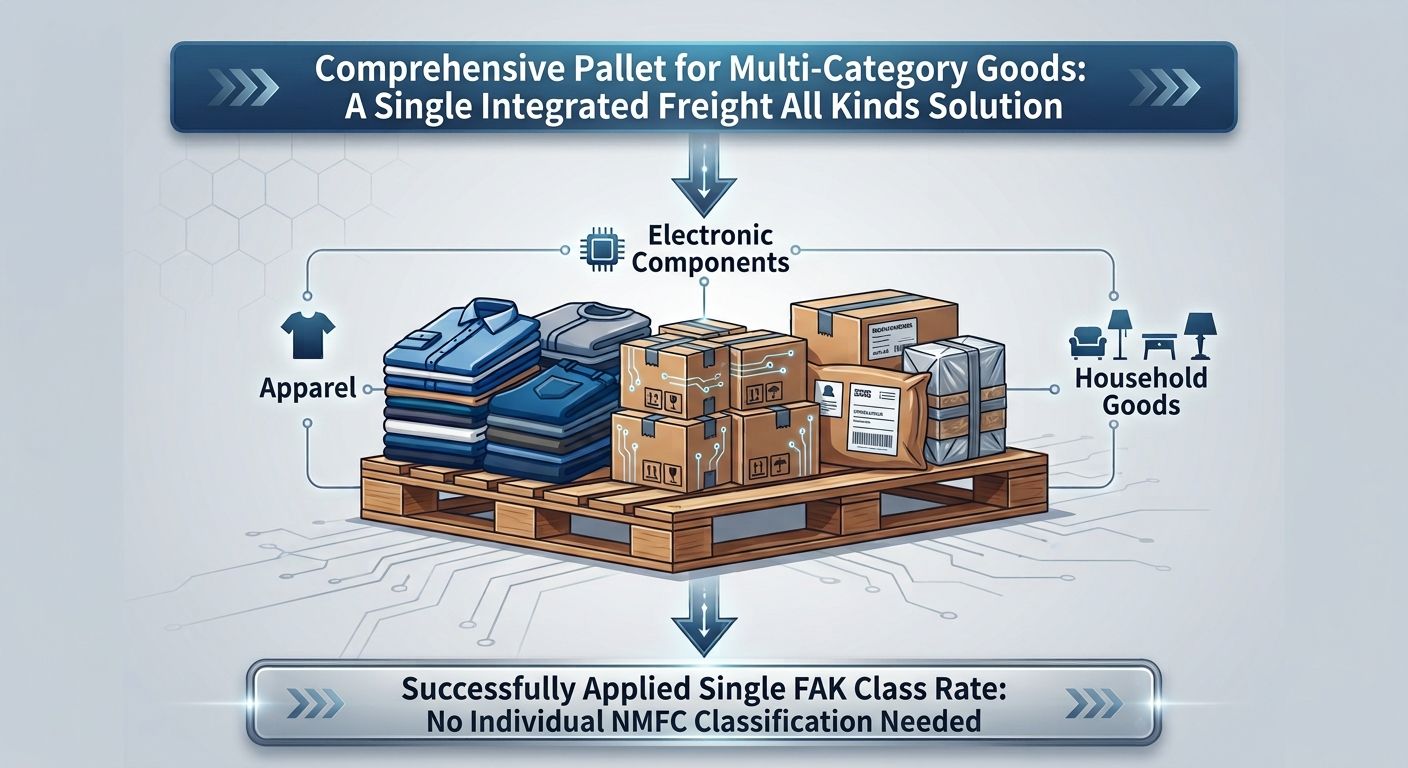
FAK stands for Freight All Kinds, a negotiated pricing method that applies one blended rate to mixed commodities instead of rating each item by its individual NMFC class.
Carriers and shippers agree on a single class—often Class 70, 85, or 100—for eligible general cargo. This avoids assigning separate freight classes to every SKU on a pallet or in a container.
FAK is not an official NMFC category. It is a private commercial arrangement between parties. It works best for non-hazardous, non-perishable general merchandise with varying densities.
Shippers choose FAK when product mix changes frequently or when individual classification creates too much administrative burden.
How FAK Works in Modern Logistics
The process begins when a shipper declares the shipment as FAK on the bill of lading and provides a commodity list without individual NMFC codes.
Carriers review average density, declared value, and handling needs. Once accepted, the entire load receives the agreed FAK class rate.
Typical steps include:
Confirm cargo falls within the carrier’s approved FAK commodity list.
Mark the BOL clearly as “FAK” with a short description of contents.
Provide accurate weights, dimensions, and piece counts.
Carrier applies the negotiated class and issues the rate.
Post-shipment audits may still occur if density or value differs significantly.
Digital e-BOL platforms in 2026 make declaration faster and reduce errors. Accurate average density remains the key factor carriers use to approve or reject FAK requests.
Common FAK Commodities and Real-World Examples
FAK commodities are everyday general goods that can safely mix on the same pallet or container without special handling rules.
Typical eligible items include:
Apparel, textiles, and footwear
Consumer electronics components and accessories
Furniture parts and home goods
Plastic products, toys, and household items
Books, paper products, and printed materials
Non-hazardous auto parts and hardware
A classic example is an e-commerce pallet containing clothing, phone cases, and small home décor. Without FAK, each product group might receive a different class. With FAK, the whole pallet ships under one rate.
Hazardous materials, perishables, high-value jewelry, and certain regulated goods are almost always excluded.
Understanding FAK Rates and Pricing in 2026
FAK rates are determined by the negotiated class, total weight, distance, fuel surcharges, and current market conditions rather than individual item classes.
Heavier, denser loads usually receive better per-pound pricing. Peak-season capacity constraints and fuel indexes still apply.
Key pricing factors in 2026 include:
Negotiated FAK class (commonly 70–100)
Average shipment density
Lane volume and frequency
Accessorial charges and fuel surcharges
Carrier capacity and spot-market pressure
Factor
Impact on FAK Rate
Weight
Higher weight often lowers cost per pound
Distance
Longer lanes use zone or mileage pricing
Density
Higher density supports lower FAK class
Seasonality
Peak periods add surcharges
Volume Commitment
Regular shippers secure stronger discounts
Shippers who track actual density over time negotiate stronger long-term FAK agreements.
Key Advantages of Freight All Kinds Shipping
FAK delivers simplicity, predictability, and often lower overall costs for mixed-product shippers.
Major benefits include:
One rate instead of multiple classifications
Faster BOL preparation and fewer coding errors
Easier invoice auditing and freight bill reconciliation
Flexibility for e-commerce returns and mixed pallets
Potential savings when high-class items average down with lower-class goods
Reduced administrative time for logistics teams
High-volume shippers with consistent mixed loads gain the most. The single-rate structure also helps finance and procurement teams forecast landed costs more accurately.
Disadvantages and Risks of FAK
The main risks involve reclassification, unexpected costs, and limited applicability to certain cargo types.
Common drawbacks are:
Carriers may reclassify after inspection if density or value differs
Potential audits and adjustment fees
Less precise cost control compared with pure class-based rating
Restricted or excluded commodities (hazmat, high-value, temperature-sensitive)
Possible overpayment on very dense, low-class freight
Dependence on accurate average-density data
Shippers must maintain good records and monitor carrier compliance to avoid surprises.
FAK vs Classified Freight: Side-by-Side Comparison
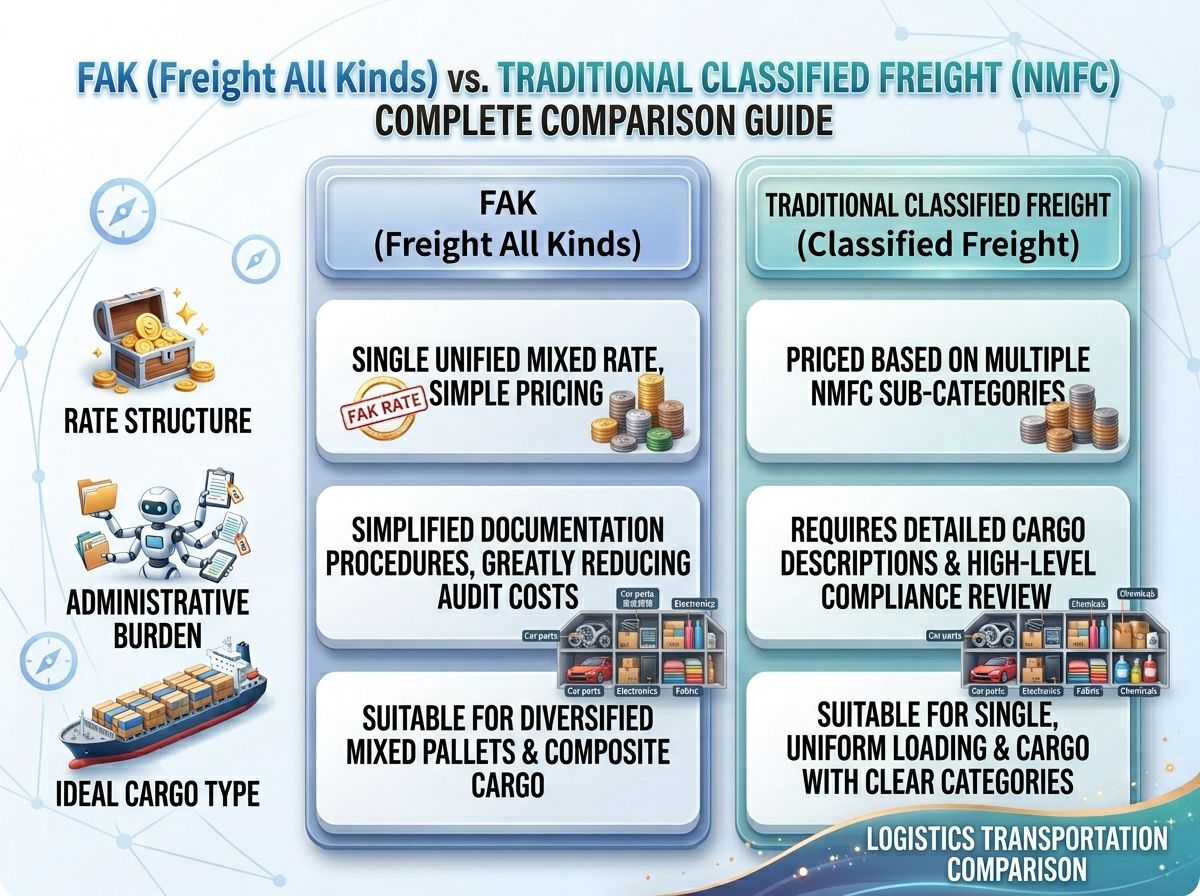
Classified freight rates each commodity by its specific NMFC code, while FAK applies one negotiated average class to the whole shipment.
Aspect
FAK (Freight All Kinds)
Classified (NMFC-Based)
Rating Basis
Single negotiated class
Individual NMFC class per item
Paperwork
Low – simple declaration
High – precise coding required
Cost Predictability
High once agreement is set
Variable with product mix
Best For
Mixed general cargo
Uniform or high-value specialized goods
Reclassification Risk
Present if averages shift
Lower if codes are accurate
Negotiation Flexibility
High – private agreement
Limited – follows published NMFC
Choose FAK for diverse pallets. Choose classified rating when every item is similar or when precise liability and claims handling matter most.
FAK Regulations and Industry Updates for 2026
In 2026, digital documentation requirements and sustainability reporting continue to tighten around FAK shipments.
Carriers increasingly demand accurate electronic commodity lists and density data. Some regions require carbon-footprint estimates even for general cargo.
Key 2026 considerations:
Wider adoption of e-BOL and digital audit trails
Stronger emphasis on accurate average-density declarations
Growing use of AI tools by carriers to flag potential reclass candidates
Sustainability metrics appearing on more invoices
Continued exclusion of hazmat and restricted goods from FAK
Shippers who keep clean digital records and track density trends stay ahead of audits.
2026 Case Study: FAK Cost Optimization
A mid-sized e-commerce retailer shipping apparel and electronics from Asia to North America reduced LTL costs by 19% in the first half of 2026 by switching mixed pallets to a negotiated FAK Class 85 agreement.
They standardized pallet builds, documented average density monthly, and shared volume forecasts with the carrier. Compliance with digital list requirements eliminated previous adjustment fees.
The result was more predictable monthly freight spend and faster invoice processing. Similar results appear when shippers treat FAK as a managed program rather than a one-off rate.
Frequently Asked Questions
What does FAK mean in shipping?
FAK means Freight All Kinds. It is a pricing agreement that lets shippers move mixed general cargo under one negotiated freight class instead of rating each product separately by NMFC code.
What is a FAK commodity?
A FAK commodity is any non-hazardous, non-perishable general merchandise eligible for blended-rate shipping, such as apparel, electronics accessories, furniture parts, or household goods.
How are FAK rates calculated?
FAK rates are based on the agreed class, total weight, distance, fuel surcharges, and the shipment’s average density. Carriers also consider volume commitments and current capacity.
Is FAK cheaper than classified freight?
For mixed loads, FAK is often cheaper overall because high-class items average down with lower-class goods. Very dense uniform loads may still cost less under pure classified rating.
Can hazardous materials ship under FAK?
No. Hazardous materials, temperature-controlled goods, and many high-value or regulated items are almost always excluded from FAK agreements and require separate handling.
What is the difference between FAK and NMFC?
NMFC is the official classification system that assigns specific codes and classes. FAK is a private commercial agreement that overrides individual classes with one blended rate.
Provide consistent volume, maintain accurate density data, use digital BOLs, and share forecasts with carriers. Regular shippers with clean records negotiate the strongest agreements.
Conclusion and Next Steps
Mastering FAK Freight All Kinds meaning gives shippers a practical tool for controlling costs and simplifying mixed-cargo operations in 2026.
Evaluate your product mix, track density, and compare FAK offers against pure classified rates. When the numbers work, a well-managed FAK program delivers both savings and operational ease.
For expert guidance, Book a Demo with FreightAmigo.


























 Global Popular RoutesTop sea & air shipping lanes
 Special OfferLimited-time shipping promotions





 Express
 Document
 Parcel - Air/Sea
 Container
 Relocation