Navigating the Maze: Additional Restrictions for Shipping Toys with Electronics
Shipping electronic toys in 2026 faces stricter lithium battery mandates, digital compliance filings, and region‑specific safety upgrades—master the latest rules, packaging, and documentation to avoid delays, rejections, or fines..
Why Shipping Toys with Electronics is More Complex in 2026
Tech‑integrated toys continue to drive strong global demand, but compliance has become far more stringent. Shippers must simultaneously satisfy transport regulations (IATA DGR for air, IMDG Code for sea), regional product-safety laws (CPSC in the US, EN 71 in the EU, GB 6675 in China), and import-clearance procedures at every destination customs authority. Five major regulatory shifts are compounding this complexity in 2026:
IATA DGR 67th Edition — mandatory state-of-charge (SoC) limits and new packaging instructions for lithium cells in toys.
EU Toy Safety Regulation (TSR 2025/2509) — legally binding upgrade from the former Toy Safety Directive, effective from 2026 onward.
U.S. CPSC eFiling — digital certification submission via the ACE system becomes mandatory on July 8, 2026; no paper certificates accepted.
China GB 6675-2025 — new national toy safety standard; CCC certification uses the updated version from August 2026.
UFLPA Supply Chain Enforcement — enhanced screening for Xinjiang-sourced components intensifies across US Customs.
Missing any single compliance requirement can result in shipment holds, costly returns, or regulatory fines.
Battery Restrictions for Shipping Toys with Electronics
Lithium batteries in toys are classified as dangerous goods (UN3481), limiting air shipments.
Air Freight Battery Rules
Maximum 2.7 Wh per individual lithium-ion cell; 20 Wh per battery pack for consumer goods.
State of charge must not exceed 30% for spare/loose batteries; built-in batteries need over-current protection circuits.
Shipments exceeding 100 Wh require airline approval and Cargo Aircraft Only (CAO) designation.
IATA DGR 2026 (67th Edition): Updated Packing Instructions PI 967 / PI 970 apply — check Section II conditions carefully.
Batteries must be protected against short-circuit and packed to prevent movement.
Sea Freight Battery Rules
IMDG Code (Amendment 42-24) governs sea transport — classified under Class 9 miscellaneous dangerous goods.
UN-certified outer packaging required; document as UN3481 (lithium-ion batteries contained in equipment).
Emergency Response Procedures (ERP) and proper shipping name must appear on the container manifest.
China restrictions: Lithium toys exceeding 160 Wh require additional approvals since 2025.
Battery Safety Data Sheet (SDS) must accompany all sea freight consignments.
FreightAmigo's real shipment data shows that 30% of electronic toy rejections at air freight are caused by missing or incorrect state-of-charge labels. Pre-test batteries at 80% SoC before dispatch and affix the lithium battery handling mark (UN3481) visibly on all four sides of the outer carton.
Safety Standards for International Toy Shipping 2026
Electronic toys must pass region-specific certifications or face seizures. No global standard exists, so multi-compliance is key.
Region
Key Regulation
Certification Required
2026 Key Changes
USA
CPSC / ASTM F963-23 / FCC Part 15
Children's Product Certificate (CPC) + FCC SDoC
eFiling mandatory July 8, 2026 via ACE; stricter phthalate & lead limits; UFLPA supply-chain checks intensified
EU
EN 71-1:2026 / CE Mark / EU TSR (2025/2509)
CE Mark + DoC / Digital Product Passport (prep phase)
TSR effective from 2026; EN 71-1:2026 mandatory Aug 2027; REACH battery traceability; PFAS restrictions expanded
China
GB 6675-2025 / CCC
CCC Certification (mandatory for electronic parts)
New standard effective Nov 1, 2026; stricter element migration; CCC updated from Aug 2026
Australia / NZ
AS/NZS 62115:2018+A1
Supplier Declaration of Conformity
Updated lithium fire testing; child-resistant battery compartments mandatory
UK
UKCA Mark / UK Toy Safety Regulations 2011
UKCA DoC
Post-Brexit divergence: separate CA filing required; GB-specific labelling
Japan
PSE / ST Mark / VCCI
PSE Certificate (electrical safety) + ST Mark
Revised PSE categories for wireless toys; electromagnetic compatibility (EMC) checks updated
Include test reports in shipments to speed clearance.
Customs Requirements When Shipping Toys with Electronics (2026)
Undocumented electronic toys face 40% higher delay rates. Prepare these documents:
Core Documentation for All Markets
Commercial Invoice — must include full component description, HS code (primary + supplementary), declared value, and country of origin.
Packing List — item-level breakdown including battery type, watt-hours, and cell count per carton.
Certificate of Conformity (CoC) — third-party lab-issued evidence of compliance with applicable safety standard.
Safety Data Sheet (SDS) / Material Safety Data Sheet (MSDS) — mandatory for all shipments containing lithium batteries.
Shipper's Declaration for Dangerous Goods — required for air shipments; must be IATA-formatted and signed by a certified IATA DGR shipper.
Bill of Lading or Air Waybill — must reference UN3481 for battery-containing toys.
Import Licences / Pre-shipment Approvals — required for Brazil (INMETRO), India (BIS), and select other markets.
2026 Key Changes
U.S. CPSC eFiling: July 8, 2026 mandatory digital submission of 7 core data points via ACE; no paper certificates accepted at customs.
EU TSR: Full chemical compliance + battery traceability; non‑compliance risks fines and recalls.
UFLPA enforcement: Enhanced screening for Xinjiang‑sourced components.
China GB 6675‑2025: Aug 1, 2026 CCC uses new standard; full transition Nov 1, 2026.
Packaging Guidelines for Toys with Electronics
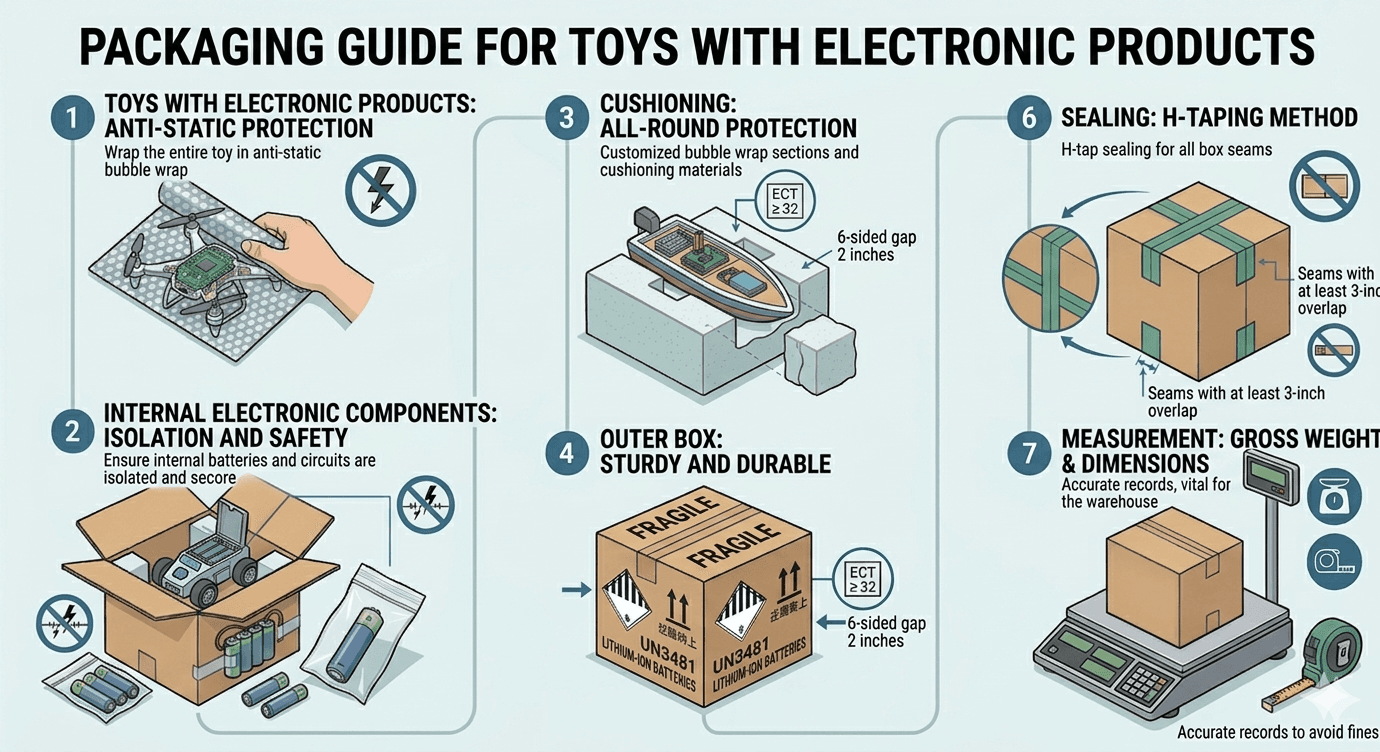
Robust packaging prevents 95% of transit damage in toy shipments. Use anti-static bubble wrap for circuits.
Inner Layer: Wrap each electronic unit in anti-static bubble wrap or anti-static poly bags to protect circuits from electrostatic discharge.
Battery Isolation: Tape battery terminals or place batteries in individual plastic bags to prevent short-circuit.
Foam Inserts: Use custom-cut EPE or polyurethane foam with a minimum 2-inch void fill on all six faces.
Outer Carton: Double-wall corrugated cardboard rated 32 ECT (Edge Crush Test) minimum; mark weight and fragile indicators.
Hazardous Goods Labels: Affix Class 9 lithium battery mark, 'This Way Up' orientation arrows, and UN3481 shipping name on at least two opposite faces.
Sealing: H-tape method with minimum 3-inch overlap on all seams; do not use single-strip taping.
Weighing & Measuring: Record gross weight and dimensions accurately — dimensional weight penalties are common for toy cartons.
Do not discharge batteries below manufacturer specifications before shipping — IATA requires batteries be shipped at no more than 30% SoC for standalone batteries, but batteries installed in equipment (UN3481) may be at any charge level unless the airline specifies otherwise. Always confirm with your freight forwarder.
HS Code Classification for Toys with Electronics
Correct HS code classification is the gateway to accurate duty calculation, smooth customs clearance, and avoiding costly mis-declaration penalties.
Electronic toys commonly span two HS chapters. The principal code determines the tariff rate; secondary codes may be required for components or batteries.
Product Type
Primary HS Code
Battery/Component Code
Notes
Remote-Control Toys (electric motor)
9503.00.00
8507.60((Li-ion battery)
Most common; verify local tariff subheadings
Interactive Electronic Toys (AI/voice)
9503.00.00 / 8543.70
8507.60
If primary function is electronic; customs ruling recommended
Toy Drones / Flying Toys
8806.91 / 8806.99
8507.60
Drone classification overrides toy chapter in many jurisdictions
Educational STEM Kits (circuit-based)
9503.00.00
8506.xx / 8507.xx
Must include component manifest for kit classification
Toy Vehicles with Li Battery
9503.00.00
8507.60
Child safety labelling mandatory in all markets
Smart Wearables for Children
8517.62 / 9503.00.00
8507.60
Classified as telecommunication equipment if primary function is wireless communication
Top Challenges in Shipping Toys with Electronics 2026
Over 60% of first-time electronic toy exporters encounter avoidable delays — the root causes are predictable and preventable.
Air Freight Battery Bans
Challenge: Many airlines refuse electronic toy shipments due to lithium battery declarations.
Solution: Pre-qualify with your freight forwarder for approved air carriers that accept UN3481. Use sea freight for high-volume, non-urgent orders to bypass air restrictions entirely.
US CPSC eFiling Non-Compliance
Challenge: Mandatory digital eFiling from July 8, 2026 catches many importers off-guard.
Solution: Register for the ACE portal now. Ensure your third-party test lab provides data in the 7 required eFiling fields. Build eFiling submission into your standard pre-shipment checklist.
Multi-Market Certification Costs
Challenge: Achieving CPC (US), CE (EU), CCC (China), and UKCA simultaneously is expensive.
Solution: Use accredited labs (e.g., SGS, Intertek, Bureau Veritas) that offer multi-market testing packages. Prioritise your primary markets and phase certifications based on launch schedule.
Solution: Book freight at least 8 weeks ahead for November–December shipments. Use FreightAmigo's platform to compare real-time rates across 200+ carriers and lock in bookings early.
UFLPA Supply Chain Scrutiny
Challenge: US CBP detains shipments without adequate supply chain documentation for Xinjiang-origin components.
Solution: Conduct a full supply chain audit. Obtain mill certificates and raw material origin declarations for all key components. Maintain records for a minimum of 5 years.
Solution: Engage a China-based certification consultant and update your CCC application before August 2026. Allow 3–4 months lead time for lab testing and re-certification.
2026 Case Study: Successful Toy Electronics Shipment
A Hong Kong toy exporter shipped 5,000 smart dolls to the U.S. without issues. Challenges: Lithium motors. Solution: IATA-compliant packaging + CPSC certs. Result: On-time delivery, zero claims—saved 18% vs. prior delays. Key: Pre-clearance with CBP.
FAQ: Shipping Toys with Electronics Restrictions
Quick answers to top queries on toy electronics shipping.
Can I ship toys with lithium batteries by air?
Yes, if under 100Wh with protection and proper labeling per IATA.
What packaging for electronic toys sea freight?
IMDG UN-spec boxes with cushioning and hazard labels.
EU requirements for toy electronics 2025?
CE mark, EN71 safety, REACH compliance docs.
How to classify toys with electronics in customs?
Use HTS 9503.00 primary, note batteries separately.
Are button cell batteries restricted in toys?
Yes, child-safe designs required; shipping limits apply if loose.
2025 changes for U.S. toy imports?
Stricter CPSC lithium testing and UFLPA checks.
Best mode for high-volume toy electronics?
Sea freight for cost; air for urgency under battery limits.
Do I need insurance for electronic toys?
Recommended—covers 85% of claims from damage/vibration.








 Global Popular RoutesTop sea & air shipping lanes
 Special OfferLimited-time shipping promotions





 Express
 Document
 Parcel - Air/Sea
 Container
 Relocation