Regulatory Requirements for Cold Chain Shipping of Food Products
Want To Compare The Best Express, Air Freight, Sea Freight, Rail Freight & Trucking Rates So As To Have Better Control On Cost?
This guide breaks down every regulatory requirement you must meet for cold chain shipping of food products in 2026 — from FDA FSMA Rule 204 to HACCP critical control points — and shows you exactly how a digital logistics platform can automate compliance.
Understanding Cold Chain Shipping
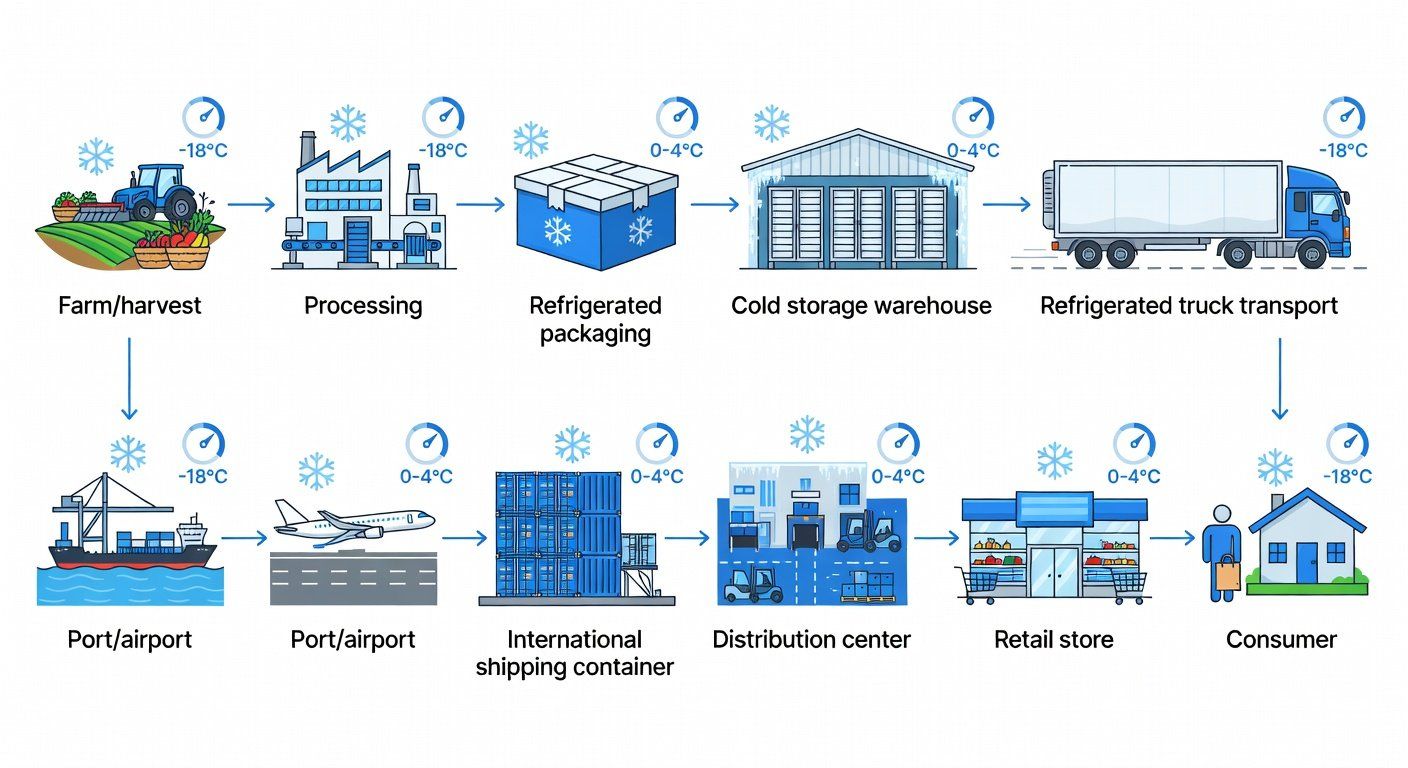
Cold chain shipping is the end-to-end temperature-controlled supply chain that preserves perishable food products from the point of harvest to the final consumer.
Every link in the cold chain — production, packaging, warehousing, transport, and last-mile delivery — must maintain a precise temperature window. A single break can trigger microbial growth, chemical degradation, or textural changes that render food unsafe or unsaleable.
The cold chain covers a wide product spectrum:
Frozen foods (ice cream, fish, meat): must remain at or below −18 °C
Chilled ready meals & dairy: 0 °C to 4 °C
Fresh produce & floriculture: product-specific ranges, often 2 °C to 12 °C
Pharmaceuticals & nutraceuticals: 2 °C to 8 °C (overlapping food regulations in many jurisdictions)
Live seafood & aquaculture: near-0 °C with humidity and oxygen controls
Globally, the cold chain logistics market was valued at USD 271 billion in 2024 and is forecast to exceed USD 400 billion by 2028.
Why Cold Chain Regulations Matter More Than Ever in 2026
Regulators worldwide tightened cold chain rules throughout 2025–2026, introducing digital traceability mandates, IoT monitoring requirements, and expanded enforcement powers.
FSMA Rule 204 compliance date (January 20, 2026): All businesses handling foods on the FDA's Food Traceability List (FTL) must now maintain digital records of Critical Tracking Events (CTEs) with Key Data Elements (KDEs) retrievable within 24 hours.
Post-pandemic supply chain resilience: Regulators demand redundant temperature monitoring systems after high-profile cold chain failures exposed in 2022–2024.
Consumer transparency expectations: EU Digital Product Passport legislation and equivalent Asian frameworks require end-to-end provenance data that only a compliant cold chain can generate.
Climate-driven stricter storage standards: Higher ambient temperatures in transit corridors have prompted updated minimum refrigeration power requirements.
Cross-border harmonisation: WHO, Codex Alimentarius, and GFSI are aligning national standards to reduce trade barriers while raising the compliance floor.
Non-compliance is existential: the FDA can halt imports, USDA can mandate product recalls, and EU authorities can impose shipment bans — all without prior warning.
Key Regulatory Bodies and Standards
Five international organisations set the rules that govern virtually every cross-border cold chain food shipment in 2026.
Regulatory Body
Jurisdiction
Primary Cold Chain Mandate
2026 Focus
FDA
USA (imports + domestic)
FSMA Sanitary Transport Rule + Rule 204
Digital KDE records within 24 hrs
USDA FSIS
USA (meat, poultry, eggs)
HACCP + temperature logs for animal products
Enhanced sanitation audits
Codex Alimentarius
Global (WHO/FAO)
CAC/RCP 1-1969 food hygiene principles
Cold chain traceability harmonisation
ISO
Global (voluntary)
ISO 22000:2018 food safety management
Alignment with FSMA digital records
IATA
Global (air freight)
IATA Temperature Control Regulations (TCR)
Pharma-grade cold chain for high-value food
These organizations set standards and guidelines that form the basis of regulatory requirements for cold chain shipping of food products. Let's explore some of the key regulations and standards in more detail.
FDA FSMA & Rule 204: What Changed in 2026
FSMA Rule 204 — the Food Traceability Final Rule — became enforceable on January 20, 2026. The Sanitary Transportation of Human and Animal Food Rule (STR) already set baseline requirements for vehicles, equipment, and operations. Rule 204 adds a digital traceability layer on top:
Food Traceability List (FTL): Covers high-risk foods including leafy greens, shell eggs, nut butters, fresh herbs, certain fish species, and more — all commonly shipped cold.
Critical Tracking Events (CTEs): Six defined events — harvesting, cooling, initial packing, first land-based receiving, shipping, and transformation — each requiring a documented record.
Key Data Elements (KDEs): Specific data fields (quantity, date, location, traceability lot code) mandatory at each CTE.
24-Hour Retrieval: On FDA request, you must produce all relevant traceability records within 24 hours in a sortable electronic format.
Two-Year Retention: All KDE records must be retained for a minimum of two years.
Routine inspections begin 2027, but for-cause inspections (e.g., outbreak investigations) started January 2026.
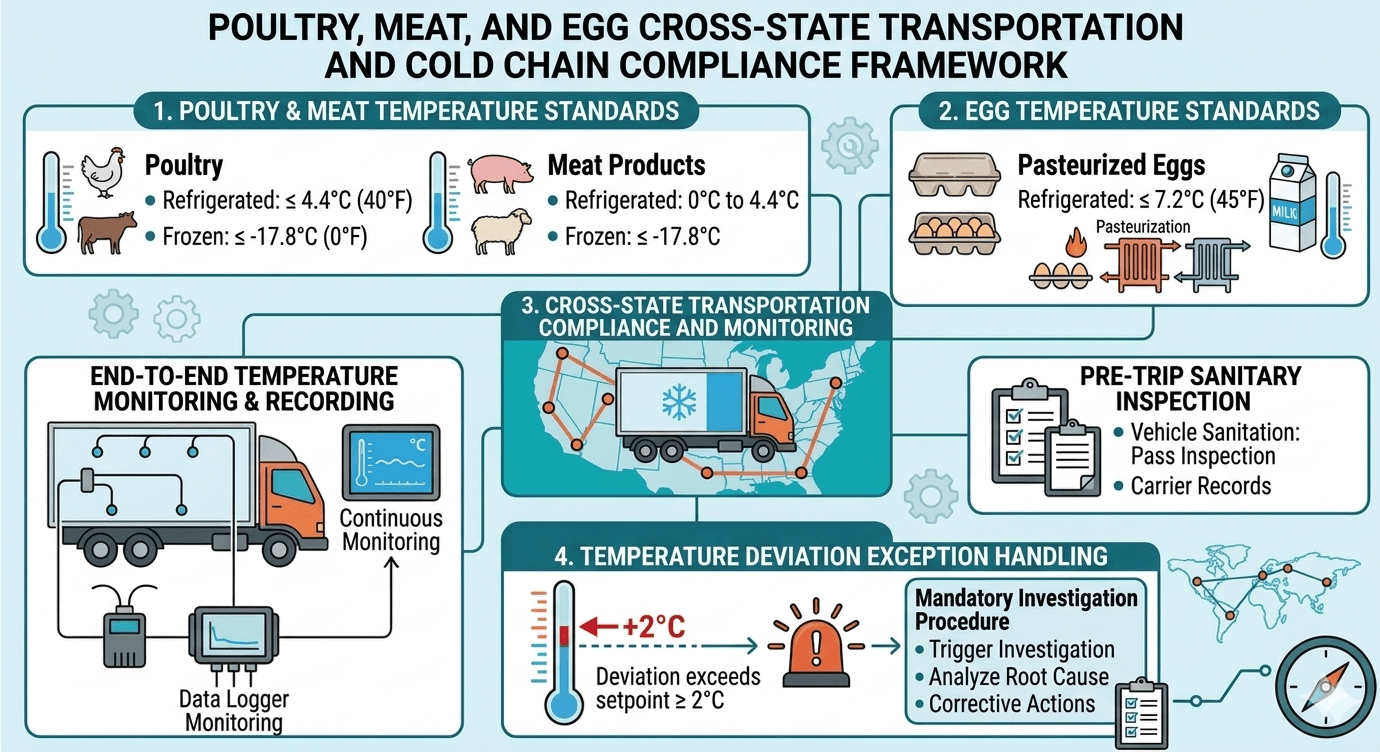
The USDA's Food Safety and Inspection Service (FSIS) enforces some of the strictest cold chain rules in the world for meat, poultry, and egg products.
FSIS-regulated products must comply with 9 CFR Part 381 (poultry) and 9 CFR Part 317 (meat) for labelling and cold storage requirements. Core transport requirements include:
Poultry: must be maintained at 4.4 °C (40 °F) or below; frozen at −17.8 °C (0 °F) or below
Meat products: chilled at 0 °C to 4.4 °C; frozen at −17.8 °C or below
Egg products: pasteurised eggs must be refrigerated at ≤7.2 °C (45 °F)
Continuous temperature monitoring and logging mandatory for all interstate movements
Vehicles must pass pre-trip sanitation inspection documented by the carrier
Any temperature deviation ≥2 °C from setpoint triggers a mandatory investigation protocol
FSIS increased unannounced inspection frequency for refrigerated transport in its 2025–2026 enforcement plan, with particular attention to cross-border Mexico–US and Canada–US cold chain movements.
International Standards: HACCP, ISO 22000, and GDP
Three international frameworks form the compliance backbone: HACCP, ISO 22000, and Good Distribution Practice (GDP).
These standards are regulatory requirements in many jurisdictions, major retailers and food service chains now mandate documented certification before onboarding suppliers.
HACCP — Hazard Analysis and Critical Control Points
HACCP is a systematic, science-based approach to identifying and controlling food safety hazards. Critical Control Points (CCPs) typically include:
Temperature maintenance throughout transit (physical/biological hazard control)
Sanitation of vehicles and loading equipment (cross-contamination prevention)
Loading and unloading time limits (temperature abuse prevention)
ISO 22000 provides a framework integrating HACCP principles:
Systematic identification and control of food safety hazards
Integration of prerequisite programmes (PRPs) for infrastructure and environment
Communication protocols across the supply chain
Continuous improvement cycles aligned with regulatory updates
Good Distribution Practice (GDP)
Originally developed for pharmaceuticals, GDP principles are now widely applied to premium food cold chains. GDP requires:
Qualified personnel responsible for distribution operations
Premises and equipment qualification with documented calibration
Written SOPs for all cold chain operations including complaint handling
Regular self-inspection and supplier audit programmes
Temperature Control Requirements by Food Category
Maintaining the appropriate temperature throughout the entire cold chain is paramount. Regulatory requirements often specify temperature ranges for different types of food products. For example:
Documentation & Record-Keeping: The Paper Trail That Protects You
Thorough documentation is not bureaucratic overhead — it is your primary defence in the event of a regulatory audit, a product recall, or a customer liability claim. Under FSMA Rule 204 and international GDP standards, the following documents must be maintained:
Temperature logs for every shipment (continuous electronic records, min. 2-year retention)
Cleaning and sanitation records for every vehicle and piece of equipment used
Calibration certificates for all temperature monitoring devices
Training records for every personnel handling cold chain operations
Shipping manifests with traceability lot codes (TLCs) assigned to every FTL product
Critical Tracking Event (CTE) records with complete KDE data
Supplier qualification records and audit reports
Deviation reports and corrective action logs for any temperature excursion
Packaging & Labeling Compliance
Packaging failures and labeling errors are among the top five causes of cold chain shipment rejections at customs. Regulatory requirements for cold chain food packaging and labeling include:
Food-grade packaging materials compliant with FDA 21 CFR (US) or EU Regulation 1935/2004 (EU)
Clear temperature requirement markings on outer packaging (e.g., 'Keep Frozen: −18 °C or below')
Traceability Lot Code (TLC) barcodes or QR codes on two adjacent package sides (FSMA Rule 204)
Country of origin labeling (mandatory under US, EU, and most Asian import regulations)
Accurate 'use by' or 'best before' dates consistent with cold chain integrity assumptions
Net weight, producer details, and certifications (organic, halal, kosher, etc.) as required<
The Role of Technology in Cold Chain Compliance
Digital technology has transformed cold chain compliance from a manual, reactive process into a proactive, automated system that detects issues before they become violations. Key technologies reshaping cold chain regulatory compliance in 2026:
IoT Sensors & Data Loggers: Continuous temperature, humidity, and shock monitoring with cellular/satellite transmission — the foundation of FSMA Rule 204 KDE records
Blockchain Traceability: Immutable, timestamped records of every CTE that cannot be altered — preferred by FDA auditors and major retailers for its tamper-proof integrity
AI-Powered Anomaly Detection: Machine learning models predict refrigeration equipment failure 6–12 hours before it occurs, triggering preventive maintenance before a temperature excursion happens
Digital Freight Platforms: Integrate carrier performance data, temperature logs, and customs documentation in one interface — eliminating the data silos that cause compliance failures
Predictive Routing: AI analyses weather patterns, port congestion, and border crossing wait times to route shipments through the path of least temperature risk
Q&A
Q1: What is cold chain shipping and why is it important for food products?A: Cold chain shipping is a temperature-controlled supply chain used to transport perishable food products. It is critical because it prevents spoilage, maintains food safety, preserves quality and nutritional value, and ensures compliance with strict regulatory standards from farm to table.
Q2: What are the main regulatory bodies governing cold chain shipping of food?A: The primary regulatory bodies include the U.S. FDA, USDA, European Food Safety Authority (EFSA), Codex Alimentarius Commission, and IATA (for air transport). These organizations set standards for temperature control, sanitation, and documentation.
Q3: What is the FDA Food Safety Modernization Act (FSMA) and how does it affect cold chain shipping?A: The FSMA shifts the focus from reacting to food contamination to preventing it. It includes the Sanitary Transportation Rule, which sets requirements for vehicles, equipment, training, and record-keeping for anyone transporting food in the U.S.
Q4: What temperature ranges are typically required for different types of food products?A: Common temperature requirements are:
Frozen foods: -18°C (0°F) or below
Chilled/refrigerated foods: 0°C to 4°C (32°F to 39°F)
Fresh produce: Varies depending on the product type.
Q5: What are the key compliance areas businesses must focus on in cold chain shipping?A: The five major compliance areas are:
Temperature control & monitoring
Sanitation and hygiene
Proper packaging and labeling
Documentation and record-keeping
Staff training and education
Q6: How does the USDA regulate cold chain shipping?A: The USDA, through its Food Safety and Inspection Service (FSIS), regulates the transportation of meat, poultry, and egg products. It enforces strict temperature control, sanitation standards for vehicles, and proper handling procedures.
Q7: What international standards should companies follow for global cold chain shipping?A: Important international standards include ISO 22000 (food safety management), HACCP (Hazard Analysis and Critical Control Points), GDP (Good Distribution Practice), and IATA Temperature Control Regulations for air freight.
Q8: Why is record-keeping and documentation so important in cold chain logistics?A: Accurate records (temperature logs, sanitation records, training certificates, etc.) serve as proof of compliance during audits and help trace products in case of a recall or food safety incident.
Q9: How is technology helping companies meet cold chain regulatory requirements?A: Technologies such as IoT real-time temperature sensors, GPS tracking, automated alerts, blockchain for traceability, and digital record-keeping systems help maintain compliance, reduce human error, and provide better visibility across the supply chain.
Q10: What are the consequences of failing to comply with cold chain regulations?A: Non-compliance can result in product recalls, shipment rejections, heavy fines, loss of business licenses, reputational damage, and — most seriously — risks to public health from spoiled or contaminated food.
Conclusion: Navigating the Complex World of Cold Chain Regulations
In 2026, cold chain regulatory compliance is no longer just a legal obligation — it is a market differentiator that separates premium, trustworthy food suppliers from the rest.
The regulatory landscape — led by FDA FSMA Rule 204, USDA FSIS enforcement escalation, EU digital traceability mandates, and international HACCP/ISO 22000 standards — demands digital, automated, end-to-end compliance infrastructure.
The good news: the same digital tools that ensure compliance also deliver operational benefits. Automated temperature monitoring reduces spoilage. Digital documentation cuts admin costs. Real-time tracking improves customer satisfaction. A well-run cold chain is a profitable cold chain.
FreightAmigo's platform connects shippers to certified carriers, automates compliance documentation, and provides the visibility needed to maintain cold chain integrity at every step — from booking to delivery.
For expert guidance, Book a Demo with FreightAmigo.








 Global Popular RoutesTop sea & air shipping lanes
 Special OfferLimited-time shipping promotions





 Express
 Document
 Parcel - Air/Sea
 Container
 Relocation