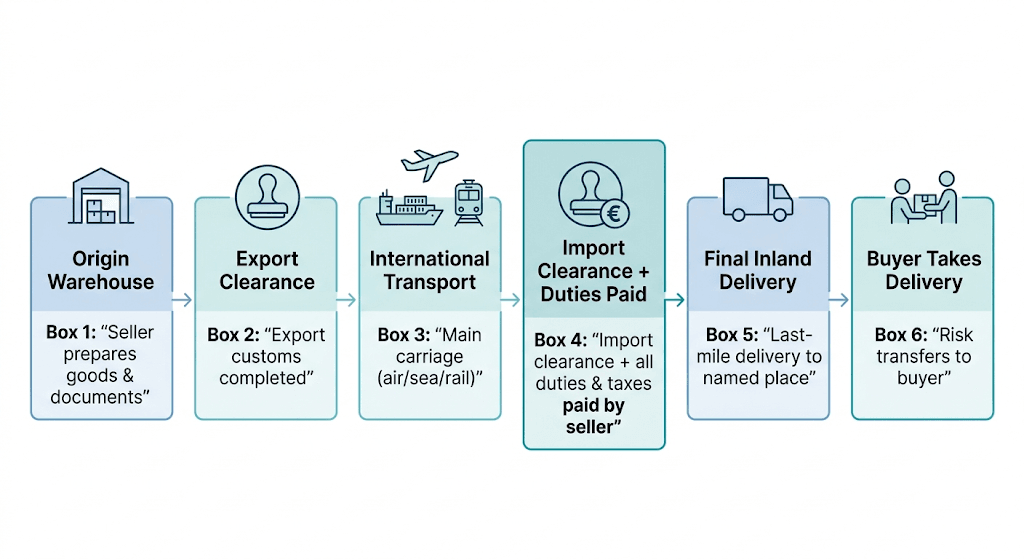
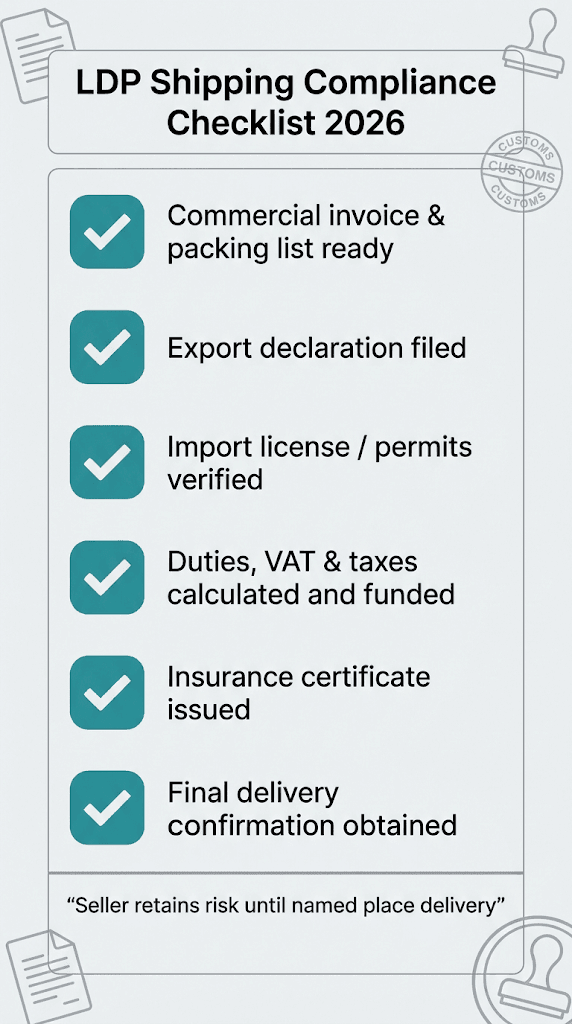
LDP shipping, also known as Landed Duty Paid, functions as the practical equivalent of the DDP (Delivered Duty Paid) Incoterm in modern global trade. Under this arrangement the seller assumes maximum responsibility from origin to the buyer’s named destination. This covers international transport, export and import clearance, all duties, taxes, VAT, and final inland delivery.
In 2026 the term remains fully compatible with Incoterms 2020 rules and works with any transport mode—air, ocean, rail, or multimodal. Sellers use LDP to deliver a true door-to-door, all-inclusive service. Buyers receive goods ready for use without handling complex customs processes.
Key elements of LDP shipping include:
Full international transportation arranged by the seller
Complete export and import customs clearance
Payment of all duties, taxes, and VAT
Inland delivery to the agreed final point
This model continues to grow in popularity among cross-border e-commerce sellers and manufacturers targeting new markets.
LDP vs Other Incoterms: Clear Comparison
Understanding how LDP compares with other common Incoterms helps buyers and sellers choose the right level of responsibility. LDP places the heaviest burden on the seller, while terms like EXW or FOB shift more work to the buyer.
Aspect
LDP / DDP
DAP
CIF
FOB
Seller pays duties & taxes
Yes
No
No
No
Seller handles import clearance
Yes
No
No
No
Risk transfers
At named place of destination
At named place of destination
On board vessel at origin
On board vessel at origin
Best for
Buyers wanting zero logistics work
Buyers with import capability
Ocean shipments with insurance
Experienced importers
Complexity for seller
Highest
Medium
Medium
Lower
Sellers who select LDP must possess strong local knowledge or reliable partners in the destination country. Buyers gain simplicity but usually pay a premium that covers the seller’s extra risk and administration.
Seller Obligations Under LDP Shipping Terms
The seller carries almost every logistical, financial, and legal duty until the goods reach the named destination. This comprehensive responsibility is the defining feature of LDP shipping in 2026.
Typical seller obligations include:
Supplying the goods and all required commercial documents
Providing suitable packaging and labeling for international transit
Arranging and paying for inland transport at origin
Completing export customs clearance and related costs
Booking and paying for main international carriage
Managing destination port or terminal charges
Handling full import clearance in the buyer’s country
Paying all import duties, VAT, and special taxes
Organizing final inland delivery to the agreed point
Optionally unloading the goods if the contract requires it
Because the seller retains risk until delivery, many exporters purchase comprehensive cargo insurance that covers the entire journey. Failure to meet any of these obligations can result in delays, extra costs, or contractual penalties.
Buyer Responsibilities in LDP Arrangements
Under LDP terms the buyer’s role remains deliberately simple and limited. This simplicity is one of the strongest attractions for companies new to international trade or those without in-house import teams.
Buyer obligations typically consist of only two core actions:
Paying for the goods according to the agreed payment terms
Taking physical delivery of the goods at the named destination
The buyer does not need to arrange transport, file customs entries, or calculate and pay import taxes. However, the buyer should still verify that the delivery address and any special unloading requirements are clearly stated in the sales contract. Any failure to accept delivery promptly can create demurrage or storage charges that may fall back on the buyer depending on the contract wording.
Advantages and Limitations of LDP Shipping
LDP shipping offers clear benefits and trade-offs for both parties that must be weighed carefully in 2026. Buyers enjoy maximum convenience while sellers gain service differentiation but accept higher risk.
For buyers the main advantages are:
Zero need to manage customs or duty payments
Minimal administrative workload
Predictable landed cost when the seller quotes accurately
Ideal for first-time importers or lean teams
Buyer limitations include:
Higher overall purchase price that absorbs the seller’s risk premium
Reduced control over carrier choice and transit routes
Less visibility into exact duty calculations unless the seller shares details
For sellers the advantages include:
Ability to offer a premium, hassle-free service
Full control over the logistics chain and service quality
Opportunity to increase margins by bundling services
Seller limitations are:
Maximum legal and financial exposure in the destination country
Need for local expertise or reliable agents
Risk of unexpected duty changes or customs delays
Choosing LDP therefore requires honest assessment of each party’s capabilities and risk tolerance.
When LDP Shipping Works Best in 2026
LDP shipping delivers the greatest value in specific commercial situations that remain common in 2026. Sellers and buyers should match the term to their operational strengths rather than apply it universally.
Ideal scenarios include:
Buyers who lack import licenses, bonded warehouse access, or customs brokerage relationships
Sellers who already maintain strong local agents or subsidiaries in the destination market
High-value or time-sensitive cargo where the seller wants continuous control
Cross-border e-commerce brands expanding into new countries with complex duty regimes
Markets with frequent regulatory changes that favor experienced local handlers
Sellers should avoid LDP when they lack destination-country knowledge or when duty rates fluctuate unpredictably. In those cases DAP or DPU may prove more suitable.
Insurance and Risk Management for LDP Shipments
Although insurance is not mandatory under DDP/LDP rules, most professional sellers treat it as essential in 2026. The seller retains risk of loss or damage until the goods reach the named place of destination.
Recommended insurance practices include:
Purchasing all-risk cargo insurance that covers the full door-to-door journey
Explicitly stating insurance requirements and coverage limits inside the sales contract
Confirming that the policy includes war, strikes, and temporary storage risks
Reviewing policy wording for any destination-country exclusions
Coordinating claims procedures in advance with the insurer and local agents
Digital logistics platforms now allow sellers to obtain and bind insurance quotes in real time alongside freight rates, reducing administrative friction and coverage gaps.
Best Practices for Successful LDP Shipping
Following proven operational practices dramatically reduces the risks inherent in LDP arrangements. These guidelines remain relevant and have been strengthened by digital tools available in 2026.
Define the exact named place of delivery and any unloading requirements in the sales contract.
Partner with reliable local agents who understand current customs regulations and duty rates.
Perform a formal risk assessment covering political, customs, and infrastructure factors before quoting.
Secure comprehensive cargo insurance that travels with the goods from origin to final delivery.
Use digital platforms for real-time tracking, document generation, and cost visibility.
Monitor destination-country regulatory changes weekly or through automated alerts.
Build contingency buffers into both transit times and cost estimates.
Conduct post-shipment reviews to refine future LDP quotations and processes.
How FreightAmigo Supports LDP Shipping in 2026
FreightAmigo’s digital logistics platform is purpose-built to reduce the complexity sellers face when offering LDP terms. The platform combines rate comparison, tracking, customs, insurance, and documentation in one interface.
Automated generation of commercial invoices, packing lists, and shipping instructions
24/7 expert support from logistics specialists familiar with destination regulations
By centralizing these services, sellers can quote accurate LDP prices faster, manage risk more tightly, and deliver a smoother experience to buyers.
Future Trends in LDP Shipping Beyond 2026
Several structural shifts are already reshaping how LDP shipping operates and will continue to do so after 2026. Companies that adapt early will maintain competitive advantage.
Emerging trends include:
Deeper digitalization through AI-powered duty calculators and automated compliance checks
Greater demand for carbon-transparent LDP options as sustainability regulations tighten
Increased use of LDP by mid-sized e-commerce brands entering complex markets
Potential simplification or complication of duty regimes driven by new free-trade agreements
Wider adoption of real-time visibility platforms that give both parties shared data access
Sellers who invest in digital tools and local expertise today will be best positioned to offer reliable LDP services in the years ahead.
Frequently Asked Questions About LDP Shipping
What does LDP shipping mean in simple terms?
LDP (Landed Duty Paid) means the seller handles and pays for everything—transport, customs, duties, taxes, and final delivery—until the goods arrive at the buyer’s named location. The buyer simply receives the goods and pays the agreed purchase price.
Is LDP the same as DDP Incoterms?
Yes. LDP is the commercial nickname commonly used for the official Incoterm DDP (Delivered Duty Paid). Both place maximum responsibility on the seller through to the named destination.
Who pays the import duties under LDP terms?
The seller is fully responsible for calculating, paying, and clearing all import duties, VAT, and special taxes in the destination country. These costs are normally built into the quoted selling price.
When should a buyer prefer LDP over DAP?
Choose LDP when the buyer has no import experience, lacks a customs broker, or wants a completely hands-off landed cost. DAP is better when the buyer already has import capability and wants lower prices.
Does the seller have to unload the goods under LDP?
Unloading is not automatically required. It becomes the seller’s duty only if the sales contract explicitly includes unloading at the named place. Always confirm this point in writing.
Is cargo insurance mandatory for LDP shipments?
No, insurance is not mandatory under Incoterms rules. However, because the seller retains risk until delivery, comprehensive door-to-door insurance is strongly recommended and widely practiced.
Can LDP be used for air freight as well as ocean freight?
Yes. LDP/DDP works with any mode of transport—air, ocean, rail, road, or multimodal—making it highly flexible for 2026 supply chains.
How can sellers reduce the risk of unexpected duty costs?
Sellers should use accurate HS-code classification tools, work with local customs experts, monitor duty rate changes, and include contingency buffers in their LDP quotations.
Conclusion: Master LDP Shipping with Confidence
LDP shipping remains one of the most buyer-friendly yet seller-intensive terms available in global trade. When executed with clear contracts, strong local partners, comprehensive insurance, and modern digital platforms, it creates a seamless experience that builds long-term customer loyalty.
In 2026 the combination of digital logistics tools and disciplined process management allows more companies than ever to offer reliable LDP services profitably. Whether you are a buyer seeking simplicity or a seller looking to differentiate, mastering LDP terms gives you a powerful competitive edge in international commerce.
For expert guidance, Book a Demo with FreightAmigo.
LDP shipping refers to Landed Duty Paid, equivalent to the DDP Incoterm. The seller handles all logistics including transport, customs clearance, duties, and final delivery.
What responsibilities does the seller have under LDP shipping?
The seller assumes nearly all shipping duties. These cover documentation, packaging, export clearance, international freight, import clearance, taxes, and inland delivery to the destination.
What are the buyer's obligations in LDP shipping?
The buyer's duties remain minimal. They must pay for the goods and take delivery at the agreed destination point.
How does insurance factor into LDP shipping?
Insurance is not mandatory but strongly recommended for sellers. Comprehensive coverage across the full logistics chain helps mitigate transport risks until final delivery.
What advantages and limitations does LDP shipping offer?
Buyers gain simplicity while sellers gain service differentiation. Buyers face reduced control and possible higher costs, whereas sellers encounter maximum responsibility and added complexity.
In what scenarios is LDP shipping ideal?
LDP works well for inexperienced buyers or sellers offering full-service options. It suits markets with strong seller expertise and high-value shipments requiring full control.
How can FreightAmigo assist with LDP shipping?
FreightAmigo provides quote comparison, tracking, and clearance tools. These features streamline customs, insurance, documentation, and 24/7 support for complex shipments.
What best practices should be followed for LDP shipping?
Clear contracts, local expertise, and risk assessments are essential. Additional steps include insurance, digital platforms, customs compliance, and ongoing cost monitoring.

























 Global Popular RoutesTop sea & air shipping lanes
 Special OfferLimited-time shipping promotions





 Express
 Document
 Parcel - Air/Sea
 Container
 Relocation