Understanding POL and POD in Shipping: Key Terms for Efficient Logistics
Want To Compare The Best Express, Air Freight, Sea Freight, Rail Freight & Trucking Rates So As To Have Better Control On Cost?
What Do POL and POD Mean in Shipping?
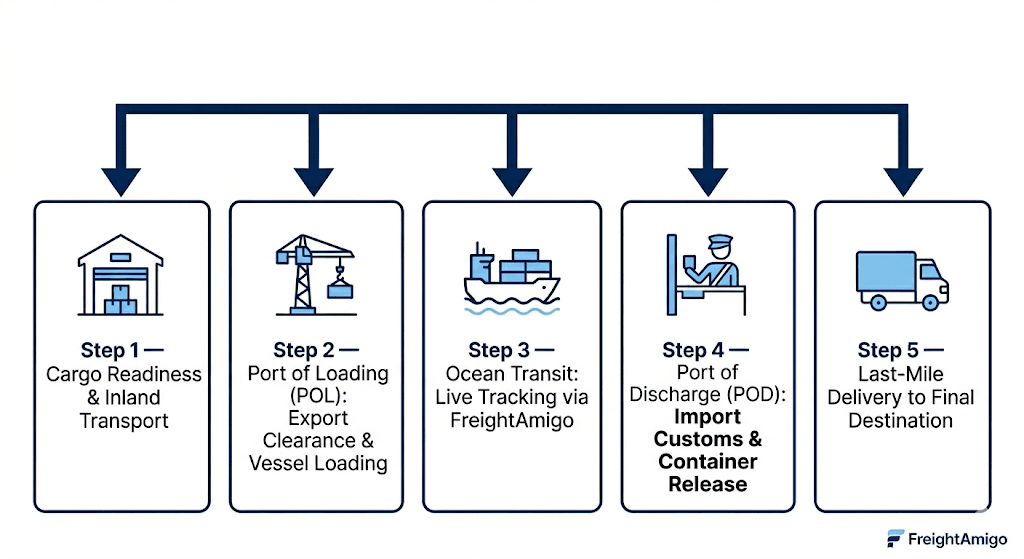
In international shipping, POL stands for Port of Loading and POD stands for Port of Discharge — two of the most foundational terms in global freight logistics.
These two terms define where your cargo begins and ends its ocean voyage. Every Bill of Lading, freight quote, and customs declaration requires both to be stated accurately.
Getting POL and POD wrong causes delays, customs holds, and unexpected surcharges — all avoidable with proper understanding.
2026 Market Context: The global container shipping market is projected to exceed $8.8 billion by 2028, growing at a CAGR of 4.3%. With over 849 million TEUs handled annually, the stakes for accurate port management have never been higher.
Port of Loading (POL): The Starting Point
The Port of Loading (POL) is the specific port where your cargo is physically loaded onto an ocean vessel to begin its maritime journey.
Think of POL as the launch pad for your shipment. Everything that happens before the vessel departs — export customs clearance, container stuffing, terminal handling — is tied directly to the POL.
Choosing the right POL influences your entire supply chain performance.
Why POL selection matters:
Transit Time: Different POLs connect to different shipping lanes with different voyage durations.
Port Fees & Surcharges: Each port has its own Terminal Handling Charges (THC), documentation fees, and congestion surcharges.
Vessel Frequency: Some POLs offer daily sailings; others may only have weekly or biweekly departures.
Export Customs: Your export declaration and clearance are processed at the POL country's customs authority.
Inland Access: The POL you choose must be accessible from your factory or warehouse via road, rail, or barge.
Port of Discharge (POD): The Destination Defined
The Port of Discharge (POD) is the designated port where your cargo is unloaded from the ocean vessel at the end of its sea voyage.
POD is not always the final destination. It is where the ocean freight leg ends and where import customs clearance begins. From POD, cargo typically moves by truck or rail to its ultimate delivery point.
Selecting the right POD is as strategically important as selecting the POL.
Key functions of the POD:
Import Customs Clearance: All import duties, taxes, and inspections are conducted at the POD country's port of entry.
Container Demurrage: Free time for container pickup begins once cargo is discharged at POD.
Final Inland Routing: The POD determines your drayage options and inland delivery costs.
Congestion Risk: High-traffic PODs like Los Angeles or Rotterdam can add days to effective delivery times.
How POL and POD Work Together in Global Trade
The relationship between POL and POD is the backbone of every ocean freight transaction — they define the route, the cost, the timeline, and the documentation requirements.
No element of your shipping process is unaffected by this pairing. Freight forwarders, customs brokers, carriers, and buyers all reference POL-POD combinations constantly.
Here is how the two interact across your supply chain:
Route Determination: The POL-POD pair defines which shipping lanes and vessel services are available to you.
Rate Quotation: Ocean freight rates (base rates + surcharges) are always quoted from a specific POL to a specific POD.
Bill of Lading Accuracy: Both POL and POD must appear exactly on the Bill of Lading — errors cause customs rejections.
Transit Time Calculation: Carriers calculate ETD from POL and ETA to POD based on vessel schedules.
Risk Management: Knowing congestion levels at both ports helps shippers build realistic buffer time into supply chain planning.
Understanding this interplay is what separates reactive shippers from strategic logistics operators.
Beyond POL and POD: Other Critical Shipping Terms
While POL and POD are fundamental, they're just the tip of the iceberg when it comes to shipping terminology. Let's explore some other crucial acronyms that every shipper should know:
FCL vs. LCL: Full Container Load and Less than Container Load
These terms describe how your cargo is shipped:
FCL (Full Container Load): Your goods occupy an entire container.
LCL (Less than Container Load): Your goods share container space with other shippers' cargo.
Understanding the difference can help you choose the most cost-effective shipping method based on your cargo volume.
ETA and ETD: Estimated Time of Arrival and Departure
These acronyms are crucial for planning and scheduling:
ETD (Estimated Time of Departure): When your shipment is expected to leave the POL.
ETA (Estimated Time of Arrival): When your shipment is anticipated to reach the POD.
Accurate ETAs and ETDs are essential for coordinating logistics and managing customer expectations.
TEU: Twenty-Foot Equivalent Unit
TEU is a standard unit of measurement in container shipping, equivalent to a 20-foot container. It's used to quantify cargo capacity and port throughput. Understanding TEUs helps in planning shipments and comparing vessel capacities.
How Digital Logistics Platforms Optimize POL and POD Selection
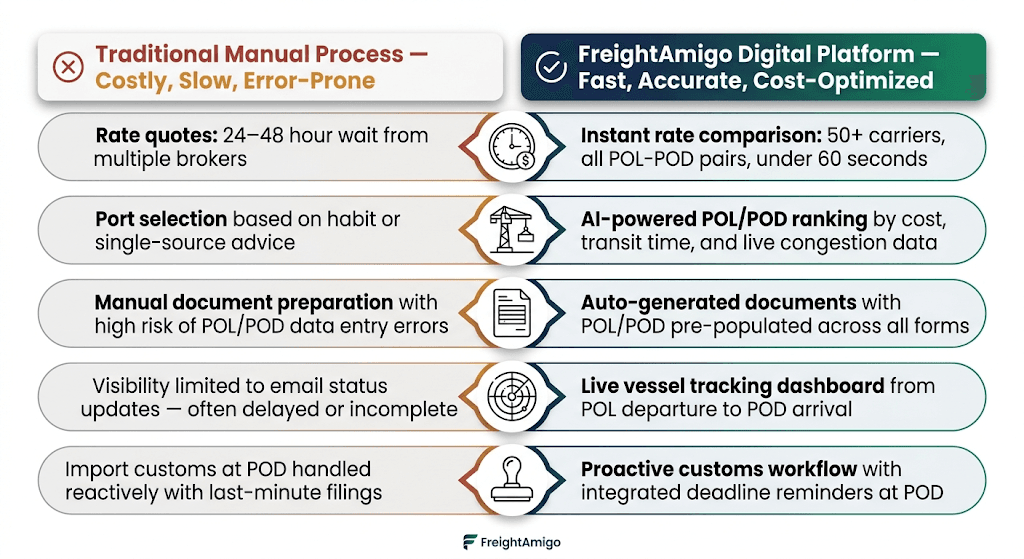
In 2026, manually comparing ports, rates, and schedules is no longer competitive — digital logistics platforms now automate and optimize every layer of POL and POD decision-making.
FreightAmigo's Digital Logistics Platform is purpose-built to give shippers real-time intelligence across all major global trade lanes.
Core platform capabilities for POL/POD management:
Instant Rate Comparison: Query live rates across multiple carrier services and POL-POD combinations simultaneously — no broker calls required.
Real-Time Vessel Tracking: Monitor your shipment's progress from POL to POD with live AIS vessel position data integrated into the dashboard.
Automated Documentation: The platform pre-populates POL, POD, and cargo details across all required documents — Bills of Lading, shipping instructions, and customs filings.
Congestion Alerts: Receive proactive notifications when your selected POL or POD is experiencing above-average dwell times or vessel backlogs.
Customs Clearance Support: Built-in workflows guide importers through POD customs procedures, reducing costly delays and penalties.
The result is a logistics operation that reacts faster, costs less, and delivers more reliably.
Real-World Case Study: Switching Ports to Cut Costs by 10%
A mid-sized electronics manufacturer in Shenzhen discovered that their default POL-POD pairing was quietly draining margins — until a data-driven platform revealed a better route.
The company had been shipping components to US distributors using a fixed routing: Port of Shenzhen (POL) → Port of Los Angeles (POD). They experienced chronic congestion, unpredictable delays, and rising surcharges.
The problem breakdown:
Port of Los Angeles congestion added 5–8 days to effective delivery time
Peak season surcharges at both ports escalated quarterly
Their logistics team had no visibility into alternative routes or real-time port performance data
Using FreightAmigo's platform, they:
Ran a multi-port rate and transit time comparison across 6 POL-POD combinations
Analyzed live congestion scores for each port pairing
Modeled total landed cost including inland drayage from alternative PODs
Identified the optimal switch: Port of Guangzhou (POL) → Port of Oakland (POD)
Results after switching:
Metric
Before (SZX → LAX)
After (CAN → OAK)
Improvement
Average Transit Time
18 days
15.3 days
-15%
Total Shipping Cost
Baseline
−10% vs. baseline
-10%
On-Time Delivery Rate
71% 89%
89%
+18 pts
Port Congestion Delays
Frequent
Rare
Significantly Reduced
This outcome was only possible because the team had access to real-time, comparative data — not guesswork.
The Future of POL and POD: AI, Sustainability, and Green Corridors
The way shippers select and manage POL and POD pairings is being fundamentally transformed by artificial intelligence, blockchain, and international sustainability mandates entering full force in 2026.
These are not distant trends. They are shaping routing decisions and carrier selection right now.
Digital transformation forces reshaping POL/POD:
AI Route Optimization: Machine learning models now predict optimal POL-POD pairings based on real-time demand, vessel availability, port congestion, and weather patterns.
Blockchain Documentation: Immutable digital Bills of Lading with auto-verified POL/POD data are reducing fraud and customs disputes across major trade lanes.
IoT Cargo Monitoring: Sensors on containers transmit live condition data — temperature, humidity, shock — from POL all the way to POD.
Sustainability shifts affecting port selection:
Green Corridors: Designated low-emission shipping routes between specific POL-POD pairs (e.g., Shanghai → Los Angeles, Rotterdam → Halifax) are gaining regulatory momentum.
Shore Power Requirements: An increasing number of PODs now mandate that vessels use onshore electricity while berthed, reducing emissions — and shippers selecting these PODs demonstrate ESG commitment.
CII Ratings: Carriers' Carbon Intensity Indicator scores now influence which vessels operate on which POL-POD routes, affecting available capacity and pricing.
FreightAmigo continuously integrates these sustainability metrics and digital innovations into its platform, so your port decisions are always forward-compatible.
If You Wish To Learn More About Ocean Freight Rates, Please Go To The FreightAmigo Page For Inquiries








 Global Popular RoutesTop sea & air shipping lanes
 Special OfferLimited-time shipping promotions





 Express
 Document
 Parcel - Air/Sea
 Container
 Relocation