Want To Compare The Best Express, Air Freight, Sea Freight, Rail Freight & Trucking Rates So As To Have Better Control On Cost?
If You Wish To Learn More About Ocean Freight Rates, Please Go To The FreightAmigo Page For Inquiries
The procedures for the regulation of restricted items and tariff arrangements are complicated. If you want to safely deliver your favorite items to your new home, it is best to have logistics experts to support you throughout the process! If you are planning to arrange overseas moving, welcome to FreightAmigo’s special page for overseas moving freight quotations.
FreightAmigo offers oversea immigration service to make your move-in easier!
There are different options for cargo transportation. If you want to choose the most convenient and suitable solution, it is best to have the full support of logistics experts! If you are planning to ship goods overseas, please go to the FreightAmigo page for inquiries.
If you are looking for logistics experts, please visit FreightAmigo Page
There Are Different Options For Transporting Goods, And To Choose The Most Convenient And Suitable Solution, It Is Best To Have Full Support From Logistics Experts! If You Are Planning To Ship Goods Overseas, Please Visit The FreightAmigo Page For Inquiries!
FreightAmigo, a supply chain e-marketplace, would ship your documents, small parcels or pallet anywhere in the world with flexible solutions. Get an instant quote on FreightAmigo and make trade easier!
If you’re looking For Cosmetics Shipping, Please Go To The FreightAmigo Page For Inquiries

Understanding US Customs Holds: Types, Processes, and Implications for Shippers

Imagine your shipment arriving at a US port after weeks at sea from Hong Kong, only to be stalled indefinitely due to a customs hold. Delays mount, storage fees accrue, and your supply chain grinds to a halt—costing thousands in unexpected expenses and lost opportunities. As experienced logistics professionals at FreightAmigo Services Limited, we’ve seen this scenario frustrate countless shippers, but it doesn’t have to be your story. In this comprehensive guide, we break down US customs holds, from common types like 1H exam holds and CET holds to processes and strategies for mitigation, empowering you to navigate CBP inspections with confidence.

Key Benefits of This Guide

  • Master the spectrum of US customs hold types, including 7H customs holds, CBPA holds, and PGA holds, to anticipate risks.
  • Understand exam processes like NII exams and 1H holds, with realistic timelines and cost breakdowns.
  • Gain actionable insights to minimize holds, reduce delays, and optimize your US-bound shipments.
Hold/Exam TypeDescriptionAverage DurationEstimated Cost per Container
Manifest HoldIssues with carrier manifest or ISF data1-3 days$0 (initial hold)
CET HoldAnti-terrorism/contraband checks3-7 days$150-$350
PGA HoldPartner Government Agency review (e.g., FDA)5-14 daysVaries by agency
NII Exam (X-Ray)Non-intrusive scan2-3 days$150-$350
1H Tailgate ExamDoor-open visual check2-5 days$150-$350
Intensive Exam (2H)Full container unload5-10+ days$1,000-$2,500+

This table draws from our extensive experience handling US imports and reflects typical outcomes at major ports like Los Angeles, New York, and Savannah. Accurate data submission upfront can prevent many of these holds.

What Are US Customs Holds and Why Do They Happen?

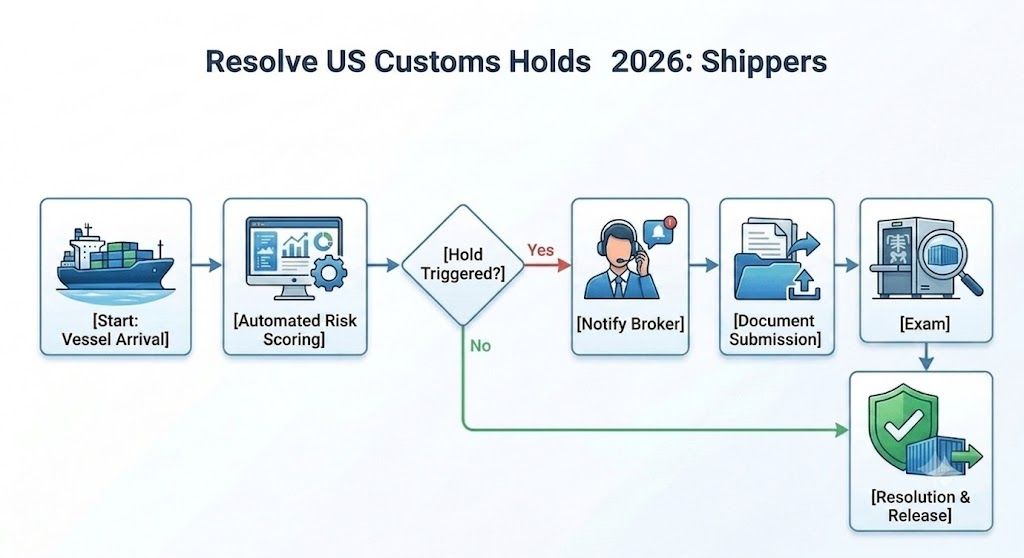
US Customs and Border Protection (CBP) imposes holds on shipments to ensure compliance with trade laws, security protocols, and regulatory standards. Since post-9/11 enhancements, CBP’s mandate has expanded beyond smuggling prevention to include national security, using advanced targeting systems that score shipments based on data from manifests, Importer Security Filings (ISF), and entry summaries.

We at FreightAmigo have assisted thousands of shippers from Asia to the US, observing that holds often stem from data discrepancies, first-time importer status, high-risk commodities (e.g., electronics, apparel, perishables), or origins flagged for scrutiny. For instance, incomplete ISF filings—required 24 hours before ocean vessel departure—frequently trigger manifest holds. Our clients avoid these pitfalls through proactive compliance checks.

CBP sources data via the Automated Manifest System (AMS) from carriers and forwarders, cross-referencing it against historical patterns. A score exceeding thresholds leads to holds like customs hold or specific codes such as 1C customs clearance delays. Understanding these mechanics is crucial for shippers asking, “how long does customs hold packages?”—answers vary, but preparation shortens them significantly.

Common Types of US Customs Holds

Customs holds come in various forms, each tied to specific triggers. Here’s an in-depth look at the most prevalent, including those from our keyword focus like 7H customs hold, CBPA hold, and CTF hold.

Manifest Hold

This initial hold arises from inconsistencies or omissions in the carrier’s manifest or ISF data. For sea freight from Hong Kong to the US West Coast, mismatched Harmonized System (HS) codes or values can flag shipments. Resolution involves submitting corrected documents, often within 1-3 days if addressed promptly.

Commercial Enforcement Hold (CBPA Hold)

CBPA holds, linked to CBP Agriculture or broader commercial enforcement, target potential violations of trade regulations. These encompass undervaluation, misclassification, or issues under agencies like FDA or USDA. In our experience, apparel and consumer goods shipments frequently encounter CBPA holds due to labeling discrepancies.

Statistical Validation Hold

Triggered by anomalies in declared value, weight, or quantity against commodity benchmarks—e.g., unusually low values for electronics—these holds require invoice validation. Shippers can preempt them with detailed commercial documentation.

CET Hold and CET Exam Customs

CET (Contraband Enforcement Team) holds, sometimes coded as A-TCET, focus on anti-terrorism risks like drugs, weapons, or radiological materials. Gamma scanning at ports detects anomalies. Our Track & Trace tool (Track & Trace) provides real-time alerts, helping clients monitor CET-impacted shipments and coordinate responses.

PGA Hold

Partner Government Agency holds involve external regulators (e.g., FDA for food, CPSC for toys). CBP acts as gatekeeper, holding shipments until PGA clearance. Durations extend if samples are needed, emphasizing accurate HS code classification.

Other Specific Holds: 1H Hold, 2H Hold Customs, 7H Customs Hold, CTF Hold

Code-specific holds like 1H hold customs (tailgate exam precursor), 2H hold customs (intensive prep), 7H (often agriculture-related), and CTF (Customs Task Force variants) escalate from initial reviews. These are port-specific but universally demand swift broker action. First-time shippers to the US face higher incidences, as established importers benefit from compliance history.

Types of Customs Exams Following Holds

Once held, shipments may undergo exams, escalating in invasiveness and cost. CBP prioritizes based on risk.

NII Exam Hold (Non-Intrusive Inspection or X-Ray)

The least disruptive, NII exams use VACIS or gamma tech for scanning without opening containers. At ports like Long Beach, containers drive through scanners. Clear scans lead to quick release; fees: $150-$350 per 20ft/40ft. Duration: 2-3 days for ocean freight.

1H Exam Hold / Tailgate Exam

Officers open container doors at the terminal for visual inspection—the “drive-by” check. Common for 1H hold customs, it verifies manifests match contents. Fees mirror NII; if issues found, escalation to intensive occurs. We’ve seen tailgates resolve 70% of cases efficiently.

Intensive Exams and 1C Customs Clearance

The most thorough, involving full devanning at a Customs Exam Site (CES). Labor-intensive, with parcels unpacked for inspection/samples. Costs soar to $1,000-$2,500+, prorated for LCL. 1C customs clearance often follows, tying into final release. Air freight exams are faster (1-2 days) due to pallet handling.

Exam TypeInvasiveness LevelTypical TriggersCost Range (20ft Container)US Port Examples
NII/X-RayLowData anomalies$150-$225LAX, NYNJ
1H TailgateMediumCET/PGA flags$200-$350SAV, HOU
IntensiveHighSecurity risks$1,000-$2,500LGB, MIA

How Shippers Are Notified and Who Pays

CBP notifies brokers and importers via electronic systems like ACE. Brokers request additional docs (invoices, packing lists, certificates). Importers bear exam/storage costs per regulations—not CBP. For LCL, forwarders apportion fees. Storage at congested ports like LA adds $100-200/day post-free time (5 days).

Durations: How Long Does Customs Hold Packages?

Timelines vary: X-ray/NII: 2-3 days; Tailgate: 3-5 days; Intensive: 5-10+ days, up to weeks with PGAs. Air: faster at 1-3 days. Congestion exacerbates; 2023-2025 peaks saw 20% longer holds. Use our Customs Clearance service for AI-driven HS validation to slash risks.

This tool illustrates baseline transit times, helping you factor in potential hold delays for US routes.

Implications for Shippers: Costs, Delays, and Supply Chain Disruptions

Holds inflate costs 10-50% via exams/storage/demurrage, disrupt inventory (e.g., stockouts), and erode customer trust. For eCommerce shippers, delays mean lost sales; manufacturers face production halts. Repeated holds harm compliance scores, increasing future risks. From our Hong Kong vantage, we see Asian exporters hit hardest without robust partners.

How FreightAmigo Mitigates US Customs Holds

Our platform equips shippers with tools to preempt issues. The Customs Clearance service offers AI-powered HS code validation, duty optimization, and compliance support, reducing hold triggers by verifying data pre-shipment. Pair it with Duties & Taxes Calculator for accurate estimates, avoiding valuation holds.

Real-time visibility via Track & Trace flags potential issues early. For sea/air freight to the US, integrate Instant Quote for competitive rates factoring compliance.

Prevention Strategies: Best Practices for Shippers

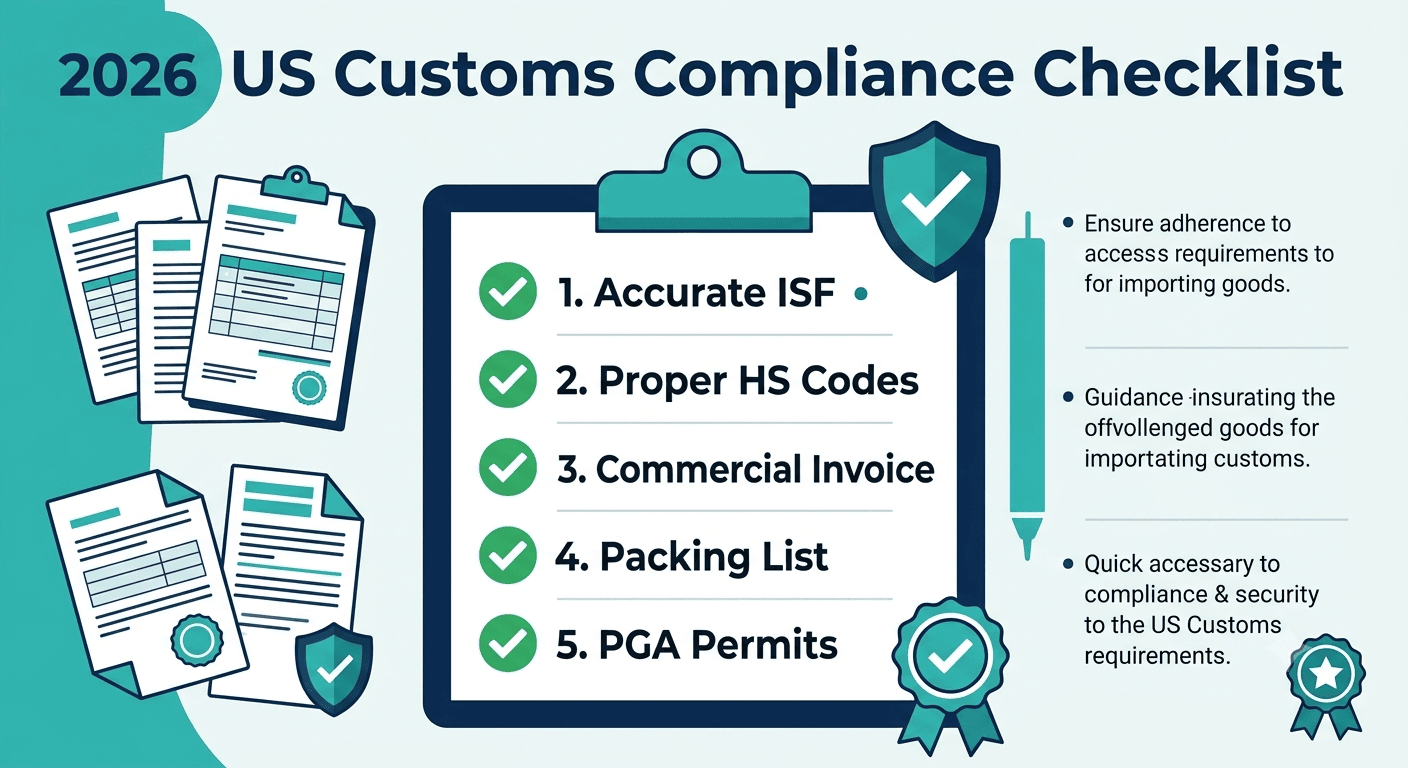
1. File accurate ISF/AMS early (24-48 hrs pre-departure).
2. Use correct 10-digit HS codes—leverage our Customs Clearance.
3. Maintain detailed docs: invoices, packing lists, origins certs.
4. Build compliance history with consistent filings.
5. Opt for trusted forwarders experienced in US imports.
6. Monitor high-risk commodities (textiles, toys, foods).
7. Insure via Cargo Insurance against hold-related damages.

For high-volume shippers, PO to POD streamlines end-to-end, minimizing errors.

Case Studies from Our Experience

A Hong Kong electronics exporter faced repeated CET holds due to HS misclassification. Switching to our Customs Clearance reduced holds by 80%, saving $15K/year. Another apparel shipper avoided PGA holds via proactive FDA checks, cutting delays from 14 to 3 days.

Future Trends in US Customs Enforcement

By 2026, AI targeting and single-window systems will intensify scrutiny. Shippers adopting digital compliance—like FreightAmigo’s solutions—will thrive. ESG-focused green logistics via AmiGo Green complements secure, efficient chains.

FAQ

What is a 1H hold customs?

A 1H hold refers to a tailgate exam where CBP officers visually inspect the opened container doors at the terminal, typically lasting 2-5 days.

How long does customs hold packages?

Durations range from 1-3 days for simple holds to 5-14+ days for intensive exams or PGA reviews, influenced by port congestion.

What is a CET hold?

CET holds target contraband and security risks via the Anti-Terrorism Contraband Enforcement Team, often leading to NII scans.

What causes a PGA hold?

PGA holds occur when agencies like FDA or USDA require compliance checks on regulated goods before CBP release.

Who pays for customs exams like NII exam holds?

Importers or consignees pay exam and storage fees, as per CBP regulations, often prorated for shared containers.

What is a CBPA hold?

CBPA holds relate to agriculture or commercial enforcement issues, flagging potential regulatory violations in shipments.

Conclusion

US customs holds—from 7H and 1H exam holds to CET and PGA—pose significant challenges, but armed with knowledge of types, processes, and prevention, shippers can minimize impacts. At FreightAmigo, our Customs Clearance and Track & Trace services deliver compliance and visibility, ensuring smoother US imports. Start optimizing today with our Instant Quote tool for seamless planning.