




















 快递
 文件
 包裹 - 空运/海运
 货柜
 海外搬屋
起运地

结果
目的地
结果
货件信息
1
× × 厘米
公斤
- Why Postal Codes Matter for Global Freight in 2026
- United Kingdom: Alphanumeric Precision
- Canada: Unique Alternating Format
- United States: The ZIP Code System
- Australia: Four-Digit Simplicity
- New Zealand: Four-Digit Precision
- Taiwan: Flexible Numeric Codes
- Japan: Seven-Digit Accuracy
- Germany: Five-Digit Efficiency
- France: Administrative Divisions
- Netherlands: Letters Meet Numbers
- Hong Kong's Unique Situation
- How Postal Codes Impact Global E-Commerce & Freight
- Global Postal Code System Comparison Table
- How FreightAmigo Supports Global Shipping in 2026
- Frequently Asked Questions
- Start Shipping Smarter to Every Postal Zone in 2026


发布日期:
更新日期:
Decoding Postal Codes: The Ultimate 2026 Guide to the World's Top 10 Freight Destinations
Compare International Shipping Rates Instantly → Get My Free Quote
Table of Contents (Click to expand)
- Why Postal Codes Matter for Global Freight in 2026
- United Kingdom: Alphanumeric Precision
- Canada: Unique Alternating Format
- United States: The ZIP Code System
- Australia: Four-Digit Simplicity
- New Zealand: Four-Digit Precision
- Taiwan: Flexible Numeric Codes
- Japan: Seven-Digit Accuracy
- Germany: Five-Digit Efficiency
- France: Administrative Divisions
- Netherlands: Letters Meet Numbers
- Hong Kong's Unique Situation
- How Postal Codes Impact Global E-Commerce & Freight
- Global Postal Code System Comparison Table
- How FreightAmigo Supports Global Shipping in 2026
- Frequently Asked Questions
- Start Shipping Smarter Today
Why Postal Codes Matter for Global Freight in 2026
Postal codes are the invisible backbone of modern international logistics, and in 2026, their role has never been more critical. As global e-commerce continues to accelerate, a single incorrect postal code can delay a shipment, inflate costs, or trigger a customs rejection.
Whether you're a growing SME or a multinational enterprise, understanding how each country structures its postal code system gives you a direct operational edge.
This guide breaks down the top 10 freight destination postal systems — plus Hong Kong's fascinating exception — so you can ship smarter, faster, and with full confidence.
United Kingdom: Alphanumeric Precision
The UK postal code system is one of the world's most granular, capable of pinpointing a single building on a specific street. Introduced in the early 1950s, it uses a two-part alphanumeric structure that enables highly automated mail sorting.
How It Works:
- Outward Code (e.g.,
EH1) — identifies the postal area and district - Inward Code (e.g.,
3YZ) — narrows down to a specific street or address cluster
Example: EH1 3YZ
EH1= Edinburgh postal district3YZ= precise delivery point within that district
For freight shippers, UK postal codes are mandatory on all commercial invoices and customs declarations post-Brexit.
Canada: Unique Alternating Format
Canada's postal code follows a distinctive ANA NAN pattern — alternating letters and numbers — that provides exceptional geographic granularity across a vast territory. The system covers urban centres and remote rural areas with equal precision.
Structure Breakdown:
- 1st character (A): Identifies the postal district (Forward Sortation Area)
- 2nd character (N): Narrows to city, town, or rural zone
- 3rd character (A): Further specifies sub-area
- Last 3 characters (NAN): Pinpoints a small group of addresses or single building
Example: M5V 2S9
M5V= Downtown Toronto2S9= Specific delivery block within that zone
United States: The ZIP Code System
The US ZIP (Zone Improvement Plan) Code system, launched in 1963, underpins one of the highest-volume freight markets in the world. With over 42,000 active ZIP codes, it enables granular routing across 50 states and territories.
Two Formats:
- 5-digit ZIP (e.g.,
10001) — identifies a general delivery zone - ZIP+4 (e.g.,
10001-2000) — pinpoints a specific building, floor, or address cluster
Freight Relevance in 2026:
- Carrier surcharges (residential vs. commercial) are calculated by ZIP code
- Last-mile delivery optimization algorithms rely on ZIP+4 data
- Customs Entry Summaries (CBP Form 7501) require accurate ZIP codes
Australia: Four-Digit Simplicity
Australia's four-digit postal code system is a model of elegant simplicity, efficiently covering one of the world's largest landmasses with a straightforward numeric structure. The system is administered by Australia Post.
Structure:
- 1st digit: State or territory identifier
- Remaining 3 digits: Specific suburb or locality
State/Territory Prefix Guide:
| Digit | Region |
|---|---|
| 1 | New South Wales (some) |
| 2 | New South Wales & ACT |
| 3 | Victoria |
| 4 | Queensland |
| 5 | South Australia |
| 6 | Western Australia |
| 7 | Tasmania |
| 8–9 | Northern Territory & special codes |
Example: 2000 = Sydney CBD, New South Wales
New Zealand: Four-Digit Precision
New Zealand's postal code system, introduced in 1977 and modernised in 2006, uses a clean four-digit format that balances simplicity with geographic accuracy. The updated system aligned with international courier standards.
How It Works:
- 1st digit: Major region or city zone
- Remaining digits: Specific suburb, locality, or street
Example: 1010
1= Auckland central zone010= Specific delivery area within Auckland CBD
For freight into New Zealand, postal codes are cross-referenced against NZ Customs Service records for import duty calculation.
Taiwan: Flexible Numeric Codes
Taiwan offers a two-tier postal code system — three-digit or five-digit — giving shippers flexibility depending on the precision required for delivery. The system is managed by Chunghwa Post.
Structure:
- 3-digit code: Identifies the administrative district (city or county)
- 5-digit code: Adds a two-digit suffix for the specific district or zone
Examples:
100= Taipei City (district level)10045= Da'an District, Taipei City (zone level)
In 2026, Taiwan's growing role as a semiconductor and electronics export hub makes accurate postal coding essential for time-sensitive air freight shipments.
Japan: Seven-Digit Accuracy
Japan's seven-digit postal code system (NNN-NNNN format) is one of the most precise in Asia, capable of identifying individual buildings in dense urban environments like Tokyo and Osaka. Japan Post manages over 124,000 unique codes nationwide.
Structure:
- First 3 digits: Large geographic area (city, ward, or town)
- Last 4 digits: Specific street address or building
Example: 100-8111
100= Chiyoda Ward, Tokyo8111= Exact delivery point within Chiyoda
Key Freight Notes:
- Japanese customs (Japan Customs, MOF) requires postal codes on all import declarations
- The 〒 symbol precedes all Japanese postal codes on shipping labels
- E-commerce returns to Japan require exact 7-digit codes or parcels are rejected
Germany: Five-Digit Efficiency
Germany's five-digit postal code (Postleitzahl or PLZ) system is engineered for speed, supporting one of Europe's most powerful manufacturing and export economies. Introduced in its unified form in 1993 post-reunification, it covers over 8,200 distinct zones.
Structure:
- First 2 digits: Broader region or state zone
- Last 3 digits: City, town, or specific urban district
Example: 10115
10= Berlin region115= Mitte district, Central Berlin
Germany is a major EU freight hub. Inaccurate PLZ codes cause delays at Deutsche Post and DHL sorting hubs, directly impacting cross-border delivery SLAs.
Ship to Germany or any EU destination — FreightAmigo auto-validates postal codes to prevent costly customs delays. Get a quote in 60 seconds.
France: Administrative Divisions
France's five-digit postal code system is structurally tied to the country's historic 96 metropolitan departments, making it one of the most administratively logical systems in Europe. The system is managed by La Poste.
Structure:
- First 2 digits: Department number (e.g., 75 = Paris)
- Last 3 digits: Specific commune, town, or arrondissement
Example: 75010
75= Paris (Ville de Paris department)010= 10th arrondissement
Freight Tip: France uses a separate DOM-TOM coding block (971–976) for overseas territories — critical for shippers routing goods to Martinique, Guadeloupe, or Réunion.
Netherlands: Letters Meet Numbers
The Netherlands uses one of Europe's most distinctive postal code formats — four digits followed by two capital letters (NNNN LL) — delivering remarkable precision in one of the world's busiest logistics hubs. Rotterdam, the largest port in Europe, processes millions of shipments annually using this system.
Structure:
- 4 digits: Identify a geographic zone or neighbourhood
- 2 letters: Narrow down to a specific street segment or building
Example: 1012 ES
1012= Amsterdam canal district zoneES= Specific street within that zone
The Netherlands' position as the EU's primary air and sea freight gateway (Schiphol + Rotterdam) makes accurate postal coding a non-negotiable for import/export compliance.
Hong Kong's Unique Situation
Hong Kong is one of the world's busiest trade hubs yet operates without a formal postal code system — a deliberate and functional choice rooted in geography and efficiency. This frequently surprises international shippers and e-commerce merchants.
Why Hong Kong Doesn't Use Postal Codes:
- Small geographic footprint — Dense population and compact land area allow Hong Kong Post to route deliveries accurately using district names and street addresses alone.
- Highly developed address infrastructure — A well-established district-based system (18 districts across Hong Kong Island, Kowloon, and NT) makes numeric codes redundant.
- Historical precedent — Efficient mail delivery was established before postal codes became a global standard, removing the urgency to retrofit.
- Cost-benefit calculus — Implementing and maintaining a new system offered minimal improvement over the existing reliable infrastructure.
Practical Tip for Online Shoppers & Shippers:
When a website requires a postal code for a Hong Kong address, enter 000000 or 0000 as a widely accepted workaround. Major logistics carriers including DHL, FedEx, and UPS recognise this convention.
How Postal Codes Impact Global E-Commerce & Freight
In 2026, postal codes are not just delivery tools — they are the foundational data layer powering every dimension of modern logistics technology. From AI-driven route optimisation to dynamic customs compliance, their impact is systemic.
Five Critical Freight Functions of Postal Codes:
- Automated Sorting: Enable high-speed mechanical sorting at hubs, reducing processing time by up to 70%
- Precise Delivery: Minimise misdelivery risk by providing exact geographic coordinates for last-mile routing
- Freight Rate Calculation: Carrier pricing engines use origin-destination postal pairs to generate dynamic quotes
- Business Intelligence: Companies use postal code-level data for demand forecasting and warehouse placement decisions
- Address Validation: E-commerce platforms cross-reference postal codes against national databases to reject invalid entries before order fulfilment
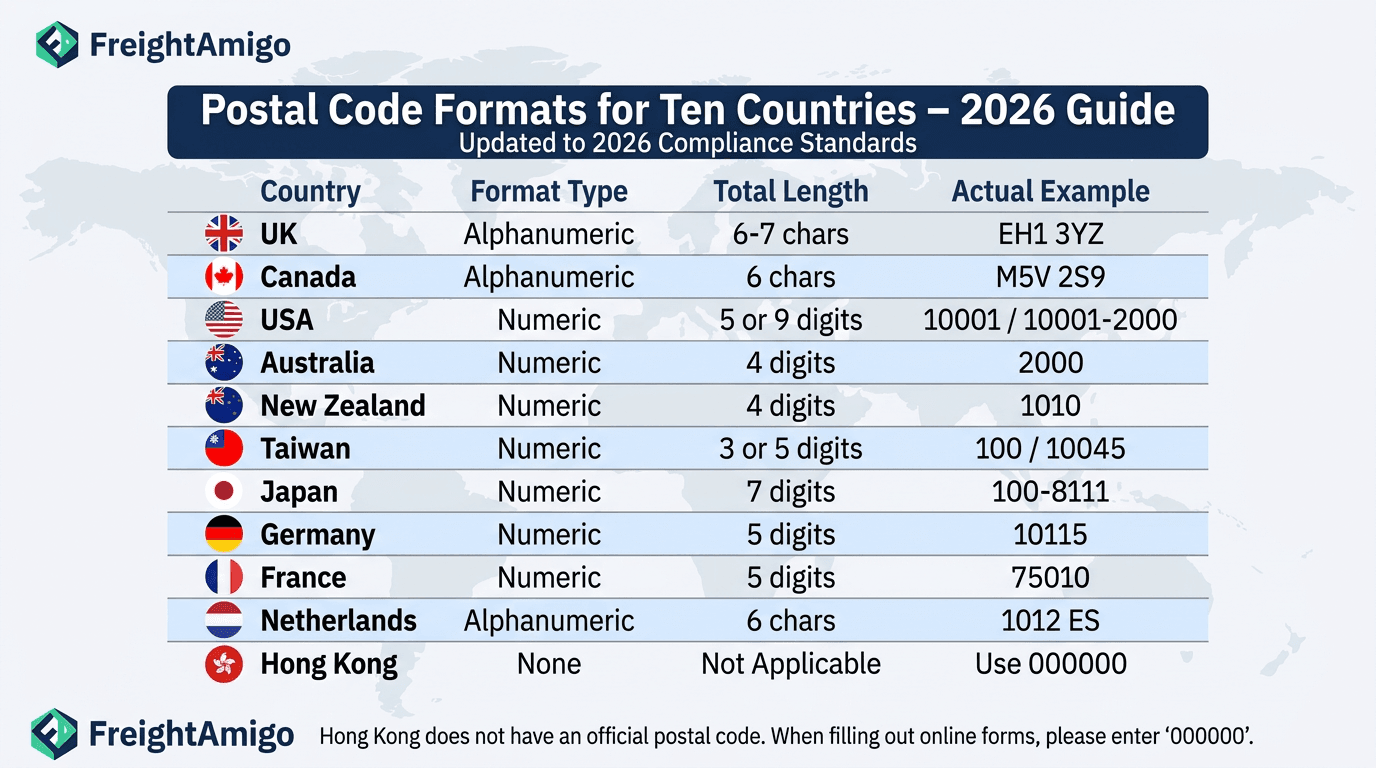
Global Postal Code System Comparison Table
Understanding the structural differences between global postal code systems helps shippers avoid address errors that cause customs delays and failed deliveries.
| Country | Format | Length | Example | Postal Authority | Freight Complexity |
|---|---|---|---|---|---|
| 🇬🇧 United Kingdom | Alphanumeric | 6–7 chars | EH1 3YZ | Royal Mail | High (post-Brexit customs) |
| 🇨🇦 Canada | Alphanumeric (ANA NAN) | 6 chars | M5V 2S9 | Canada Post | Medium |
| 🇺🇸 United States | Numeric | 5 or 9 digits | 10001-2000 | USPS | Medium–High (zone surcharges) |
| 🇦🇺 Australia | Numeric | 4 digits | 2000 | Australia Post | Low–Medium |
| 🇳🇿 New Zealand | Numeric | 4 digits | 1010 | NZ Post | Low |
| 🇹🇼 Taiwan | Numeric | 3 or 5 digits | 10045 | Chunghwa Post | Medium (tech cargo) |
| 🇯🇵 Japan | Numeric | 7 digits | 100-8111 | Japan Post | High (strict labelling) |
| 🇩🇪 Germany | Numeric | 5 digits | 10115 | Deutsche Post | Medium (EU Customs Union) |
| 🇫🇷 France | Numeric | 5 digits | 75010 | La Poste | Medium (DOM-TOM variance) |
| 🇳🇱 Netherlands | Alphanumeric | 6 chars | 1012 ES | PostNL | High (EU transit hub) |
| 🇭🇰 Hong Kong | None | N/A | 000000 | Hongkong Post | Low (district-based) |
 How FreightAmigo Supports Global Shipping in 2026
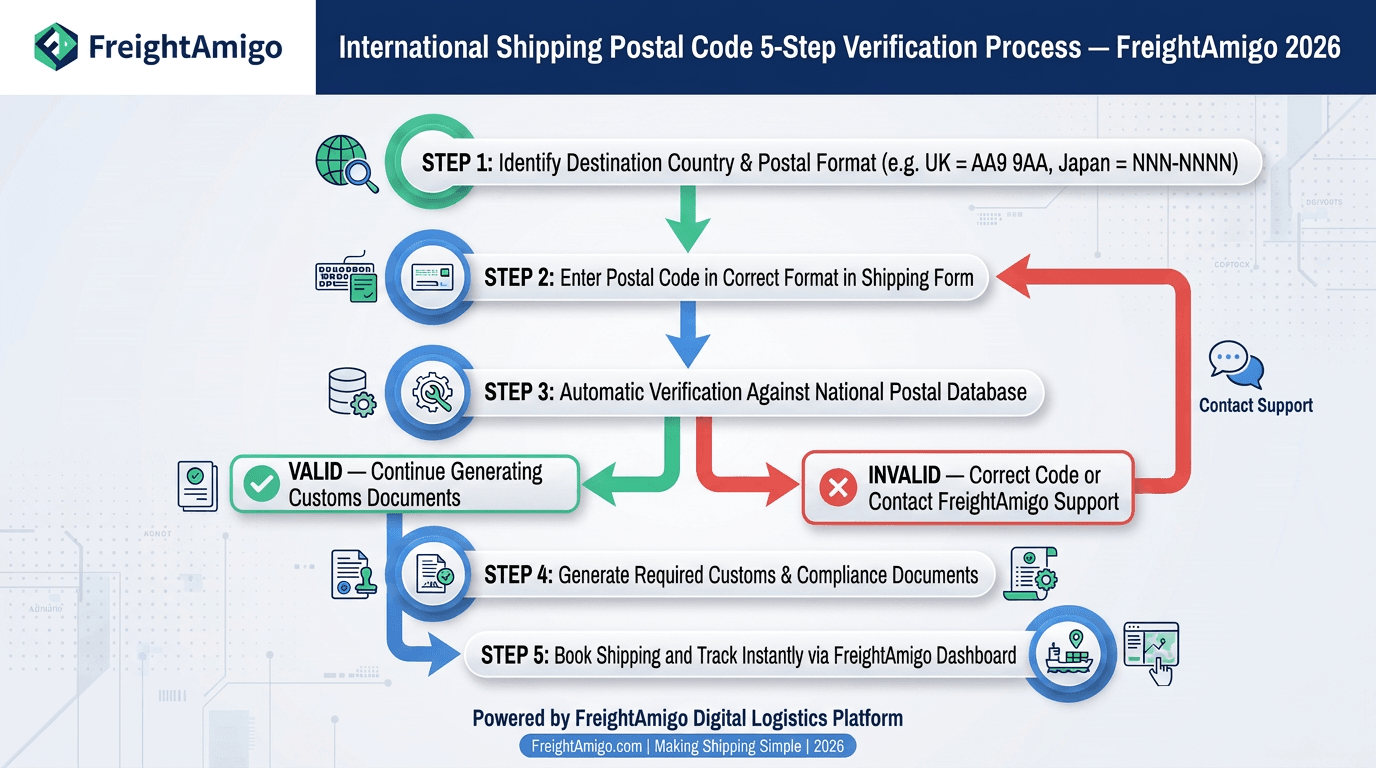
FreightAmigo's digital logistics platform is purpose-built to eliminate the postal code errors that cause the most common — and most expensive — international shipping failures. Our technology layer sits between your order management system and the global carrier network, validating every address before a shipment is booked.
Five Ways FreightAmigo Eliminates Postal Code Pain:
- Auto Address Validation: Integrated with national postal databases across 200+ countries and territories — including special handling for Hong Kong's no-code system
- Real-Time Rate Calculation: Postal code pairs drive instant, accurate quotes across air, sea, rail, and road freight modes
- Customs Document Generation: Pre-populated with verified postal codes to prevent customs rejections and border delays
- Global Shipment Tracking: Monitor your cargo as it moves through postal zones worldwide via a single dashboard
- Data-Driven Analytics: Postal code-level shipping data helps you identify your highest-volume lanes and optimise carrier selection
Whether you're shipping electronics from Taiwan's 10045 zone to Rotterdam's 1012 ES port district, or routing pharmaceutical cargo from London's EH1 to Tokyo's 100-8111, FreightAmigo ensures every digit is correct before your freight moves.
Frequently Asked Questions
The questions below reflect the most common real-world postal code and international freight concerns searched in 2026.
What is a postal code and why is it important for international shipping?
A postal code is a numeric or alphanumeric string assigned to a geographic area to enable efficient mail and parcel sorting. In international freight, an incorrect postal code can trigger customs rejections, misrouting, or carrier surcharges — making accuracy essential for every shipment.
Does Hong Kong have a postal code?
Hong Kong does not use a formal postal code system. When online forms require one, entering 000000 or 0000 is the universally accepted workaround recognised by major carriers including DHL, FedEx, and UPS.
What is the difference between a ZIP code and a postal code?
ZIP code is the United States-specific term for its Zone Improvement Plan system, using 5 or 9 digits. "Postal code" is the international generic term covering all country-specific formats, including alphanumeric systems like the UK's or Canada's.
How do postal codes affect freight shipping costs?
Carriers use origin and destination postal codes to calculate distance, delivery zone, and applicable surcharges (e.g., residential delivery, remote area fees). Incorrect codes can result in quote inaccuracies and post-shipment billing adjustments.
Which countries use alphanumeric postal codes?
The United Kingdom (e.g., EH1 3YZ), Canada (e.g., M5V 2S9), and the Netherlands (e.g., 1012 ES) are the most prominent countries using alphanumeric postal code formats. Ireland and Argentina also use alphanumeric systems.
How do I find the correct postal code for an international shipment?
Use the destination country's official postal authority website (e.g., Royal Mail for UK, Japan Post for Japan), or use a verified address validation tool like FreightAmigo's built-in postal code checker, which cross-references live national postal databases.
What happens if I use the wrong postal code on a customs form?
An incorrect postal code on a customs declaration can cause the shipment to be held at the border, assessed incorrect duties, or returned to sender. In 2026, customs authorities increasingly use automated data matching, making accuracy more critical than ever.
How does Japan's postal code system work for freight imports?
Japan uses a 7-digit format (NNN-NNNN), preceded by the 〒 symbol on shipping labels. Japan Customs requires the exact 7-digit code on all import declarations. Missing or incorrect codes are a leading cause of freight delays at Narita and Osaka Kansai airports.
Can postal codes be used to calculate import duties?
Postal codes themselves don't directly determine duty rates — HS codes and product value do. However, postal codes establish the delivery jurisdiction, which determines applicable VAT, GST, or consumption tax thresholds for e-commerce imports in markets like Australia, Japan, and the EU.
How does FreightAmigo handle postal code validation automatically?
FreightAmigo's platform integrates with postal databases across 200+ countries in real time. When you enter a destination address, the system auto-validates the postal code format, flags errors before booking, and populates customs documentation with verified address data — preventing delays before they happen.
Start Shipping Smarter to Every Postal Zone in 2026
Understanding postal code structures across your key freight destinations is one of the highest-ROI optimisations any logistics team can make in 2026. A single corrected digit saves days of customs delays and hundreds of dollars in redelivery costs.
From the 7-digit precision of Japan's 100-8111 to Hong Kong's elegant no-code system, every market has its own rules — and FreightAmigo is built to know them all automatically.
Stop manually checking postal codes. Stop second-guessing customs forms. Start with a platform designed to get every shipment to its destination, correctly, the first time.
Compare international shipping rates across air freight, sea freight, rail, and trucking — all freight modes, all postal zones, instant results.
Last updated: 2026 | Source: FreightAmigo Research & Global Postal Authority Data | For logistics enquiries, visit the FreightAmigo platform.