




























 快递
 文件
 包裹 - 空运/海运
 货柜
 海外搬屋
起运地

结果
目的地
结果
货件信息
1
× × 厘米
公斤
- What Is ECCN? 2026 International Shipping Compliance Fundamentals
- Complete Breakdown of the ECCN Code Structure
- 2026 ECCN Updates and Their Impact on International Shipping
- ECCN vs HS Code vs Schedule B: Complete 2026 Comparison
- How to Determine the Correct ECCN for Your Cargo: 2026 Step-by-Step Guide
- Most Common ECCN Mistakes in 2026 International Logistics
- ECCN Compliance Tools and FreightAmigo Solutions
- FAQ: ECCN and 2026 International Shipping Compliance
- Conclusion: Your 2026 ECCN Compliance Action Plan


发布日期:
更新日期:
Complete Guide to ECCN Export Control Classification Numbers: Essential Knowledge for 2026 International Shipping Compliance
Table of Contents (Click to expand)
- What Is ECCN? 2026 International Shipping Compliance Fundamentals
- Complete Breakdown of the ECCN Code Structure
- 2026 ECCN Updates and Their Impact on International Shipping
- ECCN vs HS Code vs Schedule B: Complete 2026 Comparison
- How to Determine the Correct ECCN for Your Cargo: 2026 Step-by-Step Guide
- Most Common ECCN Mistakes in 2026 International Logistics
- ECCN Compliance Tools and FreightAmigo Solutions
- FAQ: ECCN and 2026 International Shipping Compliance
- Conclusion: Your 2026 ECCN Compliance Action Plan
What Is ECCN? 2026 International Shipping Compliance Fundamentals
The Export Control Classification Number (ECCN) is one of the most critical compliance codes in global international shipping in 2026, directly determining whether you can legally export your goods.
ECCN is established by the U.S. Bureau of Industry and Security (BIS) under the Export Administration Regulations (EAR) to identify dual-use goods, software, and technology subject to export controls.
Any company exporting controlled items abroad must first confirm its ECCN status to avoid violations that can result in penalties of up to one million dollars.
Core functions of ECCN include:
- Identifying export items regulated under EAR
- Working alongside HS codes to manage global logistics tariffs and controls
- Regulating dual-use goods such as electronics and chemicals
- Determining whether a BIS export license is required
- Distinguishing controlled items from the EAR99 uncontrolled category
- Protecting exporters from sanctions violation risks
Core Definition: Items that do not require an ECCN are classified as EAR99, but this does not mean they are completely unregulated — destination countries and end users are still subject to review.
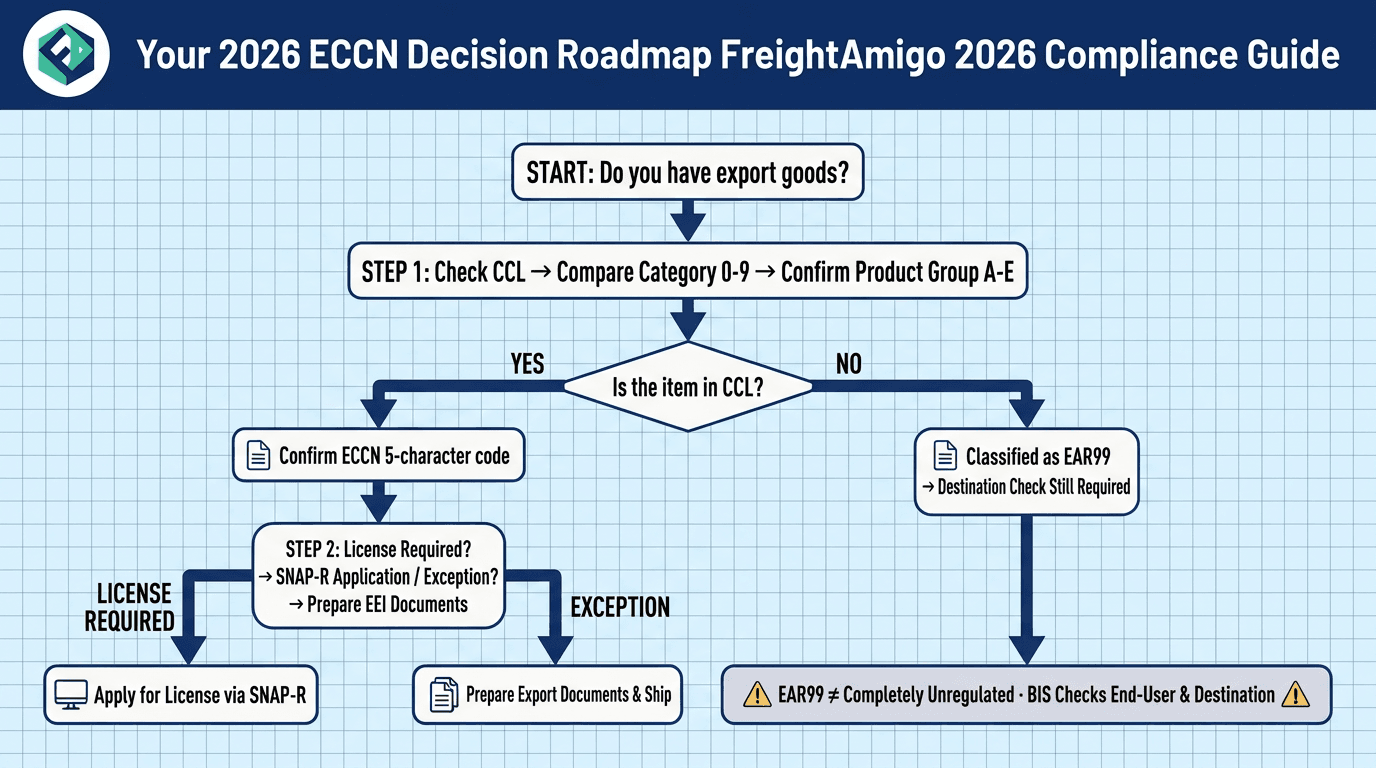
Complete Breakdown of the ECCN Code Structure
Each ECCN follows a precise 5-character format listed on the Commerce Control List (CCL) and serves as the core tool for export-controlled product classification in international logistics.
Understanding the meaning of these 5 characters is the first step toward correctly classifying cargo and avoiding violations.
The following is a complete breakdown of the ECCN structure:
| Position | Description | Example Value | Meaning |
|---|---|---|---|
| 1st Character (Number) | Category | 3 | Electronics |
| 2nd Character (Letter) | Product Group | A | Systems, Equipment, Components |
| 3rd–5th Characters (Numbers) | Specific Control Item | 001 | Specific Controlled Materials |
Quick Reference: Ten CCL Categories (0–9):
- Category 0: Nuclear Materials, Facilities, and Equipment
- Category 1: Materials, Chemicals, Microorganisms, and Toxins
- Category 2: Materials Processing / Manufacturing Equipment
- Category 3: Electronics (Most Common Export Category)
- Category 4: Computers
- Category 5: Telecommunications and Information Security
- Category 6: Sensors and Lasers
- Category 7: Navigation and Avionics
- Category 8: Marine Technology
- Category 9: Aerospace and Propulsion
Practical Tip: Categories 3 (Electronics) and 5 (Telecommunications) are the most frequently misclassified in 2026, particularly semiconductors and encryption software.
2026 ECCN Updates and Their Impact on International Shipping
The ECCN regulatory landscape in 2026 is profoundly shaped by ongoing WCO HS code revisions, geopolitical shifts, and BIS system upgrades — exporters must stay current at all times.
Following the major adjustments of 2025, the focus in 2026 has shifted toward mandatory compliance enforcement and the integration of digital licensing systems.
Key ECCN Policy Changes in 2026:
| Region | 2026 Key Change | Specific Impact on ECCN |
|---|---|---|
| United States (BIS) | SNAP-R System AI-Assisted Upgrade | License review speed increased by 40%, with higher false-positive rates |
| European Union | Updated Dual-Use Regulations (2021/821 Enforcement Strengthened) | Semiconductors and quantum technology added to control lists |
| GCC Countries | 12-Digit HS Code Fully Mandated | Tightened controls on batteries (HS 8507) and EV components |
| China | Expanded Counter-Sanction Export Controls | Must comply with both Chinese and U.S. export control regulations |
| Global | WCO HS 2022 Amendments Continue to Take Effect | Increased need to cross-check ECCN for electronics and medical devices |
Three High-Risk Cargo Categories in 2026:
- Semiconductors and Chips: Controlled under the U.S. CHIPS Act and BIS Entity List; ECCN 3A090 newly added
- Lithium Batteries and Energy Storage Devices: GCC markets now require mandatory ECCN declarations
- AI Software and Technology: ECCN 4E001 and 5D002 control scope continues to expand
Source: The WCO HS 2022 amendments remain in effect through 2026, with the next major revision expected in 2027.
ECCN vs HS Code vs Schedule B: Complete 2026 Comparison
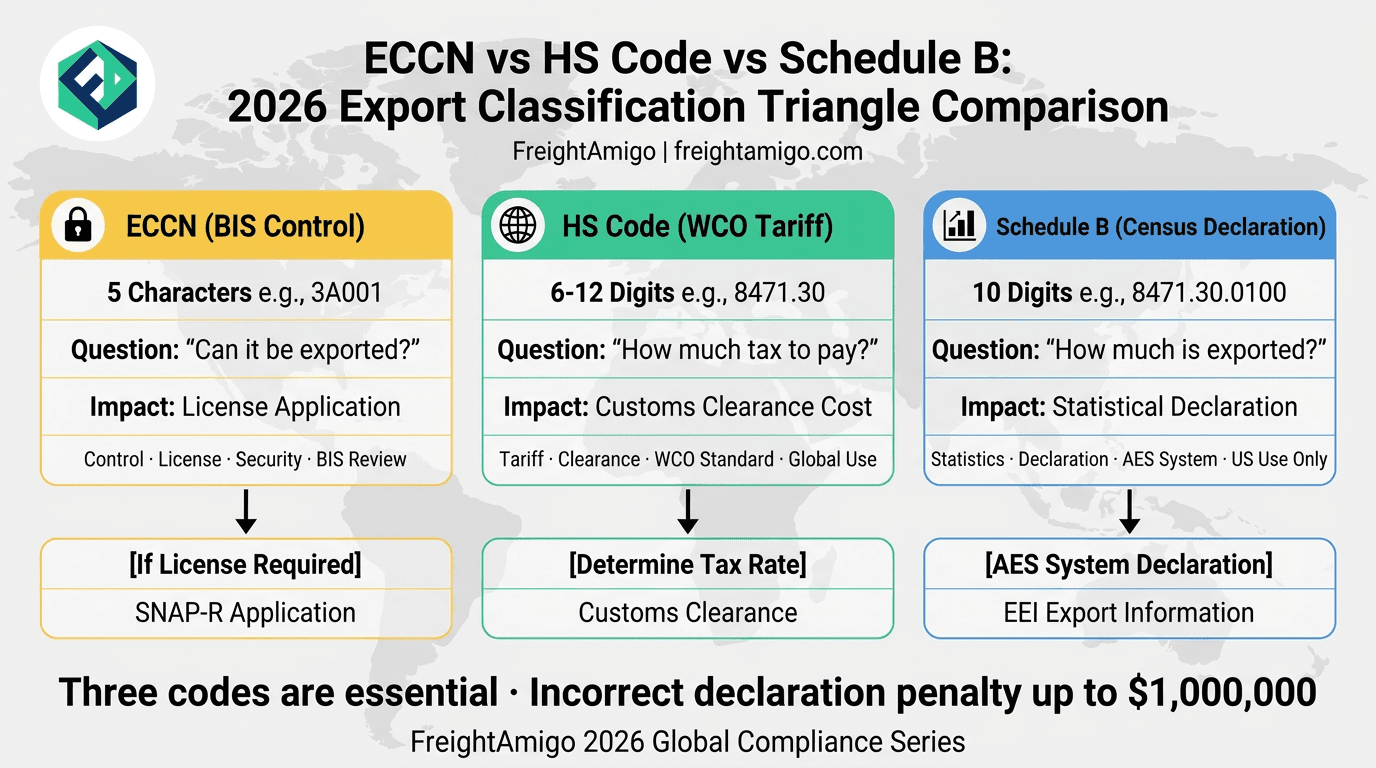
One of the most common mistakes exporters make is confusing the functions and purposes of ECCN, HS codes, and Schedule B, leading to reporting errors and customs clearance delays.
These three coding systems each have a distinct role and none can be omitted.
Core Comparison of the Three Major Export Classification Systems:
| Comparison Item | ECCN | HS Code | Schedule B |
|---|---|---|---|
| Governing Authority | U.S. BIS | WCO (Global) | U.S. Census Bureau |
| Format | 5 characters (e.g., 3A001) | 6–12 digits | 10 digits |
| Primary Purpose | Export license control | Tariff classification | Export statistical reporting |
| Scope of Application | U.S. exporters | Global trade | U.S. export declarations |
| Legal Basis | EAR (Export Administration Regulations) | HS Convention | U.S. regulations |
| Update Frequency | Updated at any time per policy | Every 5 years (WCO) | Follows HS updates |
| Mandatory Filing | Mandatory when required | All international cargo | All U.S. exports |
Key Practical Principles:
- HS codes determine tariff rates; ECCN determines whether export is permitted
- Schedule B is a statistical reporting tool filed with the U.S. Census Bureau and does not affect licensing
- The same shipment requires all three codes to be correctly completed simultaneously
- In 2026, the U.S. AES system requires consistency across all three codes
How to Determine the Correct ECCN for Your Cargo: 2026 Step-by-Step Guide
Proper ECCN self-classification requires a systematic approach — guessing or reusing outdated codes is one of the greatest export compliance risks in 2026.
The following is FreightAmigo's recommended standardized ECCN determination process:
Six Steps to ECCN Classification:
- Gather Complete Product Technical Specifications
— Including material composition, technical parameters, software functions, and intended end use - Search the BIS Commerce Control List (CCL)
— Browse Categories 0 through 9 to find the most applicable product description - Confirm the Product Group Letter (A–E)
— A = Systems/Equipment, B = Test Equipment, C = Materials, D = Software, E = Technology - Cross-Reference 2026 HS Code Updates
— Confirm whether HS code changes trigger an ECCN reclassification requirement - Assess Applicability of License Exceptions
— Common exceptions: ENC (Encryption), TSR (Technology and Software), STA (Strategic Trade Authorization) - Request an Official BIS Classification Ruling (If in Doubt)
— Submit a classification request through BIS SNAP-R to obtain official written confirmation
Important Reminder: Self-classification is legally valid, but the exporter bears full responsibility for any errors. For complex goods — especially dual-use technology — consulting a professional compliance advisor is strongly recommended.
Most Common ECCN Mistakes in 2026 International Logistics
Even experienced exporters can fall into ECCN compliance traps in 2026's complex regulatory environment, resulting in cargo seizures, fines, or even criminal liability.
Understanding the most common mistakes is the first step toward building a sound compliance system.
Seven High-Frequency ECCN Violation Types:
- Misclassifying Dual-Use Items as EAR99
— Consequence: Exporting controlled goods without a license; maximum civil penalty of $353,534 per violation - Ignoring Destination-Specific Controls (Country Chart)
— Some ECCNs are exempt in certain countries but require a license in others - Failing to Sync with 2025–2026 HS Code Revisions
— HS changes may trigger ECCN reclassification obligations - Skipping the License Application (SNAP-R) for Controlled ECCNs
— Direct export is considered a serious violation and may trigger criminal prosecution - Inconsistent Information in AES (Automated Export System) Filings
— Mismatches among ECCN, HS, and Schedule B codes cause customs clearance delays - Failure to Establish an Export Compliance Document Archiving System
— BIS audits require export records to be retained for at least five years - Failure to Screen End Users and End Uses
— Even with a correct ECCN, exporting to sanctioned entities remains illegal
Violation Consequence Levels:
| Severity of Violation | Possible Consequences |
|---|---|
| Minor (Administrative Negligence) | Warning letter, $10,000–$50,000 fine |
| Moderate (Repeated Violations) | $50,000–$353,534 per violation |
| Serious (Criminal Violation) | Up to $1,000,000 fine + 20 years imprisonment |
| Most Severe (Sanctions Violation) | Revocation of export privileges, placed on Denied Persons List |
ECCN Compliance Tools and FreightAmigo Solutions
In 2026, effective ECCN compliance management no longer relies on manual lookups — it requires a systematic approach integrating digital tools, real-time updated databases, and professional advisory support.
The following are the primary compliance resources available to exporters:
Official Free Tools:
- BIS SNAP-R System: Apply for export licenses and submit classification requests
- BIS CCL Search Tool: Official online Commerce Control List lookup
- Commerce Country Chart: Confirm license requirements for specific ECCNs by destination country
- OFAC Sanctions List Search: Screen end users for sanctions exposure
FreightAmigo 2026 Compliance Support Services:
- ECCN classification consulting and cross-verification
- HS code and ECCN consistency review
- Export license application assistance (SNAP-R filing support)
- Export document compliance package (EEI, commercial invoice, license copy)
- Real-time compliance alert notification service
2026 Real-World Case Study: A U.S. electronics exporter expanding into the GCC market discovered that its lithium battery products triggered an ECCN reclassification requirement due to the GCC's mandated 12-digit HS codes. Through timely intervention by FreightAmigo's compliance team and a SNAP-R license application, the company successfully avoided an estimated $500,000 in fines and a three-month export ban.
FAQ: ECCN and 2026 International Shipping Compliance
The following are the most frequently searched ECCN-related questions among exporters in 2026, answered directly and authoritatively by FreightAmigo.
What does ECCN stand for?
ECCN stands for Export Control Classification Number. It is a 5-character code established by the U.S. BIS under the EAR, used to identify regulated export items and their applicable license requirements.
Are ECCN and HS code the same thing?
No. ECCN is administered by the U.S. BIS and is used to determine export license requirements. HS codes are administered by the World Customs Organization (WCO) and are used for global tariff classification. The same shipment requires both codes.
What is EAR99? Does it mean completely unregulated?
EAR99 is the category for items not listed on the CCL but still subject to EAR — it does not mean fully uncontrolled. EAR99 items exported to sanctioned countries or restricted end users may still require a license or be prohibited.
How do 2026 HS code changes affect ECCN classification?
HS code updates can cause goods to be reclassified, which may trigger different ECCN control requirements. Exporters must re-verify their products' ECCN status after every HS code update, especially for batteries and semiconductors.
Who needs to confirm an ECCN?
Any exporter shipping controlled goods, software, or technology outside the United States must confirm their ECCN. Even if the goods did not originate in the U.S., products containing U.S.-origin components or technology subject to EAR may still require ECCN declaration.
Where can I find the official ECCN list?
The official ECCN list is published in the BIS Commerce Control List (CCL), available for free at the BIS official website (bis.doc.gov), with keyword search and category filtering capabilities.
Can I self-classify an ECCN, or must I hire a consultant?
Self-classification is fully valid under the law and the exporter bears full responsibility. For complex dual-use technologies or semiconductor products, consulting a compliance advisor or requesting an official BIS classification ruling is strongly recommended.
What should I do if my cargo's ECCN requires a license?
You must submit a license application through the BIS SNAP-R online portal before exporting the goods. The 2026 BIS AI-assisted review system is now live, reducing the average standard license review time to 15–30 business days.
Does the De Minimis rule affect ECCN compliance requirements?
No. ECCN export control requirements apply uniformly regardless of cargo value. This principle was further clarified following the De Minimis rule revision in May 2025.
How do I verify that my export meets ECCN compliance requirements?
Use BIS SNAP-R to verify license status, use the OFAC SDN list to screen end users, and ensure that your HS code, ECCN, and Schedule B codes are consistent within the AES system. Conducting an annual export compliance audit is best practice.
Conclusion: Your 2026 ECCN Compliance Action Plan
In the complex geopolitical and regulatory environment of 2026, ECCN compliance has evolved from an optional measure into a core competency for exporting businesses.
Proper ECCN management not only helps you avoid fines — it also accelerates customs clearance, builds buyer trust, and opens access to high-value markets that demand rigorous compliance documentation.
Your Immediate Action Checklist:
- Review whether the ECCN classifications for your existing product catalog remain valid
- Check whether the latest 2026 HS code updates trigger any reclassification requirements
- Establish an export compliance document archiving system (retain records for a minimum of 5 years)
- Screen all key customers and end users against the OFAC sanctions list
- Request an official BIS classification ruling for any items in doubt
- Contact FreightAmigo for professional ECCN compliance support
Contact FreightAmigo's Global Compliance Experts:
| Region | Contact |
|---|---|
| Hong Kong (HKG) | +852 2467 1689 / +852 2319 4879 |
| China (CHN) | +86 400 875 1689 |
| United States (USA) | +1 337 361 2833 |
| United Kingdom (GBR) | +44 808 189 0136 |
| Australia (AUS) | +61 1800 02752 |
| enquiry@freightamigo.com |
This article was written by the FreightAmigo Compliance Research Team and updated in accordance with the latest BIS regulations and WCO 2026 standards. The information provided is for reference only and does not constitute legal advice. For specific compliance guidance, please consult a licensed export control advisor.
Last Updated: 2026 | FreightAmigo Global Logistics and Compliance Solutions