A Commercial Invoice is a formal document issued by the seller to the buyer in international trade, serving as a critical declaration document for customs clearance.
It details cargo information, transaction value, parties' data, and trade terms. In 2026, an accurate commercial invoice is vital for rapid customs clearance, effectively reducing the risk of delays.
A clear and complete invoice accelerates the cargo customs clearance workflow.
Differences Between a Commercial Invoice and a Pro Forma Invoice
A commercial invoice reflects an actual completed transaction, whereas a Pro Forma Invoice is merely a preliminary quotation and estimation document.
Pro forma invoices are commonly used during the quotation stage to help the buyer estimate costs, but they do not carry the validity of final payment or complete customs valuation.
A commercial invoice is the mandatory formal document for actual shipping.
Commercial Invoice: Final proof of transaction, used for payment and customs duty calculation.
Pro Forma Invoice: Estimated quotation, non-formal customs clearance document.
Main Distinction: A commercial invoice contains actual transaction details and signatures.
Main Uses and Importance of Commercial Invoices in 2026
A commercial invoice serves as the core basis for customs to calculate duties, taxes, and ensure compliance. Utilize smart tariff calculators to instantly estimate cross-border transportation costs and avoid unexpected expenses.
It provides transaction transparency for both buyers and sellers, and assists customs in verifying cargo value and classification.
In 2026, digital auditing systems place higher importance on data accuracy.
List of main uses for a commercial invoice:
Basis for buyer payment and corporate accounting book records.
Foundation for customs duty valuation and tax calculations.
Supporting documentation for insurance claims and financing.
Compliance with international trade regulatory requirements.
Critical evidence for resolving trade disputes.
Essential Elements of a Commercial Invoice
A compliant commercial invoice in 2026 must contain specific mandatory fields to satisfy global customs requirements.
Missing key information can result in cargo seizures or fines.
Checklist of essential elements:
Full names, addresses, and contact details of both the seller and the buyer.
Invoice number, date, and transport document number such as a Bill of Lading or Air Waybill.
Detailed cargo description, HS Code, quantity, weight, and unit price.
Total value, currency, International Commercial Terms (Incoterms), and country of origin.
Payment terms, discounts, and other itemized charges.
Step-by-Step Guide on How to Complete a Commercial Invoice
Following these steps can help produce an accurate commercial invoice, significantly minimizing customs issues.
Begin with fundamental data and proceed to final review and signature.
List of completion steps:
Gather all transaction and shipping records.
Utilize a standard corporate letterhead template.
Provide a clear cargo description to facilitate HS Code classification.
Calculate and list values and fees item by item.
Conduct a comprehensive review and obtain necessary confirmations.
Attach to shipping documents in a digital format.
Common Errors and How to Avoid Them
Common errors in 2026 include vague descriptions or missing HS Codes, which easily lead to customs clearance delays.
It is imperative to cross-check the actual transaction value.
List of common errors:
Using cost price instead of transaction value.
Vague or generalized cargo descriptions.
Omiting the country of origin or Incoterms.
Currency inconsistencies or incorrect total amounts.
Failing to follow the latest tax exemption threshold regulations.
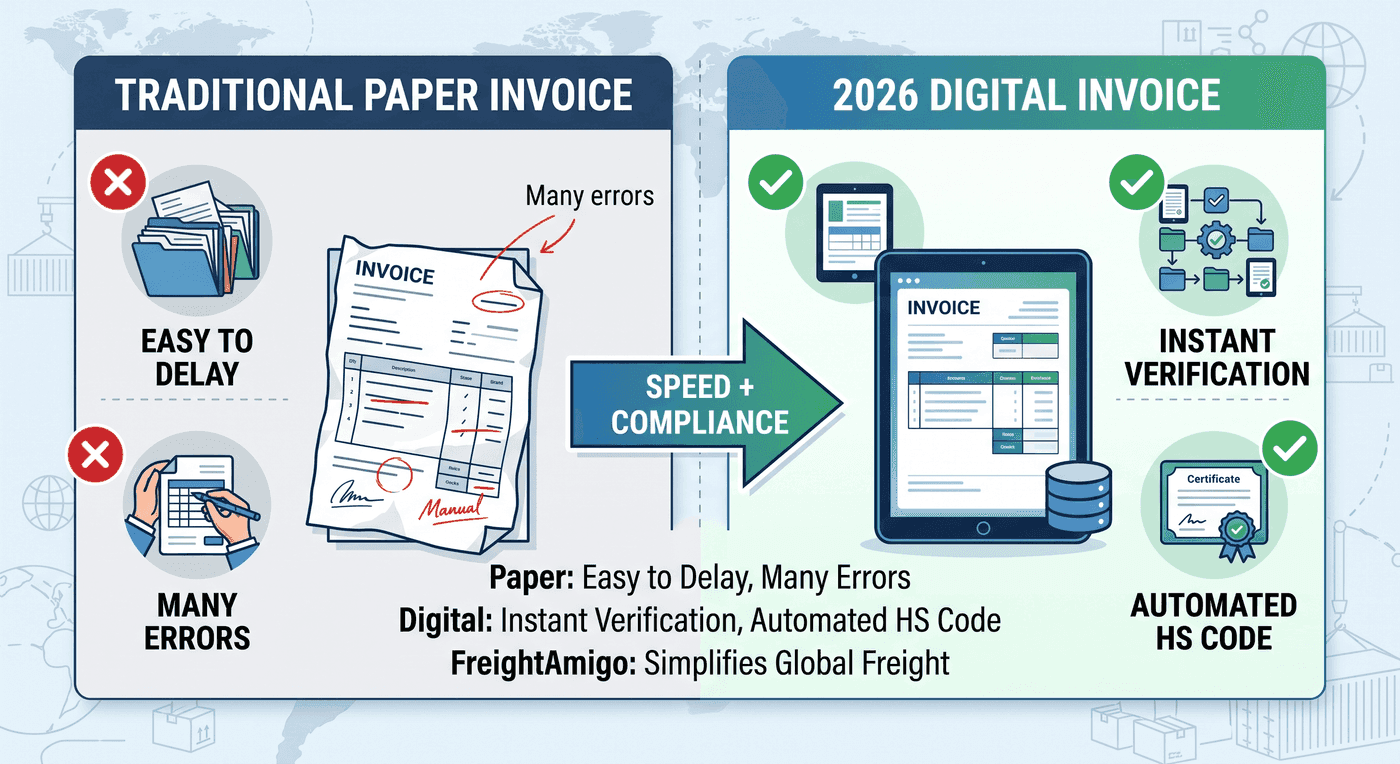
Adopting digital tools and standard templates can minimize commercial invoice errors. FreightAmigo can assist in automatically generating compliant documents, helping you with fast declarations and customs clearance.
List of 2026 best practices:
Utilize electronic signatures and PDF formats to accelerate processing.
Integrate HS Code databases to ensure accuracy.
Maintain a consistent invoice numbering system.
Include destination control statements when necessary.
Regularly update templates to align with the latest regulations.
Frequently Asked Questions
What is a commercial invoice used for in shipping?
A commercial invoice is used to collect payment from the buyer and to provide customs with cargo details for calculating duties and ensuring compliance. It is the core document for international commercial shipping.
How does a commercial invoice differ from a pro forma invoice?
A commercial invoice is the final document of an actual transaction used for payment and customs clearance, while a pro forma invoice is merely an estimated quotation. Actual shipments must use a commercial invoice.
What fields must a commercial invoice contain in 2026?
Mandatory fields include buyer and seller data, cargo descriptions along with HS Codes, value, quantity, Incoterms, and country of origin. Following the comprehensive elimination of tax exemptions in the US and Europe, accuracy is vital.
Do all international shipments require a commercial invoice?
Yes, almost all cross-border transport of commercial cargo requires one. Shipments containing purely documents with no commercial value are typically exceptions.
How can common errors on a commercial invoice be avoided?
Carefully verify values, use precise descriptions, include HS Codes, and reference the latest regulations. FreightAmigo tools can simplify this workflow.
What role does the HS Code play on a commercial invoice?
The HS Code is used for cargo classification, directly affecting duty rates and customs clearance speed. Providing an accurate code is mandatory in 2026.
Can a commercial invoice be submitted electronically in 2026?
Yes, most customs administrations accept digital versions with electronic signatures. This significantly accelerates processing timelines.
How does FreightAmigo assist with commercial invoices?
FreightAmigo provides expert support to ensure document compliance, enabling smooth customs clearance. Welcome to inquire about professional logistics solutions.
Conclusion
Ready to ship with confidence? Use FreightAmigo to enjoy real-time tracking, professional documentation support, and an optimized supply chain. Take action now to streamline your 2026 international logistics!
Learn more about HS code: 【Logistics 101 】What is HS Code? | FreightAmigo If you still have a question about ‘Commercial invoice’ when planning your shipment, you are welcome to contact FreightAmigo and our customer service specialists at any time.
For expert guidance, Book a Demo with FreightAmigo.
After searching for shipment quotations in FreightAmigo, select in , and you can compare the CO2e of each shipment solution immediately! Let’s Make Trade Greener.








 Global Popular RoutesTop sea & air shipping lanes
 Special OfferLimited-time shipping promotions





 Express
 Document
 Parcel - Air/Sea
 Container
 Relocation