Importer of Record (IOR) remains the cornerstone of legal import compliance worldwide. In 2026, evolving customs rules demand precise understanding of IOR meaning in shipping to avoid delays, penalties, and cargo holds. This guide delivers clear definitions, practical steps, and updated regulations so mobile users can act fast.
What Does IOR Stand For in Shipping in 2026?
IOR stands for Importer of Record, the legal entity fully accountable for imported goods. This party ensures every shipment meets destination-country laws before release into the local market. Without a valid IOR, customs authorities can detain cargo indefinitely.
The IOR meaning in shipping centers on three pillars of responsibility. First, accurate declaration of value, classification, and origin. Second, payment of all duties, taxes, and fees. Third, ongoing record-keeping for audits that often stretch five years or more.
Ensures legal entry of goods
Bears full liability for documentation errors
Manages tariff and tax payments
Maintains compliance history for risk scoring
Acts as the primary contact for customs inquiries
Modern supply chains increasingly rely on third-party IOR services when companies lack local registration. This flexibility supports e-commerce brands expanding into new markets without establishing a fiscal presence.
Understanding the IOR Number in Customs
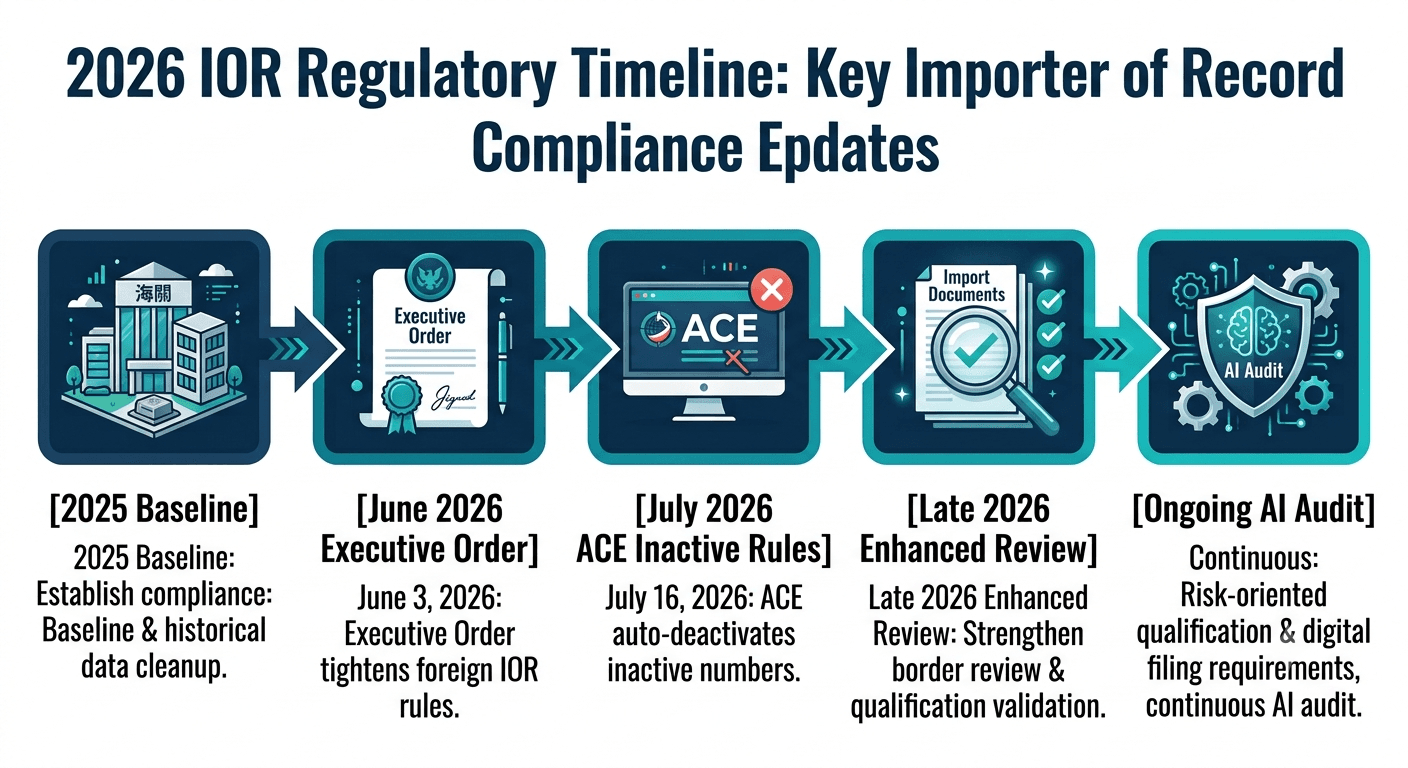
The IOR number is a unique customs identifier assigned to every registered Importer of Record. Authorities use it to track filings, assess risk, and enforce compliance across borders. In 2026, inactive numbers face automatic deactivation after 366 days of no entry activity in systems such as the U.S. ACE platform.
Obtaining and maintaining an active IOR number is non-negotiable for electronic entry filings. Most jurisdictions now require pre-arrival data linked to this number to accelerate clearance.
Country
IOR Number Format
Issuing Authority
USA
IRS Employer Identification Number (EIN) or Customs-assigned
U.S. Customs and Border Protection (CBP)
European Union
EORI Number
National Customs Services
China
Customs Registration Code
General Administration of Customs
Australia
Australian Business Number (ABN) linked to customs
Australian Border Force
United Kingdom
EORI Number (post-Brexit format)
HMRC
Register the number with local customs portals
Link it to electronic entry systems
Monitor activity to prevent inactivation
Renew or reactivate as required by jurisdiction
IOR vs EOR vs Consignee: Key Differences
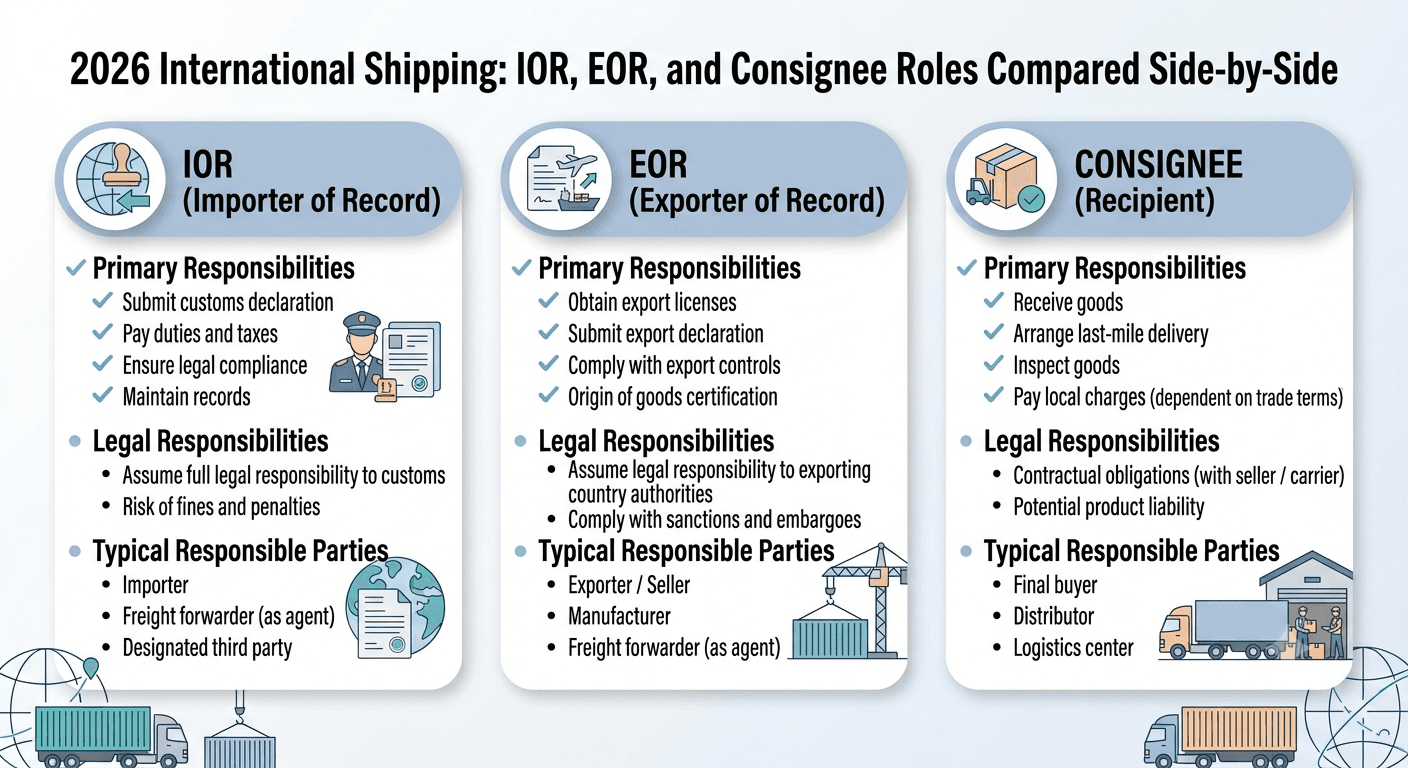
Many shippers confuse Importer of Record with Consignee or Exporter of Record, yet each role carries distinct legal weight. Clear separation prevents costly disputes and clearance failures. The table below highlights the critical contrasts for 2026 operations.
Role
Primary Function
Legal Liability
Typical Party
Importer of Record (IOR)
Customs clearance, duties, compliance
Full responsibility for taxes, classification, and penalties
Buyer, local entity, or third-party service
Exporter of Record (EOR)
Export documentation and origin compliance
Origin-country regulations and licenses
Seller or designated export agent
Consignee
Physical receipt of goods
Usually limited to delivery acceptance
End buyer or warehouse
IOR EOR services frequently operate as paired solutions. Companies gain end-to-end coverage when one provider handles both export formalities at origin and import formalities at destination. This dual approach reduces hand-off errors and shortens total transit-to-clearance time.
IOR focuses solely on inbound compliance
EOR manages outbound licenses and certificates
Consignee may or may not hold IOR status
Third-party providers can serve as IOR when local presence is missing
Core Responsibilities of an Importer of Record
An Importer of Record carries complete accountability for every aspect of customs entry. This includes classification under the correct Harmonized System code, valuation accuracy, and payment of all applicable charges. Failure triggers fines that can reach the full value of the shipment.
Key duties in 2026 include digital pre-arrival filings, Partner Government Agency coordination, and maintenance of records for potential audits. The IOR must also respond promptly to any customs inquiries or examinations.
Classify goods under accurate HS/HTS codes
Declare true transaction value and origin
Pay duties, VAT/GST, and other import taxes
Secure required permits and licenses
Maintain records for at least five years
Coordinate with licensed customs brokers
When brands ship direct-to-consumer or use delivered-duty-paid terms, the IOR role often shifts to a specialized service provider. This protects the brand from unexpected tax exposure and compliance risks in foreign markets.
Why IOR Matters for Global Trade Success in 2026
Proper IOR designation directly determines clearance speed, cost predictability, and legal safety. In an era of heightened enforcement, missing or inactive IOR status ranks among the top causes of port delays. Businesses that treat IOR as a strategic function rather than an afterthought gain measurable competitive advantages.
Strong IOR practices support e-commerce scalability and protect against penalty exposure. They also enable accurate landed-cost calculations that improve pricing and margin decisions.
Avoids cargo holds and demurrage charges
Prevents fines reaching 100 % of shipment value
Enables faster release through pre-arrival filings
Supports multi-country expansion without local entities
Builds positive compliance history for future risk scoring
How to Choose the Right IOR Provider
Selecting an IOR provider requires evaluation of registration breadth, technology capability, and proven trade-lane expertise. The ideal partner holds active importer status in your target markets and integrates seamlessly with your existing logistics systems. Cost should never outweigh reliability and regulatory knowledge.
Prioritize providers that offer real-time visibility and transparent fee structures. Ask for client references specific to your product categories and destination countries.
Strong data-security and GDPR or equivalent compliance
24/7 support for urgent customs queries
IOR Regulations and Compliance Updates for 2026
2026 introduced significant tightening of IOR eligibility and activity requirements across major markets. The United States now automatically marks IOR numbers inactive after 366 days without entry filings. An executive order further raised the bar for foreign-owned importers, emphasizing U.S. financial accountability and clean compliance histories.
European and Asian authorities continue expanding advance data mandates. Companies must verify active status before every shipment to prevent last-minute blocks.
U.S. ACE system deactivates dormant IOR numbers after 366 days
New eligibility standards for foreign-owned importers
Enhanced digital reporting under ICS2 and similar systems
Stricter cross-border e-commerce IOR rules in China
Increased AI-driven audits of classification and valuation
Steps to Obtain an IOR Number
Securing an IOR number begins with gathering corporate and tax documentation and submitting an application through the destination country’s customs portal. Processing times range from several days to four weeks depending on jurisdiction and completeness of the file. Annual or activity-based renewals keep the number active.
Many companies accelerate the process by partnering with licensed providers that already hold valid numbers. This route is especially valuable for market-entry projects with tight timelines.
Collect incorporation documents, tax ID, and proof of address
Complete the online application on the official customs portal
Undergo identity and business verification
Receive the official IOR number
Activate and monitor the number for ongoing activity
Frequently Asked Questions
What does IOR stand for in shipping?
IOR stands for Importer of Record, the party legally responsible for ensuring imported goods comply with all customs regulations, paying duties and taxes, and filing accurate entry documentation in the destination country.
What is an IOR number in customs?
An IOR number is the unique identifier issued by customs authorities to a registered Importer of Record. It is required for electronic entry filings and tracks the importer’s compliance history across shipments.
Who can act as the Importer of Record?
Any legally registered entity permitted to import into the destination country can serve as IOR. This includes the buyer, a local subsidiary, or a licensed third-party IOR service provider with proper authorization.
Do I need a separate IOR for every country?
Yes. Each destination country requires its own IOR registration or number. Using a multi-country IOR service provider simplifies management across multiple markets without establishing local entities everywhere.
What happens if my IOR number becomes inactive?
In the United States, numbers inactive for 366 days are automatically deactivated in ACE and cannot be used for new entries until reactivated. This can cause immediate shipment delays until the status is restored.
Can a freight forwarder or customs broker be the IOR?
A licensed customs broker usually acts only as an agent. True IOR status requires formal authorization and acceptance of full legal and financial liability, which most brokers avoid unless specifically contracted as a third-party IOR.
How does IOR differ from the consignee?
The consignee is the party that physically receives the goods. The IOR is the party that bears legal responsibility for customs compliance and payment of duties. These roles can be the same or different entities.
Why is IOR especially important for e-commerce brands in 2026?
E-commerce brands often ship directly to consumers across borders. Designating a reliable IOR prevents unexpected tax bills for customers, reduces clearance delays, and protects the brand from compliance penalties under tightening 2026 rules.
Conclusion: Master IOR for Seamless 2026 Imports
Understanding IOR meaning in shipping equips your business to navigate 2026 customs landscapes with confidence. Correct designation, active numbers, and expert partners transform potential bottlenecks into predictable, efficient processes. FreightAmigo specialists stand ready to support your next import strategy.
For expert guidance, Book a Demo with FreightAmigo.


























 Global Popular RoutesTop sea & air shipping lanes
 Special OfferLimited-time shipping promotions





 Express
 Document
 Parcel - Air/Sea
 Container
 Relocation