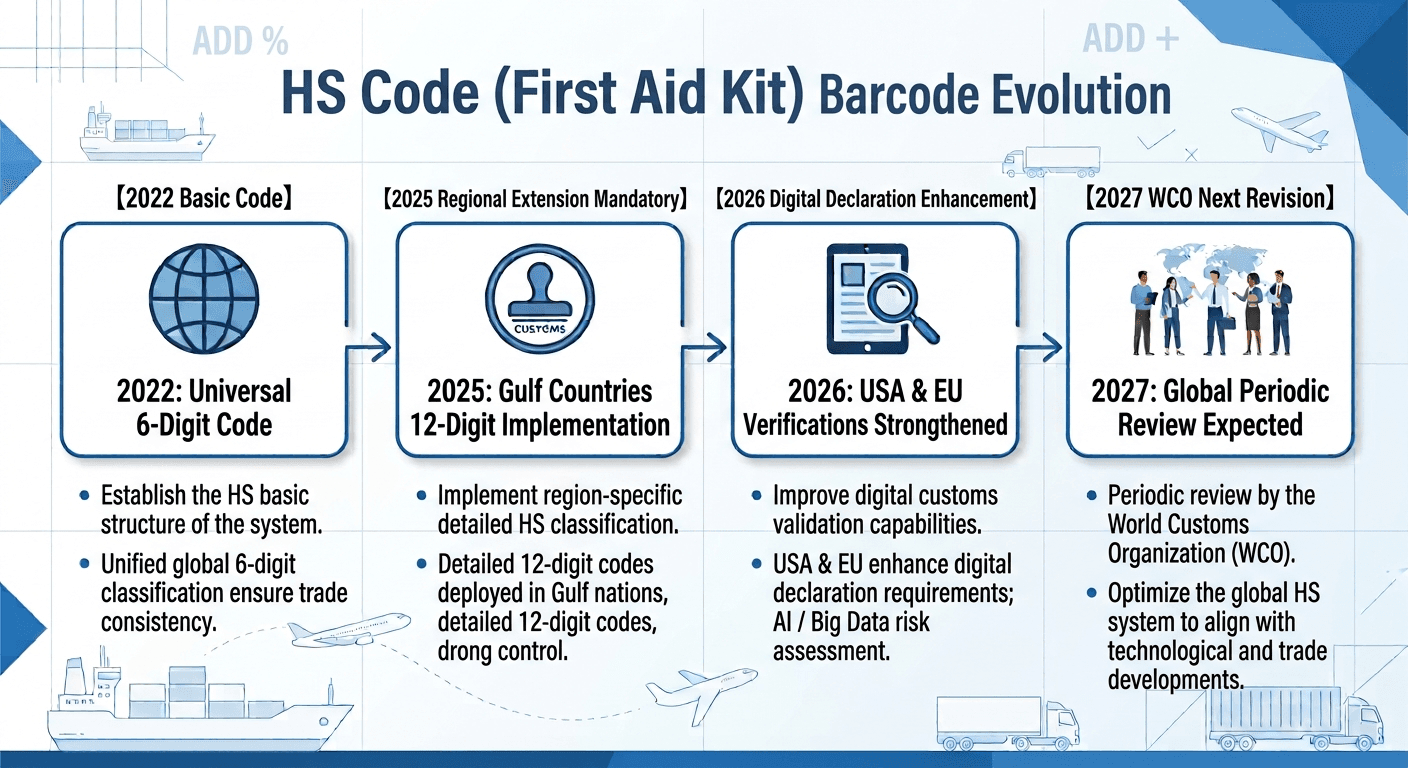
HS Code for First Aid Kits 2026: Complete Global Compliance & Shipping Guide Table of Contents (Click to expand) What Is an HS Code in 2026? The Harmonized System (HS) Code is the universal product classification standard managed by the World Customs Organization for international trade.
It covers more than 5,000 commodity groups and is used by over 200 countries.
Major revisions occur every five years, with 2026 focusing on stronger regional refinements and digital declaration requirements.
Accurate HS codes ensure correct duty calculation and significantly reduce customs clearance delays.
Managed by the World Customs Organization (WCO) 6-digit base code is globally standardized Countries may extend to 8–12 digits 2026 prioritizes digital verification and risk assessment Primary HS Code for First Aid Kits: 3006.50 First aid kits and first aid boxes are classified under HS 3006.50 within Chapter 30 (Pharmaceutical products).
This code specifically covers “first-aid boxes and kits,” regardless of whether they contain pharmaceutical items.
Destination countries may require additional national extension digits.
Correct classification prevents reclassification as general medical supplies or tools.
HS Level Description 2026 Focus 3006 Pharmaceutical products Global base code remains stable 3006.50 First-aid boxes and kits Most regions require detailed content declaration Regional extension 10–12 digit codes US HTS, GCC 12-digit, EU CN
Key HS Code Changes for First Aid Kits in 2026 The 6-digit base code stays unchanged in 2026, but many countries have strengthened extension-code and declaration rules.
The United States continues mandatory use of 10-digit HTS codes.
Gulf Cooperation Council countries fully enforce 12-digit codes.
The European Union’s Combined Nomenclature further clarifies pharmaceutical versus electronic components.
The global trend is greater transparency and digital customs filings.
United States: 10-digit HTS codes are now standard GCC countries: 12-digit codes fully applied European Union: CN codes refined for pharmaceutical content China: Increased content-detail declaration requirements Regional HS Code Variations for First Aid Kits in 2026 Different regions apply distinct extension rules on top of the base 3006.50 code, affecting duties and clearance speed.
The United States requires a full 10-digit HTS code.
GCC countries demand 12-digit codes with component-level detail.
The EU uses 8–10 digit CN codes and scrutinizes electronic elements.
China maintains a 10-digit code but increases content transparency requirements.
Region 2026 HS Code Example Key Requirement United States 3006.50.XXXX (10-digit HTS) Full code + detailed contents mandatory Gulf Cooperation Council 3006.50.XX.XX (12-digit) Component-level breakdown required European Union 3006 50 00 00 CN refinement + electronic component checks China 3006500000 Enhanced pharmaceutical and battery declaration
How to Find the Correct HS Code for First Aid Kits in 2026 Follow these steps to lock in the accurate code and minimize error risk.
First examine the actual contents of the first aid kit to confirm Chapter 30 eligibility.
Then apply the base code 3006.50 and add the destination country’s extension digits.
Always cross-check with official tools for final validation.
Review contents: bandages, antiseptics, gloves, scissors, batteries, etc. Confirm eligibility under WCO Chapter 30 pharmaceutical product rules Assign base code 3006.50 Add country-specific digits (e.g., US 10-digit, GCC 12-digit) Validate using the WCO HS database or national customs websites Common First Aid Kit Contents and Their HS Codes If the first aid kit is not shipped as a complete set, individual components may require separate classification.
Complete kits take priority under 3006.50.
When shipped separately, classify by primary function.
Batteries and metal tools are the items most frequently misclassified.
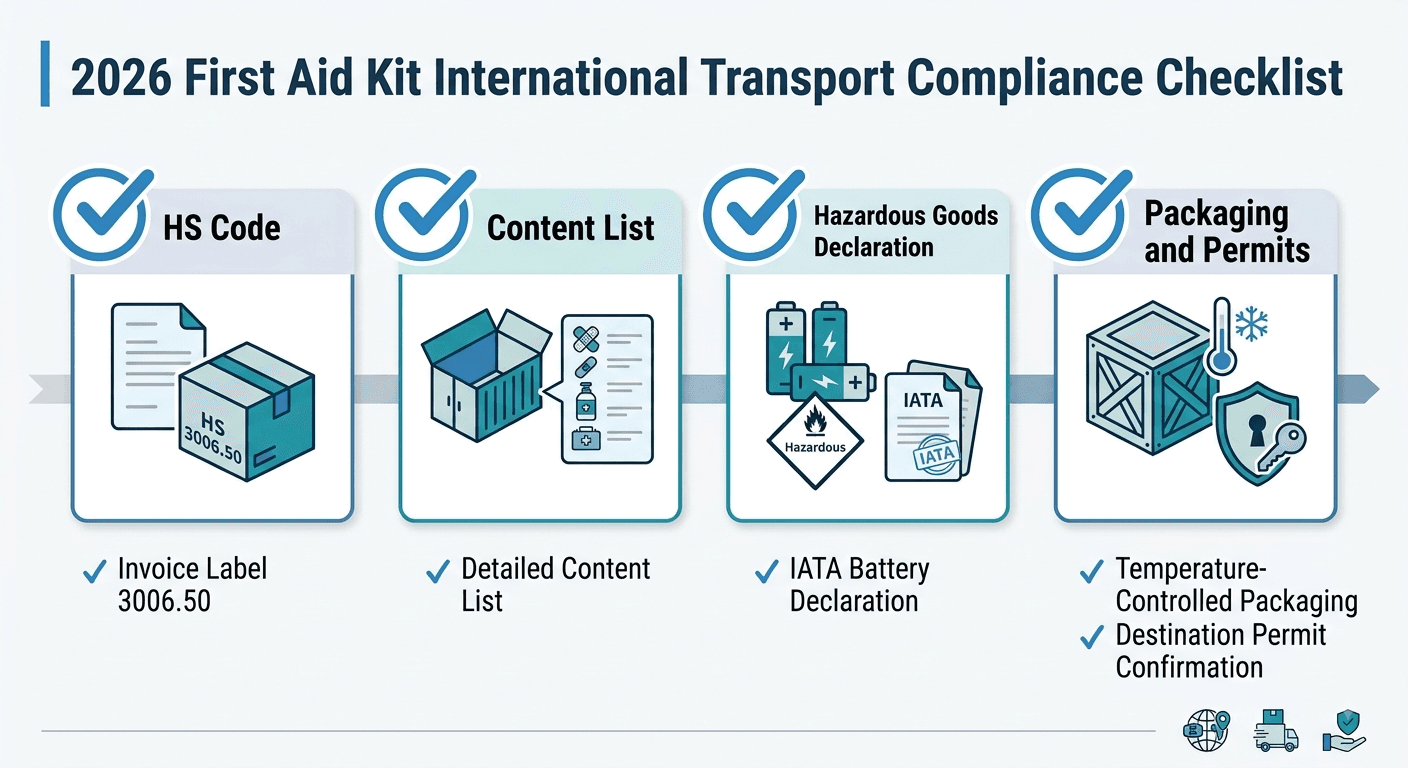
Bandages and dressings: 3005.10 Antiseptics and medicaments: 3003.90 or 3004 Scissors and metal tools: 8213.00 Lithium batteries: 8507.60 Latex or nitrile gloves: 4015.11 International Shipping Checklist for First Aid Kits 2026 A complete checklist helps ensure smooth clearance in 2026 and avoids holds or penalties.
The commercial invoice must clearly display HS 3006.50.
Content lists should detail quantities and materials.
Dangerous goods and temperature-control rules must not be overlooked.
Clearly state HS 3006.50 on the commercial invoice List all contents with quantities Comply with IATA dangerous goods rules (especially batteries) Use appropriate packaging for temperature-sensitive items Confirm whether the destination requires an import permit Pre-verify regional extension codes Common HS Code Mistakes with First Aid Kits Avoiding these frequent errors greatly reduces the chance of customs issues in 2026.
Outdated codes and missing extension digits remain the top causes of problems.
Incomplete battery or pharmaceutical content declarations also trigger delays.
Re-check the latest destination rules before every shipment.
Using outdated 2022 or earlier codes Omitting US 10-digit or GCC 12-digit requirements Failing to declare batteries separately (8507.60) Vague content descriptions Not checking de minimis thresholds or special permits 2026 Case Study: Successful First Aid Kit Shipments Correct classification directly translates into lower duties and zero delays.
In early 2026, a U.S. exporter shipped 800 first aid kits to Saudi Arabia.
By using the full 12-digit GCC code and providing detailed content lists, clearance time was reduced by 40%.
The shipment also saved approximately 4–6% in duties compared with a generic classification.
The result confirms that accurate HS codes not only ensure compliance but also improve overall supply-chain efficiency.
Frequently Asked Questions: First Aid Kit HS Code 2026 What is the HS Code for first aid kits? In 2026 the global base code remains 3006.50, covering first-aid boxes and kits. Individual countries may add 8–12 digit extensions.
Have first aid kit HS Codes changed in 2026? The 6-digit base code 3006.50 is unchanged. The main updates are stronger enforcement of extension codes in the US, GCC, and EU.
What HS Code should be used for first aid kits containing batteries? Complete kits use 3006.50. Batteries declared separately fall under 8507.60 and must follow dangerous-goods rules.
What is the 2026 US HS Code for first aid kits? A full 10-digit HTS code in the format 3006.50.XXXX is required. It should be clearly stated on the commercial invoice.
How is the EU HS Code for first aid kits written? Under the Combined Nomenclature it is typically 3006 50 00 00. Additional notes are needed if electronic components are present.
What are the 2026 GCC requirements for first aid kit codes? 12-digit codes have been mandatory since 2025 and remain fully enforced in 2026. Major components must be broken down in detail.
How should customized first aid kits be classified? Classify according to primary function and contents, prioritizing 3006.50. Then add the destination country’s extension digits.
Does the HS Code affect duties on first aid kits? Yes. Accurate use of 3006.50 ensures the correct duty rate is applied and prevents costly reclassification.
Where can I verify the HS Code for first aid kits? Use the official World Customs Organization HS database, national customs websites, or professional logistics platforms .
Conclusion & Next Steps Mastering the 2026 first aid kit HS Code 3006.50 and its regional variations is essential for duty compliance and smooth international shipping.
From accurate classification and detailed declarations to dangerous-goods handling, every step reduces risk and improves efficiency.
Review your shipping documents now and update them to the latest regional requirements.
Need end-to-end logistics and customs support? FreightAmigo is ready to assist.For expert guidance, Book a Demo with FreightAmigo.
HKG Business +852 24671689 / +852 23194879 , Personal +852 28121686 / +852 23194878 ︳ CHN +86 4008751689 ︳ USA +1 337 361 2833 ︳ GBR +44 808 189 0136 ︳ AUS +61 180002752 ︳ Email: enquiry@freightamigo.com
FAQ What is an HS code in 2026? The HS code is the universal product classification standard for international trade. It is managed by the World Customs Organization and covers more than 5,000 commodity groups used by over 200 countries.
What is the primary HS code for first aid kits? First aid kits are classified under HS 3006.50. This code covers first-aid boxes and kits within Chapter 30 regardless of pharmaceutical contents.
What key HS code changes apply to first aid kits in 2026? The 6-digit base code remains unchanged while extension rules strengthen. The US requires 10-digit codes, GCC countries enforce 12-digit codes, and the EU refines CN codes for pharmaceutical and electronic components.
What are the regional HS code variations for first aid kits? Regions apply distinct extension rules on the base 3006.50 code. The US uses 10-digit HTS, GCC requires 12-digit codes with component detail, the EU uses 8-10 digit CN codes, and China maintains 10-digit codes with added transparency.
How can the correct HS code for first aid kits be found? Review contents first then apply the base code with country extensions. Confirm eligibility under Chapter 30, assign 3006.50, add destination digits, and validate via official customs tools.
What HS codes apply to common first aid kit contents? Complete kits use 3006.50 while separate items follow individual codes. Bandages fall under 3005.10, antiseptics under 3003.90 or 3004, scissors under 8213.00, and lithium batteries under 8507.60.
What checklist should be followed for international shipping of first aid kits? Display HS 3006.50 on the commercial invoice and list all contents. Comply with dangerous goods rules for batteries, use suitable packaging, and confirm any import permits or regional extension codes.
What common HS code mistakes occur with first aid kits? Outdated codes and missing extension digits cause most issues. Additional errors include failing to declare batteries separately and providing vague content descriptions.


























 Global Popular RoutesTop sea & air shipping lanes
 Special OfferLimited-time shipping promotions





 Express
 Document
 Parcel - Air/Sea
 Container
 Relocation