Guide to Proposed US Tariffs and Trade Policy
New US Tariffs Announced for 2027 and Their Timeline
The global trade landscape is bracing for major shifts as the United States prepares to implement a comprehensive new tariff regime in 2027. On November 25, 2026, the Office of the US Trade Representative (USTR) announced affirmative determinations in 14 investigations initiated under Section 301 of the Trade Act of 1974 (BBC News). These investigations address allegations of structural excess capacity and manufacturing overproduction across several key trading partners. The proposed measures target 14 economies that form the backbone of global supply chains: Bangladesh, Cambodia, China, the European Union, India, Indonesia, Japan, South Korea, Malaysia, Singapore, Switzerland, Taiwan, Thailand, and Vietnam.
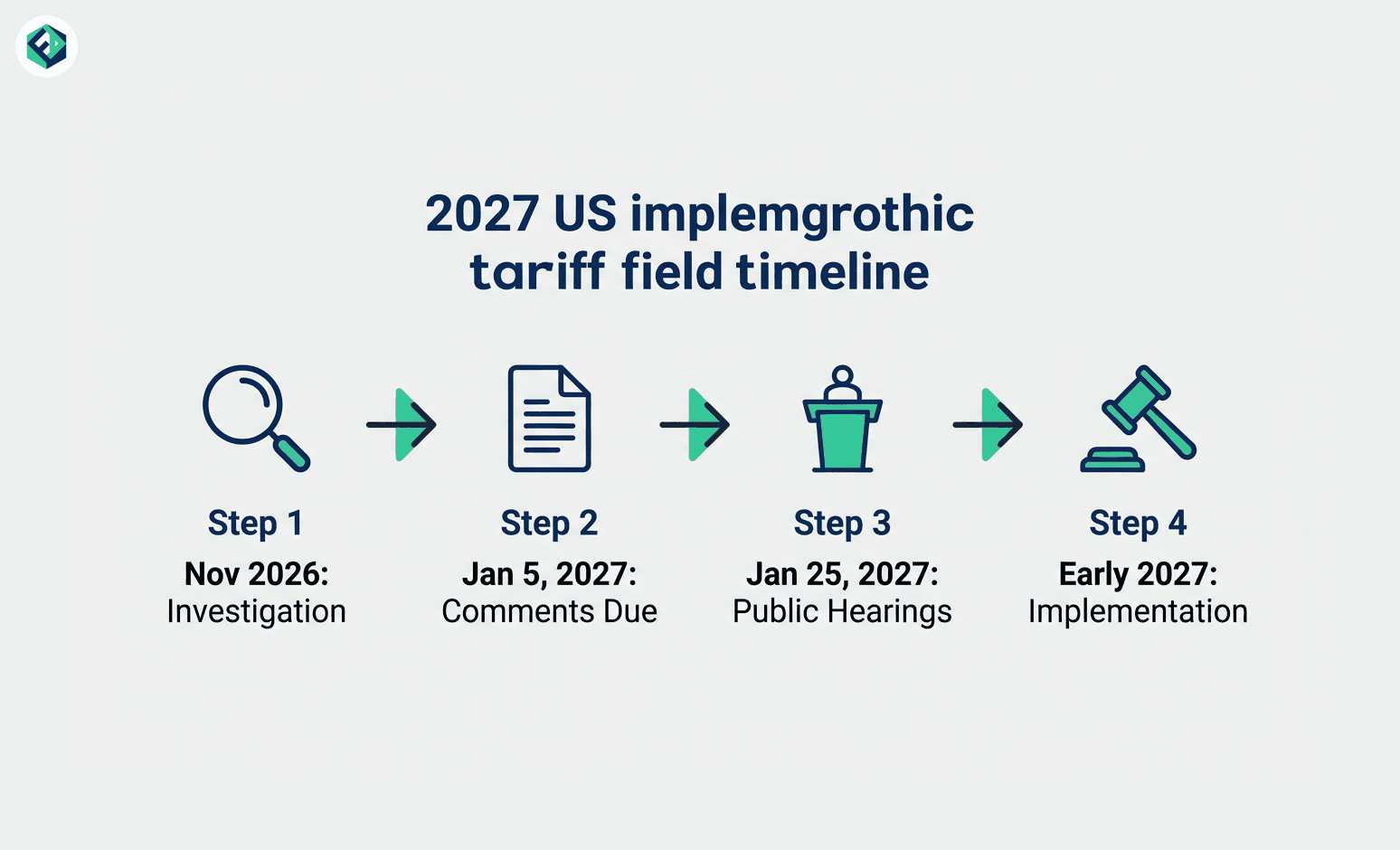
Understanding the regulatory timeline is critical for proactive supply chain planning. Written comments from industry stakeholders are due by January 5, 2027. Following this, the USTR will host public hearings beginning on January 25, 2027, allowing businesses to present evidence and request specific product exclusions. Final implementation is expected in early 2027, once the consultation period concludes, giving enterprises a narrow window to assess exposure and submit formal feedback.
The key regulatory milestones are outlined below:
- November 25, 2026: USTR issues affirmative determinations in 14 Section 301 investigations regarding manufacturing overcapacity.
- January 5, 2027: Deadline for businesses to submit written public comments on proposed tariff rates.
- January 10, 2027: Scheduled expiration of the current US-China trade truce, adding immediate pressure to negotiations.
- January 25, 2027: Public hearings commence, allowing stakeholders to testify on proposed Section 301 measures.
- Early 2027: Anticipated formal implementation of finalized Section 301 tariff rates for targeted jurisdictions.
Analyzing the Impact of Tariffs on China Imports
Among the 14 targeted jurisdictions, China faces some of the most severe proposed trade measures. The USTR has proposed an additional 20 percent tariff on Chinese goods, which would be stacked on top of existing Section 301 duties (BBC News). If ongoing trade talks between Washington and Beijing fail, this additional duty could escalate, pushing the total tariff rate on Chinese imports up to 40 percent. This potential escalation threatens to disrupt established manufacturing and assembly operations that rely on Chinese components.
A critical factor in this timeline is the impending expiration of the bilateral US-China trade truce on January 10, 2027. This truce, extended in early November 2026, has temporarily stabilized trade relations by maintaining a reduced 10 percent fentanyl-related tariff on Chinese imports, suspending certain Section 301 maritime and port fees, and extending 178 critical product exclusions through January 9, 2027. The expiration of this agreement without a successor deal would immediately expose importers to higher costs and terminate these essential exclusions. Supply chain managers must prepare for the realistic possibility that the trade truce will lapse, triggering both the new proposed 20 percent tariff and the reinstatement of previous duties.
European Union Trade Policy and Responses Under Trump
The proposed tariffs have also cast a long shadow over transatlantic trade, with the European Union identified as one of the 14 targeted jurisdictions. The USTR has proposed a 15 percent tariff on EU goods, net of Most Favoured Nation (MFN) rates and existing Section 301 duties (BBC News). This proposal is based on allegations of structural excess capacity in European manufacturing. However, the USTR has indicated that this rate could escalate to 20 percent if bilateral trade talks fail. The European Commission has strongly rejected the premise of the US investigation, arguing that Europe is not a source of overcapacity but is highly exposed to Chinese overproduction.
In responding to these unilateral measures, European trade officials have pointed to existing bilateral agreements to limit the damage. Under the EU-US Joint Statement, also known as the Turnberry Agreement signed in August 2025, an all-inclusive tariff ceiling of 15 percent applies to all European products, and the EU expects any new measures to respect this limit. The standoff highlights a growing divergence in how both regions address global manufacturing overcapacity.
The following table compares the proposed tariff structures for these two major trading partners:
| Jurisdiction | Proposed Additional Tariff | Maximum Potential Rate | Governing Framework / Truce Status | Primary Regulatory Basis |
|---|
| China | 20 percent | Up to 40 percent (total stacked rate) | Bilateral trade truce expiring January 10, 2027 | Allegations of persistent overcapacity and trade imbalances |
| European Union | 15 percent | Up to 20 percent (if negotiations fail) | Turnberry Agreement (August 2025) 15 percent ceiling | Allegations of structural excess capacity in manufacturing |
How the Proposed Import Tax Affects American Businesses
The introduction of these proposed import taxes will have widespread financial consequences for American businesses and consumers alike (BBC News). Importers of record will bear the direct financial burden of rising duties, which must be paid upon customs entry. For many firms, these sudden cost increases cannot be absorbed entirely, meaning that a significant portion of the tariff burden will likely be passed down the supply chain, ultimately affecting consumer prices and contributing to inflationary pressures on everyday goods and building materials.
Despite the broad scope of the proposed Section 301 tariffs, the draft notices published by the USTR do contain several key exemptions designed to protect critical sectors. For the European Union, draft exemptions cover patented medicines, semiconductors, and goods already subject to Section 232 duties, such as steel, aluminum, and automobiles. This ensures that industries relying on these highly specialized inputs are not double-taxed. Furthermore, bilateral trade agreements signed in early 2026, such as the accord with Taiwan, secure preferential treatment for high-tech items. Semiconductors, which account for over 70 percent of Taiwan's total exports, are largely shielded from these new measures, protecting the US technology sector from severe disruption.
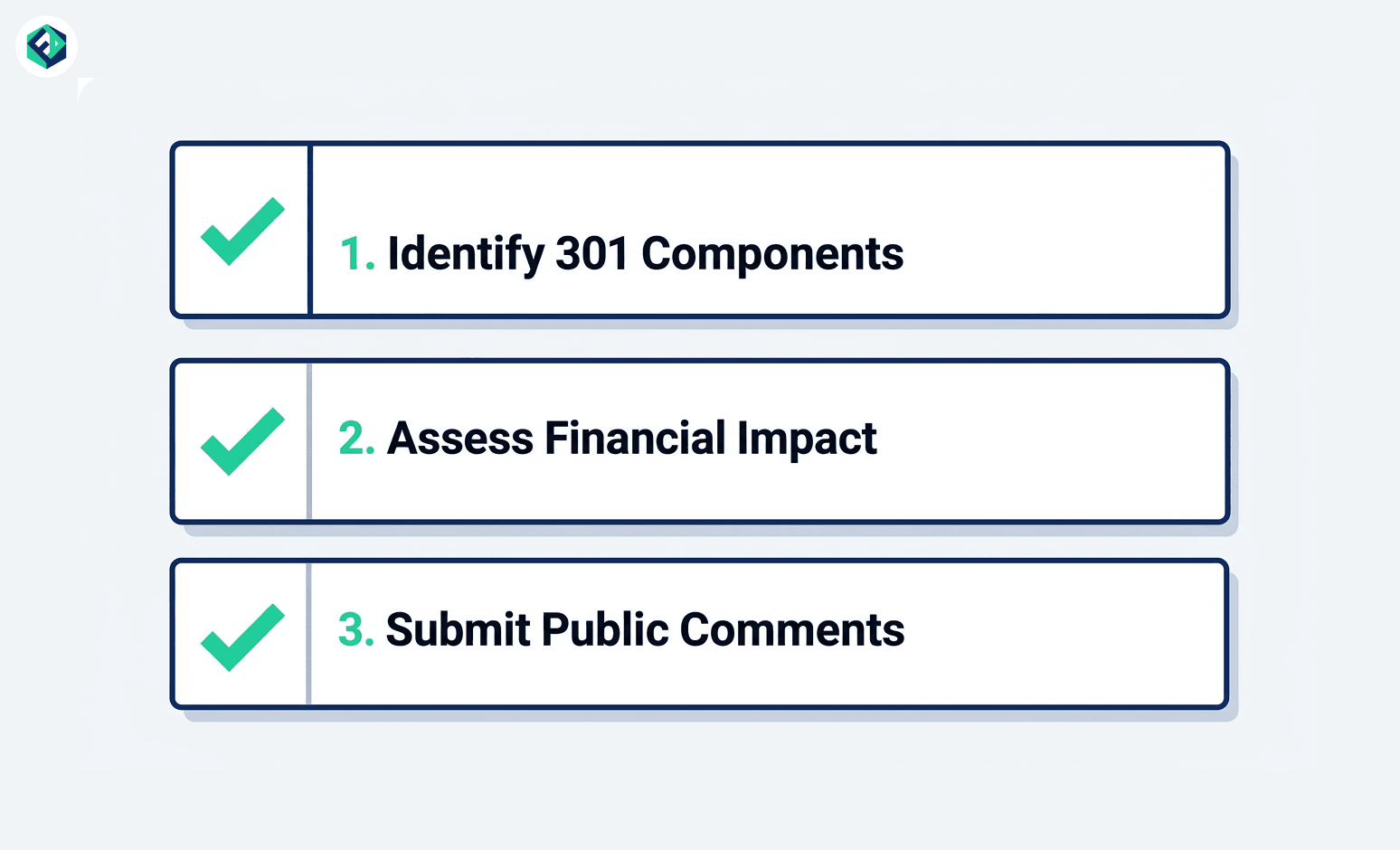
To mitigate the impact of these rising import taxes, American businesses should focus on several key areas:
- Identify which imported components fall under the proposed Section 301 lists and verify if they qualify for draft exemptions, such as patented medicines or specific high-tech components.
- Assess the financial impact of the expiring product exclusions on January 9, 2027, particularly for businesses importing from China.
- Collaborate with legal and logistics experts to submit formal comments or request specific product exclusions during the public hearing phase in January 2027.
Understanding the Supreme Court Tariff Rulings and Legal Limits
The shift toward Section 301 investigations as the primary mechanism for implementing these tariffs is a direct consequence of recent judicial constraints placed on executive power. On February 20, 2026, the US Supreme Court issued a landmark 6-3 decision in Learning Resources Inc. v. Trump (BBC News). The Court ruled that the International Emergency Economic Powers Act (IEEPA) does not grant the president unilateral authority to impose broad-based import tariffs under the guise of an economic emergency. This ruling officially struck down the administration's controversial April 2025 'Liberation Day' tariffs as illegal, declaring that the executive branch had exceeded its statutory authority.
This major legal defeat forced a fundamental reorganization of the administration's trade policy. Deprived of the ability to use emergency executive orders for tariff implementation, the administration pivoted to Section 301 of the Trade Act of 1974. Unlike the emergency powers of the IEEPA, Section 301 provides a robust, legally established framework that mandates formal investigations, extensive fact-finding, and mandatory public comment and hearing periods. By initiating the 14 investigations in March 2026 and releasing the affirmative determinations in November 2026, the administration is seeking to establish a legally defensible foundation for the 2027 tariffs, ensuring they can withstand future court challenges while still achieving its trade objectives.
Alternative Trade Plans and US Customs Compliance
As the early 2027 implementation deadline approaches, global businesses must actively develop alternative trade plans to minimize tariff exposure while maintaining strict US customs compliance. Sourcing diversification is a primary strategy, where companies shift production, assembly, or raw material procurement to countries not targeted by the new Section 301 investigations. However, because the 14 targeted economies include major manufacturing hubs across Asia and Europe, businesses must conduct thorough cost-benefit analyses before relocating operations, taking into account labor availability, infrastructure quality, and transit times.
In addition to physical supply chain changes, companies must adapt their customs clearance and entry procedures to navigate the new regulatory framework. Ensuring US customs compliance requires precise Harmonized Tariff Schedule (HTS) classification, as minor classification errors can lead to severe penalties or the accidental application of higher tariff rates. Importers should also explore legal duty-saving mechanisms, such as the First Sale Rule for multi-tiered transactions, duty drawback programs for re-exported goods, or utilizing bonded warehouses and Foreign Trade Zones (FTZs) to defer duty payments.
Navigating these complex trade regulations and shifting tariffs requires a highly agile logistics strategy that prioritizes regulatory compliance. FreightAmigo provides the digital infrastructure and expertise necessary to simplify these compliance challenges and streamline your international trade operations. Our platform integrates comprehensive trade-compliance tools and digital documentation support to minimize manual errors, helping your business maintain seamless operations across changing borders. To secure your supply chain against upcoming tariff adjustments, we invite you to consult our experts and manage your next shipment with our dedicated Customs Clearance solutions.
FAQ
What is the implementation timeline and global trade impact of the new US tariffs proposed for 2027?
The new tariffs are expected to take effect in early 2027 following a public consultation period. The USTR has scheduled public comment deadlines for January 5, 2027, and hearings starting January 25, 2027, targeting 14 major global trading partners.
What are the long-term financial consequences of the new China import tariffs on global supply chains?
They will likely increase manufacturing costs and disrupt established supply chains. The US has proposed an additional 20 percent tariff on Chinese goods, which could rise to 40 percent if negotiations fail after the trade truce expires on January 10, 2027.
How will the European Union trade policy respond to the newly proposed American tariffs?
The European Union rejects the overcapacity allegations and expects the US to respect existing tariff agreements. European trade officials point to the Turnberry Agreement, which sets an all-inclusive 15 percent tariff ceiling, to limit potential damages from the proposed US duties.
What are the best import tax cost mitigation strategies for American businesses facing rising duties?
Businesses should seek product exemptions and analyze the impact of expiring trade truces. Firms can review draft exemptions for high-tech items and pharmaceuticals, and collaborate with experts to submit formal requests during the public hearing phase.
How do the recent Supreme Court tariff rulings define the legal limits of presidential authority over trade policy?
The Supreme Court ruled that the president cannot use emergency economic powers to unilaterally impose broad tariffs. In February 2026, the Court struck down the 2025 Liberation Day tariffs, forcing the administration to transition to structured Section 301 investigations instead.
What alternative trade plans and customs clearance procedures can businesses adopt to maintain compliance?
Companies can diversify their sourcing and utilize legal duty-saving mechanisms. Strategies include shifting production to non-targeted countries, ensuring precise HTS classification, and leveraging programs like Foreign Trade Zones or the First Sale Rule.


























 Global Popular RoutesTop sea & air shipping lanes
 Special OfferLimited-time shipping promotions





 Express
 Document
 Parcel - Air/Sea
 Container
 Relocation