International Trade: Pak-India Route Shifts
Analyzing the Pakistan India Bilateral Trade Figures and Volumes
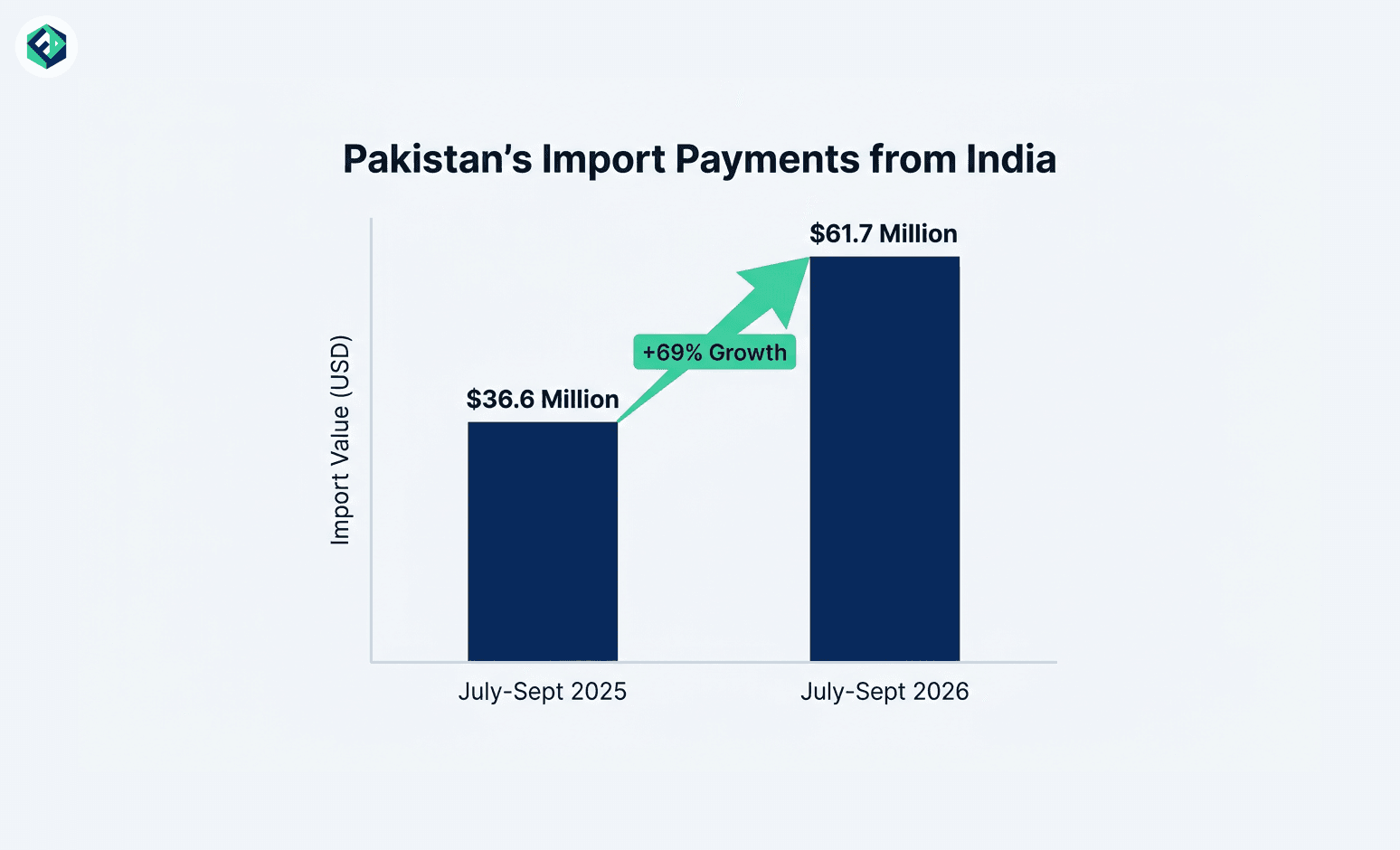
Bilateral trade volume between Pakistan and India continues to present a complex picture of economic interdependence operating beneath a surface of political friction. According to official State Bank of Pakistan data, Pakistan's payments for imports from India reached $61.7 million (specifically $61.74 million) between July and September 2026. This represents a significant 69% increase compared to the $36.6 million (or $36.55 million) recorded during the exact same period in 2025. This sharp rise highlights how quickly trade can recover after severe disruptions, such as the downturn following the April 2025 Pahalgam conflict. During that period, monthly SBP trade records showed import payments plummeting from $20 million in April 2025 down to $9.2 million in June and $8.2 million in July 2025, before starting to recover to $19.6 million by September 2025 (Al Jazeera, 2026).
Looking at the broader timeline, Pakistani bank payments for Indian imports over the full 2025-2026 fiscal year totaled $203.8 million, which was 7.6% lower than the previous fiscal year due to the immediate aftermath of the Pahalgam escalation. However, the monthly averages have now returned to near pre-conflict baselines. In the twelve months prior to the conflict, the monthly average stood at $19.3 million, whereas the average over the thirteen months starting September 2025 reached $19.1 million. While Pakistan imports from India have rebounded, the flow of goods is strictly one-way; Pakistan recorded zero exports to India during the July–September 2026 quarter. Interestingly, there is a minor discrepancy between payment-based and commodity-based data: while State Bank of Pakistan data records imports at $61.7 million, commodity-based government customs data values the trade at $62.6 million. This variance of nearly one million dollars typically arises from the lag between physical customs clearance at the port and the final processing of bank payments through financial institutions.
| Metric | July - September 2025 | July - September 2026 | Year-over-Year Change (%) |
|---|
| SBP Import Payments | $36.6 million | $61.7 million | +69% |
| Customs-Based Commodity Value | Not Disclosed | $62.6 million | N/A |
| Pakistani Exports to India | $0.0 million | $0.0 million | 0% |
Evaluating Key Pharmaceutical Products Imported From India
The primary driver behind these persistent trade volumes is the critical role of pharmaceutical logistics. The Pakistani healthcare market remains deeply reliant on active pharmaceutical ingredients and finished medical formulations manufactured across the border. Local pharmaceutical logistics operators must maintain a steady inflow of active pharmaceutical ingredients sourced from India to prevent nationwide shortages of life-saving medicines. Many local manufacturers find themselves with limited alternatives for these raw materials, as India remains one of the world's largest and most cost-effective producers of active pharmaceutical ingredients.
Sourcing these critical inputs requires specialized medicine logistics to preserve product integrity throughout a complex transit path. When raw pharmaceutical materials are delayed, local drug production lines can grind to a halt, risking public health crises. This high level of dependence means that even during periods of intense diplomatic strain, the trade of essential healthcare ingredients must find a way to persist. Consequently, the pharma supply chain operates under special regulatory considerations, shielding it from the absolute trade bans that apply to other commercial sectors. For instance, raw materials for essential antibiotics, pain relievers, and life-saving chronic disease therapies continue to flow because domestic alternative sources cannot scale up quickly enough to meet local healthcare demands. This reliance is not merely a matter of convenience; the cost of importing raw materials from alternative European or North American markets would make finished medicines unaffordable for a vast majority of the Pakistani population. Consequently, maintaining a resilient pharmaceutical supply chain is a matter of national security and public health.
How Third Country Routing Trade Logistics Facilitate Indirect Shipments
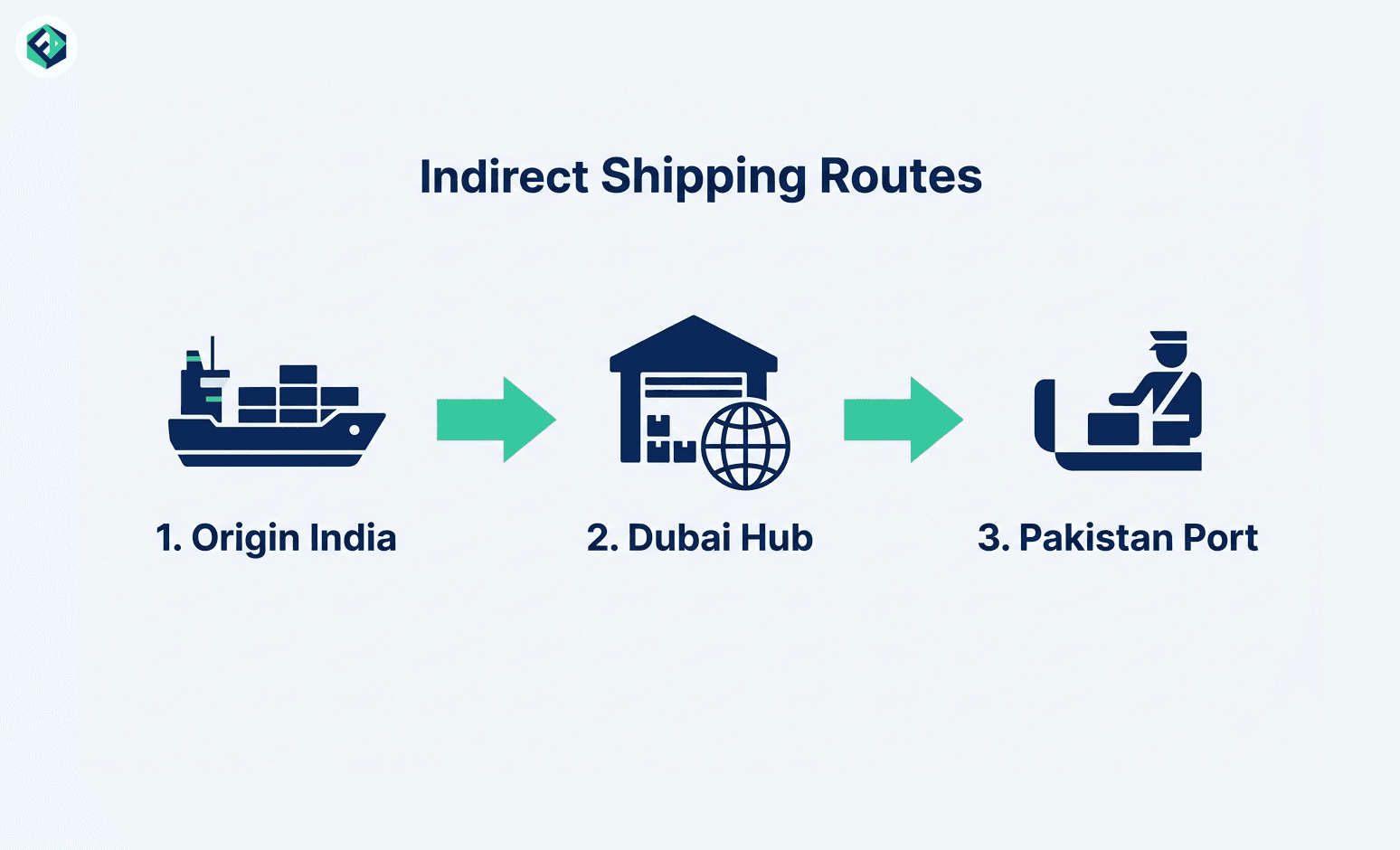
To navigate direct trade bans, businesses rely heavily on third-country routing trade logistics. Instead of direct shipping routes, Indian goods shipped through dubai to pakistan utilize intermediate hubs to bypass political blockades. Under indirect trade routing, cargo is first shipped from India to a transshipment hub, with Dubai serving as the primary gateway due to its advanced maritime infrastructure and flexible free zone regulations. Once the goods arrive in Dubai, they undergo a process of re-documentation and repackaging. This effectively hides the direct origin-destination link from standard shipping manifests, allowing the goods to be legally imported into Pakistan.
This indirect trade routing introduces significant logistical steps:
- Origin Shipping: Consignments originate from Indian ports under local export documentation.
- Intermediary Transshipment: Cargo arrives at a neutral hub, primarily Dubai, for repackaging and re-documentation.
- Destination Clearance: Ships carry the re-routed goods to Pakistani ports like Karachi, where local customs clearance procedures are executed.
While this third-country routing ensures the continuity of supply, it significantly extends transit times and adds layers of administrative complexity to the customs clearance process. Importers must coordinate with international freight forwarders who possess deep expertise in multi-jurisdictional compliance to avoid costly delays at intermediary ports.
Understanding the Broader Impact of Bilateral Trade Bans on Supply Chains
The regulatory landscape governing these trade flows is defined by a strict trade ban enacted in 2019, which halted most direct bilateral commerce. However, the Pakistan Ministry of Commerce maintains specific trade ban exemptions to prevent critical shortages of essential goods. The most notable of these is the therapeutic products exemption, which permits the import of essential medicines and active pharmaceutical ingredients regulated by the Drug Regulatory Authority of Pakistan (DRAP).
These DRAP regulated imports are vital for sustaining local healthcare systems. While the import ban remains active for luxury goods, textiles, and agricultural products, the medicine import exemption serves as a humanitarian lifeline. However, the administrative burden of obtaining these exemptions can be immense. Importers must navigate stringent customs clearance protocols and prove that their shipments align perfectly with the allowed therapeutic categories. This regulatory environment creates a highly stratified market, where certain sectors face total exclusion while others must navigate high compliance costs to survive. The coordination between DRAP and customs authorities requires meticulous documentation to verify that each consignment matches approved drug formulas precisely. The regulatory frameworks are designed to prevent the unauthorized entry of non-exempt goods, meaning that logistics providers must maintain flawless compliance records. Any discrepancy in shipping documentation can lead to immediate impoundment of cargo at the destination ports, highlighting the high stakes involved in managing these restricted supply chains.
Addressing the Alternative Sourcing Costs for Pharmaceuticals and Logistics
The reliance on indirect routing and the need for supply chain diversification have placed a heavy financial burden on Pakistani importers. Alternative sourcing costs for pharmaceuticals are significantly higher than direct trade would be. When switching suppliers to countries like China or European nations, importers face different active pharmaceutical ingredients specifications and higher raw material prices. Furthermore, the indirect routing via Dubai results in increased freight charges and prolonged transit times.
These increased logistics and freight costs for imports are ultimately passed down to the consumer, driving up local medicine pricing and reducing overall availability.
- Freight Surcharges: Multi-leg shipping paths require paying port handling fees and shipping rates twice (India to Dubai, and Dubai to Pakistan).
- Inventory Holding Costs: Longer transit times force pharmaceutical manufacturers to maintain larger safety stocks, tying up working capital.
- Compliance and Brokerage Fees: Navigating multiple customs jurisdictions requires specialized customs brokers, adding to the administrative overhead.
Additionally, the double-handling of cargo in third-country hubs exposes importers to exchange rate risks and additional storage fees during transshipment delays. Consequently, while supply chain diversification is a prudent risk-mitigation strategy, the immediate financial impact of these alternative pharmaceutical sources remains a major challenge for local healthcare affordability.
Identifying Early Signs of Diplomatic Relations Thaw and Trade Resumption
Despite the economic necessity driving indirect trade, identifying signs of a genuine diplomatic relations thaw remains highly challenging. While some analysts suggest that the steady flow of humanitarian trade benefits could pave the way for a gradual resumption of Pakistan India trade relations, recent events indicate that geopolitical tensions remain deeply entrenched. For instance, in October 2026, Pakistan summoned an Indian diplomat to protest the border killing of two Pakistani civilians by Indian Border Security Force personnel in the Bedian sector (Al Jazeera, 2026). This incident highlights the fragile state of bilateral security and serves as a major obstacle to any diplomatic thaw.
Furthermore, political animosity continues to spill over into cultural and sports diplomacy. During the Asian Games T20 cricket final in Nagoya in October 2026, the captains of both teams refused to perform the traditional handshake, reflecting the deep-seated political tensions that prevent normal social relations (Al Jazeera, 2026). On the strategic front, the Permanent Court of Arbitration in The Hague ruled in September 2026 that India cannot unilaterally suspend the Indus Waters Treaty, a ruling that India promptly rejected (Al Jazeera, 2026). Additionally, both nations have engaged in competitive defense procurement, such as Pakistan signing a drone deal with a US firm that also licenses military technology to India (Al Jazeera, 2026).
While a diplomatic thaw remains distant and security disputes continue to disrupt direct trade lanes, businesses must find reliable ways to navigate these volatile international routes. FreightAmigo offers the necessary expertise to manage complex cross-border logistics, helping enterprises coordinate indirect shipments and maintain supply chain resilience despite geopolitical friction.
Through our comprehensive digital platform, we provide professional freight booking and dedicated logistics consultation to simplify alternative routing. Our team supports businesses with flexible multimodal options and end-to-end door-to-door support, ensuring that critical materials are planned and shipped under the safest, most efficient regulatory parameters. To optimize your transit routes and receive expert guidance on complex trade lanes, explore our Tailored Solution.
FAQ
How do Pakistani bank payments and official data reflect the current bilateral trade volumes with India?
Bilateral trade shows a notable recovery despite official restrictions. State Bank of Pakistan records show imports reached over $61 million in late 2026, marking a significant year-over-year increase.
Why does the domestic market remain dependent on active pharmaceutical ingredients sourced from India?
India remains the most cost-effective and accessible producer of these raw materials. Sourcing ingredients from alternative Western markets is prohibitively expensive, making local production reliant on Indian supplies to avoid medicine shortages.
How are Indian goods shipped through Dubai to Pakistan to bypass direct shipping restrictions?
Goods are routed through Dubai as an intermediary transshipment hub. Cargo is repackaged and re-documented in Dubai to mask the direct origin-destination link before being shipped to Pakistani ports.
What specific trade ban exemptions does the Pakistan Ministry of Commerce allow for critical goods?
Exemptions are primarily granted for therapeutic and medical products. The ministry permits the import of essential medicines and active ingredients regulated by the Drug Regulatory Authority of Pakistan to protect public health.
How do increased logistics and freight costs for imports affect local medicine pricing and availability?
Indirect routing drives up local drug prices and limits immediate supply. Double-handling fees, longer transit periods, and higher inventory holding costs create financial burdens that are passed on to consumers.
What diplomatic indicators suggest a gradual resumption of Pakistan India trade relations?
There are very few signs of a diplomatic thaw due to ongoing geopolitical tensions. Recent border incidents, water disputes, and diplomatic friction indicate that relations remain highly strained despite essential trade.





















 Global Popular RoutesTop sea & air shipping lanes
 Special OfferLimited-time shipping promotions


 Express
 Document
 Parcel - Air/Sea
 Container
 Relocation