Navigating the EU Carbon Tariff for Canadian Exports
Canada and EU Carbon Tariff Progress: Key Policy Updates
In late October 2026, the Canada-EU Summit in Montreal brought trade and climate policy to the forefront of bilateral discussions. Prime Minister Mark Carney hosted European Commission President Ursula von der Leyen to address trade barriers, including the impending EU carbon import levy. As detailed in the CBC report on the Canada-EU Montreal Summit, this policy threatens to impose substantial duties on carbon-intensive goods entering the European market from partners like Canada. As a key summit outcome, the two parties launched the Canada-EU Alliance for the Future on October 30, 2026, as confirmed in the official Prime Minister statement on the Canada-EU partnership, aimed at fostering regulatory cooperation. While the European Commission initially proposed making Canada the EU's first associate member, objections from some member states, notably Germany, led to the term being revised to an ever closer association. According to official diplomatic statements, negotiations to conclude this framework are scheduled to end by June 2027. For Canadian businesses, these ongoing Canada carbon tariff negotiations represent a shifting regulatory landscape. Exporters must monitor these policy updates, as the outcome of the bilateral trade negotiations will directly influence the tariff barriers, compliance timelines, and overall competitive positioning of Canadian goods in European markets. Despite the optimistic rhetoric, no immediate exemptions from the carbon levy were secured, meaning Canadian firms must prepare for integration into the European carbon accounting framework.
Understanding EU CBAM Compliance Costs for Canadian Businesses
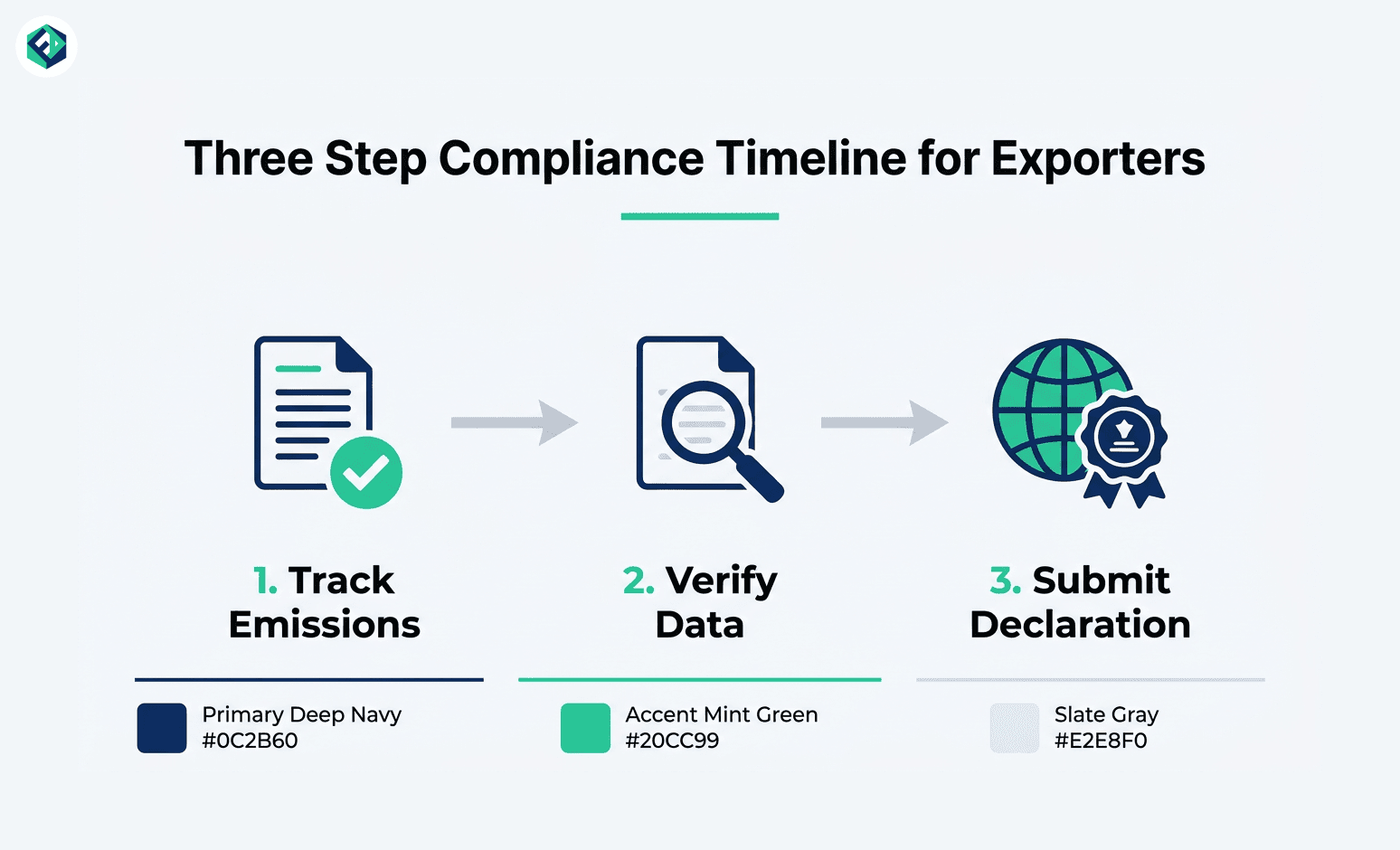
The transition into the definitive phase of the Carbon Border Adjustment Mechanism starting in 2026 marks a significant operational shift for Canadian businesses exporting to the European Union. Under the established EU CBAM compliance requirements, importers in the EU must submit annual declarations detailing the embedded greenhouse gas emissions of imported goods. These declarations must rely on actual verified emissions data or default values approved by the European Commission. To ensure data integrity, the European Union mandates rigorous CBAM reporting and verification protocols. Exporters must engage independent, accredited third-party verifiers. National Accreditation Bodies in Europe began the accreditation process for these verifiers in April 2026, with the first wave of accredited verifiers established around September 2026, as outlined in the European Commission CBAM verification guidelines. Consequently, verified compliance reports will be required starting in January 2027, forcing Canadian manufacturers to implement robust monitoring systems immediately. The administrative cost of CBAM compliance is expected to be a substantial burden for many organizations. These compliance expenses encompass direct fees paid to accredited verifiers and the internal resources required to track emissions across complex supply chains. To manage these carbon border adjustment compliance obligations, Canadian companies should focus on the following core administrative actions:
- Establish internal greenhouse gas inventory protocols to track direct emissions at the facility level.
- Identify and establish relationships with EU-accredited independent verification bodies before the January 2027 deadline.
- Coordinate closely with European buyers who must apply for authorized CBAM declarant status starting in January 2026.
- Evaluate current supply chain data systems to ensure they can produce audit-ready emissions documentation.
Analyzing the Impact on Canadian Metals and Industrial Exports
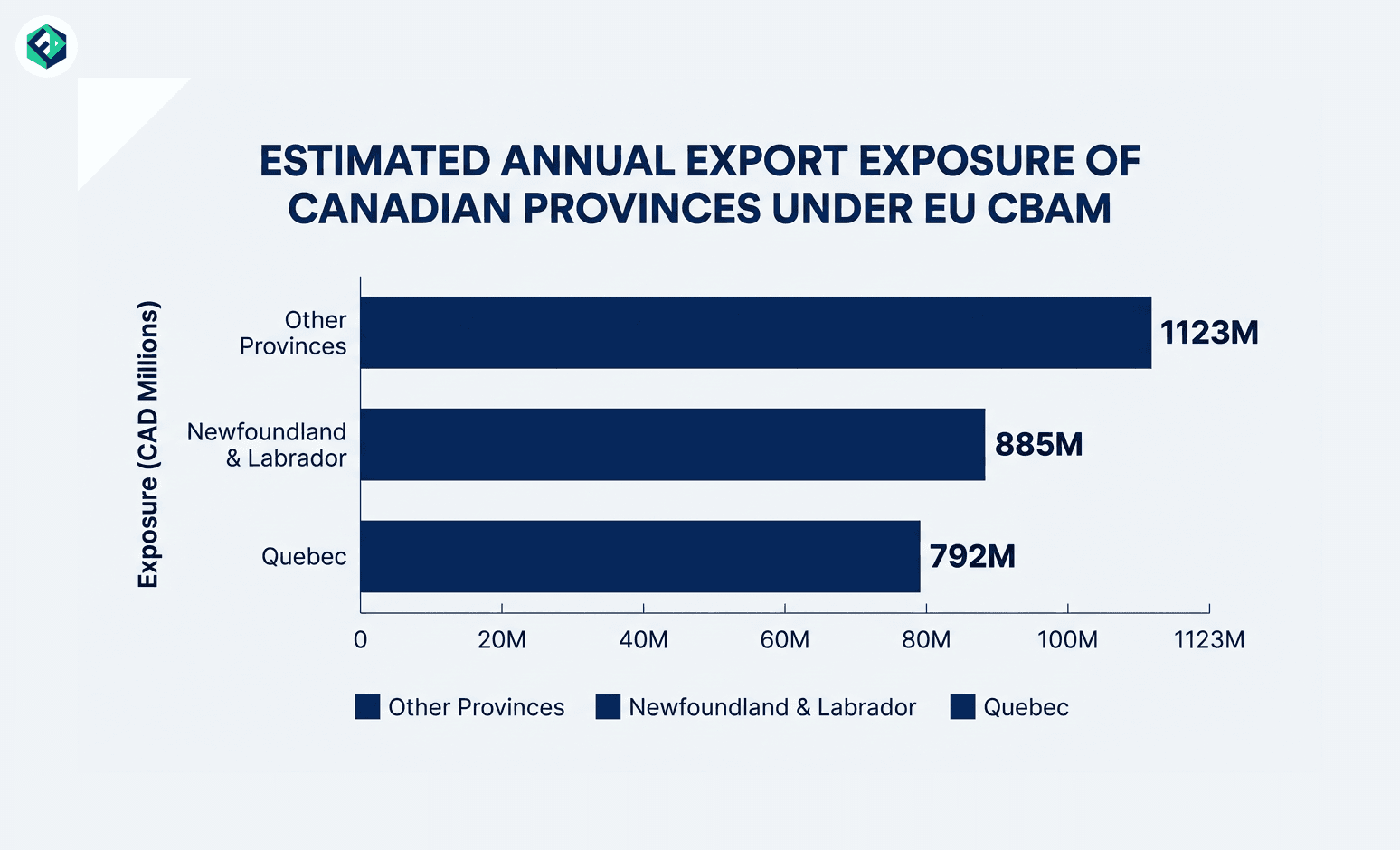
The commercial implications of the European carbon tariff are severe for Canada's heavy industrial sectors. An internal memorandum from Global Affairs Canada, highlighted in the CBC News investigation on the Canadian carbon tariff threat, confirmed that Canadian iron, steel, and aluminum exports will not receive a special exemption from the carbon border levy. Global Affairs Canada estimates that approximately $2.8 billion worth of Canadian goods are exposed to the carbon tariff annually. This exposure is highly concentrated in specific regions, threatening local economies that depend on the production of energy-intensive Canadian goods. In particular, Quebec faces an estimated annual exposure of $792 million, driven by its extensive aluminum, iron, and steel manufacturing sectors. Similarly, Newfoundland and Labrador faces an exposure of $885 million, primarily concentrated in iron ore and steel exports. As Canadian metals exporters seek alternative international markets to bypass potential trade barriers elsewhere, their reliance on European buyers makes them highly vulnerable to these metals export tariffs. The lack of an exemption means that industrial goods export exposure will translate into direct cost increases unless manufacturers can drastically reduce their production emissions. The following table outlines the estimated annual export exposure for key Canadian provinces under the EU CBAM framework:
| Region | Primary Sectors | Exposure (CAD) |
|---|
| Newfoundland and Labrador | Iron Ore, Steel | 885 Million |
| Quebec | Aluminum, Iron, Steel | 792 Million |
| Other Provinces | Mixed Metals, Goods | 1123 Million |
To remain competitive, exporters of Canadian steel and aluminum must accelerate their transition toward low-carbon manufacturing processes, thereby minimizing their physical greenhouse gas footprint and the corresponding tariff burden.
Will the EU Recognize Canada's Industrial Carbon Price?
A major point of discussion in bilateral trade negotiations is whether the European Union will credit Canada's domestic carbon pricing system to offset the CBAM tariff burden. Under the official EU CBAM regulations, the mechanism allows for the deduction of carbon costs already paid in the country of origin. This means that a Canadian industrial carbon price paid domestically can technically be used as a credit to reduce the number of CBAM certificates required at the European border. However, this credit mechanism does not equate to an outright exemption for Canadian goods. The practical application of this rule is complicated by the significant price gap between the two regulatory jurisdictions, as discussed in The Energy Mix analysis of the Canada-EU carbon tax dispute. In 2026, Canada's national price on carbon is set at $95 per tonne. In contrast, the European Union's emissions trading system recorded a carbon price of approximately $134 per tonne in 2025. Because the systems are not formally linked, and because Canada's effective carbon price is lower, Canadian exporters must pay the difference. Furthermore, the domestic carbon tax credit calculation is based on the actual, effective price paid by a specific facility, rather than Canada's nominal headline price. While Canadian companies can leverage their greenhouse gas footprint reduction efforts to claim partial relief, they must recognize that Canada's national pricing mechanism will not fully eliminate their European CBAM obligations. Exporters must meticulously document all domestic carbon payments to ensure they receive the maximum possible credit under European rules.
Estimating the Total Landed Cost for Canadian Exports to the EU
To maintain profitability and protect operating margins, Canadian businesses must incorporate carbon tariff calculations into their export landed cost calculations. The total landed cost of metals exports to Europe will no longer consist solely of freight rates, terminal handling charges, and standard customs duties; it must now include the cost of purchasing CBAM certificates. The European Union calculates CBAM liability based on the total embedded emissions of the imported goods, adjusted for the free allowances granted to European domestic producers. This adjustment factor, known as the CBAM factor, is set to gradually phase out, starting at 97.5% in 2026. The official EU CBAM financial impact is calculated using a specific formula defined by the European Commission's implementing regulations, which are detailed in the European Commission CBAM legislation and guidance. The number of required certificates is determined by subtracting the free allocation and any eligible domestic carbon price credits from the total verified embedded emissions, multiplied by the quantity of the goods. Performing an accurate carbon tariff landed cost assessment requires exporters to collaborate closely with their European importers, who are responsible for purchasing and surrendering these certificates. If Canadian manufacturers fail to conduct these detailed CBAM tariff cost assessments, they risk facing unexpected financial liabilities that could wipe out their profit margins. By integrating these carbon adjustments into their pricing models, exporters can make informed decisions about product pricing, contract negotiations, and market viability.
Streamlining Your Customs Clearance and Logistics Under CBAM
Managing the complex administrative and physical logistics of exporting under the CBAM framework requires a proactive strategy that integrates regulatory reporting with daily supply chain operations.
Our digital logistics platform helps Canadian exporters streamline this transition by combining freight forwarding with compliance support, ensuring your emissions data and commercial documentation move together seamlessly.
With the EU customs clearance process becoming increasingly stringent, having centralized visibility and expert documentation support is critical to avoid costly border delays. Our digital platform simplifies cross-border trade by minimizing manual paperwork errors and organizing essential customs declarations in one secure portal.
To keep your shipments moving smoothly without regulatory disruptions, learn more about how we can support your business with our dedicated Customs Clearance services.
FAQ
What is the current status of bilateral trade negotiations between Canada and the EU regarding upcoming carbon tariffs?
Bilateral negotiations are ongoing but have not secured exemptions for Canadian exports. While Canada and the EU launched the Alliance for the Future in October 2026, negotiations on closer association are scheduled to conclude by June 2027.
How can Canadian businesses prepare for and manage the administrative expenses of carbon emissions reporting and verification?
Exporters must establish internal tracking and partner with EU-accredited verifiers. Managing compliance requires developing greenhouse gas inventory protocols, updating data systems, and coordinating with European buyers before the January 2027 verification deadline.
What is the tariff exposure for domestic iron ore, steel, and aluminum under the new EU regulations?
Canadian metals face an estimated annual tariff exposure of 2.8 billion CAD. This exposure is highly concentrated in specific regions, threatening local economies in Newfoundland and Labrador as well as Quebec.
How will the EU rules handle crediting domestic greenhouse gas pricing mechanisms like Canada's carbon tax?
The EU allows deductions for domestic carbon costs, but it will not fully eliminate CBAM obligations. Because Canada's effective carbon price is lower than the EU's price, Canadian exporters must pay the difference.
How do exporters calculate total import fees and landed costs including the new carbon adjustment levies?
Exporters must calculate the required CBAM certificates based on verified embedded emissions. This calculation subtracts domestic carbon price credits and free allocations from total emissions, which is then multiplied by the certificate price.
What steps should exporters take to streamline compliance documentation for smooth European Union border entry?
Exporters should integrate emissions reporting with supply chain logistics and utilize digital platforms. Centralizing compliance documentation and leveraging dedicated customs clearance services help prevent manual paperwork errors and border delays.


















 Global Popular RoutesTop sea & air shipping lanes
 Special OfferLimited-time shipping promotions


 Express
 Document
 Parcel - Air/Sea
 Container
 Relocation