How Record Grain and Oil Shipments Propelled Port of Vancouver Cargo Volumes in 2026
Port of Vancouver Sets Historic Mid-Year Cargo Records in 2026
In the first half of 2026, Canada's premier Pacific gateway achieved unprecedented milestones, demonstrating its vital role in global trade. According to the mid-year report released by the Vancouver Fraser Port Authority (Port of Vancouver H1 2026 Report), the port handled a record 88.1 million metric tonnes of cargo during the first six months of the year, as reported by CBC News (CBC News Port of Vancouver Report). This represents a three percent year-over-year increase in overall freight traffic compared to the same period in 2025. The robust performance highlights the critical function of the Vancouver Fraser Port Authority's cargo management systems and showcases how the gateway successfully absorbed shifts in global commodity demand. For international businesses navigating these surging Vancouver port freight volumes, digital logistics services, such as those provided by FreightAmigo, have been utilized to maintain supply chain visibility and efficiency.
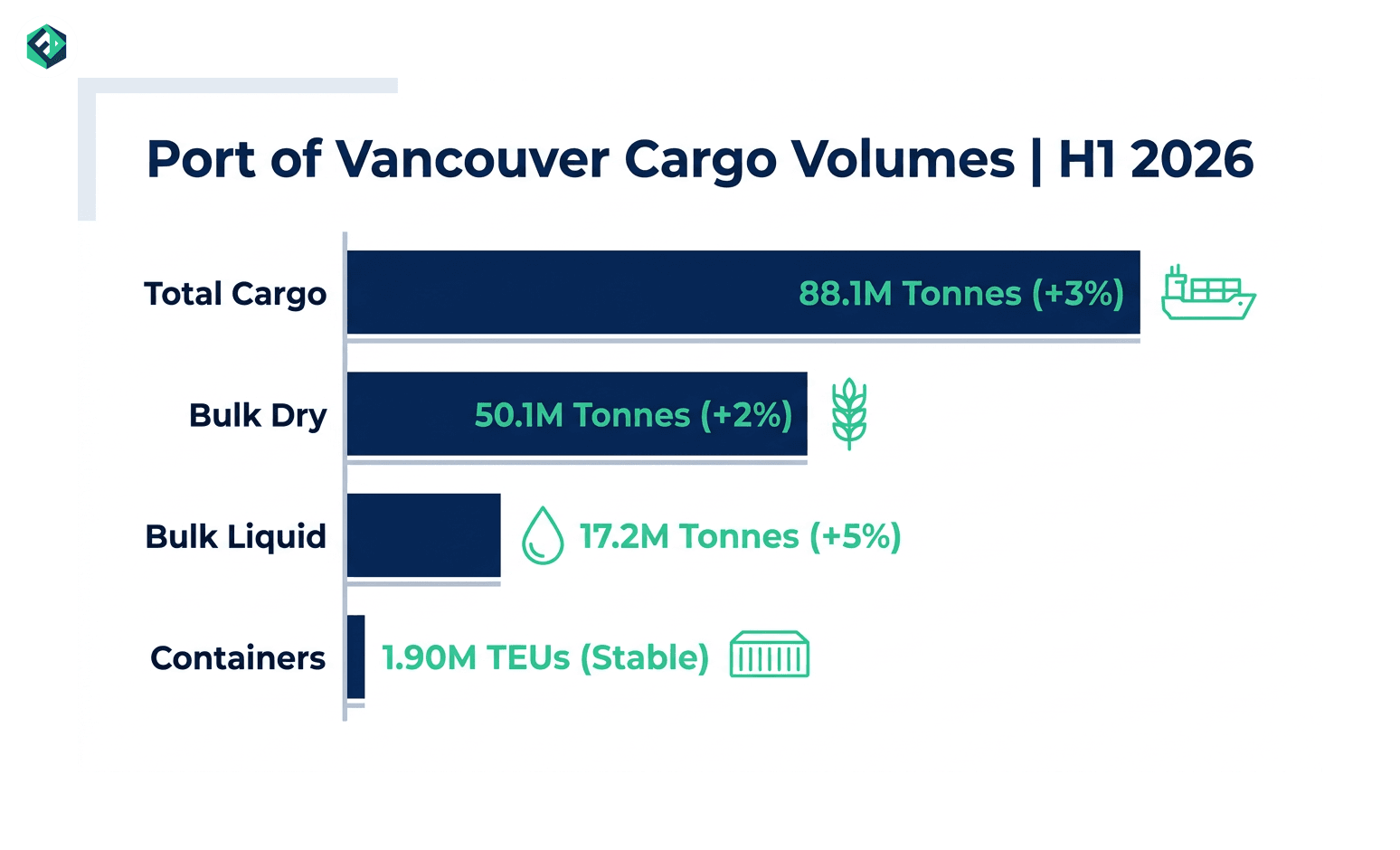
The Port of Vancouver cargo statistics for the first half of 2026 reveal a dynamic breakdown across multiple sectors. Dry bulk commodities increased by two percent to reach 50.1 million metric tonnes, while liquid bulk shipments experienced a five percent surge to 17.2 million metric tonnes. Meanwhile, container throughput remained stable at 1.90 million twenty-foot equivalent units (TEUs), reflecting steady two-way container trade despite broader macroeconomic fluctuations. The following table outlines the key performance metrics of the port's cargo volumes during this record-breaking period:
| Cargo Category | H1 2026 Volume (Metric Tonnes / TEUs) | Year-over-Year Change (%) |
|---|
| Total Handled Cargo | 88.1 million tonnes | +3% |
| Bulk Dry Cargo | 50.1 million tonnes | +2% |
| Bulk Liquid Cargo | 17.2 million tonnes | +5% |
| Container Throughput | 1.90 million TEUs | Stable |
Surging Canadian Crude Oil Exports Reach New Heights
The energy sector emerged as a primary driver of the port's historic performance, with Western Canadian petroleum shipments reaching unprecedented volumes. Driven by geopolitical shifts and high global oil prices, Alberta crude oil shipping volumes experienced massive growth, culminating in a mid-year record of 12 million tonnes. This remarkable surge was heavily influenced by international market conditions. As reported by CBC News (CBC News Oil Market Analysis), the escalation of Middle East tensions and the ongoing Iran war drove Brent crude prices up to nearly $110 US per barrel, which in turn brought billions of dollars to Canada's economy and incentivized producers to maximize export volumes.
As petroleum shipments on Vancouver routes expanded, the traditional distribution of Canadian oil export destinations underwent a significant realignment. Rather than relying solely on traditional pipeline corridors, producers increasingly utilized marine terminals at the Pacific gateway. The resulting increase in crude oil transit volumes reflects a broader strategic shift to supply energy-hungry markets across the Pacific. By utilizing crude oil exports via Vancouver, Canadian energy firms have established a more resilient, multi-destination export network that can adapt rapidly to global price signals and geopolitical disruptions.
The Trans Mountain Pipeline Expansion and Its Massive Cargo Impact
The physical capability to support this unprecedented volume of energy exports is directly attributable to major infrastructure upgrades. The operational impact of the newly twinned Trans Mountain pipeline expansion has completely transformed the gateway's petroleum shipment capacity. By significantly increasing the flow of crude oil from Alberta to British Columbia's marine terminals, the expansion has enabled a massive increase in Trans Mountain cargo volumes. This infrastructure milestone represents a structural pivot for Canadian resource logistics, allowing the country to efficiently handle larger tankers and streamline the loading process.
The pipeline's export impact is felt most acutely in the diversification of Canada's customer base. By resolving historical transportation bottlenecks, the expansion has unlocked fossil fuel cargo capacity for major East Asian economies, most notably China and South Korea. These long-term infrastructure developments at the Pacific gateway have not only optimized local maritime logistics but have also repositioned Canada as a reliable, direct supplier of crude oil to the Pacific Rim, challenging traditional global supply patterns and offering Asian buyers a secure alternative source of energy.
Record Canadian Bulk Grain Exports Dominate Global Shipping
Alongside energy, the agricultural sector delivered an outstanding performance in the first half of 2026. Canadian bulk grain exports surged by 14 percent year-over-year, reaching a record-breaking 17.4 million tonnes. This exceptional growth was supported by highly favorable growing conditions across the Canadian Prairies and a robust international demand for staple crops. Agricultural shippers heavily relied on Vancouver port grain shipments to move vast quantities of canola seed, barley, and wheat to overseas buyers, cementing the port's role as the primary outlet for Canadian agricultural crop exports.
In addition to bulk movements, the containerized specialty crop market showed impressive vitality. The export of Canadian pulse crops, including lentils and peas, increasingly utilized container shipping methods. This shift toward containerized agricultural exports has allowed smaller producers to access niche international markets with greater flexibility, ensuring that high-value pulse crops arrive in optimal condition. The combination of efficient bulk handling systems and flexible container logistics has enabled Canadian agricultural exporters to maintain a dominant position in the highly competitive global food supply chain.
Canada Trade Diversification Strategies Focus on Non-US Markets
The record-breaking cargo volumes at the Port of Vancouver underscore a broader geopolitical imperative: diversifying Canadian export markets to reduce historical reliance on the United States. As Canadian trade diversification strategies actively seek to mitigate trade risks, West Coast shipping corridors have become the focal point for expanding exports to non-US markets. This strategic shift has yielded tangible results; for instance, a CBC report indicated that Canadian exports to China rose by 30.1% to $21.74 billion in the first half of 2026, driven largely by energy and mineral shipments (CBC News Canada-China Trade Report).
This drive toward Indo-Pacific trade diversification is not limited to energy and agriculture. Other major resource sectors are also actively seeking new global partners. In May 2026, B.C. Forests Minister Ravi Parmar announced $12 million in provincial funding for Forestry Innovation Investment to develop new lumber export markets in non-traditional regions (CBC News B.C. Lumber Export Report). This initiative specifically targets emerging markets to establish new trade relationships. The primary non-US markets targeted by Canadian exporters include:
- East Asian shipping destinations, particularly China and South Korea, for crude oil, liquid propane, and grain.
- The Middle East, including Saudi Arabia and Dubai, as new destinations for high-quality British Columbia lumber.
- The United Kingdom and North Africa, to expand forestry product exports and establish resilient wood supply chains.
- Mexico, serving as an increasingly important bilateral partner for both agricultural and industrial goods.
Understanding the Impact of China Canola Tariffs in 2026
While trade volumes have reached historic highs, Canadian exporters have also had to navigate complex trade barriers and shifting tariff regimes. The impact of China canola tariffs in 2026 has required significant agility from agricultural logistics networks. Shippers have had to adapt to a 15 percent tariff on Canadian canola seeds in China, alongside a steep 100 percent tariff on canola oil, which threatened to severely depress vegetable oil volumes. These canola seed export duties and canola oil trade barriers forced a rapid reorganization of agricultural trade flows.
Fortunately, the sector's adaptability has prevented a major downturn. Canadian exporters successfully mitigated the impact of these tariffs by rerouting shipments and diversifying canola exports to alternative markets, including Europe and Mexico. Furthermore, tariff adjustments on other agricultural products, such as peas, helped offset the losses. By actively managing these trade barriers, Canadian agricultural logistics providers have demonstrated remarkable resilience, proving that diversified shipping channels are the best defense against localized geopolitical trade shocks.
Key Shifts in Vancouver Port Automotive Imports and Aviation Fuel Cargo Trends
Beyond bulk commodities and energy, the Port of Vancouver experienced notable shifts in import dynamics and specialized liquid cargo. Automotive imports grew by ten percent year-over-year, reflecting robust consumer demand and a steady recovery in global automotive supply chains. This rise in car shipping volumes handled by Vancouver terminals required sophisticated yard management and efficient transport logistics to prevent congestion at the port's specialized vehicle docks.
Concurrently, aviation fuel shipping trends showed a 26 percent surge in import volumes, driven by critical supply chain adjustments that necessitated sourcing fuel directly from South Korea to avoid Middle East supply disruptions. Managing these sudden shifts in import routes and automotive supply chains requires a highly flexible digital freight platform that simplifies rate comparisons. FreightAmigo provides an advanced platform where businesses can instantly compare air, sea, rail, and express shipping rates. This instant rate transparency allows cargo managers to quickly adjust their routes, manage transport budgets, and bypass port congestion with real-time digital solutions. To streamline your global supply chain and compare multi-modal freight options, get an Instant Quote with us today.
FAQ
What key insights does the Vancouver Fraser Port Authority mid-year cargo statistics report reveal about Canada's overall shipping performance?
The Port of Vancouver handled a record 88.1 million metric tonnes of cargo in the first half of 2026. This represents a three percent year-over-year increase in freight traffic, with dry bulk rising to 50.1 million tonnes and liquid bulk increasing to 17.2 million tonnes.
Which major global markets have emerged as the primary Alberta crude oil export destinations from the Port of Vancouver?
East Asian buyers have emerged as the primary destinations for Alberta crude oil exports. Due to shifting market dynamics, producers are pivoting petroleum shipments to Pacific markets to establish a highly resilient, multi-destination export network.
How has the Trans Mountain pipeline expansion driven crude oil shipping volume growth and reshaped Pacific maritime logistics?
The Trans Mountain pipeline expansion has greatly boosted petroleum capacity and unlocked cargo volume for East Asian markets. By resolving historical transportation bottlenecks and allowing the gateway to efficiently handle larger tankers, the expansion has established Canada as a reliable supplier to China and South Korea.
Which specific nations lead the Canadian bulk grain export volumes to Asian markets, and how are these shipments handled?
Asian countries lead the demand for Canadian bulk grains, which are managed through high-efficiency bulk terminals and flexible container logistics. Total bulk grain exports surged 14 percent to a record 17.4 million tonnes, driven by canola, barley, and wheat, alongside containerized specialty crops like lentils and peas.
How are Canadian trade diversification strategies actively reducing reliance on traditional US markets through West Coast shipping corridors?
Canada is systematically expanding its trade footprint in the Indo-Pacific, Middle East, Europe, and Mexico. This strategic shift is highlighted by a 30.1% increase in exports to China during the first half of 2026, alongside targeted provincial funding to develop new lumber export markets.
How have the recent Canadian canola seed exports to China tariff rate changes impacted agricultural trade patterns and vegetable oil volumes?
The tariffs forced agricultural shippers to reorganize logistics and diversify into alternative global markets. Exporters successfully bypassed the 15 percent canola seed tariff and 100 percent canola oil tariff in China by rerouting shipments to alternative destinations, including Europe and Mexico.
What factors are driving the latest Vancouver port automotive and aviation fuel shipping volume trends, and how do they affect global supply chains?
Automotive imports grew due to strong consumer demand, while aviation fuel imports rose 26 percent to bypass Middle East supply disruptions. To maintain supply chain stability, aviation fuel logistics adjusted by sourcing kerosene imports directly from South Korea.





















 Global Popular RoutesTop sea & air shipping lanes
 Special OfferLimited-time shipping promotions


 Express
 Document
 Parcel - Air/Sea
 Container
 Relocation