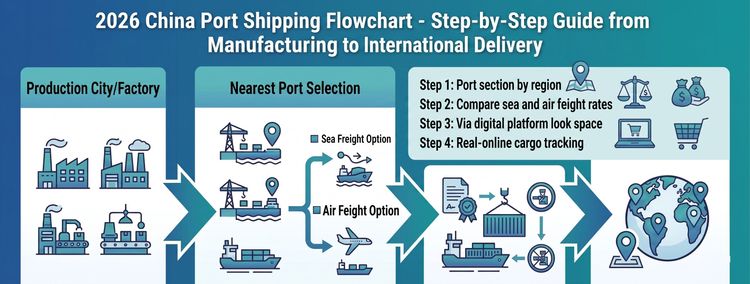
China Ports Map: A Comprehensive Guide to Major Shipping Hubs
Want To Compare The Best Express, Air Freight, Sea Freight, Rail Freight & Trucking Rates So As To Have Better Control On Cost?
In 2026, China remains the absolute leader in global maritime trade. Its ports handle a massive volume of containers and efficiently connect manufacturers with global markets. This updated guide provides a map of major shipping hubs in 2026, helping importers, exporters, and logistics teams optimize their supply chains.
Overview of China's Port Infrastructure in 2026
In 2026, China's port network continues to dominate global rankings with outstanding capacity and technology. Continuous government investment in automation, green initiatives, and deep-water berths ensures efficient operations to meet growing trade demands.
Ports handle over 400 million TEUs annually, covering coastal and inland facilities, providing more reliable support for businesses.
Major Shipping Regions and Ports
Strategic port selection in 2026 directly impacts freight rates, transit times, and reliability. Key regions are closely integrated with manufacturing clusters to achieve optimal supply chain flow.
Pearl River Delta: Focuses on electronics and consumer goods exports.
Yangtze River Delta: High-capacity global transshipment hub.
Bohai Rim: Gateway for northern heavy industry and railway connections.
Southeast Coast: Flexible options for trade with Taiwan and Southeast Asia.
Pearl River Delta Ports
The Pearl River Delta drives South China's export engine with world-class facilities.
Ports in Shenzhen and Guangzhou excel in speed and connectivity, making them suitable for time-sensitive cargo.
Shenzhen Port ranks among the top globally, with strong growth in tech freight. Guangzhou Port integrates seamlessly with inland manufacturing.
Yangtze River Delta Hubs
In 2026, Shanghai and Ningbo-Zhoushan ports remain the busiest container ports globally. They handle massive amounts of cargo with advanced automation and extensive international routes.
Shanghai Yangshan Deep Water Port – The world's busiest.
Ningbo-Zhoushan Port – Record-breaking tonnage and bulk cargo capacity.
Suzhou Port – Multimodal river transport connections.
Bohai Rim and Northern Hubs
Northern ports such as Tianjin and Qingdao serve as vital gateways to Beijing and inland provinces.
They support heavy cargo and growing sea-rail multimodal transport services.
Qingdao Port is highly automated with developed Yellow Sea routes. Tianjin Port efficiently connects northern industrial zones.
Air Freight Hubs and Multimodal Transport
Air freight complements maritime routes for high-value or urgent cargo.
Major airports coordinate perfectly with nearby seaports to achieve hybrid logistics.
Beijing Capital International Airport
Shanghai Pudong International Airport
Guangzhou Baiyun International Airport
Shenzhen Baoan International Airport
Chengdu Shuangliu International Airport
Key Considerations for Shipping from China in 2026
Port selection, regulations, and seasonal factors determine success or failure in competitive markets.
Proximity to suppliers and route frequency are most critical.
Carefully compare options to balance cost, speed, and reliability.
In 2026, automation, sustainability, and digital platforms propel Chinese ports forward. Tools like FreightAmigo simplify comparison and tracking processes.
Real-time visualization and AI optimization can significantly reduce delays.
Future Trends and Digital Solutions
In 2026, automation, sustainability, and digital platforms propel Chinese ports forward. Tools like FreightAmigo simplify comparison and tracking processes.
Real-time visualization and AI optimization can significantly reduce delays.
China's vast port network is welcoming a deep integration of "hardware automation" and "software digitalization." For enterprises to achieve efficient transport, the key lies in the following three digital transformations:
Smart Ports & Instant Quotes : With ports like Shanghai and Shenzhen fully popularizing 5G automated terminals, digital logistics platforms like FreightAmigo can seamlessly connect sea freight and air freight data in real time, allowing enterprises to obtain the best schedules and smart quotes with one click.
Data Transparency and Automated Customs Clearance: Implementing IoT and blockchain technologies makes traditional ocean freight's "black box" transparent. Shippers can monitor cargo dynamics throughout the journey with real-time tracking , and automate declarations through the platform's e-Customs system, significantly shortening clearance times and reducing port congestion risks.
AI Route Optimization and Green Shipping: In line with the low-carbon transformation of Chinese ports, digital platforms utilize AI algorithms to plan the most time-saving and low-carbon multimodal routes within seconds, combining https://www.freightamigo.com/en/logistics/green-logistics-technology/ green carbon offset solutions to build a sustainable smart supply chain.
Frequently Asked Questions
What is the busiest port in China in 2026?
Shanghai Port remains the world's busiest container port, with an annual handling volume exceeding 55 million TEUs, possessing unparalleled global connectivity and automation levels.
Which port is best for exporting electronics from China?
Shenzhen Port (Yantian, Shekou) is most suitable for electronics due to its proximity to manufacturing bases and fast turnaround, making it ideal for high-value tech cargo.
How to choose between Shanghai Port and Ningbo Port?
Shanghai Port is suitable for high-volume international routes, while Ningbo-Zhoushan Port offers more competitive bulk cargo and mixed cargo rates for Zhejiang suppliers.
What are the major air freight hubs in China?
Shanghai Pudong, Guangzhou Baiyun, and Shenzhen Baoan lead the way, providing extensive international connections and efficient cargo handling, suitable for urgent shipments.
Will there be port congestion in China in 2026?
Major hubs minimize port congestion through advanced automation, but peak seasons such as Chinese New Year require advance planning to ensure smooth operations.
How does FreightAmigo help with China freight?
FreightAmigo provides instant multi-carrier quotes, Track & Trace, and Customs Clearance support, covering all major Chinese ports to optimize costs.
What documents are required for shipping from Chinese ports?
Main documents include commercial invoices, packing lists, bills of lading, and certificates of origin. Digital tools can simplify preparation and compliance processes.
Which northern port is best suited to serve Beijing?
Tianjin Port is the main maritime gateway to Beijing and the North China region, with strong railway integration capabilities.
Conclusion
Mastering the 2026 China ports map unlocks faster, cheaper, and more reliable global trade.
Utilize digital platforms like FreightAmigo to achieve seamless operations from any major hub.
For expert guidance, Book a Demo with FreightAmigo.








 Global Popular RoutesTop sea & air shipping lanes
 Special OfferLimited-time shipping promotions





 Express
 Document
 Parcel - Air/Sea
 Container
 Relocation